2016 SUBARU OUTBACK front
[x] Cancel search: frontPage 522 of 572

Specifications/Specifications
Specifications
These specifications are subject to change without notice.
&Dimensions
in (mm)
ItemLegacy Outback
2.5 L
3.6 L2.5 L
3.6 L
Drive system
AWD
Transmission type
MT CVT CVT MT CVT CVT
Overall length
188.8 (4,796) 189.6 (4,817)
Overall width
72.4 (1,840) 72.4 (1,840)
Overall height
59.0 (1,500) 66.1 (1,680)
Wheelbase
108.3 (2,750) 108.1 (2,745)
Tread Front
62.2 (1,580) 61.8 (1,570)
Rear
62.8 (1,595) 62.2 (1,580)
Ground clearance
*15.9 (150)8.7 (220)
*1: Measured with vehicle empty
MT: Manual transmission
CVT: Continuously variable transmission
AWD: All-Wheel Drive
12-2
Page 527 of 572
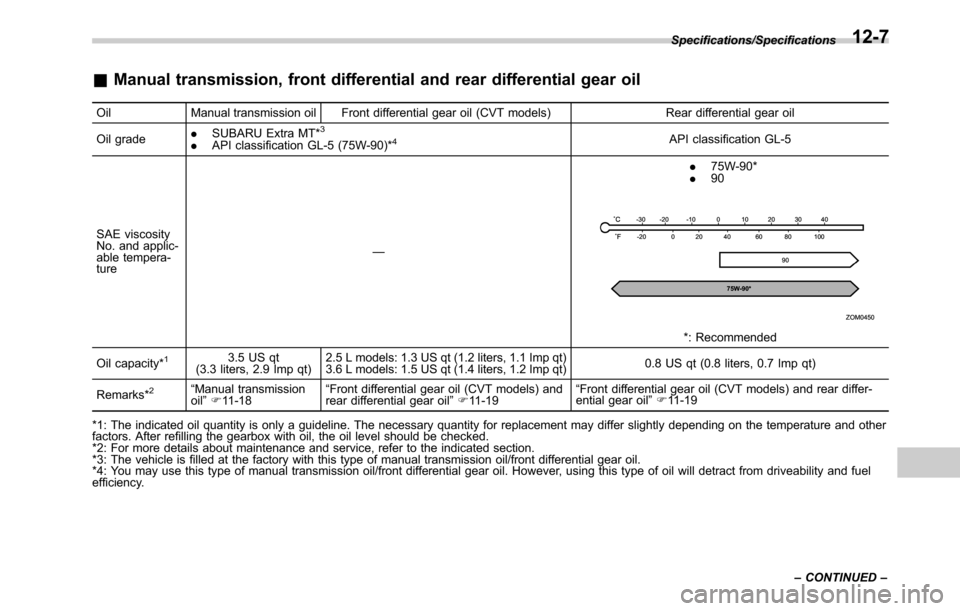
&Manual transmission, front differential and rear differential gear oil
Oil Manual transmission oil Front differential gear oil (CVT models) Rear differential gear oil
Oil grade.SUBARU Extra MT*3
.API classification GL-5 (75W-90)*4API classification GL-5
SAE viscosity
No. and applic-
able tempera-
ture—.75W-90*
.90
*: Recommended
Oil capacity*
13.5 US qt
(3.3 liters, 2.9 Imp qt)2.5 L models: 1.3 US qt (1.2 liters, 1.1 Imp qt)
3.6 L models: 1.5 US qt (1.4 liters, 1.2 Imp qt)0.8 US qt (0.8 liters, 0.7 Imp qt)
Remarks*
2“Manual transmission
oil”F11-18“Front differential gear oil (CVT models) and
rear differential gear oil”F11-19“Front differential gear oil (CVT models) and rear differ-
ential gear oil”F11-19
*1: The indicated oil quantity is only a guideline. The necessary quantity for replacement may differ slightly depending on the temperature and other
factors. After refilling the gearbox with oil, the oil level should be checked.
*2: For more details about maintenance and service, refer to the indicated section.
*3: The vehicle is filled at the factory with this type of manual transmission oil/front differential gear oil.
*4: You may use this type of manual transmission oil/front differential gear oil. However, using this type of oil will detract from driveability and fuel
efficiency.Specifications/Specifications
–CONTINUED–
12-7
Page 529 of 572

&Electrical system
Battery type
2.5 L models 55D23R
3.6 L models
75D23R
Alternator
12V-130A
Spark plugs
2.5 L models SILZKAR7B11 (NGK)
3.6 L modelsSILFR6C11 (NGK)
&Tires
Tire size
225/55R17
97V225/50R18
95H225/65R17
102H225/60R18
100H
Wheel size
1767J
1767 1/2J1867 1/2J 1767J 1867J
Pressure Front
33 psi (230 kPa, 2.3 kgf/cm
2) 35 psi (240 kPa, 2.4 kgf/cm2)
Rear
32 psi (220 kPa, 2.2 kgf/cm2) 33 psi (230 kPa, 2.3 kgf/cm2)
Temporary spare tire
Size T155/70 D17 110M T155/80 R17 101M
Pressure 60 psi (420 kPa, 4.2 kgf/cm
2)
Wheel nut tightening torque
88.5 lbf·ft (120 N·m, 12.2 kgf·m)*1
*1: This torque is equivalent to applying approximately 88 to 110 lbf (40 to 50 kgf) at the end of the wheel nut wrench. If you have tightened the wheel
nuts by yourself, have the tightening torque checked at the nearest automotive service facility as soon as possible. For the wheel nut tightening
procedure, refer to“Changing a flat tire”F9-5.
&Brake disc
If you need information on the usage limit value of brake discs and the method for measuring them, consult your SUBARU dealer.
Specifications/Specifications12-9
Page 536 of 572

Specifications/Bulb chart
Wattage Bulb No.
1) High beam headlight 12V-60W HB3
2) Low beam headlight
Models with HID headlights 12V-35W D4S
Models without HID headlights 12V-55W H11
3) Front side marker light 12V-5W W5W
4) Map light 12V-8W
5) Dome light 12V-8W
6) Door step light 12V-5W W5W
7) Front turn signal light 12V-21W WY21W
8) Front fog light
Legacy (models without steering responsive fog
lights system)12V-19W H16
Legacy (models with steering responsive fog lights
system)12V-55W H11
Outback 12V-55W H11
9) Vanity mirror light 14V-1.4W HTU
10) Cargo area light 12V-13W SAE #912
11) Licence plate light (Outback)12V-5W W5W
12) Backup light (Outback) 12V-16W W16W
13)
Rear turn signal light (Outback) 12V-21W WY21W
14) Rear side marker light (Outback)
12V-5W W5W
15) Trunk light (Legacy) 12V-3.8W SAE #194
16)
License plate light (Legacy) 12V-5W W5W
17) Backup light (Legacy) 12V-16W W16W12-16
Page 547 of 572

Table 1—Occupant loading and distribution for vehicle normal load for
various designated seating capacities
Designated seating
capacity, number of
occupantsVehicle normal load,
number of occupantsOccupant distribution in a
normally loaded vehicle
2 through 4 2 2 in front.
5 through 10 32 in front, 1 in second
seat.
11 through 15 52 in front, 1 in second
seat, 1 in third seat, 1 in
fourth seat.
16 through 22 72 in front, 2 in second
seat, 2 in third seat, 1 in
fourth seat.&Tire care–maintenance and
safety practices
.Check on a daily basis that the
tires are free from serious damage,
nails, and stones. At the same time,
check the tires for abnormal wear.
.Inspect the tire tread regularly
and replace the tires before their
tread wear indicators become visi-
ble. When a tire’s tread wear
indicator becomes visible, the tire
is worn beyond the acceptable limit
and must be replaced immediately.
With a tire in this condition, driving
at even low speeds in wet weather
can cause the vehicle to hydro-
plane. Possible resulting loss of
vehicle control can lead to an
accident.
Consumer information and Reporting safety defects/Tire information
–CONTINUED–13-9
Page 548 of 572
Consumer information and Reporting safety defects/Tire information
.To maximize the life of each tire
and ensure that the tires wear
uniformly, it is best to rotate the
tires every 7,500 miles (12,000 km).
Rotating the tires involves switch-
ing the front and rear tires on the
right-hand side of the vehicle and
similarly switching the front and
rear tires on the left-hand side of
the vehicle. (Each tire must be kept
on its original side of the vehicle.)
Replace any damaged or unevenly
worn tire at the time of rotation.
After tire rotation, adjust the tire
pressures and make sure the wheel
nuts are correctly tightened. For
information about the tightening
torque and tightening sequence
for the wheel nuts, refer to“Flat
tires”F9-5
.
&Vehicle load limit–how to
determine
The load capacity of your vehicle is
determined by weight, not by avail-
able cargo space. The load limit of
your vehicle is shown on the
vehicle placard attached to thedriver’s side B-pillar. Locate the
statement“The combined weight
of occupants and cargo should
never exceed XXX kg or XXX lbs”
on your vehicle’s placard.
Thevehicleplacardalsoshows
seating capacity of your vehicle.
The total load capacity includes the
total weight of driver and all pas-
sengers and their belongings, any
cargo, any optional equipment such
as a trailer hitch, roof rack or bike
carrier, etc., and the tongue load of
a trailer. Therefore cargo capacity
can be calculated by the following
method.
Cargo capacity = Load limit−(total
weight of occupants + total weight
of optional equipment + tongue
load of a trailer (if applicable))
For towing capacity information and
weight limits, refer to“Trailer towing
(Outback)”F8-21.
!Calculating total and load ca-
pacities varying seating con-
figurations
Calculate the available load capa-
city as shown in the following
examples:
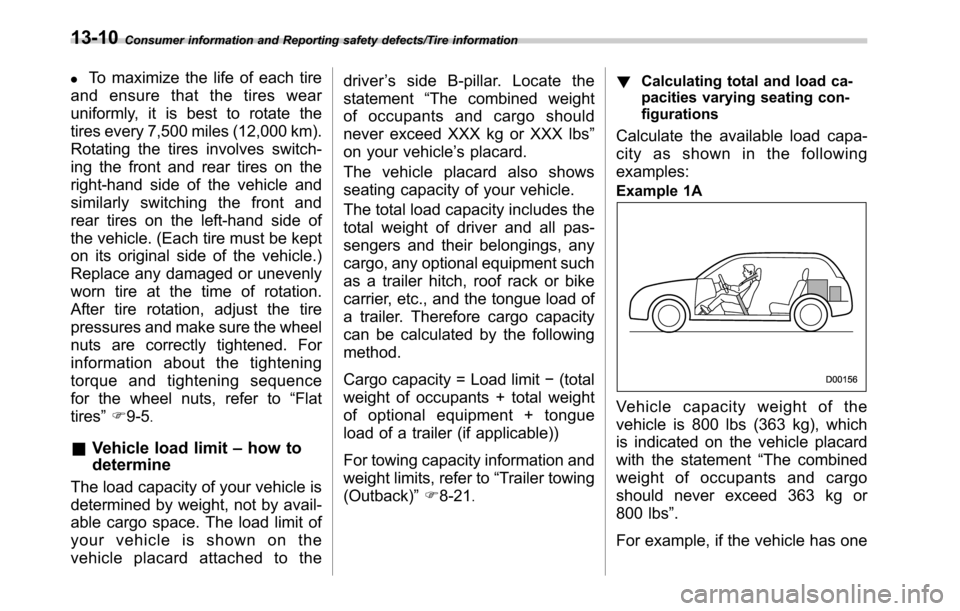
Example 1A
Vehicle capacity weight of the
vehicle is 800 lbs (363 kg), which
is indicated on the vehicle placard
with the statement“The combined
weight of occupants and cargo
should never exceed 363 kg or
800 lbs”.
For example, if the vehicle has one
13-10
Page 551 of 572

3.The total weight now exceeds
the capacity weight by 22 lbs (10
kg), so the cargo weight must be
reduced by 22 lbs (10 kg) or more.
&Determining compatibility of
tire and vehicle load capaci-
ties
The sum of four tires’maximum
load ratings must exceed the max-
imum loaded vehicle weight
(“GVWR”). In addition, sum of the
maximum load ratings of two front
tires and of two rear tires must
exceed each axle’s maximum
loaded capacity (“GAWR”). Original
equipment tires are designed to
fulfill those conditions.
The maximum loaded vehicle
weight is referred to Gross Vehicle
Weight Rating (GVWR). And eachaxle’s maximum loaded capacity is
referred to Gross Axle Weight Rat-
ing (GAWR). The GVWR and each
axle’s GAWR are shown on the
vehicle certification label affixed to
the driver’s door.
The GVWR and front and rear
GAWRs are determined by not only
the maximum load rating of tires but
also loaded capacities of the vehi-
cle’s suspension, axles and other
parts of the body.
Therefore, this means that the
vehicle cannot necessarily be
loaded up to the tire’s maximum
load rating on the tire sidewall.
&Adverse safety conse-
quences of overloading on
handling and stopping and
on tires
Overloading could affect vehicle
handling, stopping distance, vehicle
and tire as shown in the following.
This could lead to an accident and
possibly result in severe personal
injury.
.Vehicle stability will deteriorate.
.Heavy and/or high-mounted
loads could increase the risk of
rollover.
.Stopping distance will increase.
.Brakes could overheat and fail.
.Suspension, bearings, axles and
other parts of the body could break
or experience accelerated wear
that will shorten vehicle life.
.Tires could fail.
.Tread separation could occur.
.Tire could separate from its rim.
&Steps for Determining Cor-
rect Load Limit
1.Locate the statement“The com-
bined weight of occupants and
cargo should never exceed XXX
kg or XXX lbs.”on your vehicle’s
placard.
2.Determine the combined weight
of the driver and passengers that
will be riding in your vehicle.
3.Subtract the combined weight of
the driver and passengers from
XXX kg or XXX lbs.
Consumer information and Reporting safety defects/Tire information
–CONTINUED–13-13
Page 558 of 572

14-4Index
Locks................................................................... 2-33
Chime
Key ........................................................................ 3-4
Light..................................................................... 3-43
Seatbelt................................................................ 3-12
Cleaning
Aluminum wheels................................................... 10-3
Interior.................................................................. 10-5
Ventilation grille....................................................... 4-9
Climate control system................................................. 4-3
Automatic................................................................ 4-5
Manual................................................................... 4-6
Clock........................................................................ 3-32
Clutch
Fluid............................................................ 11-21, 12-8
Pedal.................................................................. 11-23
Coat hook................................................................. 6-13
Console...................................................................... 6-6
Continuously variable transmission (CVT)..................... 7-25
Fluid............................................................ 11-19, 12-8
Oil temperature warning light (AT OIL TEMP)............ 3-16
Coolant............................................................ 11-14, 12-8
Cooling system......................................................... 11-14
Corrosion protection................................................... 10-4
Crossbars................................................................. 8-14
Cruise control............................................................ 7-49
Indicator................................................................ 3-30
Set indicator.......................................................... 3-30
Cup holder.................................................................. 6-8
Front passenger’s .................................................... 6-8
Rear passenger’s..................................................... 6-9D
Daytime running light system....................................... 3-46
Defogger................................................................... 3-54
Defrosting................................................................... 4-9
Deicer....................................................................... 3-54
Differential gear oil
Front........................................................... 11-19, 12-7
Rear........................................................... 11-19, 12-7
Dimensions................................................................ 12-2
Disarming the alarm system......................................... 2-32
Disc brake pad wear warning indicators........................ 7-33
Dome light......................................................... 6-2, 11-48
Door
Locks..................................................................... 2-6
Open indicator light................................................. 3-22
Step light............................................................. 11-48
Unlock selection function................................. 2-17, 3-42
Double trip meter......................................................... 3-9
Drive belts............................................................... 11-18
Driving
All-Wheel Drive warning light................................... 3-22
AWD vehicles......................................................... 8-5
Car phone/cell phone
.................................................. 7
Drinking..................................................................... 6
Drugs........................................................................ 6
Foreign countries..................................................... 8-4
Off road.................................................................. 8-6
Pets.......................................................................... 7
Snowy and icy roads.............................................. 8-10
Tips ................................................. 7-24, 7-30, 8-2, 8-5
Tired or sleepy........................................................... 6