Page 87 of 108
Conventional Cruise Control
83
CAUTION
When shifting the selector lever to the position, Adaptive Cruise Control
will be automatically canceled. Do not shift the lever to the position unless
it is an emergency. Otherwise the engine brake may not operate, which could
cause an accident.
NOTE
xIf EyeSight is malfunctioning, the EyeSight warning indicator is displayed
on the multi information display and the Pre-Collision Braking System OFF
indicator light and Lane Departure Warning OFF indicator light illuminate. If
this occurs, stop the vehicle in a safe location and then stop the engine
and restart it. If the indicators remain illuminated after restarting the
engine, Conventional Cruise Control cannot be used. This will not interfere
with ordinary driving; however the system should be inspected by a
SUBARU dealer as soon as possible.
Ÿ Refer to page 86.
xWhen operation of Conventional Cruise Control has been automatically
canceled, perform the set operation again after the condition that caused
the cancellation has been eliminated. If cruise control cannot be set even
after the condition has been corrected, EyeSight may be malfunctioning.
This will not interfere with ordinary driving; however the system should be
inspected by a SUBARU dealer as soon as possible.
N
N
Page 90 of 108
86
EyeSight malfunction and temporary stop
If a malfunction is detected in the EyeSight system, the indicators in the instrument panel
and the multi information display inform the driver of the malfunction. Check the displayed
contents and take the appropriate action.
■Malfunction (including position/angle misalignment of stereo
cameras)
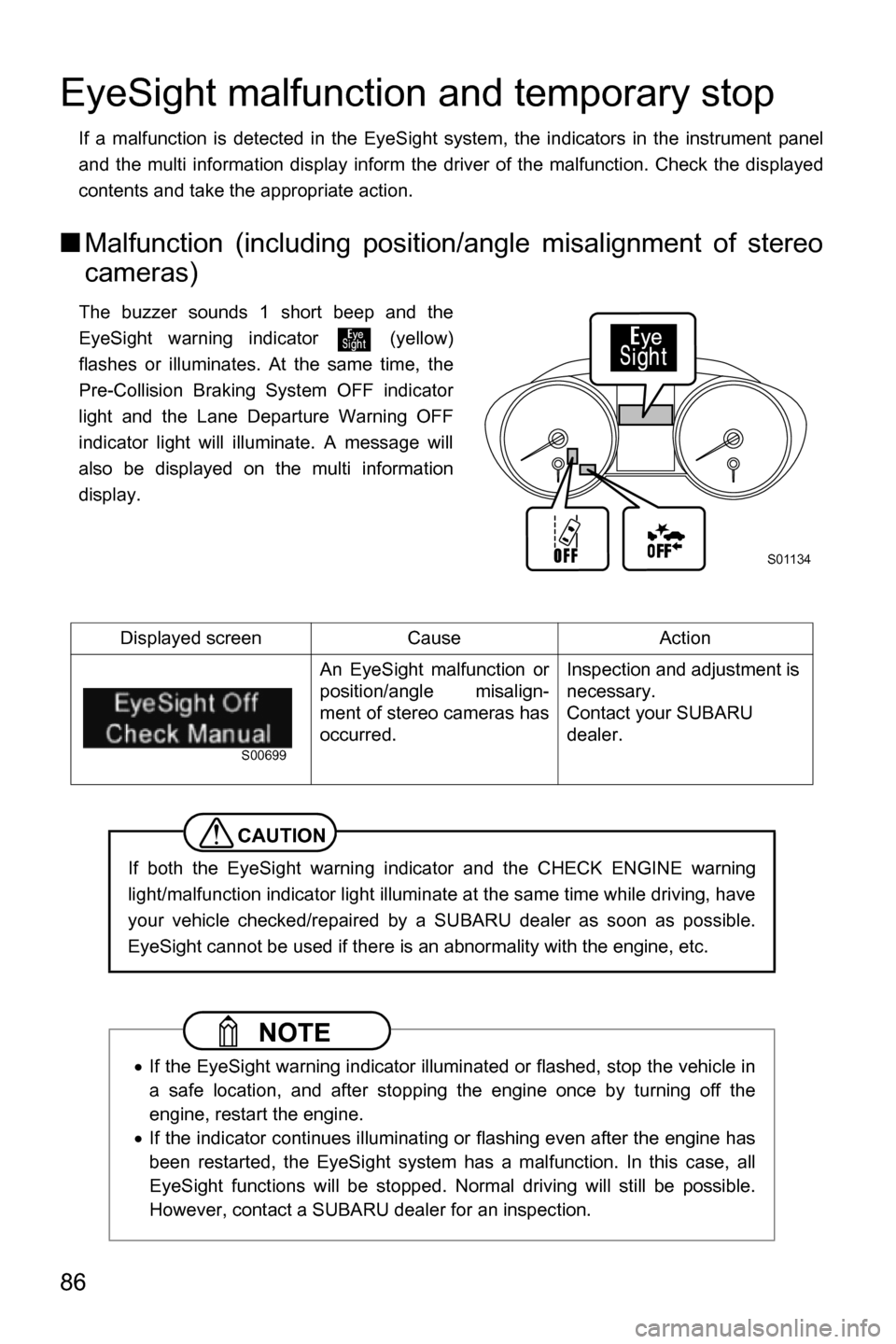
The buzzer sounds 1 short beep and the
EyeSight warning indicator (yellow)
flashes or illuminates. At the same time, the
Pre-Collision Braking System OFF indicator
light and the Lane Departure Warning OFF
indicator light will illuminate. A message will
also be displayed on the multi information
display.
Displayed screen Cause Action
An EyeSight malfunction or
position/angle misalign-
ment of stereo cameras has
occurred.Inspection and adjustment is
necessary.
Contact your SUBARU
dealer.
CAUTION
If both the EyeSight warning indicator and the CHECK ENGINE warning
light/malfunction indicator light illuminate at the same time while driving, have
your vehicle checked/repaired by a SUBARU dealer as soon as possible.
EyeSight cannot be used if there is an abnormality with the engine, etc.
NOTE
xIf the EyeSight warning indicator illuminated or flashed, stop the vehicle in
a safe location, and after stopping the engine once by turning off the
engine, restart the engine.
xIf the indicator continues illuminating or flashing even after the engine has
been restarted, the EyeSight system has a malfunction. In this case, all
EyeSight functions will be stopped. Normal driving will still be possible.
However, contact a SUBARU dealer for an inspection.
S01134
S00699
Page 91 of 108
EyeSight malfunction and temporary stop
87
■Temporary stop
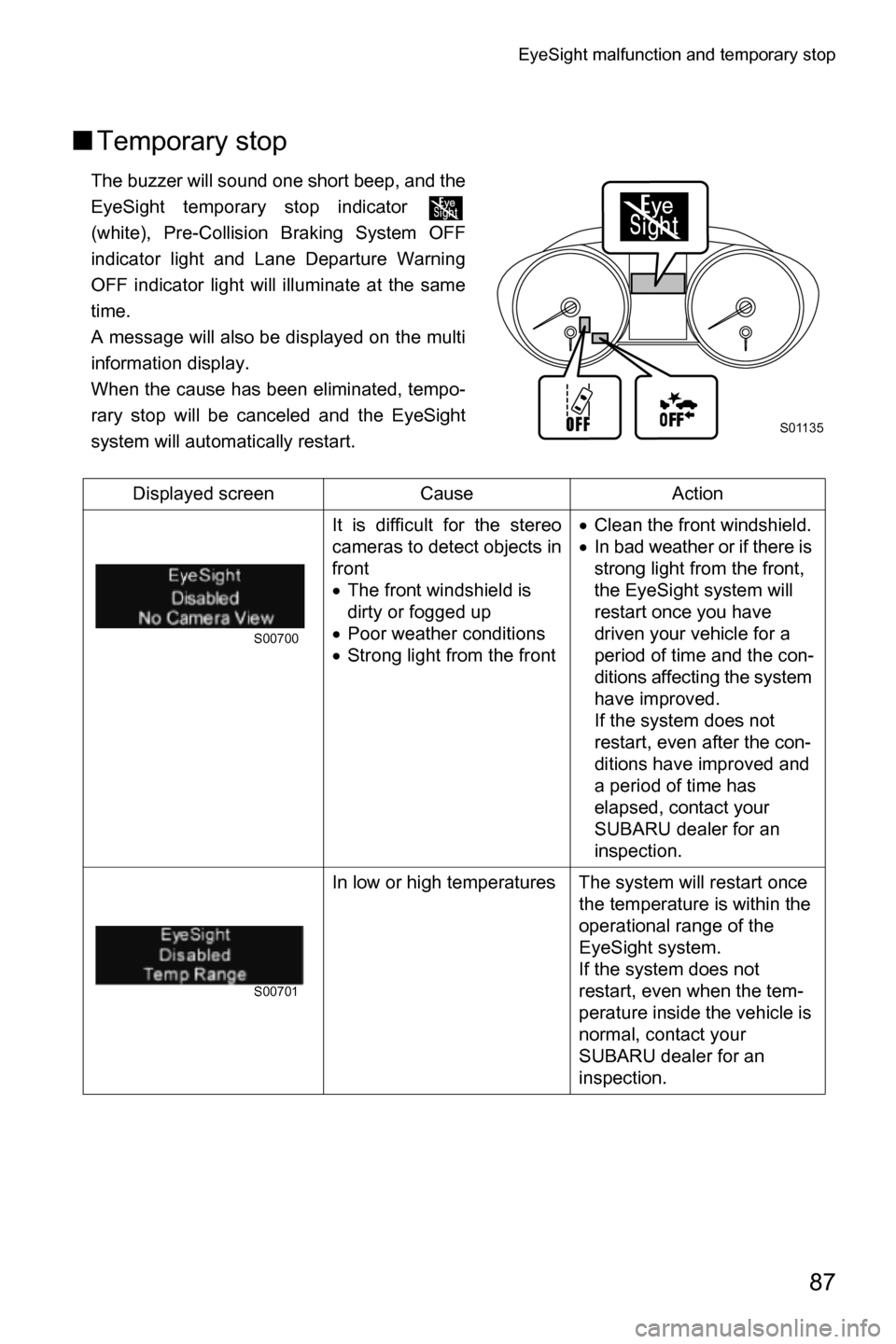
The buzzer will sound one short beep, and the
EyeSight temporary stop indicator
(white), Pre-Collision Braking System OFF
indicator light and Lane Departure Warning
OFF indicator light will illuminate at the same
time.
A message will also be displayed on the multi
information display.
When the cause has been eliminated, tempo-
rary stop will be canceled and the EyeSight
system will automatically restart.
Displayed screen Cause Action
It is difficult for the stereo
cameras to detect objects in
front
xThe front windshield is
dirty or fogged up
xPoor weather conditions
xStrong light from the frontxClean the front windshield.
xIn bad weather or if there is
strong light from the front,
the EyeSight system will
restart once you have
driven your vehicle for a
period of time and the con-
ditions affecting the system
have improved.
If the system does not
restart, even after the con-
ditions have improved and
a period of time has
elapsed, contact your
SUBARU dealer for an
inspection.
In low or high temperatures The system will restart once
the temperature is within the
operational range of the
EyeSight system.
If the system does not
restart, even when the tem-
perature inside the vehicle is
normal, contact your
SUBARU dealer for an
inspection.
S01135
S00700
S00701
Page 97 of 108
Troubleshooting
93
Troubleshooting
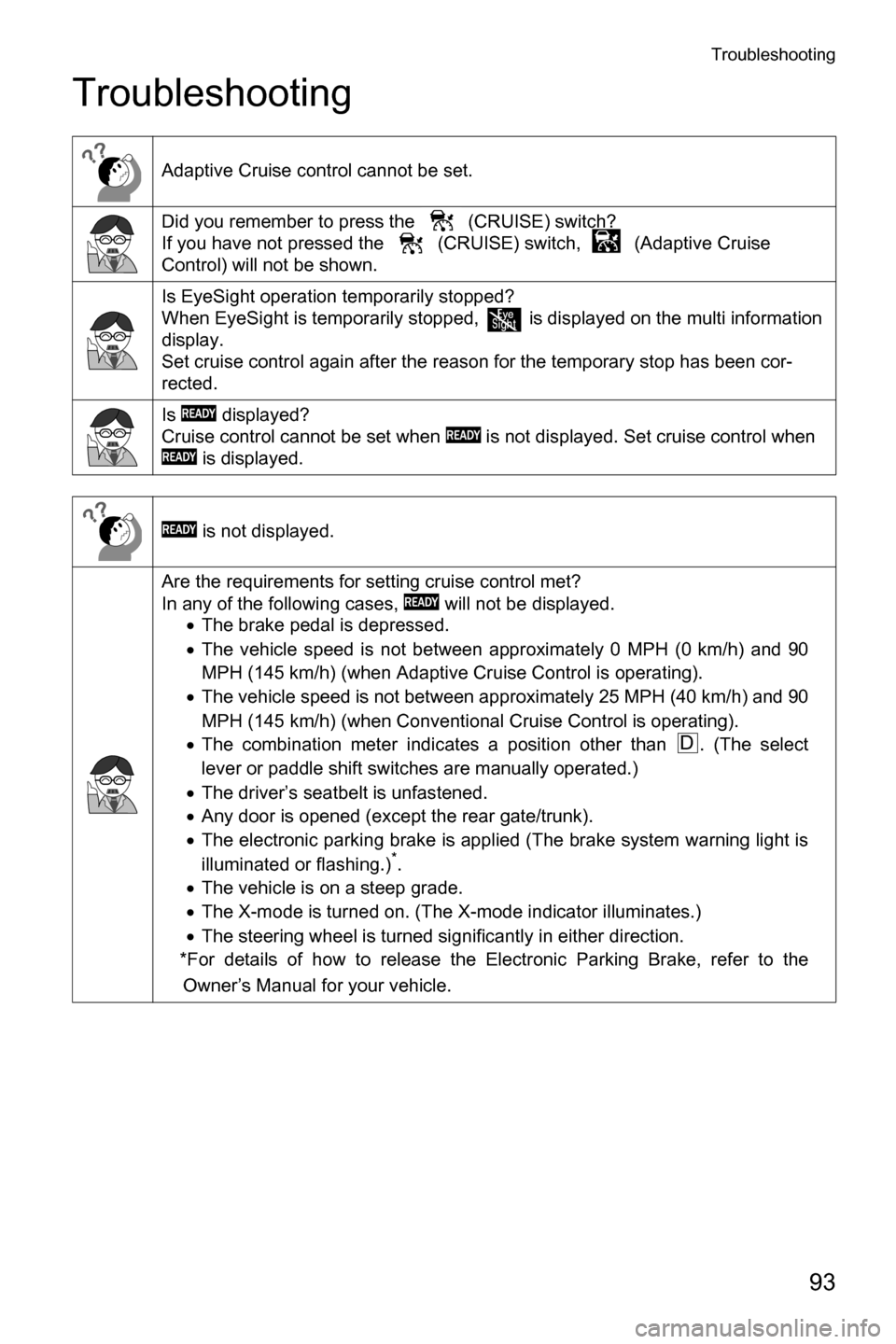
Adaptive Cruise control cannot be set.
Did you remember to press the (CRUISE) switch?
If you have not pressed the (CRUISE) switch, (Adaptive Cruise
Control) will not be shown.
Is EyeSight operation temporarily stopped?
When EyeSight is temporarily stopped, is displayed on the multi information
display.
Set cruise control again after the reason for the temporary stop has been cor-
rected.
Is displayed?
Cruise control cannot be set when is not displayed. Set cruise control when
is displayed.
is not displayed.
Are the requirements for setting cruise control met?
In any of the following cases, will not be displayed.
xThe brake pedal is depressed.
xThe vehicle speed is not between approximately 0 MPH (0 km/h) and 90
MPH (145 km/h) (when Adaptive Cruise Control is operating).
xThe vehicle speed is not between approximately 25 MPH (40 km/h) and 90
MPH (145 km/h) (when Conventional Cruise Control is operating).
xThe combination meter indicates a position other than . (The select
lever or paddle shift switches are manually operated.)
xThe driver’s seatbelt is unfastened.
xAny door is opened (except the rear gate/trunk).
xThe electronic parking brake is applied (The brake system warning light is
illuminated or flashing.)
*.
xThe vehicle is on a steep grade.
xThe X-mode is turned on. (The X-mode indicator illuminates.)
xThe steering wheel is turned significantly in either direction.
*For details of how to release the Electronic Parking Brake, refer to the
Owner’s Manual for your vehicle.
D
Page 99 of 108
Troubleshooting
95
EyeSight does not restart after a temporary stop.
Is the X-mode turned on?
EyeSight cannot be activated when the X-mode is turned on.
Are you driving in the rain with old wipers or is there an oily film on the windshield?
Replace the wipers with new ones, or clean the oily film off the windshield.
Are you driving in poor weather conditions with heavy rain, snow, fog, or dust? In
these cases, EyeSight may temporarily stop operating while visibility is very low.
Is your vehicle subject to sunlight from the front (sunset or sunrise, etc.) or to
bright headlights from oncoming vehicles at nighttime?
In these cases, EyeSight may temporarily stop operating.
Has the vehicle been parked in a cold or hot place? In either of these cases,
EyeSight may temporarily stop operating until the temperature increases or
decreases to a temperature at which the camera is operable.
The timing of the “brake more” warning is sometimes earlier and sometimes later
than what seems to be normal operation.
The “brake more” warning sounds when the system determines that more braking
is necessary, based on conditions such as the distance from the vehicle in front
and the difference in speed compared to it. As a result, timing may vary depend-
ing on how the brakes are applied in relation to the vehicle in front, and your rela-
tive speed to that vehicle.
When the vehicle in front has turned off the road away or the distance from the
vehicle in front has increased, acceleration is sometimes slower or faster.
Depending on the timing of when the detection of the vehicle in front is lost,
EyeSight’s ability to react may be slower, causing the start of acceleration to feel
delayed and braking time to feel longer than what seems to be normal operation.
Page 101 of 108
Troubleshooting
97
Lane Keep Assist was unexpectedly canceled
Did you take your hands off the steering wheel? Did you just lightly put your hands
on the steering wheel while driving?
If the system cannot detect the steering operation of the driver, it will temporarily
cancel Lane Keep Assist.
Did you turn a tight corner?
Lane Keep Assist does not operate while turning a tight corner.
Did you perform one of the following operations?
xOperating the turn signal lever
xOperating the steering wheel to depart from a lane
xDepressing the accelerator pedal deeply
xOperating the windshield wiper in a high speed
xDriving your vehicle at a speed less than approximately 37 MPH (60 km/h)
or more than approximately 93 MPH (150 km/h)
xDepressing the brake pedal
xTurning on the hazard warning flasher switch