Page 296 of 490
295 4-3. Do-it-yourself maintenance
4
Maintenance and care
WARNING
The engine compartment contains many mechanisms and fluids that may
move suddenly, become hot, or become electrically energized. To avoid death
or serious injury, observe the following precautions.
■When working in the engine compartment
●Keep hands, clothing, and tools away from the moving fan and engine
drive belt.
●Be careful not to touch the engine, radiator, exhaust manifold, etc. right
after driving as they may be hot. Oil and other fluids may also be hot.
●Do not leave anything that may burn easily, such as paper or rags, in the
engine compartment.
●Do not smoke, cause sparks or expose an open flame to fuel or the bat-
tery. Fuel and battery fumes are flammable.
●Be extremely cautious when working on the battery. It contains poisonous
and corrosive sulfuric acid.
■When working near the electric cooling fans or radiator grille
Vehicles without a keyless access with push button start system: Be sure the
engine switch is off. With the engine switch in the “ON” position, the electric
cooling fans may automatically start to run if the air conditioning is on and/or
the coolant temperature is high. (oP. 304)
Vehicles with a keyless access with push button start system: Be sure the
push-button ignition switch is off. With the push-button ignition switch in
“ON” mode, the electric cooling fans may automatically start to run if the air
conditioning is on and/or the coolant temperature is high. (oP. 304)
■Safety glasses
Wear safety glasses to prevent flying or falling material, fluid spray, etc. from
getting in the eyes.
CAUTION
■If you remove the air cleaner filter
Driving with the air cleaner filter removed may cause excessive engine wear
due to dirt in the air. Also a backfire could cause a fire in the engine compart-
ment.
Page 309 of 490

308 4-3. Do-it-yourself maintenance
■Before recharging
When recharging, the battery produces hydrogen gas which is flammable
and explosive. Therefore, before recharging:
●If recharging with the battery installed on the vehicle, be sure to discon-
nect the ground cable.
●Make sure the power switch on the charger is off when connecting and
disconnecting the charger cables to the battery.
■After recharging/reconnecting the battery (vehicles with a keyless
access with push button start system)
●Unlocking the doors using the keyless access with push button start sys-
tem may not be possible immediately after reconnecting the battery. If
this happens, use the remote keyless entry system or the mechanical
key to lock/unlock the doors.
●Start the engine with the push-button ignition switch in “ACC” mode. The
engine may not start with the push-button ignition switch turned off. How-
ever, the engine will operate normally from the second attempt.
●The push-button ignition switch mode is recorded by the vehicle. If the
battery is reconnected, the vehicle will return the push-button ignition
switch mode to the status it was in before the battery was disconnected.
Make sure to turn off the engine before disconnect the battery. Take extra
care when connecting the battery if the push-button ignition switch mode
prior to discharge is unknown.
If the engine will not start even after multiple attempts, contact your
SUBARU dealer.
Page 327 of 490
326
4-3. Do-it-yourself maintenance
Air conditioning filter
The air conditioning filter must be changed regularly to maintain air
conditioning efficiency.
■Removal method
Vehicles without a keyless access with push button
start system
Turn the engine switch off.
Vehicles with a keyless access with push button start
system
Turn the push-button ignition switch off.
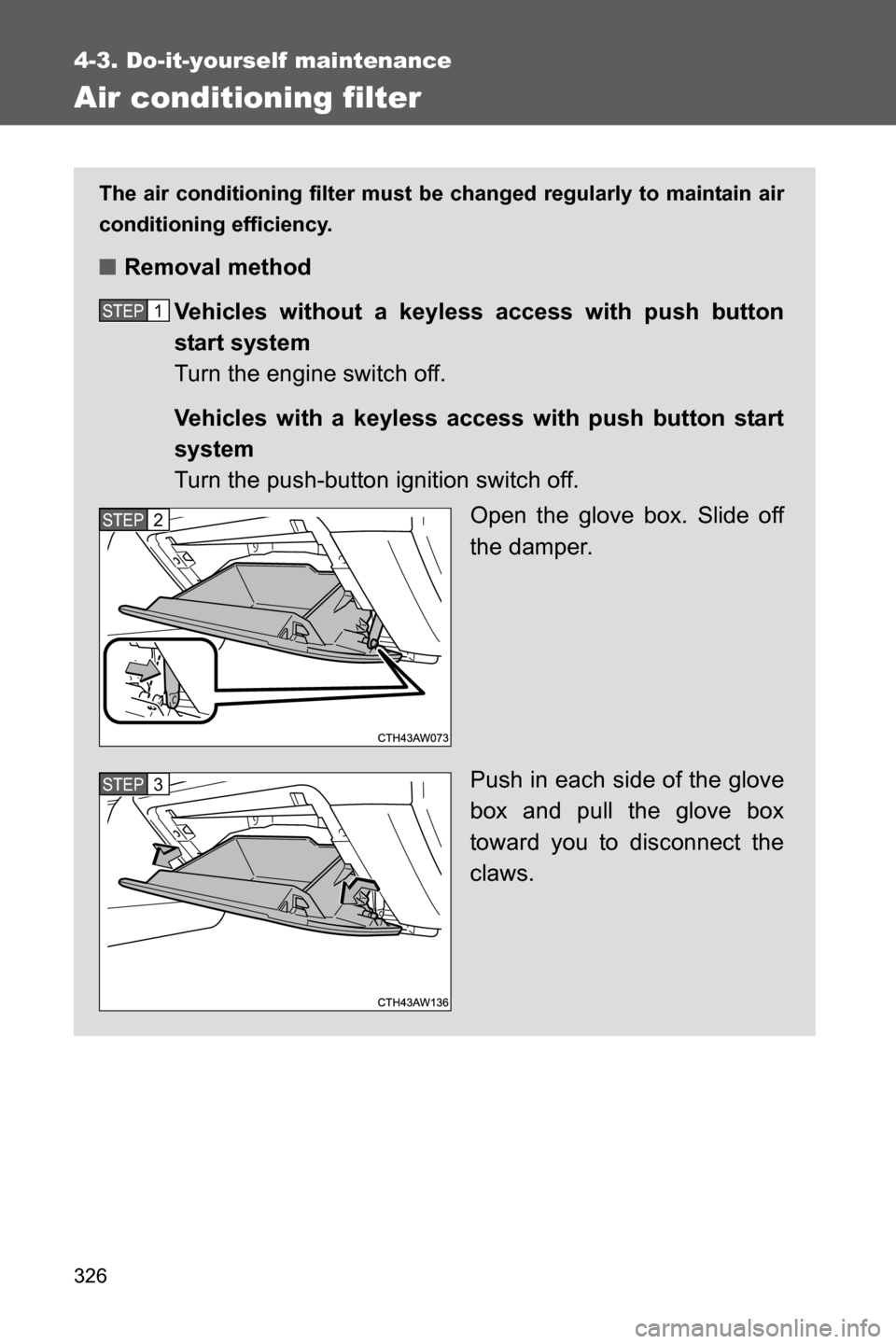
Open the glove box. Slide off
the damper.
Push in each side of the glove
box and pull the glove box
toward you to disconnect the
claws.
STEP 1
STEP 2
STEP 3
Page 335 of 490
334
4-3. Do-it-yourself maintenance
Checking and replacing fuses
If any of the electrical components do not operate, a fuse may have
blown. If this happens, check and replace the fuses as necessary.
Vehicles without a keyless access with push button
start system
Turn the engine switch off.
Vehicles with a keyless access with push button start
system
Turn the push-button ignition switch off.
Open the fuse box cover.
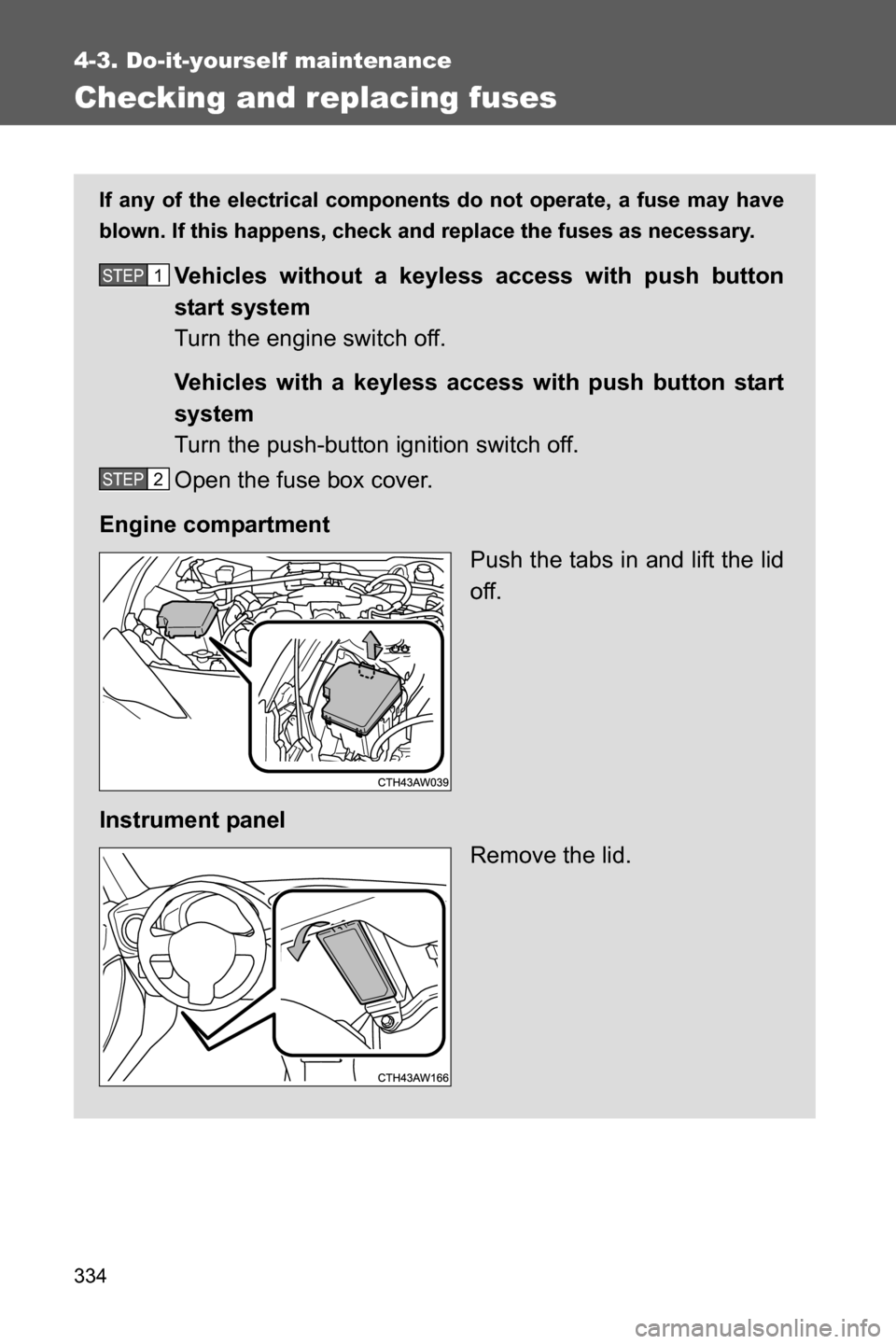
Engine compartment
Push the tabs in and lift the lid
off.
Instrument panel
Remove the lid.STEP 1
STEP 2
Page 361 of 490
360 5-1. Essential information
■Before emergency towing
Release the parking brake.
Shift the select lever to N (vehicles with an automatic transmission)
or shift lever to neutral (vehicles with a manual transmission).
Vehicles without a keyless access with push button start system:
Turn the engine switch to the “ACC” (engine off) or “ON” (engine
running) position.
Vehicles with a keyless access with push button start system: Turn
the push-button ignition switch to “ACC” (engine off) or “ON”
(engine running) mode.
■If towing a vehicle
Do not tow another vehicle. If towing a vehicle that has broken down is
unavoidable, avoid towing a vehicle that is heavier than your vehicle. Also,
do not pull out a vehicle that has fallen into a ditch.
WARNING
■Caution while towing
●Use extreme caution when towing the vehicle.
Avoid sudden starts or erratic driving maneuvers which place excessive
stress on the emergency towing eyelets and the cables or chains. Always
be cautious of the surroundings and other vehicles while towing.
●If the engine is not running, the power assist for the brakes and steering
will not function, making steering and braking more difficult.
STEP 1
STEP 2
STEP 3
Page 365 of 490
364 5-1. Essential information
CAUTION
■Towing with a wheel lift-type truck is not recommended
If a flat bed truck is not available, observe the following precautions to pre-
vent damage to the drive train or body.
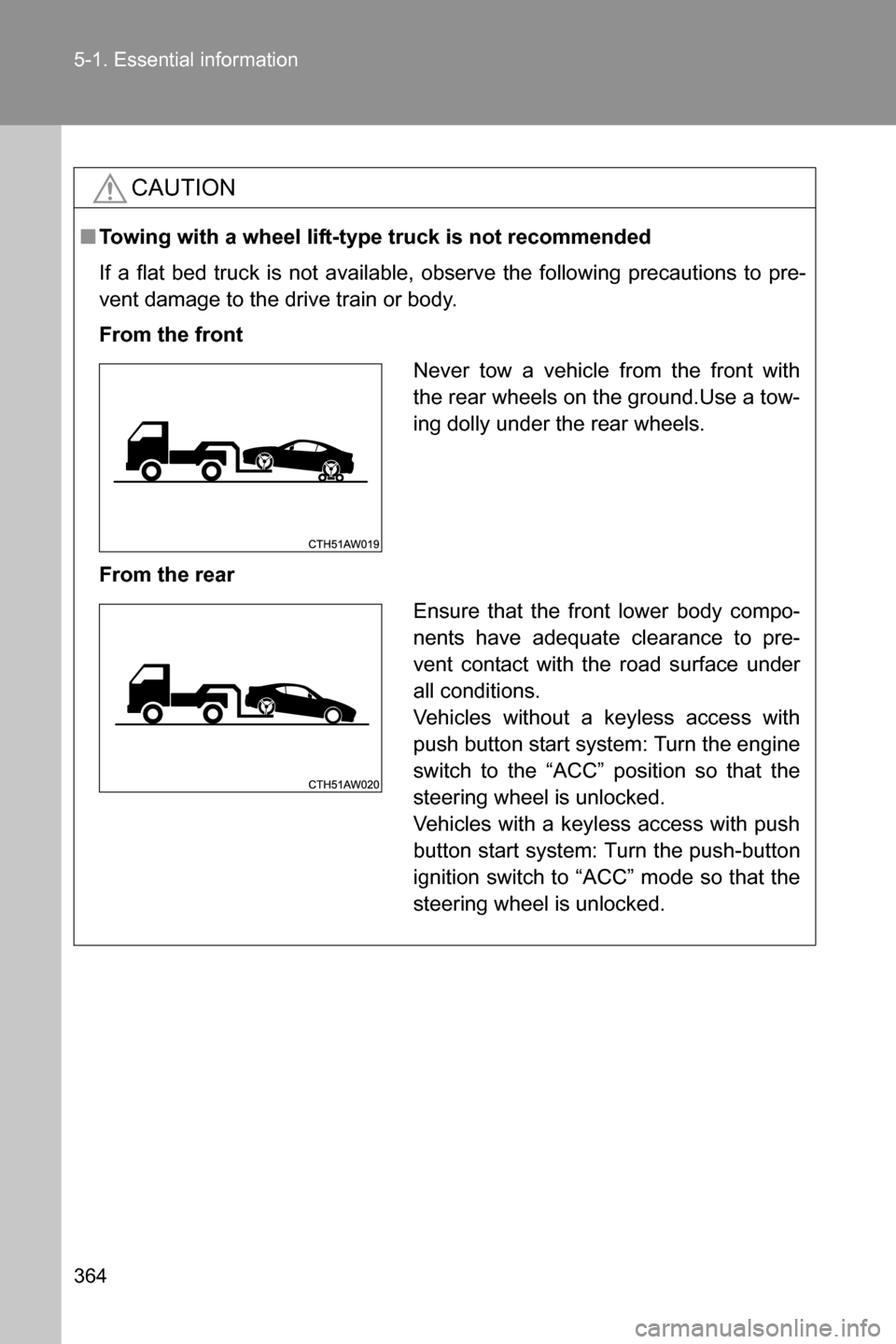
From the front
From the rear
Never tow a vehicle from the front with
the rear wheels on the ground.Use a tow-
ing dolly under the rear wheels.
Ensure that the front lower body compo-
nents have adequate clearance to pre-
vent contact with the road surface under
all conditions.
Vehicles without a keyless access with
push button start system: Turn the engine
switch to the “ACC” position so that the
steering wheel is unlocked.
Vehicles with a keyless access with push
button start system: Turn the push-button
ignition switch to “ACC” mode so that the
steering wheel is unlocked.
Page 368 of 490
5
When trouble arises
367
5-1. Essential information
Fuel pump shut off system
Follow the procedure below to restart the engine after the system is
activated.
Vehicles without a keyless access with push button start system
Turn the engine switch to the “ACC” or “LOCK” position.
Restart the engine.
Vehicles with a keyless access with push button start system
Turn the push-button ignition switch to “ACC” mode or turn it off.
Restart the engine.
CAUTION
■Before starting the engine
Inspect the ground under the vehicle.
If you find that fuel has leaked on to the ground, the fuel system has been
damaged and is in need of repair. Do not restart the engine.
To minimize the risk of fuel leakage when the engine stalls or an air-
bag inflates upon collision, the fuel pump shut off system stops sup-
plying fuel to the engine.
STEP 1
STEP 2
STEP 1
STEP 2
Page 374 of 490

5
When trouble arises
373 5-2. Steps to take in an emergency
Vehicles with a keyless access with push button start system
The driver’s seatbelt buzzer sounds to alert the driver that his or her seatbelt
is not fastened. Once the
push-button ignition switch is turned to “ON”
mode
, the buzzer sounds for 6 seconds. If the vehicle reaches a speed of
12 mph (20 km/h), the buzzer sounds once. If the seatbelt is still unfastened
after 30 seconds, the buzzer will sound intermittently for 10 seconds. Then,
if the seatbelt is still unfastened, the buzzer will sound in a different tone for
20 more seconds.
*2: Front passenger’s seatbelt buzzer:
The front passenger’s seatbelt buzzer sounds to alert the front passenger
that his or her seatbelt is not fastened. The buzzer sounds once if the vehi-
cle reaches a speed of 12 mph (20 km/h). If the seatbelt is still unfastened
after 30 seconds, the buzzer will sound intermittently for 10 seconds. Then,
if the seatbelt is still unfastened, the buzzer will sound in a different tone for
20 more seconds.
■Low fuel level warning light
When the vehicle is on an incline, curve and so forth, the fuel inside the tank
moves, which may cause the warning light to come on early.
■Front passenger detection sensor and passenger seatbelt reminder
and warning buzzer
●If luggage is placed on the front passenger seat, the front passenger
detection sensor may cause the warning light to flash and warning
buzzer to sound, even if a passenger is not sitting in the seat.
●If a cushion is placed on the seat, the sensor may not detect a passen-
ger, and the warning light may not operate properly.
■
When the tire pressure warning light comes on (if equipped)
Check the tire inflation pressure and adjust to the appropriate level.
■The tire pressure warning light may turn on due to natural causes
(if equipped)
The tire pressure warning light may turn on due to natural causes such
as natural air leaks or tire inflation pressure changes caused by temper-
ature. In this case, adjusting the tire inflation pressure will turn off the
warning light (after a few minutes).