Page 360 of 490
5
When trouble arises
359
5-1. Essential information
If your vehicle needs to be towed
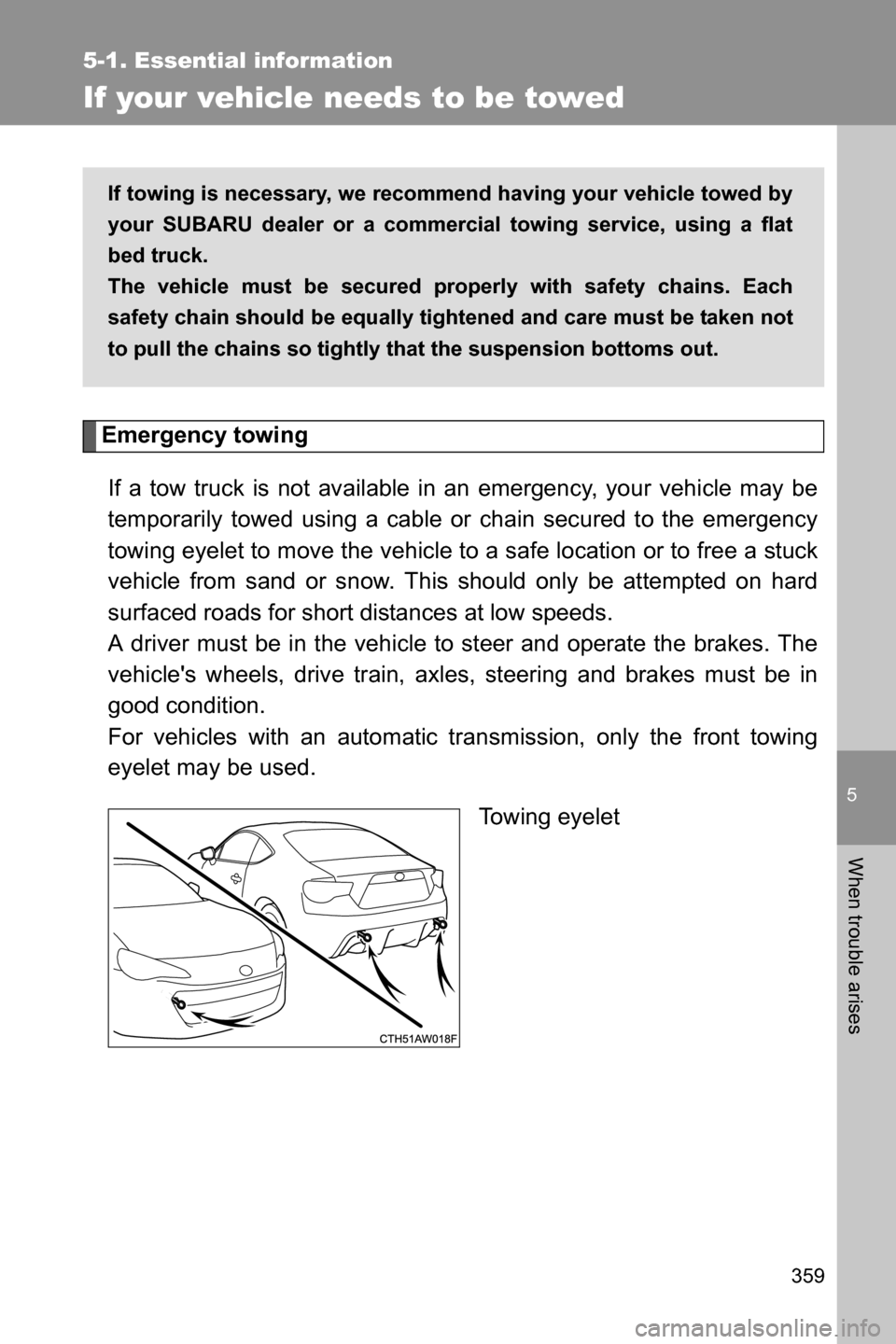
Emergency towing
If a tow truck is not available in an emergency, your vehicle may be
temporarily towed using a cable or chain secured to the emergency
towing eyelet to move the vehicle to a safe location or to free a stuck
vehicle from sand or snow. This should only be attempted on hard
surfaced roads for short distances at low speeds.
A driver must be in the vehicle to steer and operate the brakes. The
vehicle's wheels, drive train, axles, steering and brakes must be in
good condition.
For vehicles with an automatic transmission, only the front towing
eyelet may be used.
Towing eyelet
If towing is necessary, we recommend having your vehicle towed by
your SUBARU dealer or a commercial towing service, using a flat
bed truck.
The vehicle must be secured properly with safety chains. Each
safety chain should be equally tightened and care must be taken not
to pull the chains so tightly that the suspension bottoms out.
Page 361 of 490
360 5-1. Essential information
■Before emergency towing
Release the parking brake.
Shift the select lever to N (vehicles with an automatic transmission)
or shift lever to neutral (vehicles with a manual transmission).
Vehicles without a keyless access with push button start system:
Turn the engine switch to the “ACC” (engine off) or “ON” (engine
running) position.
Vehicles with a keyless access with push button start system: Turn
the push-button ignition switch to “ACC” (engine off) or “ON”
(engine running) mode.
■If towing a vehicle
Do not tow another vehicle. If towing a vehicle that has broken down is
unavoidable, avoid towing a vehicle that is heavier than your vehicle. Also,
do not pull out a vehicle that has fallen into a ditch.
WARNING
■Caution while towing
●Use extreme caution when towing the vehicle.
Avoid sudden starts or erratic driving maneuvers which place excessive
stress on the emergency towing eyelets and the cables or chains. Always
be cautious of the surroundings and other vehicles while towing.
●If the engine is not running, the power assist for the brakes and steering
will not function, making steering and braking more difficult.
STEP 1
STEP 2
STEP 3
Page 362 of 490
5
When trouble arises
361 5-1. Essential information
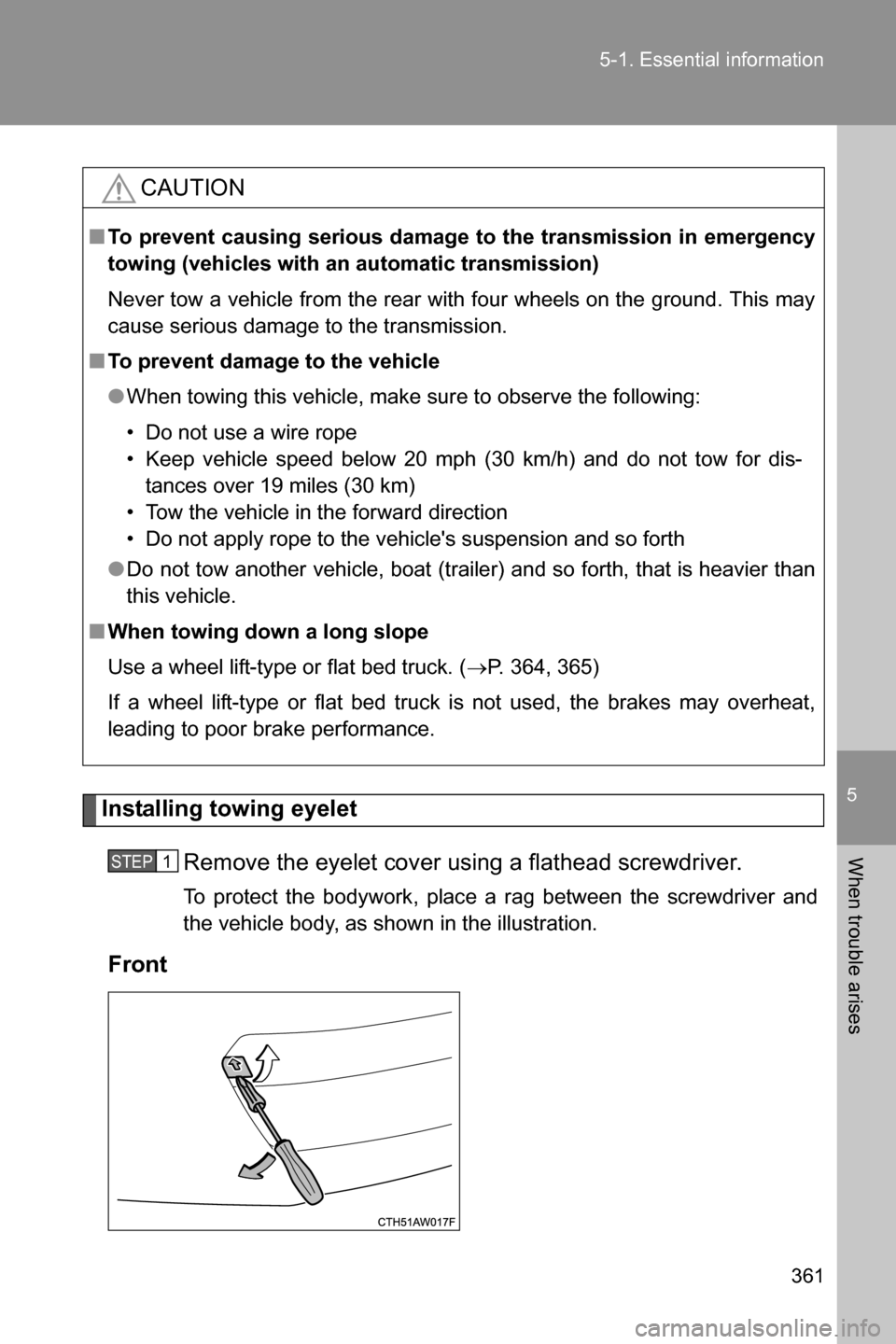
Installing towing eyelet
Remove the eyelet cover using a flathead screwdriver.
To protect the bodywork, place a rag between the screwdriver and
the vehicle body, as shown in the illustration.
Front
CAUTION
■To prevent causing serious damage to the transmission in emergency
towing (vehicles with an automatic transmission)
Never tow a vehicle from the rear with four wheels on the ground. This may
cause serious damage to the transmission.
■To prevent damage to the vehicle
●When towing this vehicle, make sure to observe the following:
• Do not use a wire rope
• Keep vehicle speed below 20 mph (30 km/h) and do not tow for dis-
tances over 19 miles (30 km)
• Tow the vehicle in the forward direction
• Do not apply rope to the vehicle's suspension and so forth
●Do not tow another vehicle, boat (trailer) and so forth, that is heavier than
this vehicle.
■When towing down a long slope
Use a wheel lift-type or flat bed truck. (oP. 364, 365)
If a wheel lift-type or flat bed truck is not used, the brakes may overheat,
leading to poor brake performance.
STEP 1
Page 367 of 490
366
5-1. Essential information
If you think something is wrong
If you notice any of the following symptoms, your vehicle probably
needs adjustment or repair. Contact your SUBARU dealer as soon as
possible.
■Visible symptoms
●Fluid leaks under the vehicle
(Water dripping from the air conditioning after use is normal.)
●Flat-looking tires or uneven tire wear
●Engine coolant temperature gauge needle continually points
higher than normal
■Audible symptoms
●Changes in exhaust sound
●Excessive tire squeal when cornering
●Strange noises related to the suspension system
●Pinging or other noises related to the engine
■Operational symptoms
●Engine missing, stumbling or running rough
●Appreciable loss of power
●Vehicle pulls heavily to one side when braking
●Vehicle pulls heavily to one side when driving on a level road
●Loss of brake effectiveness, spongy feeling, pedal almost
touches the floor
Page 369 of 490
368
5-2. Steps to take in an emergency
If a warning light turns on or a war ning buzzer sounds...
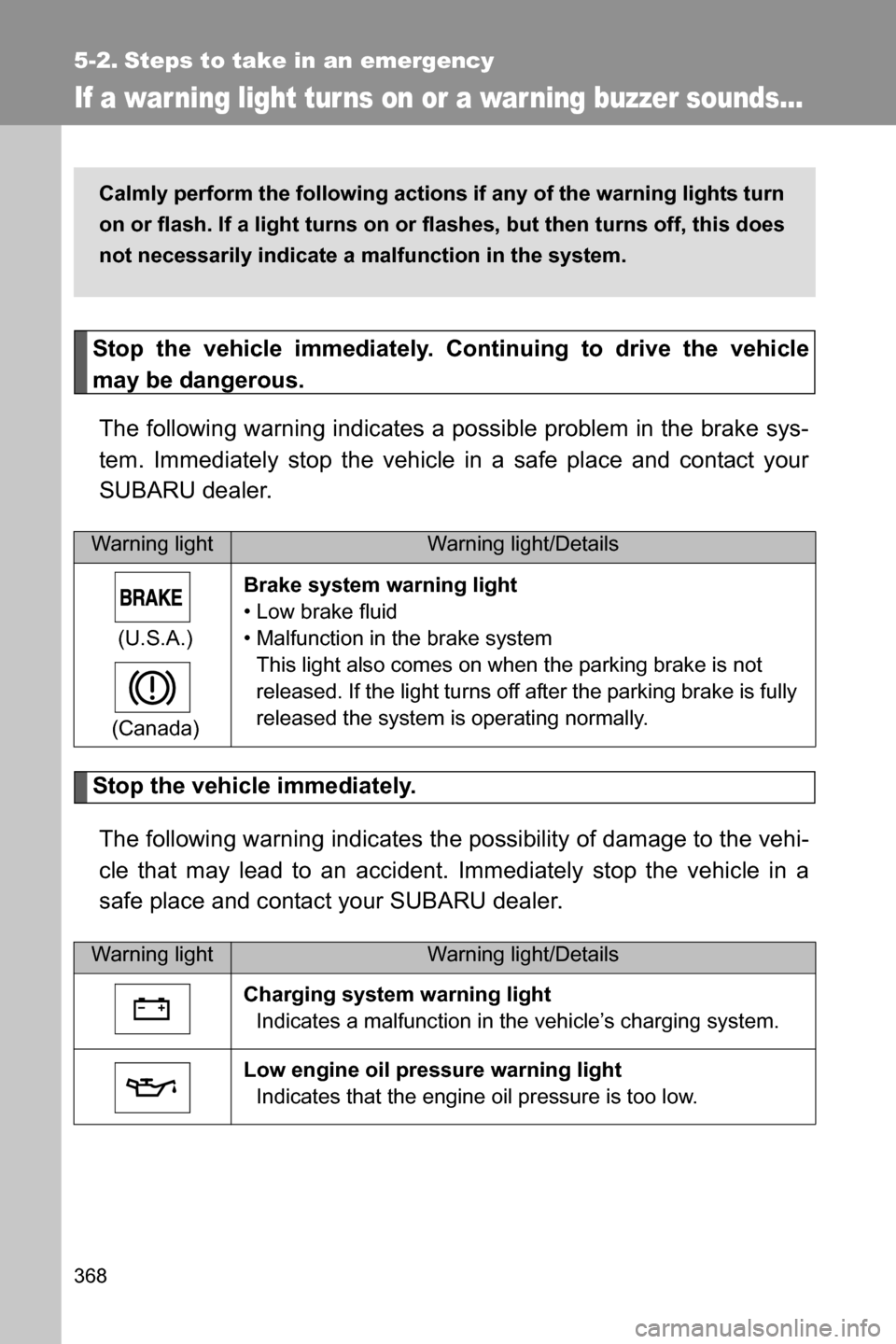
Stop the vehicle immediately. Continuing to drive the vehicle
may be dangerous.
The following warning indicates a possible problem in the brake sys-
tem. Immediately stop the vehicle in a safe place and contact your
SUBARU dealer.
Stop the vehicle immediately.
The following warning indicates the possibility of damage to the vehi-
cle that may lead to an accident. Immediately stop the vehicle in a
safe place and contact your SUBARU dealer.
Warning lightWarning light/Details
(U.S.A.)
(Canada)Brake system warning light
• Low brake fluid
• Malfunction in the brake system
This light also comes on when the parking brake is not
released. If the light turns off after the parking brake is fully
released the system is operating normally.
Warning lightWarning light/Details
Charging system warning light
Indicates a malfunction in the vehicle’s charging system.
Low engine oil pressure warning light
Indicates that the engine oil pressure is too low.
Calmly perform the following actions if any of the warning lights turn
on or flash. If a light turns on or flashes, but then turns off, this does
not necessarily indicate a malfunction in the system.
Page 370 of 490
5
When trouble arises
369 5-2. Steps to take in an emergency
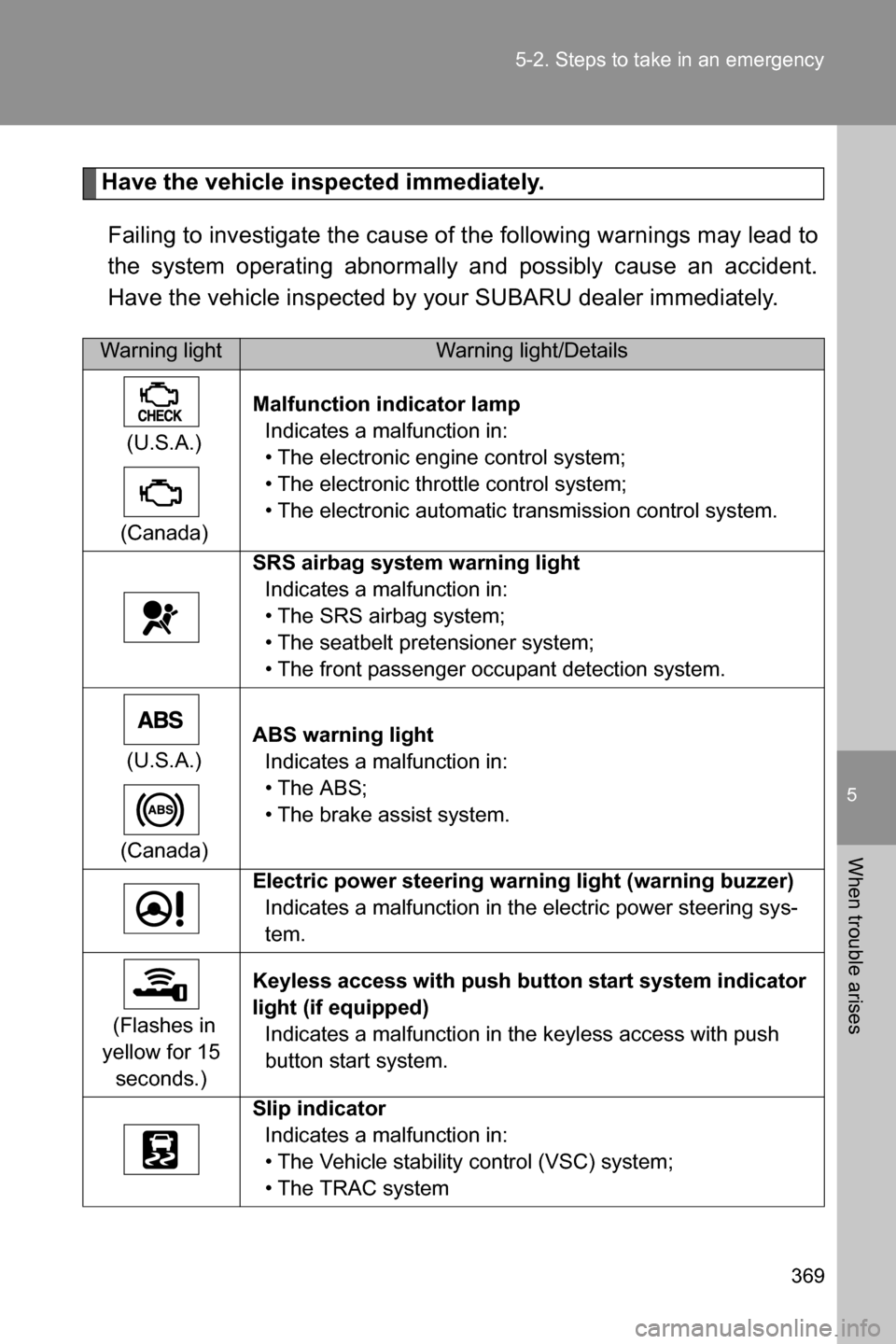
Have the vehicle inspected immediately.
Failing to investigate the cause of the following warnings may lead to
the system operating abnormally and possibly cause an accident.
Have the vehicle inspected by your SUBARU dealer immediately.
Warning lightWarning light/Details
(U.S.A.)
(Canada)Malfunction indicator lamp
Indicates a malfunction in:
• The electronic engine control system;
• The electronic throttle control system;
• The electronic automatic transmission control system.
SRS airbag system warning light
Indicates a malfunction in:
• The SRS airbag system;
• The seatbelt pretensioner system;
• The front passenger occupant detection system.
(U.S.A.)
(Canada)ABS warning light
Indicates a malfunction in:
• The ABS;
• The brake assist system.
Electric power steering warning light (warning buzzer)
Indicates a malfunction in the electric power steering sys-
tem.
(Flashes in
yellow for 15
seconds.)Keyless access with push button start system indicator
light (if equipped)
Indicates a malfunction in the keyless access with push
button start system.
Slip indicator
Indicates a malfunction in:
• The Vehicle stability control (VSC) system;
• The TRAC system
Page 376 of 490
5
When trouble arises
375 5-2. Steps to take in an emergency
■If the tire pressure warning light frequently comes on after blinking
for approximately one minute (if equipped)
If the tire pressure warning light frequently comes on after blinking for
approximately one minute when the push-button ignition switch is turned
to “ON” mode (vehicles with a keyless access with push button start sys-
tem) or the engine switch is turned to the “ON” position (vehicles without
a keyless access with push button start system), have it checked your
SUBARU dealer.
WARNING
■If the tire pressure warning light comes on (if equipped)
Be sure to observe the following precautions. Failure to do so could
cause loss of vehicle control and result in death or serious injury.
●Stop your vehicle in a safe place as soon as possible. Adjust the tire
inflation pressure immediately.
●If the tire pressure warning light comes on even after tire inflation pres-
sure adjustment, it is probable that you have a flat tire. Check the tires.
If the tire is flat, change to the spare tire and have the flat tire repaired
by the nearest SUBARU dealer.
●Avoid abrupt maneuvering and braking. If the vehicle tires deteriorate,
you could lose control of the steering wheel or the brakes.
■If a blowout or sudden air leakage should occur (vehicles with a tire
pressure monitoring system)
The tire pressure monitoring system may not activate immediately.
Page 382 of 490
5
When trouble arises
381 5-2. Steps to take in an emergency
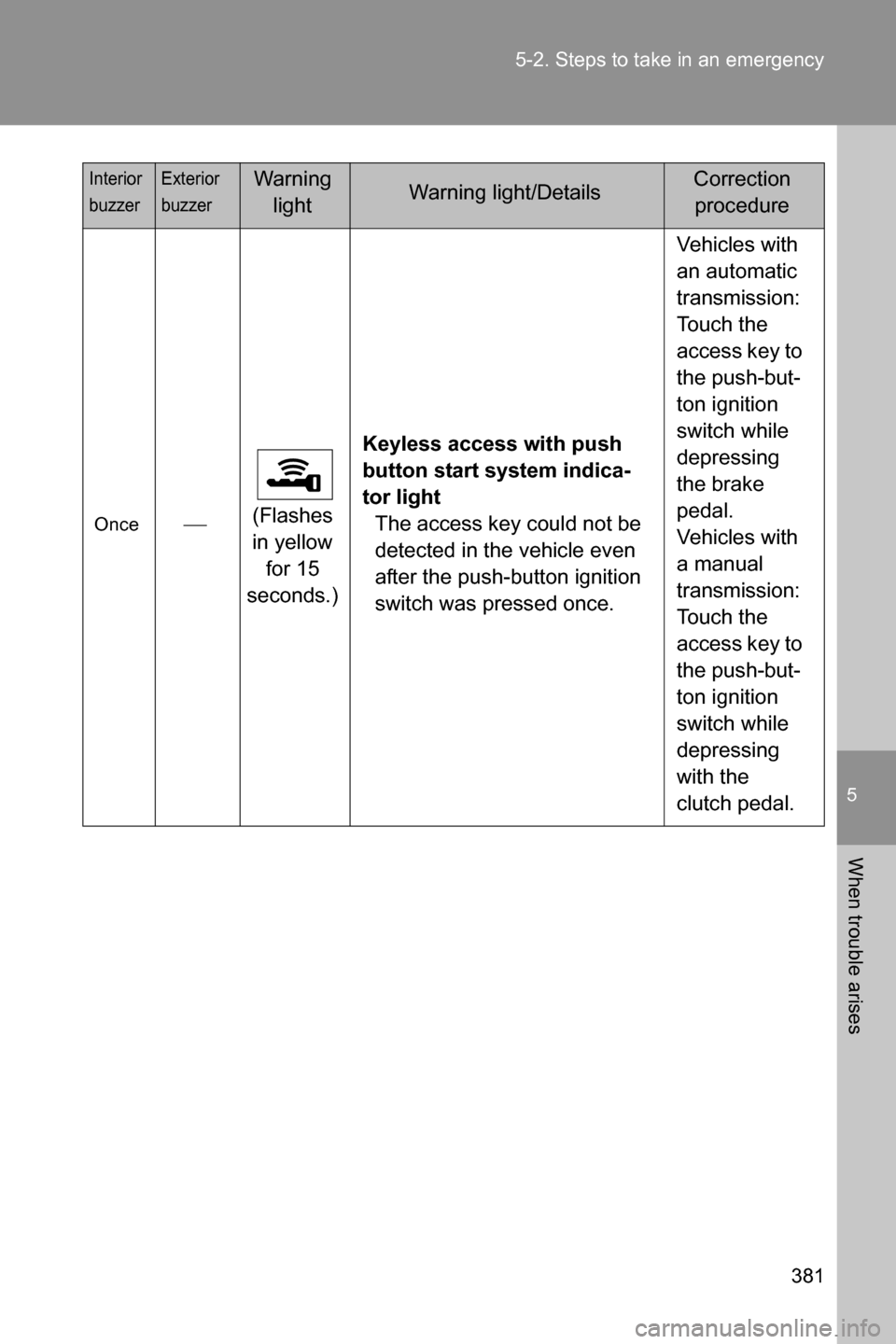
Once(Flashes
in yellow
for 15
seconds.)Keyless access with push
button start system indica-
tor light
The access key could not be
detected in the vehicle even
after the push-button ignition
switch was pressed once.Vehicles with
an automatic
transmission:
Touch the
access key to
the push-but-
ton ignition
switch while
depressing
the brake
pedal.
Vehicles with
a manual
transmission:
Touch the
access key to
the push-but-
ton ignition
switch while
depressing
with the
clutch pedal.
Interior
buzzerExterior
buzzerWarning
lightWarning light/DetailsCorrection
procedure