2016 SUBARU BRZ fuel
[x] Cancel search: fuelPage 423 of 490
422 6-1. Specifications
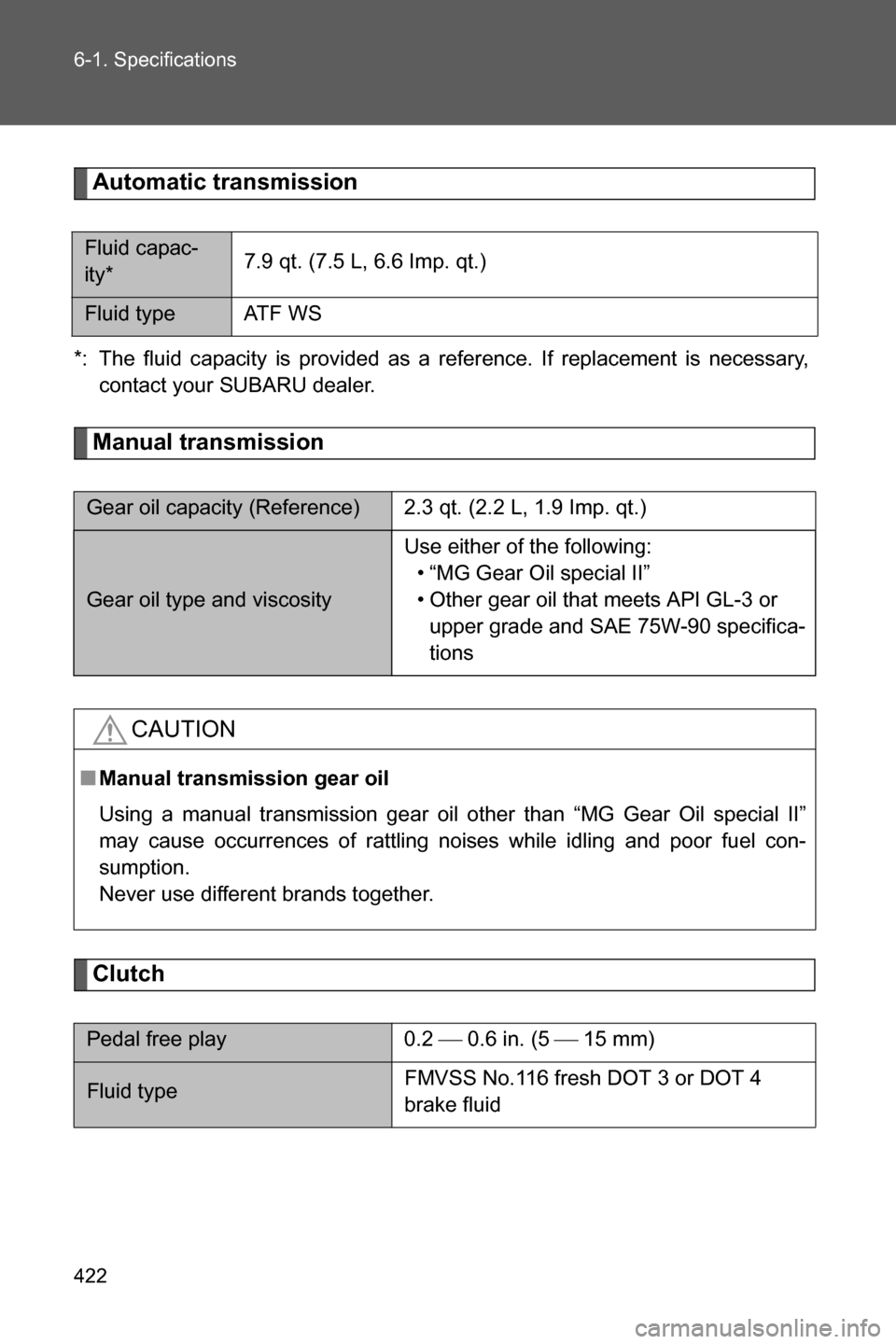
Automatic transmission
*: The fluid capacity is provided as a reference. If replacement is necessary,
contact your SUBARU dealer.
Manual transmission
Clutch
Fluid capac-
ity*7.9 qt. (7.5 L, 6.6 Imp. qt.)
Fluid type ATF WS
Gear oil capacity (Reference) 2.3 qt. (2.2 L, 1.9 Imp. qt.)
Gear oil type and viscosityUse either of the following:
• “MG Gear Oil special II”
• Other gear oil that meets API GL-3 or
upper grade and SAE 75W-90 specifica-
tions
CAUTION
■Manual transmission gear oil
Using a manual transmission gear oil other than “MG Gear Oil special II”
may cause occurrences of rattling noises while idling and poor fuel con-
sumption.
Never use different brands together.
Pedal free play 0.2 0.6 in. (5 15 mm)
Fluid typeFMVSS No.116 fresh DOT 3 or DOT 4
brake fluid
Page 427 of 490
426
6-1. Specifications
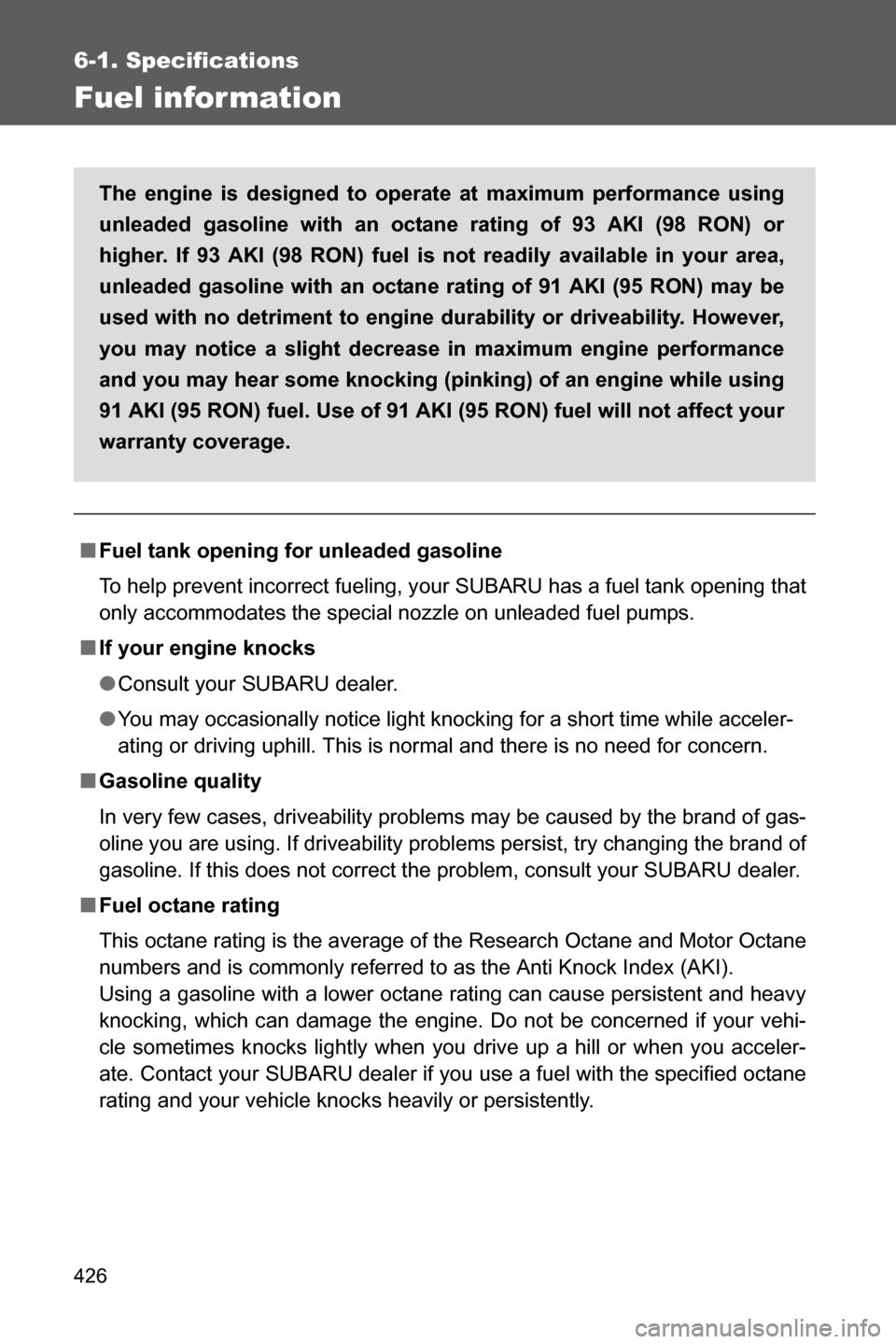
Fuel infor mation
■Fuel tank opening for unleaded gasoline
To help prevent incorrect fueling, your SUBARU has a fuel tank opening that
only accommodates the special nozzle on unleaded fuel pumps.
■If your engine knocks
●Consult your SUBARU dealer.
●You may occasionally notice light knocking for a short time while acceler-
ating or driving uphill. This is normal and there is no need for concern.
■Gasoline quality
In very few cases, driveability problems may be caused by the brand of gas-
oline you are using. If driveability problems persist, try changing the brand of
gasoline. If this does not correct the problem, consult your SUBARU dealer.
■Fuel octane rating
This octane rating is the average of the Research Octane and Motor Octane
numbers and is commonly referred to as the Anti Knock Index (AKI).
Using a gasoline with a lower octane rating can cause persistent and heavy
knocking, which can damage the engine. Do not be concerned if your vehi-
cle sometimes knocks lightly when you drive up a hill or when you acceler-
ate. Contact your SUBARU dealer if you use a fuel with the specified octane
rating and your vehicle knocks heavily or persistently. The engine is designed to operate at maximum performance using
unleaded gasoline with an octane rating of 93 AKI (98 RON) or
higher. If 93 AKI (98 RON) fuel is not readily available in your area,
unleaded gasoline with an octane rating of 91 AKI (95 RON) may be
used with no detriment to engine durability or driveability. However,
you may notice a slight decrease in maximum engine performance
and you may hear some knocking (pinking) of an engine while using
91 AKI (95 RON) fuel. Use of 91 AKI (95 RON) fuel will not affect your
warranty coverage.
Page 428 of 490
427 6-1. Specifications
6
Vehicle specifications
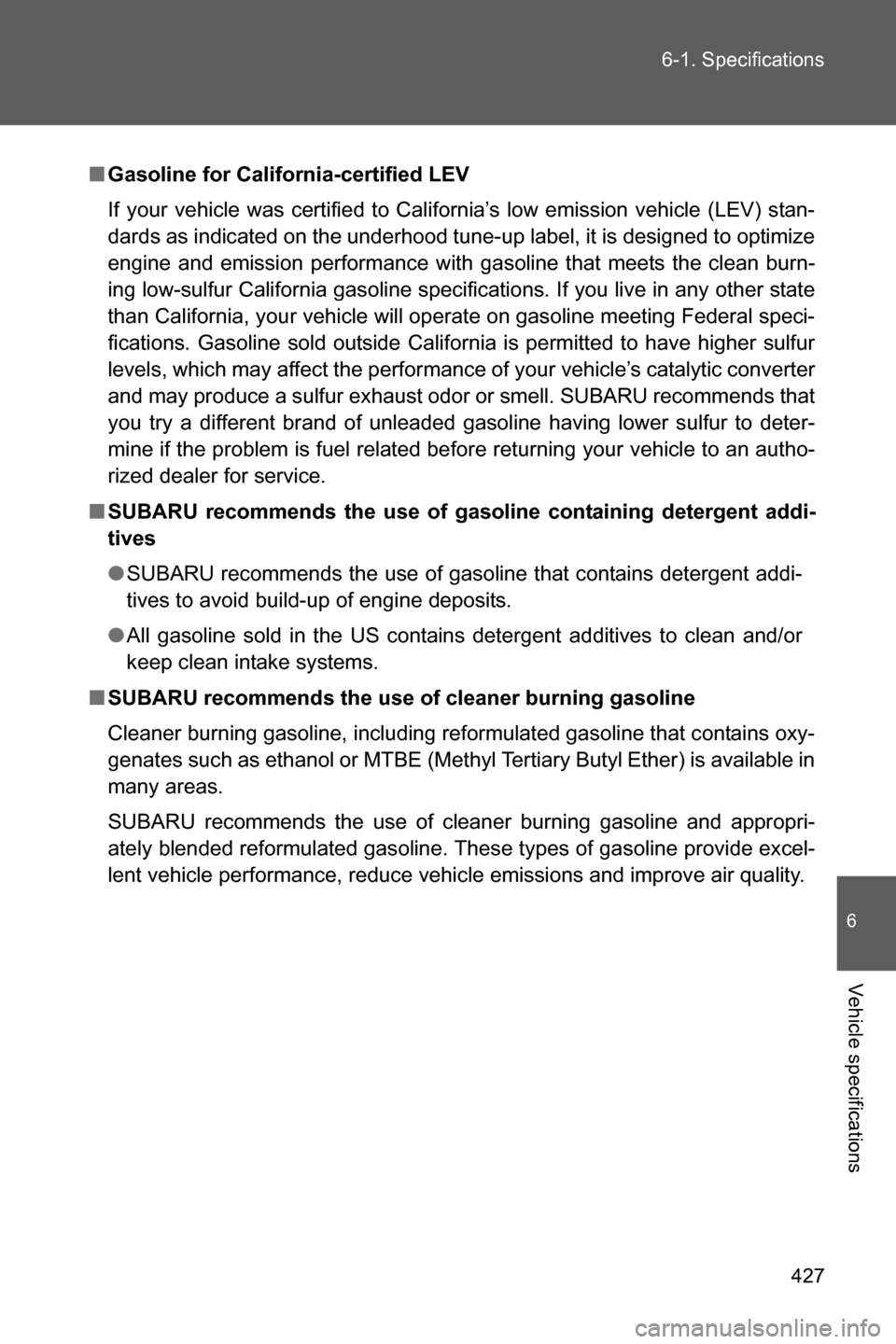
■Gasoline for California-certified LEV
If your vehicle was certified to California’s low emission vehicle (LEV) stan-
dards as indicated on the underhood tune-up label, it is designed to optimize
engine and emission performance with gasoline that meets the clean burn-
ing low-sulfur California gasoline specifications. If you live in any other state
than California, your vehicle will operate on gasoline meeting Federal speci-
fications. Gasoline sold outside California is permitted to have higher sulfur
levels, which may affect the performance of your vehicle’s catalytic converter
and may produce a sulfur exhaust odor or smell. SUBARU recommends that
you try a different brand of unleaded gasoline having lower sulfur to deter-
mine if the problem is fuel related before returning your vehicle to an autho-
rized dealer for service.
■SUBARU recommends the use of gasoline containing detergent addi-
tives
●SUBARU recommends the use of gasoline that contains detergent addi-
tives to avoid build-up of engine deposits.
●All gasoline sold in the US contains detergent additives to clean and/or
keep clean intake systems.
■SUBARU recommends the use of cleaner burning gasoline
Cleaner burning gasoline, including reformulated gasoline that contains oxy-
genates such as ethanol or MTBE (Methyl Tertiary Butyl Ether) is available in
many areas.
SUBARU recommends the use of cleaner burning gasoline and appropri-
ately blended reformulated gasoline. These types of gasoline provide excel-
lent vehicle performance, reduce vehicle emissions and improve air quality.
Page 429 of 490
428 6-1. Specifications
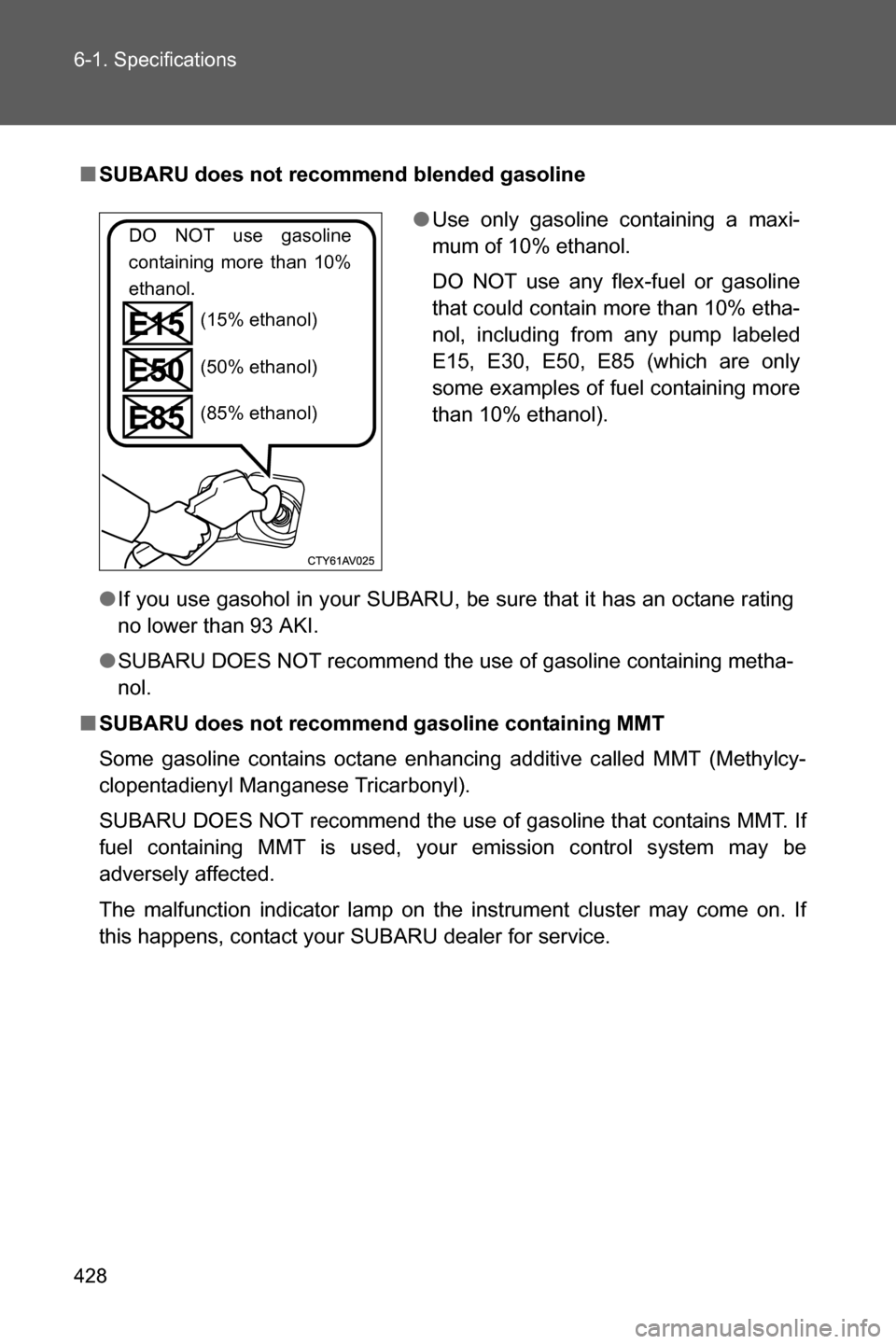
■SUBARU does not recommend blended gasoline
●If you use gasohol in your SUBARU, be sure that it has an octane rating
no lower than 93 AKI.
●SUBARU DOES NOT recommend the use of gasoline containing metha-
nol.
■SUBARU does not recommend gasoline containing MMT
Some gasoline contains octane enhancing additive called MMT (Methylcy-
clopentadienyl Manganese Tricarbonyl).
SUBARU DOES NOT recommend the use of gasoline that contains MMT. If
fuel containing MMT is used, your emission control system may be
adversely affected.
The malfunction indicator lamp on the instrument cluster may come on. If
this happens, contact your SUBARU dealer for service.●Use only gasoline containing a maxi-
mum of 10% ethanol.
DO NOT use any flex-fuel or gasoline
that could contain more than 10% etha-
nol, including from any pump labeled
E15, E30, E50, E85 (which are only
some examples of fuel containing more
than 10% ethanol).
DO NOT use gasoline
containing more than 10%
ethanol.
(15% ethanol)
(50% ethanol)
(85% ethanol)
Page 430 of 490
429 6-1. Specifications
6
Vehicle specifications
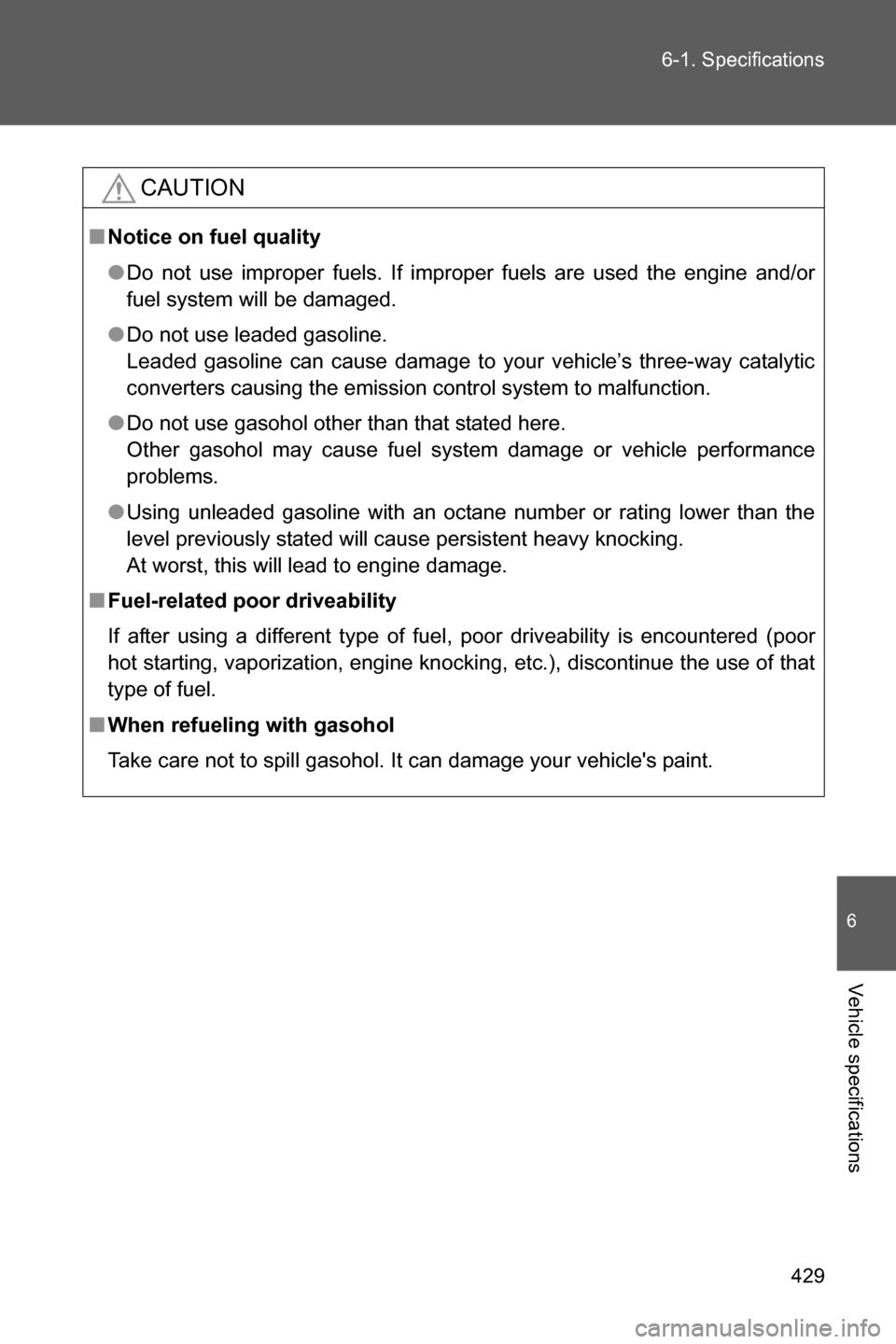
CAUTION
■Notice on fuel quality
●Do not use improper fuels. If improper fuels are used the engine and/or
fuel system will be damaged.
●Do not use leaded gasoline.
Leaded gasoline can cause damage to your vehicle’s three-way catalytic
converters causing the emission control system to malfunction.
●Do not use gasohol other than that stated here.
Other gasohol may cause fuel system damage or vehicle performance
problems.
●Using unleaded gasoline with an octane number or rating lower than the
level previously stated will cause persistent heavy knocking.
At worst, this will lead to engine damage.
■Fuel-related poor driveability
If after using a different type of fuel, poor driveability is encountered (poor
hot starting, vaporization, engine knocking, etc.), discontinue the use of that
type of fuel.
■When refueling with gasohol
Take care not to spill gasohol. It can damage your vehicle's paint.
Page 437 of 490
436 6-1. Specifications
Warning: The temperature grades of a tire assume that it is properly
inflated and not overloaded.
Excessive speed, underinflation, or excessive loading, either sepa-
rately or in combination, can cause heat buildup and possible tire fail-
ure.
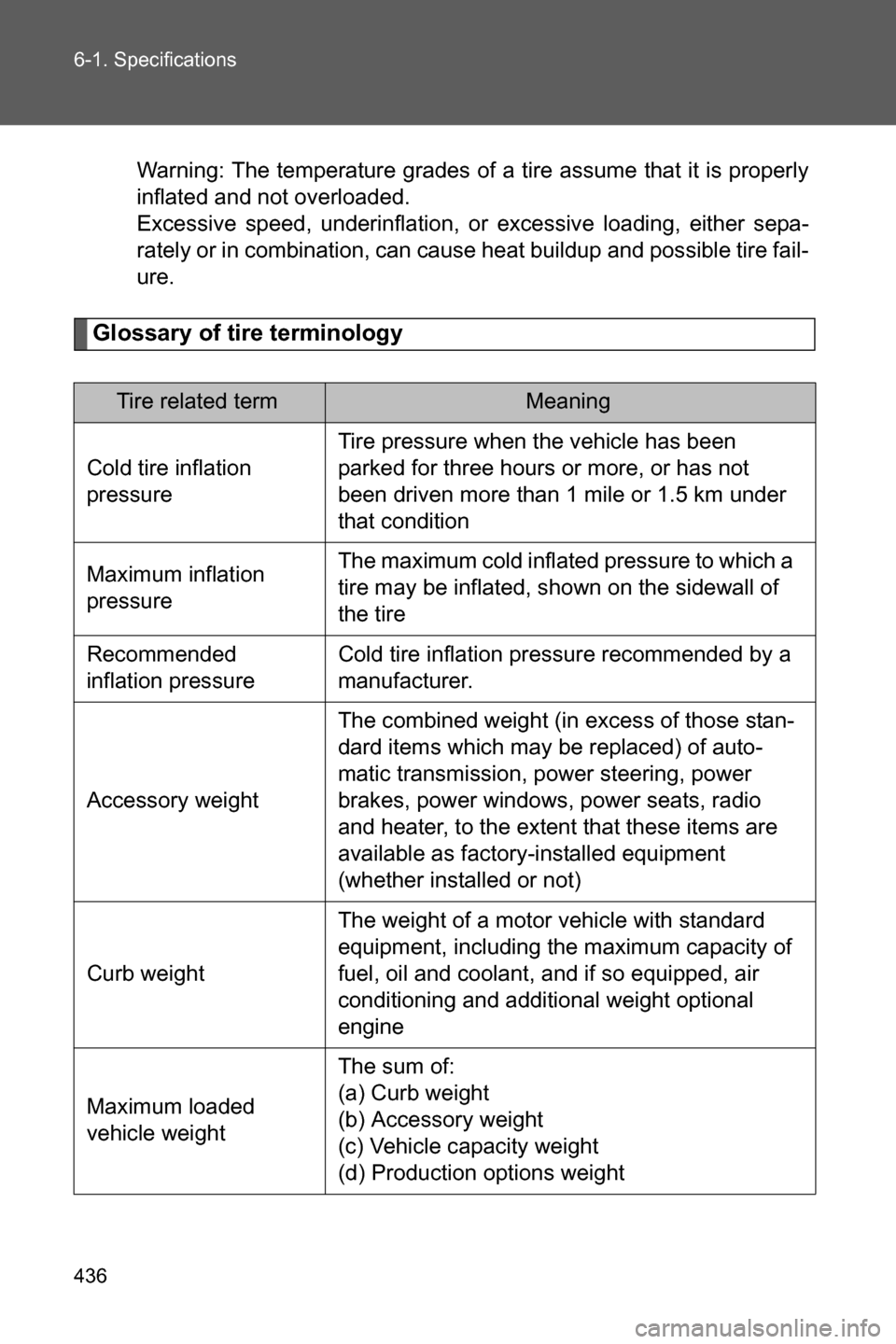
Glossary of tire terminology
Tire related termMeaning
Cold tire inflation
pressureTire pressure when the vehicle has been
parked for three hours or more, or has not
been driven more than 1 mile or 1.5 km under
that condition
Maximum inflation
pressureThe maximum cold inflated pressure to which a
tire may be inflated, shown on the sidewall of
the tire
Recommended
inflation pressureCold tire inflation pressure recommended by a
manufacturer.
Accessory weightThe combined weight (in excess of those stan-
dard items which may be replaced) of auto-
matic transmission, power steering, power
brakes, power windows, power seats, radio
and heater, to the extent that these items are
available as factory-installed equipment
(whether installed or not)
Curb weightThe weight of a motor vehicle with standard
equipment, including the maximum capacity of
fuel, oil and coolant, and if so equipped, air
conditioning and additional weight optional
engine
Maximum loaded
vehicle weightThe sum of:
(a) Curb weight
(b) Accessory weight
(c) Vehicle capacity weight
(d) Production options weight
Page 479 of 490

478 Alphabetical index
Engine
Compartment ........................ 298
Engine hood .......................... 296
Engine switch ................162, 171
How to start the
engine .........................162, 171
Identification number............. 415
If the engine will not start ...... 393
Ignition switch................162, 171
Overheating........................... 407
Engine coolant
Capacity ................................ 420
Checking ............................... 302
Engine coolant temperature
gauge ...................................... 187
Engine hood ............................. 296
Engine immobilizer system....... 78
Engine oil
Capacity ................................ 418
Checking ............................... 299
Preparing and checking
before winter ....................... 229
Engine switch ...................162, 171
Engine switch light .................. 258
Event data recorder ...................16Floor mat .................................. 273
Fluid
Brake..................................... 304
Washer.................................. 310
Fog lights
Replacing light bulbs ............. 342
Switch ................................... 208
Wattage................................. 425
Front fog lights
Replacing light bulbs ............. 342
Switch ................................... 208
Wattage................................. 425
Front passenger occupant
detection system ................... 124
Front passenger's seatbelt
reminder light ........................ 371
Front seats
Adjustment .............................. 51
Front side marker light
Replacing light bulbs ............. 342
Wattage................................. 425
Front turn signal lights
Replacing light bulbs ............. 342
Switch ................................... 184
Wattage................................. 425
Fuel
Capacity ................................ 417
Fuel gauge ............................ 187
Fuel pump shut off system .... 367
Gas station information ......... 488
Information ............................ 426
Refueling................................. 74
Fuel door .................................... 74
Fuel filler lid................................ 74
Fuel pump shut off system ..... 367
Fuses ........................................ 334F
Page 482 of 490
481 Alphabetical index
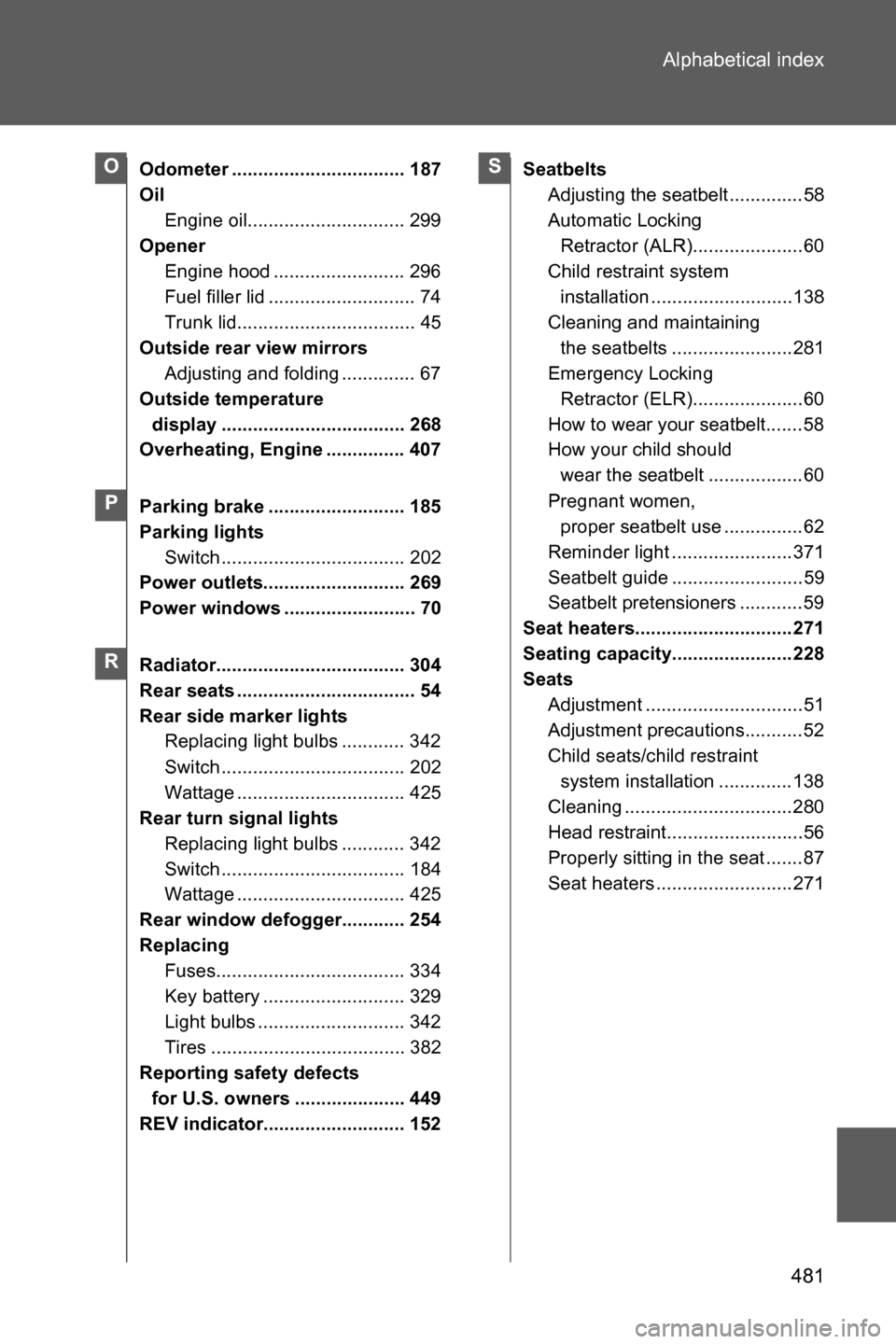
Odometer ................................. 187
Oil
Engine oil.............................. 299
Opener
Engine hood ......................... 296
Fuel filler lid ............................ 74
Trunk lid.................................. 45
Outside rear view mirrors
Adjusting and folding .............. 67
Outside temperature
display ................................... 268
Overheating, Engine ............... 407
Parking brake .......................... 185
Parking lights
Switch ................................... 202
Power outlets........................... 269
Power windows ......................... 70
Radiator.................................... 304
Rear seats .................................. 54
Rear side marker lights
Replacing light bulbs ............ 342
Switch ................................... 202
Wattage ................................ 425
Rear turn signal lights
Replacing light bulbs ............ 342
Switch ................................... 184
Wattage ................................ 425
Rear window defogger............ 254
Replacing
Fuses.................................... 334
Key battery ........................... 329
Light bulbs ............................ 342
Tires ..................................... 382
Reporting safety defects
for U.S. owners ..................... 449
REV indicator........................... 152Seatbelts
Adjusting the seatbelt ..............58
Automatic Locking
Retractor (ALR).....................60
Child restraint system
installation ...........................138
Cleaning and maintaining
the seatbelts .......................281
Emergency Locking
Retractor (ELR).....................60
How to wear your seatbelt....... 58
How your child should
wear the seatbelt ..................60
Pregnant women,
proper seatbelt use ...............62
Reminder light .......................371
Seatbelt guide .........................59
Seatbelt pretensioners ............59
Seat heaters..............................271
Seating capacity.......................228
Seats
Adjustment ..............................51
Adjustment precautions...........52
Child seats/child restraint
system installation ..............138
Cleaning ................................280
Head restraint..........................56
Properly sitting in the seat .......87
Seat heaters ..........................271O
P
R
S