Page 335 of 490
334
4-3. Do-it-yourself maintenance
Checking and replacing fuses
If any of the electrical components do not operate, a fuse may have
blown. If this happens, check and replace the fuses as necessary.
Vehicles without a keyless access with push button
start system
Turn the engine switch off.
Vehicles with a keyless access with push button start
system
Turn the push-button ignition switch off.
Open the fuse box cover.
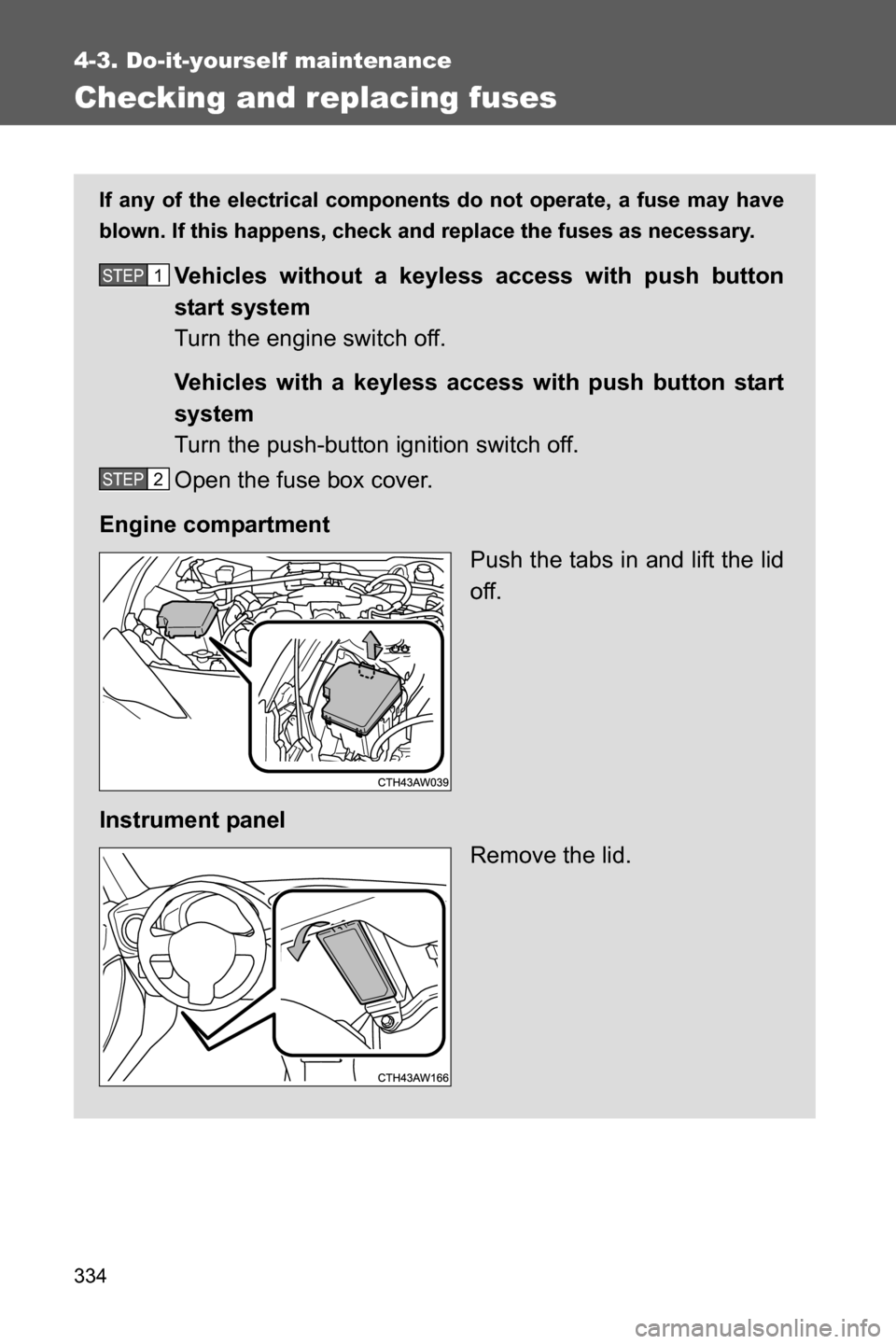
Engine compartment
Push the tabs in and lift the lid
off.
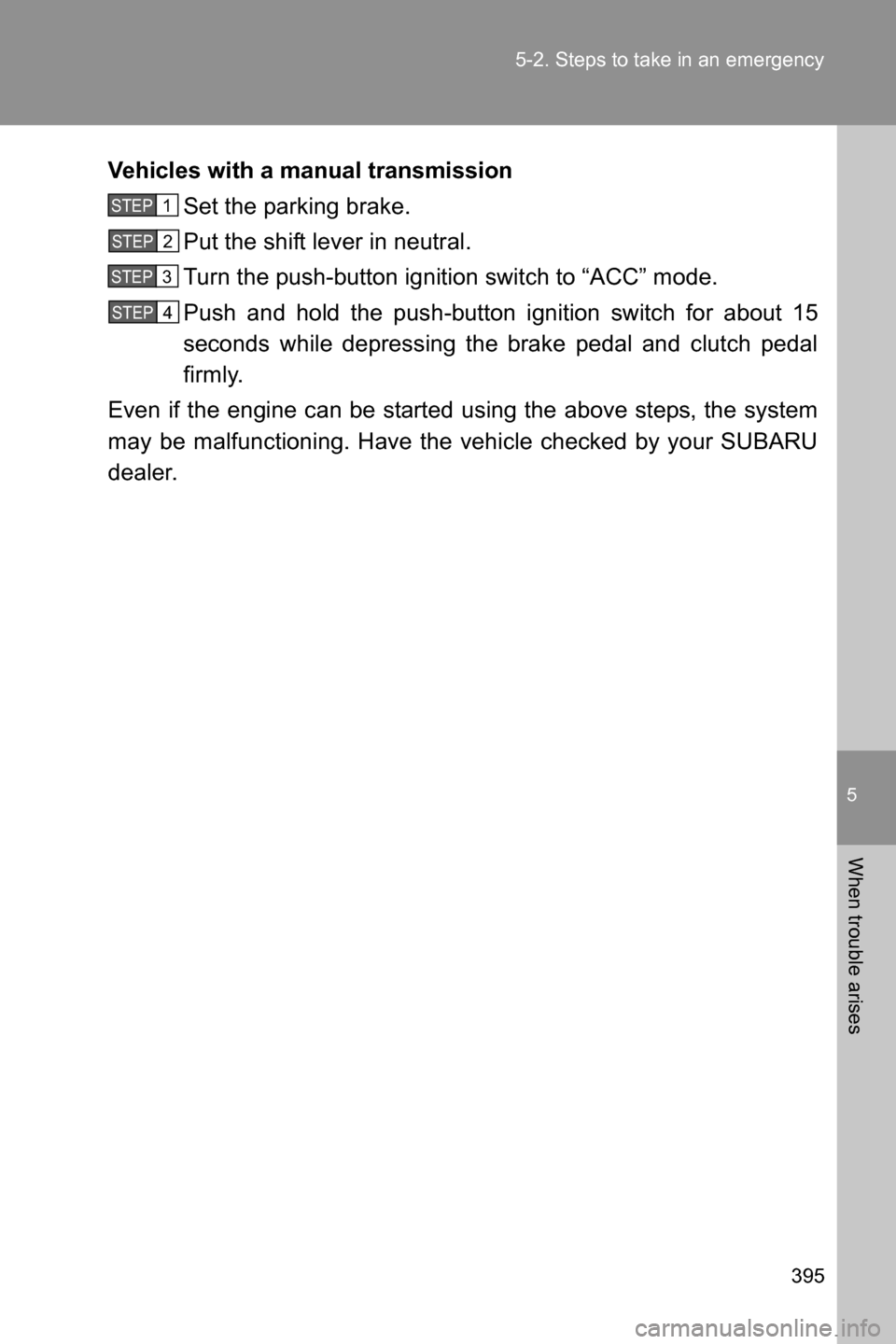
Instrument panel
Remove the lid.STEP 1
STEP 2
Page 373 of 490
372 5-2. Steps to take in an emergency
*1: Driver’s seatbelt buzzer:
Vehicles without a keyless access with push button start system
The driver’s seatbelt buzzer sounds to alert the driver that his or her seatbelt
is not fastened. Once the engine switch is turned to the “ON” position, the
buzzer sounds for 6 seconds. If the vehicle reaches a speed of 12 mph (20
km/h), the buzzer sounds once. If the seatbelt is still unfastened after 30
seconds, the buzzer will sound intermittently for 10 seconds. Then, if the
seatbelt is still unfastened, the buzzer will sound in a different tone for 20
more seconds.
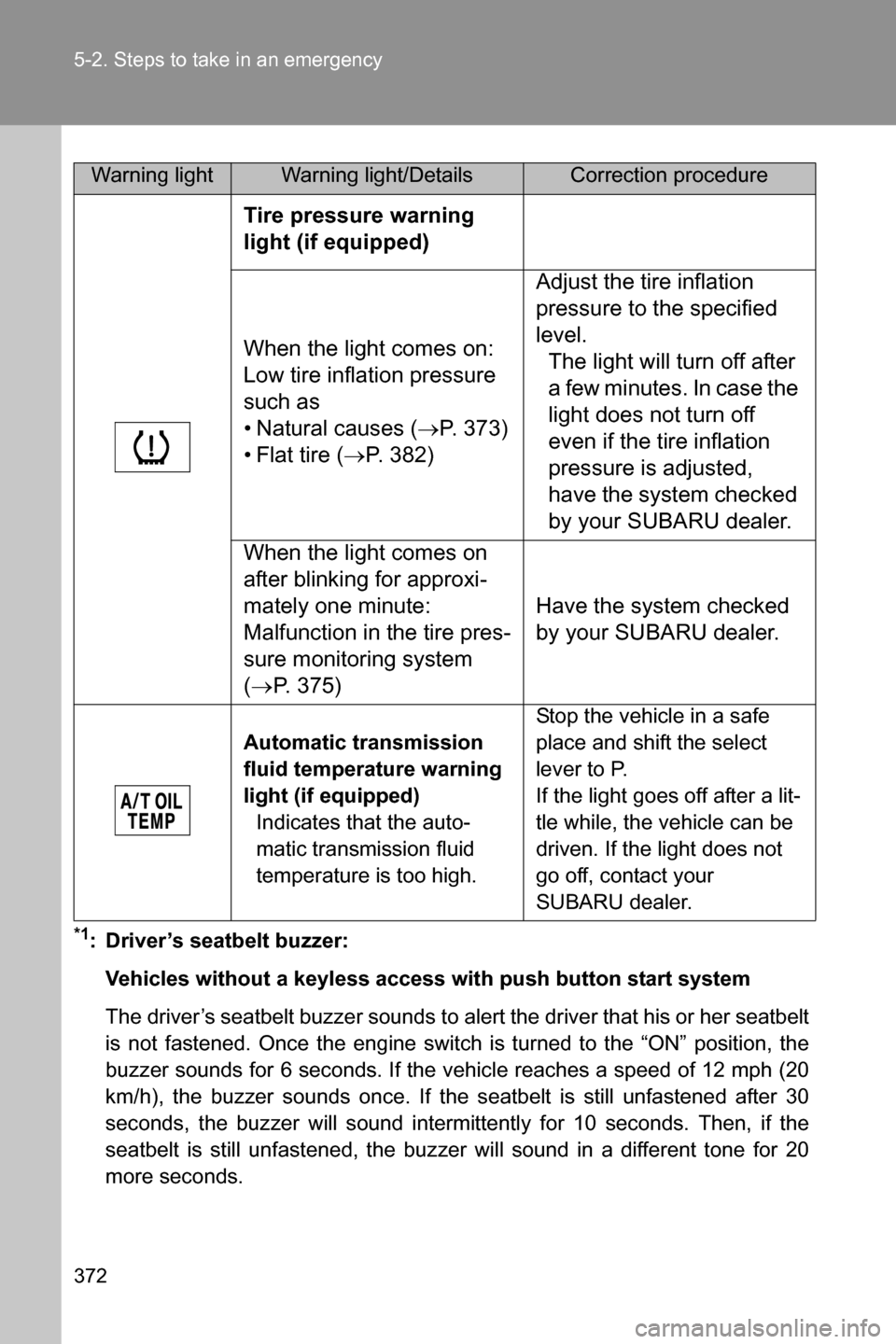
Tire pressure warning
light (if equipped)
When the light comes on:
Low tire inflation pressure
such as
• Natural causes (oP. 373)
•Flat tire (oP. 382)Adjust the tire inflation
pressure to the specified
level.
The light will turn off after
a few minutes. In case the
light does not turn off
even if the tire inflation
pressure is adjusted,
have the system checked
by your SUBARU dealer.
When the light comes on
after blinking for approxi-
mately one minute:
Malfunction in the tire pres-
sure monitoring system
(oP. 375)Have the system checked
by your SUBARU dealer.
Automatic transmission
fluid temperature warning
light (if equipped)
Indicates that the auto-
matic transmission fluid
temperature is too high.Stop the vehicle in a safe
place and shift the select
lever to P.
If the light goes off after a lit-
tle while, the vehicle can be
driven. If the light does not
go off, contact your
SUBARU dealer.
Warning lightWarning light/DetailsCorrection procedure
Page 376 of 490
5
When trouble arises
375 5-2. Steps to take in an emergency
■If the tire pressure warning light frequently comes on after blinking
for approximately one minute (if equipped)
If the tire pressure warning light frequently comes on after blinking for
approximately one minute when the push-button ignition switch is turned
to “ON” mode (vehicles with a keyless access with push button start sys-
tem) or the engine switch is turned to the “ON” position (vehicles without
a keyless access with push button start system), have it checked your
SUBARU dealer.
WARNING
■If the tire pressure warning light comes on (if equipped)
Be sure to observe the following precautions. Failure to do so could
cause loss of vehicle control and result in death or serious injury.
●Stop your vehicle in a safe place as soon as possible. Adjust the tire
inflation pressure immediately.
●If the tire pressure warning light comes on even after tire inflation pres-
sure adjustment, it is probable that you have a flat tire. Check the tires.
If the tire is flat, change to the spare tire and have the flat tire repaired
by the nearest SUBARU dealer.
●Avoid abrupt maneuvering and braking. If the vehicle tires deteriorate,
you could lose control of the steering wheel or the brakes.
■If a blowout or sudden air leakage should occur (vehicles with a tire
pressure monitoring system)
The tire pressure monitoring system may not activate immediately.
Page 390 of 490
5
When trouble arises
389 5-2. Steps to take in an emergency
WARNING
■Using the tire jack
Improper use of the tire jack may lead to death or serious injuries due to
the vehicle suddenly falling off the jack.
●Do not use the tire jack for any purpose other than replacing tires or
installing and removing tire chains.
●Only use the tire jack that comes with this vehicle for replacing a flat
tire.
Do not use it on other vehicles, and do not use other tire jacks for
replacing tires on this vehicle.
●Always check that the tire jack is securely set to the jack point.
●Do not put any part of your body under the vehicle supported by a jack.
●Do not start or run the engine while your vehicle is supported by the
jack.
●Do not raise the vehicle while someone is in it.
●When raising the vehicle, do not put an object on or under the jack.
●Do not raise the vehicle to a height greater than that required to
replace the tire.
●Use a jack stand if it is necessary to get under the vehicle.
Take particular care when lowering the vehicle to ensure that no one
working on or near the vehicle may be injured.
Page 395 of 490
394 5-2. Steps to take in an emergency
Emergency start function (vehicles with a keyless access with
push button start system)
When the engine does not start, the following steps can be used as
an interim measure to start the engine if the push-button ignition
switch is functioning normally:
Vehicles with an automatic transmission
Set the parking brake.
Put the select lever in P.
Set the push-button ignition switch to “ACC” mode.
Press and hold the push-button ignition switch about 15 sec-
onds while depressing the brake pedal firmly.
Even if the engine can be started using the above steps, the system
may be malfunctioning. Have the vehicle checked by your SUBARU
dealer.
■The starter motor does not turn over, the interior lights and
headlights do not turn on, or the horn does not sound.
One of the following may be the cause of the problem.
●One or both of the battery terminals may be disconnected.
●The battery may be discharged. (oP. 402)
●There may be a malfunction in the steering lock system. (vehi-
cles with a keyless access with push button start system)
Contact your SUBARU dealer if the problem cannot be repaired, or if
repair procedures are unknown.
STEP 1
STEP 2
STEP 3
STEP 4
Page 396 of 490
5
When trouble arises
395 5-2. Steps to take in an emergency
Vehicles with a manual transmission
Set the parking brake.
Put the shift lever in neutral.
Turn the push-button ignition switch to “ACC” mode.
Push and hold the push-button ignition switch for about 15
seconds while depressing the brake pedal and clutch pedal
firmly.
Even if the engine can be started using the above steps, the system
may be malfunctioning. Have the vehicle checked by your SUBARU
dealer.
STEP 1
STEP2
STEP 3
STEP 4
Page 400 of 490
5
When trouble arises
399 5-2. Steps to take in an emergency
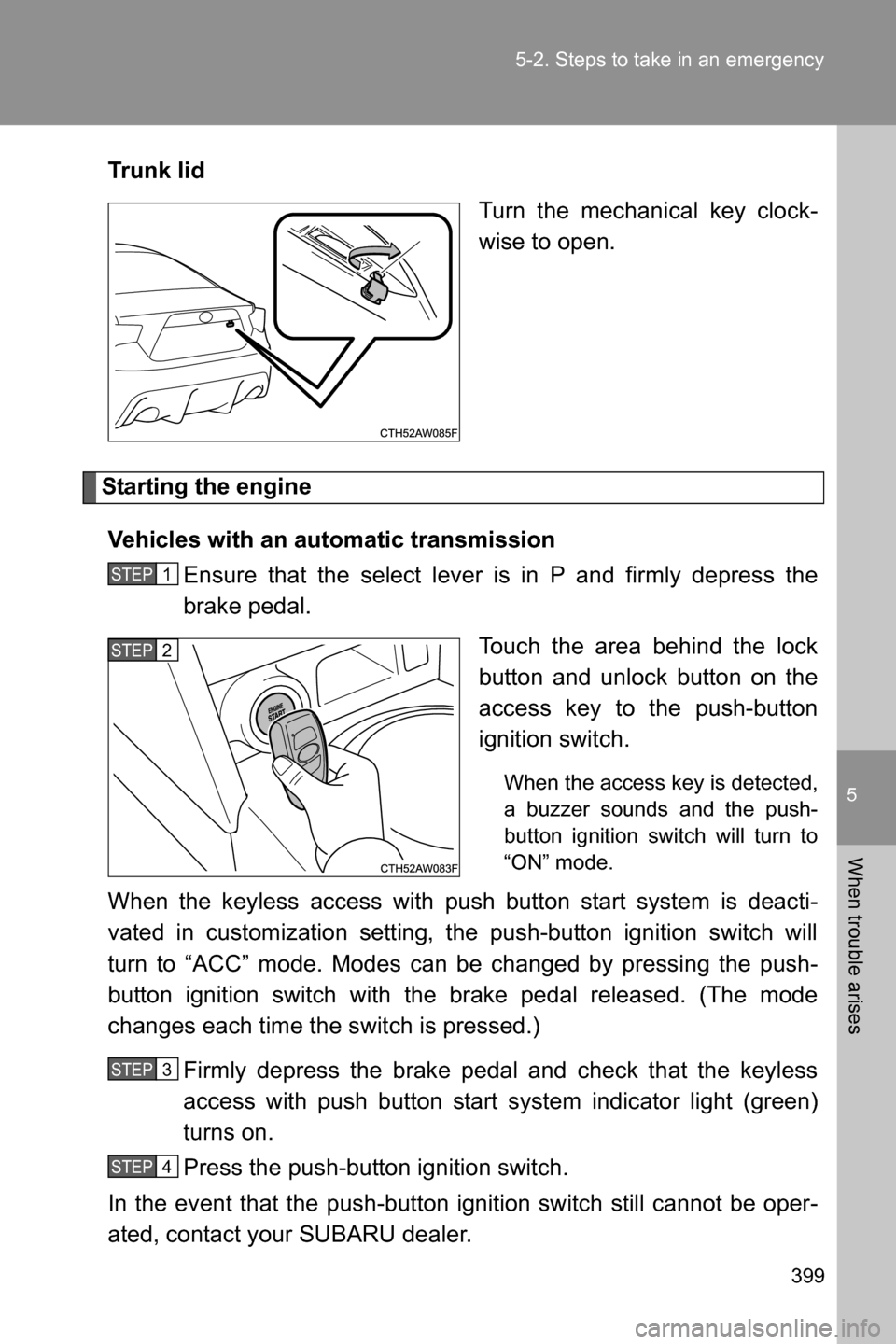
Trunk lid
Turn the mechanical key clock-
wise to open.
Starting the engine
Vehicles with an automatic transmission
Ensure that the select lever is in P and firmly depress the
brake pedal.
Touch the area behind the lock
button and unlock button on the
access key to the push-button
ignition switch.
When the access key is detected,
a buzzer sounds and the push-
button ignition switch will turn to
“ON” mode.
When the keyless access with push button start system is deacti-
vated in customization setting, the push-button ignition switch will
turn to “ACC” mode. Modes can be changed by pressing the push-
button ignition switch with the brake pedal released. (The mode
changes each time the switch is pressed.)
Firmly depress the brake pedal and check that the keyless
access with push button start system indicator light (green)
turns on.
Press the push-button ignition switch.
In the event that the push-button ignition switch still cannot be oper-
ated, contact your SUBARU dealer.
STEP 1
STEP 2
STEP 3
STEP 4
Page 404 of 490
5
When trouble arises
403 5-2. Steps to take in an emergency
Vehicles without a keyless access with push button start
system: Maintain the engine speed of the second vehicle
and turn the engine switch to the “ON” position, then start
the vehicle's engine.
Vehicles with a keyless access with push button start sys-
tem: Maintain the engine speed of the second vehicle and
turn the push-button ignition switch to “ON” mode, then
start the vehicle's engine.
Once the vehicle’s engine has started, remove the jumper
cables in the exact reverse order in which they were con-
nected.
Once the engine starts, have the vehicle checked at your SUBARU
dealer as soon as possible.STEP 4
STEP 5