2016 SKODA OCTAVIA seats
[x] Cancel search: seatsPage 24 of 324

WARNING■The key cannot be inserted into the key switch while driving. Shocks can
cause the key to turn in the slot and trigger the airbag! The airbag could be
triggered unexpectedly in an accident - it may result in injury or death!■
The driver is responsible for whether the airbag is switched on or switch-
ed off.
■
Only switch off the airbag when the ignition is switched off! Otherwise a
fault can occur in the system for deactivating the airbag.
■
If the warning lights
flash, the front passenger airbag will not
be deployed in the event of an accident! Have the airbag system checked
by a specialist garage immediately.
CAUTION
An insufficiently folded out key bit can damage the key switch!Transporting children safely
Child seat
Introduction
To reduce the risk of injury in an accident, children should only be transported
in child seats!
This chapter contains information on the following subjects:
Use of a child seat on the front passenger seat (variant 1)
23
Use of a child seat on the front passenger seat (variant 2)
24
Child safety and the side airbag
24
Classification of child seats
24
Use of child safety seats which are secured using a seat belt
24
Please refer to the instructions in this Owner's Manual and the child seat man-
ufacturer's instructions with regard to the installation and use of the child
seat.
For safety reasons, we recommend that you always transport children in the
rear seats. Only transport a child in the passenger seat in exceptional circum-
stances.
Child seats complying with the ECE-R 44 Economic Commission for Europe
standard must be used.
Child seats that comply with the ECE-R 44 standard have a test seal that can-
not be removed: a large E within a circle with the test number below.
WARNING■ One should never carry children, and also not babies! - on one's lap.■When leaving the vehicle, do not leave children unattended in the vehicle.
In an emergency, they might not be able to get out of the vehicle on their
own or to help themselves. At very high or very low temperatures can be
fatal!■
The child must be secured in the vehicle during the entire travelling time!
Otherwise, in the event of an accident, the child would be thrown through
the vehicle and as a result may suffer fatal injuries, and also injure other oc-
cupants.
22Safety
Page 25 of 324

WARNING (Continued)■Children are exposed to an increased risk of injury in the event of an acci-
dent if they lean forward or adopt an incorrect seated position when the
vehicle is moving. This particularly applies to children who are transported
on the front passenger seat as they can suffer severe, or even fatal injuries
if the airbag system is deployed!■
Pay particular attention to the information provided by the manufacturer
of the child safety seat regarding the correct routing of the belt. Seat belts
which are not correctly adjusted can themselves cause injuries even in mi-
nor accidents.
■
Safety belts must be checked to ensure that they are running properly.
One should also ensure that the belt is not damaged by sharp-edged fit-
tings.
■
When installing the child seat on the back seat, the corresponding front
seat must be adjusted so that there is no contact between the front seat
and the child seat or the child being transported in a child seat.
■
When installing a child seat in which the child faces forward, adjust the
head restraints so that they are as high as possible.
■
If the head restraints still prevent the child seat from being installed,
even in the highest position, you will need to remove them » page 80. Af-
ter removing the child seat, refit the head restraints.
Note
We recommend that you use child seats from ŠKODA Original Accessories.
These child seats were developed and also tested for use in ŠKODA vehicles.
They meet the ECE-R 44 standard.Use of a child seat on the front passenger seat (variant 1)
Does not apply to TaiwanFig. 11
Warning labels
Read and observe
on page 22 first.
Never use a rearward-facing child restraint system on a seat which is protec-
ted by an active airbag. This could cause serious injury to the child, even
death.
This warning is also given on stickers that are located in the following places.
▶ On the passenger sun visor » Fig. 11 -
.
▶ On the B-column on the front passenger side » Fig. 11 –
.
The following advice must be heeded when using a child seat in which the
child is carried on the front passenger seat.
▶ It is essential to switch off the front passenger airbag if using a child seat in
which the child is carried with its back facing the direction of travel »
.
▶ If possible, adjust the front passenger seat backrest so that it is as vertical,
so as to ensure secure contact between the passenger seat backrest and the
back of the child seat.
▶ If possible, move the front passenger seat backwards so that there is no con-
tact between the front passenger seat and the child seat behind it.
▶ Set the height-adjustable front passenger seat as high up as possible.
▶ Set the front passenger seat belt as high up as possible.
▶ With child safety seats in groups 2 and 3, make sure that the loop-around fit-
tings attached to the child seat headrest is positioned in front of or at the
same height as the loop-around fittings on the B pillar on the passenger side.
23Transporting children safely
Page 26 of 324

Adjust the height of the front passenger seat belt so that the belt does not
“jam” in the return pulley. In the event of an accident, there is the risk of in-
jury to the neck of the child carried due to the seat belt!WARNING■ Never use a rear-facing child seat on the front passenger seat if the pas-
senger airbag is activated. This child safety seat is positioned in the deploy-
ment area of the front passenger airbag. The airbag may cause the child se-
vere, or even fatal injuries, in the event of it being deployed.■
Once a child seat in which the child is transported with its back to the di-
rection of travel is no longer being used on the passenger seat, the front
passenger airbag should be reactivated.
Use of a child seat on the front passenger seat (variant 2)
Applies to Taiwan
Fig. 12
Warning labels
Read and observe on page 22 first.
No babies, infants or children are to be carried on the passenger seat.
A label to this effect can also be found on the passenger's sun visor » Fig. 12.
Child safety and the side airbagFig. 13
Incorrect seated position of a
child who is not properly secured
– risk from the side airbag/Child
properly protected by safety seat
Read and observe on page 22 first.
The child must not be positioned in the deployment area of the side air-
bag » Fig. 13 -
.
There must be sufficient room between the child and the deployment area of
the side airbag to ensure that the airbag can provide as much protection as
possible » Fig. 13 -
.
Classification of child seats
Read and observe
on page 22 first.
Classification of child seats according to the ECE-R 44 standard.
GroupWeight of the child0up to 10 kg0up to 13 kg19-18 kg215-25 kg322-36 kg
Use of child safety seats which are secured using a seat belt
Never use a rear-facing child seat on the front passenger seat if the passenger airbag is activated. This child safety seat is positioned in the deployment area of the front passenger airbag. The airbag may cause the child severe, or even fatal injuries, in the event of it being deployed.
Read and observe
on page 22 first.
Overview of the usefulness of child seats fastened with a seat belt on each of the seats in accordance with the ECE-R 16 standard. 24Safety
Page 27 of 324

GroupFront passenger seatRear seatsExternalRear seat centre0
up to 10 kgUUU0
up to 13 kgUUU1
9-18 kgUUU2
15-25 kgUUU3
22-36 kgUUU
Child seat category “Universal” - a child seat designed for fastening on
the seat with the seat belt.
Fastening elements
Introduction
This chapter contains information on the following subjects:
Attachment points of the -system
25
Use of child safety seats with the
system
25
Attachment points of the
system
26UAttachment points of the -systemFig. 14
Labels of the system
is a system for securing child seats quickly and safely.
Two locking eyes are located between the seat backrest and the seat cushion of the outer rear seats and front passenger seat for fixing the system child
seat in place.
First, remove the caps
A
in order to access the locking eyes » Fig. 14. After re-
moving the child seat, replace he caps.
WARNING■ Always refer to the instructions of the manufacturer of the child seat
when installing and removing a child seat with the system.■
Never attach other child seats, belts or objects to the attachment points
intended for the installation of a child seat with the
system – risk of
death!
Note
■ A child seat fitted with the system can only be mounted in a vehicle fit-
ted with a system if the child seat has been approved for this type of ve-
hicle. Further information is available from a ŠKODA Partner.■
Child seats with the
system can be purchased from ŠKODA Original Ac-
cessories.
Use of child safety seats with the system
Never use a rear-facing child seat on the front passenger seat if the passenger airbag is activated. This child safety seat is positioned in the deployment area of
the front passenger airbag. The airbag may cause the child severe, or even fatal injuries, in the event of it being deployed.Overview of the usefulness of child seats with the system on each of the seats in accordance with the ECE-R 16 standard. 25Transporting children safely
Page 28 of 324

GroupSize class of
the child seat a)Front passenger seat
b)Rear seats outsideRear seat middle0
up to 10 kgEXIL-SUX0+
up to 13 kgE
XIL-SUX
DC
1
9-18 kg
D
XIL-SU IUFX
CBB1A2
15-25 kg-XIL-SUX3
22-36 kg-XIL-SUXa)
The size category is shown on the label attached to the child seat.
b)
If the front passenger seat is fitted with system attachment points, it is suitable for the installation of an
child seat with “Semi-Universal” approval.
IL-SUThe seat is suitable for the use of approved child seats in
in the “Semi-Universal”category. The “Semi-Universal” category means that the child seat
with the
system is approved for your vehicle. Observe the information in the list of vehicles which comes with the child seat.IUFThe seat is suitable for the installation of a child seat with “Universal” approval and attachment with the system attachment belt.XThe seat is not fitted with -system attachment points.Attachment points of the systemFig. 15
Attachment points of the
-system
is a fastening system, which restricts the movement of the upper part
of the child seat.
The locking eyes A for attaching the belt of a child seat with the sys-
tem are located on the rear side of the outer rear seat backrests » Fig. 15.
Some country-specific models can also be equipped with a locking eye B
on
the back of the middle rear seat backrest » Fig. 15.
WARNING■
Always refer to the instructions of the manufacturer of the child seat
when installing and removing a child seat with the system.■
Only use child seats with the
system on the seats that have the
attachment points.
■
Only ever attach one belt from the child seat to a locking eye.
26Safety
Page 62 of 324

Electric WindowsFig. 41
Buttons for window levers
Read and observe and on page 59 first.
All windows can be operated from the driver's seat. The window in the front
passenger door and the windows in the rear doors are operated via the button
in each door.
Electric window buttons » Fig. 41
Left front door
Right front door
Left rear door
Right rear door:
Deactivate/activate the buttons in the rear doors (the deactivation may be
advantageous if, for example, children are transported on the rear seats)
Opening/closing window
›
To open , lightly press the appropriate button down and hold it until the win-
dow has moved into the desired position.
›
or: press the button to the stop, the window automatically opens fully. Re-
newed pressing of the button causes the window to stop.
›
To close , pull gently on the top edge of the corresponding button and hold
until the window has moved into the desired position.
›
or: pull the button briefly to the stop, the window automatically closes fully.
Renewed pulling of the button causes the window to stop immediately.
Disable / enable buttons in the rear doors
›
To deactivate/activate the buttons in the rear doors, press the
E
button. If
the buttons in the rear doors are deactivated, the warning light illuminates
in the
E
button.
ABCDENote■ After switching off the ignition, the windows can still open and close for
about 10 minutes.■
After the driver or front passenger door is opened, the operation of the win-
dow is only possible with the button
A
» Fig. 41 , in which case this is pressed
or pulled for approx. 2 seconds.
Opening/closing the windows in the front passenger door and in
the rear doors
Fig. 42
Power window button
Read and observe and on page 59 first.
There is a button in the front passenger door and in the rear doors for that
window.
›
To open , lightly press the appropriate button underneath and hold it until
the window has moved into the desired position.
›
or: press the button underneath to the stop, the window automatically
opens fully. Renewed pressing of the button causes the window to stop.
›
To close , push the corresponding button above briefly and hold until the win-
dow has moved into the desired position.
›
or: press the button above to the stop, the window automatically opens fully.
Renewed pressing of the button causes the window to stop.
Force limiter
Read and observe
and on page 59 first.
The electrical power windows are fitted with a force limiter.
If there is an obstacle, the closing process is stopped and the window goes
down by several centimetres.
60Using the system
Page 66 of 324

Lights and visibility
Light
Introduction
This chapter contains information on the following subjects:
Operating the lights
64
Daytime running lights(DAY LIGHT)
65
Turn signal and main beam
65
Automatic driving light control
66
Xenon headlight
66
High-beam assistant (Light Assist)
67
Fog lights/rear fog light
67
Fog lights with CORNER function
68
COMING HOME / LEAVING HOME
68
Hazard warning light system
68
Parking light
68
Entry space lighting
69
Driving abroad
69
The lights work only with the ignition on, unless otherwise stated.
The layout of the controls on right-hand drive vehicles differs partially from
that shown in this layout » Fig. 46 on page 64 .
WARNINGThe automatic driving lamp control only operates as a support and
does not release the driver from his responsibility to check the light and, if
necessary, to switch on the light depending on the light conditions.
Note
The headlights may mist up temporarily. When the light is on, the light-emit-
ting surface demists after a short time.Operating the lightsFig. 46
Light switch and control dial for
the headlight beam range regu-
lation
Read and observe on page 64 first.
To switch the lights on/off ,turn the
A
» Fig. 46 switch to one of the following
positions (equipment-dependent).
Switching off lights (except daytime running lights)Switching lights on/off automatically » page 66
Switching on the parking lights or parking lights on both sides » page 68
Switching on the low beam
To adjust the headlight range control , turn dial
B
» Fig. 46 in line with the
vehicle load » .
Front seats occupied, boot empty
All seats occupied, boot empty
All seats occupied, boot loaded
Driver seat occupied, boot loaded
The Xenon headlights feature no manual headlight range control. After
switching on the ignition, adjust these automatically to the load and driving
condition of the vehicle.
WARNINGAlways adjust the headlight beam to meet the following conditions - other-
wise there is a risk of an accident.■
The vehicle does not dazzle other road users, especially oncoming vehi-
cles.
■
The beam range is sufficient for safe driving.
64Using the system
Page 72 of 324
Automatic operation - position
The system is turned on when any of the following is present.
▶ The vehicle is unlocked.
▶ One of the doors is opened.
▶ The ignition key is removed.
The system is turned off when any of the following is present.
▶ The vehicle is locked.
▶ The ignition is switched on.
▶ About 30 seconds after all the doors have been closed.
Interior light, rear
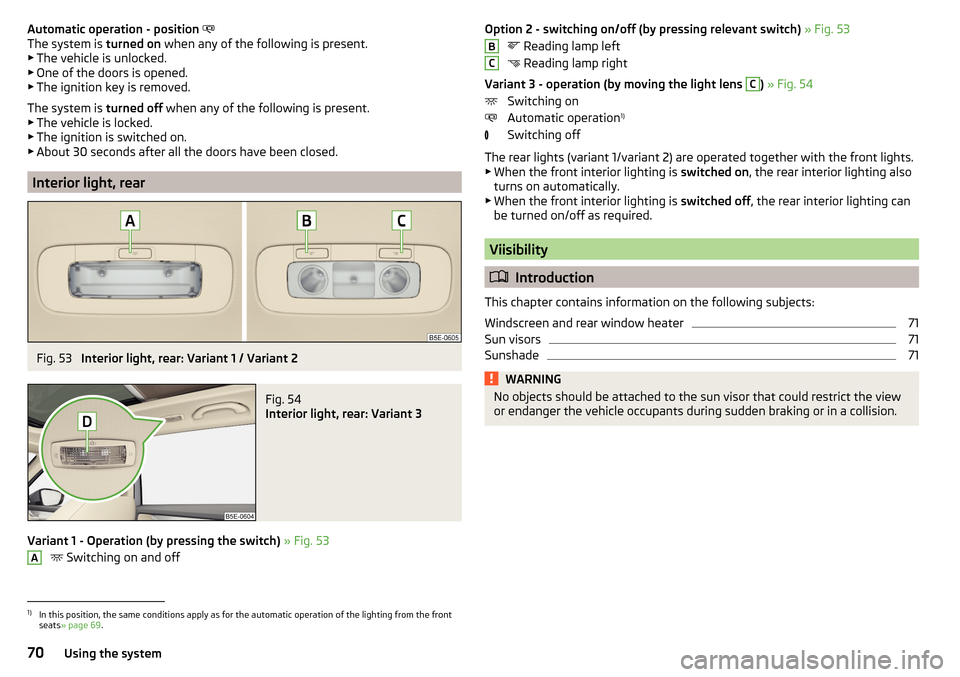
Fig. 53
Interior light, rear: Variant 1 / Variant 2
Fig. 54
Interior light, rear: Variant 3
Variant 1 - Operation (by pressing the switch) » Fig. 53
Switching on and off
AOption 2 - switching on/off (by pressing relevant switch)
» Fig. 53
Reading lamp left
Reading lamp right
Variant 3 - operation (by moving the light lens C
) » Fig. 54
Switching on
Automatic operation 1)
Switching off
The rear lights (variant 1/variant 2) are operated together with the front lights.
▶ When the front interior lighting is switched on, the rear interior lighting also
turns on automatically.
▶ When the front interior lighting is switched off, the rear interior lighting can
be turned on/off as required.
Viisibility
Introduction
This chapter contains information on the following subjects:
Windscreen and rear window heater
71
Sun visors
71
Sunshade
71WARNINGNo objects should be attached to the sun visor that could restrict the view
or endanger the vehicle occupants during sudden braking or in a collision.BC1)
In this position, the same conditions apply as for the automatic operation of the lighting from the front
seats » page 69 .
70Using the system