2016 SKODA FABIA warning
[x] Cancel search: warningPage 75 of 196

WARNING■Never leave any heavy or sharp-edged objects in the pockets of the items
of clothing that has been hung up - is a risk of injury.■
Do not use hangers to hang up the clothes - there is a risk of restricting
the effectiveness of head airbags and a danger of injury from the hanger.
■
Make sure that any clothes hanging from the hooks do not impede your
vision.
Storage pockets on the backs of the front seats
Fig. 82
Map pockets
Read and observe and on page 66 first.
The Storage pockets » Fig. 82 are intended for the Storage e.g. of maps, maga-
zines, etc.
Storage pockets on the inner sides of the front seats
Fig. 83
Storage pocket
Read and observe and on page 66 first.
The storage pockets are located on the inside of the front seats » Fig. 83and
are used to store small and light objects (e.g. mobile phones).
The maximum permissible load of each of the pockets is 150 g.
Storage compartment in the rear centre console
Fig. 84
Storage compartment: Version 1 / version 2
Read and observe
and on page 66 first.
The open storage compartment is in the rear of the centre console » Fig. 84.
Tablet holder
Introduction
This chapter contains information on the following subjects:
Installing / Remove
74
Handle holder
74
External devices (e.g. tablet, smartphone, etc.) measuring min. 122 mm and
max. 195 mm can be secured in the support.
The maximum permissible load of the compartment is 750 g.
CAUTION
Never exceed the maximum permissible load of the holder - there is a risk of
damage or functional impairment.73Useful features
Page 76 of 196

Installing / RemoveFig. 85
Inserting: Adapter / holder
Fig. 86
Removing: Holder / Adapter
Read and observe
on page 73 first.
›
To insert , attach the opened adapter to the guide rods of the front headrest
and clip in the direction of arrow
1
» Fig. 85 » .
›
Clip in the holder in the direction of arrow
2
into the adapter.
›
To remove , pull on the securing tab
A
in direction of arrow
3
and take the
holder in direction of arrow
4
out of the adapter » Fig. 86.
›
Press the adapter and remove in the direction of the arrow
5
from the guide
rods of the headrest.
WARNINGCarefully clip in the adapter - it is a risk of injuring your finger.Handle holderFig. 87
Tilt and rotate holder
Fig. 88
Adjust holder size
Read and observe on page 73 first.
The holder may be by 30° in the direction of the arrow
1
tipped and by 360°
in the direction of arrow
2
turned » Fig. 87 .
›
To adjust the holder size , pull out the securing tab
A
in the direction of ar-
row
3
and push the part
B
in the direction of arrow
4
to the desired posi-
tion » Fig. 88 .
74Operation
Page 77 of 196

Transport of cargo
Luggage compartment and transporting objects
Introduction
This chapter contains information on the following subjects:
Fastening elements
76
Fixing nets
76
Multifunction pocket
77
Hooks
77
Storage compartments in the luggage compartment
77
Luggage compartment cover
78
Other positions of the luggage compartment cover
78
Roll-up cover
79
Net partition
79
Storage compartments under the floor
80
Cargo elements
80
Flexible storage compartment
80
Class N1 vehicles
80
When transporting heavy objects, the driving characteristics change due to the
shift in the centre of gravity. The speed and style of driving must be adjusted
accordingly.
When transporting cargo the instructions below must be followed
▶ Distribute the load evenly in the luggage compartment and secure it with
suitable lashing straps to the lashing eyes or fixing nets so that they cannot
slip.
▶ Place heavy objects as far forward as possible.
▶ Match the tyre pressure to the load.
In the event of an accident, even small and light objects gain so much kinetic
energy that they can cause severe injuries.
The magnitude of the kinetic energy is dependent on the speed at which the
vehicle is travelling and the weight of the object.
Luggage compartment light
The light switches on/off when the luggage compartment lid is opened or
closed.
If the boot lid is open and the ignition switched off, the light will go out auto-
matically after 10 minutes.WARNING■ Never exceed the maximum permissible load of the respective fasteners,
nets, hooks etc. Heavy objects were not secured sufficiently – There is a
risk of injury!■
Do not exceed the permissible axle loads and permissible gross weight of
the vehicle – There is a risk of an accident!
■
An unsecured dirt or improperly attached load could slip during a sudden
manoeuvre or in an accident in the vehicle - There is a risk of injury!
■
Loose cargo could hit a deployed airbag and injure occupants – danger of
death!
■
When transporting loads in the luggage compartment that has been en-
larged by folding the rear seats forward, ensure the safety of the passen-
gers transported on the other rear seats.
CAUTION
■ Never exceed the maximum permissible load of the respective fasteners,
nets, hooks etc. - these could be damaged.■
Please ensure that the heating elements for the rear window heater are not
damaged as a result of abrasive objects.
■
Do not place sharp objects in the nets and storage compartments in the lug-
gage compartment - there is a risk of damage to the net as well as the com-
partments.
■
Put the items in the storage compartments carefully and not load these
punctiform - there is a risk of damage to the compartments.
75Transport of cargo
Page 80 of 196

Luggage compartment coverFig. 95
Remove the luggage compartment cover
Read and observe
and on page 75 first.
If the support straps
A
» Fig. 95 are attached to the boot lid, then opening the
lid will raise the boot lid cover (hereafter only referred to as "cover").
The cover can be removed from the vehicle and stowed behind the rear seat
backrests if required » Fig. 96 on page 78 .
The maximum permissible load of the cover is 1 kg.
Removing
›
On both sides of the boot lid, unhook the straps
A
in direction of arrow
1
» Fig. 95 .
›
Hold the raised cover and press on the two sides on the underside of the
cover in the area of the recess
C
.
›
Remove the cover in the direction of the arrow
2
.
Fitting
›
Position the fixtures
D
on the cover over the studs
C
» Fig. 95 .
›
Press both sides onto the upper side of the cover near the studs
C
. The fix-
ture
B
must lock into place on the studs
C
on both sides of the luggage
compartment.
›
On both sides of the boot lid, unhook the straps
A
.
WARNINGDo not place any objects on the cover during the trip - There is a risk of in-
jury if you brake or have a collision!CAUTION■ Observe the following instructions to avoid canting and the subsequent
damage to the cover or the side trim. ■ The cover must be inserted properly and the load must not exceed the
height of the cover.
■ The cover must not be jammed in the surrounding seal of the luggage com-
partment lid when it is in the raised position. ■ There must be no object in the gap between the cover in the raise position
and the rear backrest.
Other positions of the luggage compartment cover
Fig. 96
Luggage compartment cover: stowed behind the rear seats/in the
lower position
Read and observe
and on page 75 first.
The luggage compartment cover behind the rear seat backrests can be stor-ed » Fig. 96 -
or in the lower position » Fig. 96 -
.
Store cover in the lower position
›
Press the top of the cover in the arrow direction » Fig. 96 -
.
In the front area, slots
B
» Fig. 95 on page 78 on the cover must be fully en-
gaged with the bolts on the side trim. In the back, the cover must be secured
at both ends under the latching.
In the lower position, the cover is designed for storing small objects up to a
weight of 2.5 kg in total.
WARNINGDo not place any objects on the cover during the trip - There is a risk of in-
jury if you brake or have a collision!78Operation
Page 81 of 196

Roll-up coverFig. 97
Roll-up cover: Pulling/ rolling up / removing
Read and observe
and on page 75 first.
›
To Herausziehen , grasp the cover at grip-point
A
and pull it out in the direc-
tion of the arrow
1
until it audibly clicks into place » Fig. 97.
›
To the roll up the cover in the handle area
A
in direction of arrow
2
to
press. The cover rolls up automatically.
›
To Remove press the rolled door on the side of the cross bar in the direction
of arrow
3
and remove the cover in the arrow direction
4
.
›
To install , first insert the cover on the left side.
›
Press on the side of the cross bar in the direction of arrow
3
and insert the
cover against arrow direction
4
.
WARNINGNo objects should be placed on the roll-up cover - there is a risk of damage
to the cover and a risk of injury in the event of a sudden stop or a vehicle
collision!Net partitionFig. 98
Net partition behind the rear seats
Read and observe
and on page 75 first.
The net partition can be installed behind the rear seats.
For ease of installation / removal of the carabiner
B
Move the variable loading
floor back, remove it from the vehicle if necessary.
Installing/removing
›
To the installremove the foldable luggage compartment cover » Fig. 97 on
page 79 or the rear seat backrests » page 63.
›
First insert the rod into the mount
B
» Fig. 98 on one side and push it for-
wards. Insert the transverse rod into the mount
C
on the other side of the
vehicle in the same way.
›
Hang the carabines
C
at the belt ends into the lashing eyes behind the rear
seats.
›
Pull the belts through the tensioning clasp
C
.
Ausbau is carried out in the reverse order.
Note
For vehicles with variable loading floor, the nets can be secured only when the
variable loading floor is in the lower position » page 81.79Transport of cargo
Page 84 of 196

Folding / fasteningFig. 104
Fold up variable loading floor / secure variable loading floor
The variable loading floor can be folded up and secured using a hook on the
frame of the boot lid in the two positions (at the top as well as the bottom).
›
Fold the variable loading floor together using the handle
A
and fold in the
direction of arrow » Fig. 104.
›
Hook the
B
hook to the frame of the boot lid.
WARNINGThe folded-up variable cargo floor limits the driver's view to the rear.
CAUTION
Before closing the boot lid the variable loading floor must be unhook from the
frame . There is the risk of damage to the hook.
Bicycle carrier in the luggage compartment
Introduction
This chapter contains information on the following subjects:
Install/remove crossmember
82
Fitting/removing the bike rack
83
Place bicycle into the carrier
84
Ensure the stability of the bicycles with a belt
84
up to two bicycles can be transported in the luggage compartment (maximum
size - 19 "frame with 26" wheels) in a carrier.
Before transporting, the following steps must be taken.
› Remove the roll-up cover
» page 79.›Push the head rests into the seat backrests up to the latch » page 64.›
Fold the rear seats forward » page 64 and fold rear seats forward » page 63.
WARNINGWhen transporting bicycles, ensuring the safety of the passengers is para-
mount.
CAUTION
Take care handling the bicycle - there is a risk of damaging the vehicle.
Note
The bike rack cannot be installed if the variable cargo floor is stowed in the
luggage compartment.
Install/remove crossmember
Fig. 105
Install crossmember: Loosen the screws and unlock brackets /
place crossmember on the lashing eyelets
82Operation
Page 87 of 196

The attachment points A and B are located on both sides of the vehicle
» Fig. 110 .
The mounting and dismounting of the basic carrier is carried out in accordance
with the instructions provided.
Roof load
The maximum permitted weight of the load incl. carriers is 75 kg.WARNINGThe following instructions must be observed to aid road safety when trans- porting cargo on the roof rack.■
Always distribute the load on the roof rack evenly and secure properly
with suitable lashing straps or tensioning straps.
■
When transporting heavy objects or objects which take up a large area on
the roof rack system, handling of the car may change as a result of the dis-
placement of the centre of gravity. The style of driving and speed must
therefore be adapted to circumstances.
■
The permissible roof load, permissible axle loads and gross permissible
weight of the vehicle must not be exceeded under any circumstances – risk
of accident.
CAUTION
■ Ensure that the boot lid does not hit the roof load when opened.■Ensure the roof aerial is not impaired by the load being transported.
Note
We recommend that you use a roof rack from ŠKODA Original Accessories.Heating and ventilation
Heating, manual air conditioning system, Climatronic
Introduction
This chapter contains information on the following subjects:
Heating and manual air conditioning
86
Climatronic (automatic air conditioning)
87
Climatronic - automatic operation
87
Recirculated air mode
88
Air outlet vents
88
The heater heats and ventilates the vehicle interior. The air conditioning sys-
tem also cools and dehumidifies the vehicle interior.
The heating effect is dependent upon the coolant temperature, thus full heat
output only occurs when the engine has reached its operating temperature.
The cooling system works under the following conditions. The cooling system is switched on.
The engine is running.
The outside temperature is above 2 °C.
The blower is switched on.
When the cooling system is switched on, it prevents misting of the windscreen
and windows.
It is possible to boost the effectiveness of the cooling system by briefly acti-
vating the air recirculation system » page 88.
Health protection
To reduce health risks (e.g. common colds), the following instructions for the
use of the cooling system are to be observed. ▶ The difference between the outside temperature and the inside temperature
should not be greater than 5 °C.
▶ The cooling system should be turned off about 10 minutes before the end of
the journey.
▶ Once a year, a disinfection of the air conditioner must be carried out by a
specialist company.
85Heating and ventilation
Page 88 of 196
WARNING■The blower should always be on to prevent the windows from misting.
Otherwise there is a risk of accident.■
Under certain circumstances, air at a temperature of about 5 °C can flow
out of the vents when the cooling system is switched on.
Note
■ The air inlet in front of the windscreen must be free of e.g. ice, snow or
leaves to ensure that the heating and cooling system operates properly.■
After switching on the cooling system condensation from the evaporator of
the air conditioning may drip down and form a puddle below the vehicle. This is
not a leak!
■
If the coolant temperature is too high, the cooling system is switched off to
ensure that the engine cools down.
Heating and manual air conditioning
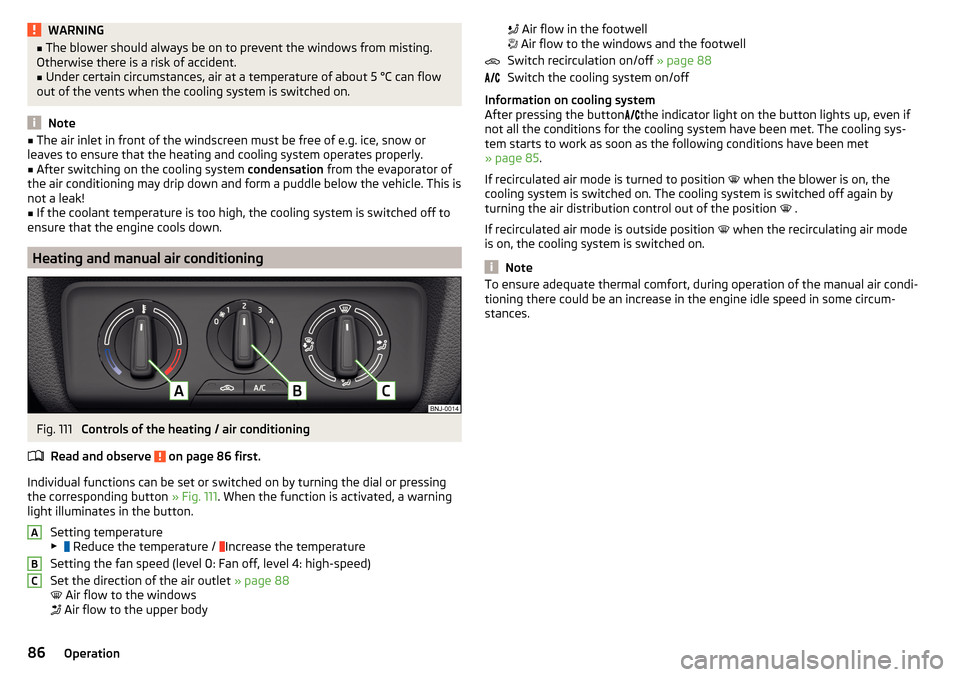
Fig. 111
Controls of the heating / air conditioning
Read and observe
on page 86 first.
Individual functions can be set or switched on by turning the dial or pressing the corresponding button » Fig. 111. When the function is activated, a warning
light illuminates in the button.
Setting temperature
▶ Reduce the temperature /
Increase the temperature
Setting the fan speed (level 0: Fan off, level 4: high-speed)
Set the direction of the air outlet » page 88
Air flow to the windows
Air flow to the upper body
ABC
Air flow in the footwell
Air flow to the windows and the footwell
Switch recirculation on/off » page 88
Switch the cooling system on/off
Information on cooling system
After pressing the button
the indicator light on the button lights up, even if
not all the conditions for the cooling system have been met. The cooling sys-
tem starts to work as soon as the following conditions have been met
» page 85 .
If recirculated air mode is turned to position
when the blower is on, the
cooling system is switched on. The cooling system is switched off again by
turning the air distribution control out of the position .
If recirculated air mode is outside position when the recirculating air mode
is on, the cooling system is switched on.
Note
To ensure adequate thermal comfort, during operation of the manual air condi-
tioning there could be an increase in the engine idle speed in some circum-
stances.86Operation