Page 97 of 216

2.23
LANE DEPARTURE WARNING (1/2)
This lane departure warning system no-
tifies the driver when they accidentally
cross a continuous or broken line.
This function uses a camera attached
to the windscreen, behind the rear-view
mirror.
This function is a driving aid in the event of the accidental crossing o\
f
a continuous or broken line in the road. However, the function is not in-
tended to replace the driver. The function can be disrupted under certain
conditions, including:
– poor visibility (rain, snow, fog, dirty windscreen, glare of the sun, partially obs- cured road lines, etc.);
– roads with tight bends;
– closely following a vehicle in the same lane;
– worn road markings, difficult to distinguish or spaced very widely apart;
– narrow roads;
– ...
In this case, warning light
on the instrument panel goes out to indicate that
the function will not operate (lines not detected).
Under no circumstances should this function replace the driver’s care or res-
ponsibility whilst performing manoeuvres.
Page 98 of 216

2.24
LANE DEPARTURE WARNING (2/2)Deactivation
Press the switch 1. The warning light 2
in the switch 1 goes out.
Operating faults
In the event of a malfunction, the warn-
ing light on the button 1 remains off,
and warning lights
© and
come on on the instrument panel along-
side a beep. Please consult an autho-
rised dealer.
When a line is crossed and the indica-
tors have not been activated, the func-
tion alerts the driver through warning
light
on the instrument panel,
and a beep.
Conditions for non-activation
of alerts
– Indicators activated or having been activated less than approximately
four seconds prior to departing from
the lane;
– Very fast lane departure;
– Driving continuously on a line;
– On bends, the function allows for slightly cutting the bend;
– dirt covering the windscreen camera;
– ...
ActivationPress the switch 1: the warning light 2
integrated on the switch 1 comes on.
The function sounds the alarm if:
– the warning light lighted integrated on the switch 1 is on;
and
– the vehicle speed is greater than ap- proximately 45 mph (70 km/h);
and
– lines are detected.
Warning light
comes on on the
instrument panel to notify the driver.
1
2
Page 111 of 216

2.37
AUTOMATIC TRANSMISSION (2/3)
Special circumstances
– If the road contours and bends
do not allow you to stay in auto-
matic mode (e.g.: in the mountains),
we recommend that you change to
manual mode.
This will prevent the automatic gear-
box from changing gears repeatedly
when climbing, and permit engine
braking on long descents.
– In cold weather, to prevent the
engine from stalling, wait a few mo-
ments before shifting the selector
lever from position P or N and en-
gaging D or R.
Driving in manual mode
With the selector lever in position D,
move the lever to the left. Shifting the
lever repeatedly allows you to change
gears manually:
– To move down through the gears, push the lever backwards;
– To move up through the gears, push the lever forwards.
The gear selected is displayed on the
instrument panel.
Special cases
Under certain driving conditions (e.g.
engine protection, electronic stability
program (ESP) operational etc.: ESC))
the automatic system may change the
gear automatically.
Likewise, to prevent incorrect manoeu-
vres, a gear change may be refused by
the automatic system: in this case the
gear display flashes for a few seconds
as a warning.
In very cold weather, the system
may prevent the gears from being
shifted in manual mode until the
gearbox reaches the right tempera-
ture.
Parking the vehicle
When the vehicle is stopped, move the
lever to position P while keeping your
foot on the brake pedal: the gearbox is
in neutral and the drive wheels are me-
chanically locked by the driveshaft.
Apply the handbrake.
An impact to the under-
side of the vehicle while
manoeuvring (e.g.: strik-
ing a post, raised kerb or
other street furniture) may result in
damage to the vehicle (e.g.: defor-
mation of an axle).
To avoid any risk of accident, have
your vehicle checked by an ap-
proved Dealer.
Page 113 of 216

3.1
Section 3: Your comfort
Air Vents . . . . . . . . . . . . . . . . . . . . . . . . . . . . . . . . . . . .\
. . . . . . . . . . . . . . . . . . . . . . . . . . . . . . . . . . 3.2
Manual air conditioning, heating system . . . . . . . . . . . . . . . . . . . . . . . . . . . . . . . . . . . . \
. . . . . . . . . . 3.4
Automatic climate control . . . . . . . . . . . . . . . . . . . . . . . . . . . . . . . . . . . .\
. . . . . . . . . . . . . . . . . . . . . 3.7
Air conditioning: information and advice on use . . . . . . . . . . . . . . . . . . . . . . . . . . . . . . . . . . . .\
. . . . 3.11
Electric windows . . . . . . . . . . . . . . . . . . . . . . . . . . . . . . . . . . . .\
. . . . . . . . . . . . . . . . . . . . . . . . . . . . 3.12
Sunroof . . . . . . . . . . . . . . . . . . . . . . . . . . . . . . . . . . . .\
. . . . . . . . . . . . . . . . . . . . . . . . . . . . . . . . . . . 3.14
Interior lighting . . . . . . . . . . . . . . . . . . . . . . . . . . . . . . . . . . . . \
. . . . . . . . . . . . . . . . . . . . . . . . . . . . . . 3.15
Passenger compartment storage/fittings . . . . . . . . . . . . . . . . . . . . . . . . . . . . . . . . . . . . \
. . . . . . . . . . 3.16
Ashtray, cigarette lighter, accessories socket . . . . . . . . . . . . . . . . . . . . . . . . . . . . . . . . . . . .\
. . . . . . 3.20
Rear headrests . . . . . . . . . . . . . . . . . . . . . . . . . . . . . . . . . . . .\
. . . . . . . . . . . . . . . . . . . . . . . . . . . . . 3.21
Rear bench seat . . . . . . . . . . . . . . . . . . . . . . . . . . . . . . . . . . . .\
. . . . . . . . . . . . . . . . . . . . . . . . . . . . 3.22
Luggage compartment. . . . . . . . . . . . . . . . . . . . . . . . . . .\
. . . . . . . . . . . . . . . . . . . . . . . . . . . . . . . . . 3.23
Luggage cover . . . . . . . . . . . . . . . . . . . . . . . . . . . . . . . . . . . . \
. . . . . . . . . . . . . . . . . . . . . . . . . . . . . . 3.24
Boot storage . . . . . . . . . . . . . . . . . . . . . . . . . . . . . . . . . . . .\
. . . . . . . . . . . . . . . . . . . . . . . . . . . . . . . 3.25
Transporting objects in the luggage compartment . . . . . . . . . . . . . . . . . . . . . . . . . . . . . . . . . . . .\
. . 3.26
Roof bars . . . . . . . . . . . . . . . . . . . . . . . . . . . . . . . . . . . . \
. . . . . . . . . . . . . . . . . . . . . . . . . . . . . . . . . . 3.27
Spoiler . . . . . . . . . . . . . . . . . . . . . . . . . . . . . . . . . . . . \
. . . . . . . . . . . . . . . . . . . . . . . . . . . . . . . . . . . . 3.27
Multimedia equipment . . . . . . . . . . . . . . . . . . . . . . . . . . . . . . . . . . . . \
. . . . . . . . . . . . . . . . . . . . . . . . 3.28
Page 114 of 216
3.2
AIR VENTS, air outlets (1/2)
3
8
5612
7
1 Left-hand side window demister
outlet.
2 Left-hand air vent.
3 Windscreen demisting vents.
4 Centre air vents.
5 Right-hand air vent.
6 Right-hand side window demister
outlet.
7 Passenger footwell heater out-
lets.
8 Control panel
7
4
Page 115 of 216
3.3
Side air vents
Air flow
To open air vent 10, press on the air
vent (point 11 ) until it is open as far as
required.
Direction
To direct the air flow, swivel side air
vent 10.
Centre air vents.
Direction
Move cursors 9 to the required position.
AIR VENTS, air outlets (2/2)
10
11
Do not add anything to the
vehicle’s ventilation circuit
(for example, to remove
bad odours).
There is a risk of damage or of
fire.
9
Page 116 of 216
3.4
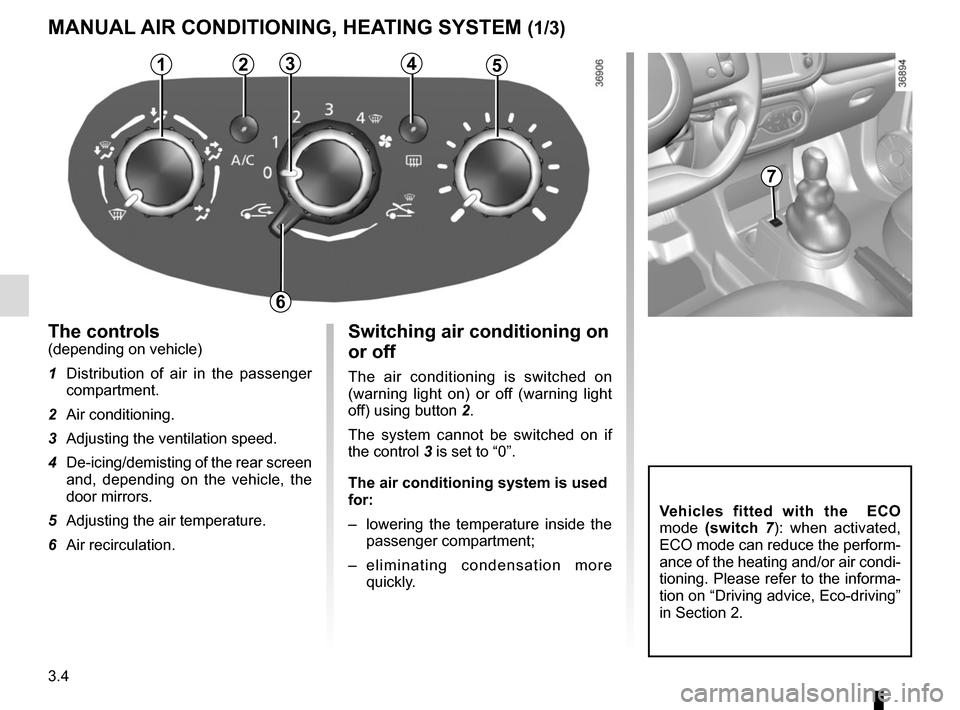
Switching air conditioning on
or off
The air conditioning is switched on
(warning light on) or off (warning light
off) using button 2.
The system cannot be switched on if
the control 3 is set to “0”.
The air conditioning system is used
for:
– lowering the temperature inside the
passenger compartment;
– eliminating condensation more quickly.
The controls(depending on vehicle)
1 Distribution of air in the passenger compartment.
2 Air conditioning.
3 Adjusting the ventilation speed.
4 De-icing/demisting of the rear screen and, depending on the vehicle, the
door mirrors.
5 Adjusting the air temperature.
6 Air recirculation.
MANUAL AIR CONDITIONING, HEATING SYSTEM (1/3)
53142
6
7
Vehicles fitted with the ECO
mode (switch 7): when activated,
ECO mode can reduce the perform-
ance of the heating and/or air condi-
tioning. Please refer to the informa-
tion on “Driving advice, Eco-driving”
in Section 2.
Page 117 of 216

3.5
Air recirculation is for:
– isolating the vehicle from the exter-
nal atmosphere (driving in polluted
areas, etc.).
– to bring the passenger compartment
to the desired temperature as quickly
as possible.Switching the air
recirculation on
Push the control 6 to the left. In these
conditions, air is taken from the pas-
senger compartment and is recycled,
with no air being taken from outside the
vehicle.
MANUAL AIR CONDITIONING, HEATING SYSTEM (2/3)
Prolonged use of air recirculation can lead to condensation forming on t\
he side
windows and windscreen, and discomfort due to the use of non-renewed air\
in
the passenger compartment.
We therefore advise you to return to normal mode (external air) as soon\
as the air
recirculation function is no longer required, by pressing the button 6 again.
53124Distribution of air in the
passenger compartment
Turn the control 1 to choose the distri-
bution option.
WThe air flow is directed to the
windscreen and the front side
window demisting vents.
iThe air flow is distributed be-
tween all the air vents, the
front side window demisting vents, the
windscreen demisting vents and the
footwells.
óThe air flow is directed mainly
towards the footwells.
GThe air flow is directed towards
the dashboard air vents and
the front footwells.
JAll the air flow is directed to the
dashboard vents.
6