Page 207 of 328

3.17
From the driver’s seat, use switch:
1 for the driver’s side;
2 for the front passenger side;
3 and 5 for the rear passenger win-
dows.
From the passenger seats, use
switch 6.
ELECTRIC WINDOWS (1/2)
1
2
34
5
6
These systems operate:
– with the engine running;
– with the ignition off until one of the front doors is opened (limited to ap-
proximately 12 minutes).
– with the engine off, front doors closed, after pressing the start
button.
Press the window switch down or pull it
up to lower or raise the window to the
desired height: the rear windows do not
open fully.
Safety of rear occupants
The driver can disable operation of the rear electric windows by pressin\
g
switch 4. A confirmation message is displayed on the instrument panel.
Driver’s responsibility
Never leave your vehicle with the RENAULT card or key inside, and never leave
a child, adult who is not self-sufficient or a pet, even for a short while. They may
pose a risk to themselves or to others by starting the engine or activat\
ing equip-
ment (such as the gear lever or electric windows). If any part of the \
body becomes
trapped, reverse the direction of the window immediately by pressing the\
relevant
switch.
Risk of serious injury.
Avoid resting any objects against
a half-open window: there is a risk
that the electric window could be
damaged.
Page 220 of 328

3.30
To manually fold down the
seatbacks
Ensure that the front seats are far
enough forward.
Raise the side headrests to the highest
position and lower the central headrest
fully.
Pull the control 1 and lower the seat-
back A.
REAR BENCH SEAT (1/2)
1
To raise the seatback
To replace the seatback, proceed in the
reverse order to removal.
Refit the seatback and click it back into
place.
A
For safety reasons, carry
out any adjustments when
the vehicle is not being
driven.
The configuration of the
two-seat bench with the
small seatback A pulled
down, does not allow the
central seat to be used as it would
be impossible to buckle the seat belt
(belt buckles inaccessible).
When refitting the seat-
back, make sure it is cor-
rectly locked in place.
If seat covers are fitted ,
make sure these do not prevent the
seatback latch from locking in.
Make sure that the seat belts are
positioned correctly.
Reposition the headrests.
When moving the rear
seats, ensure that nothing
obstructs the anchorage
points (passenger’s arm or
leg, a pet, gravel, cloth, toys, etc.).
Before folding down any side rear seat,
fasten the seat belt buckle from the seat
concerned into its corresponding catch.
This will prevent the seat belt becoming
trapped when the seat is returned to its
position for use.
In all cases, check that the seat belts
are operating correctly.
Page 221 of 328
3.31
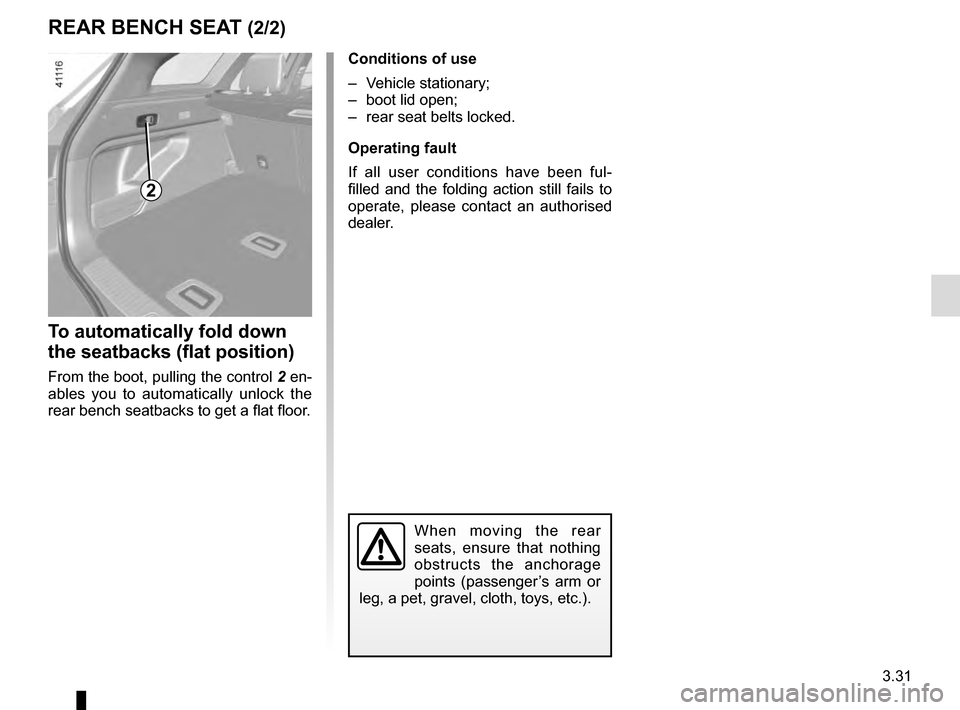
To automatically fold down
the seatbacks (flat position)
From the boot, pulling the control 2 en-
ables you to automatically unlock the
rear bench seatbacks to get a flat floor.
REAR BENCH SEAT (2/2)
2
When moving the rear
seats, ensure that nothing
obstructs the anchorage
points (passenger’s arm or
leg, a pet, gravel, cloth, toys, etc.).
Conditions of use
– Vehicle stationary;
– boot lid open;
– rear seat belts locked.
Operating fault
If all user conditions have been ful-
filled and the folding action still fails to
operate, please contact an authorised
dealer.
Page 233 of 328
3.43
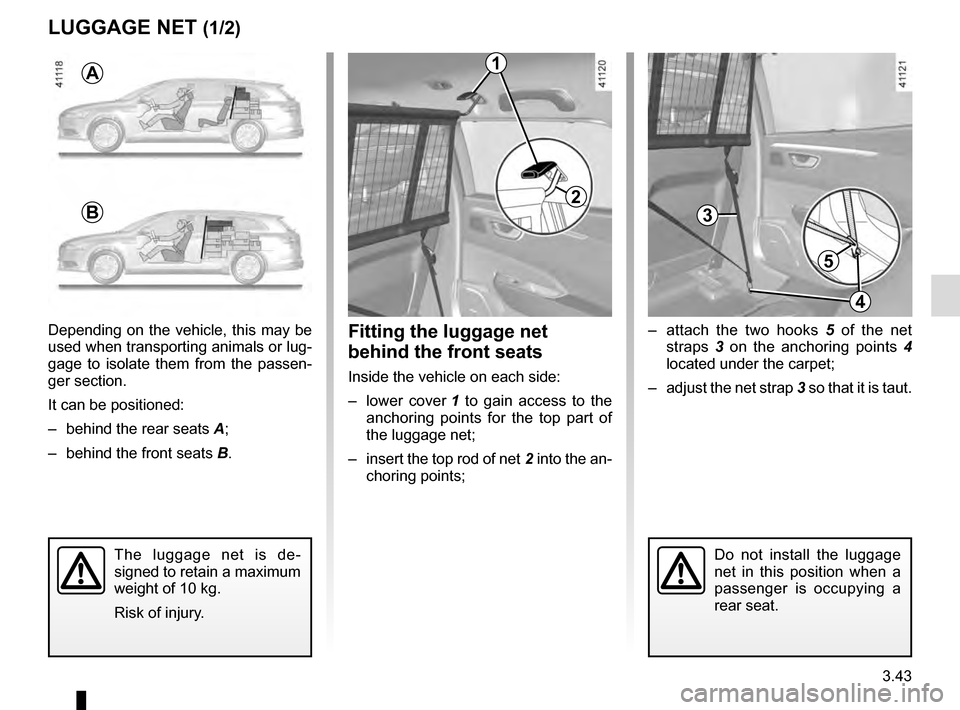
LUGGAGE NET (1/2)
– attach the two hooks 5 of the net
straps 3 on the anchoring points 4
located under the carpet;
– adjust the net strap 3 so that it is taut.Fitting the luggage net
behind the front seats
Inside the vehicle on each side:
– lower cover 1 to gain access to the
anchoring points for the top part of
the luggage net;
– insert the top rod of net 2 into the an-
choring points;
Depending on the vehicle, this may be
used when transporting animals or lug-
gage to isolate them from the passen-
ger section.
It can be positioned:
– behind the rear seats
A;
– behind the front seats B.
The luggage net is de-
signed to retain a maximum
weight of 10 kg.
Risk of injury.Do not install the luggage
net in this position when a
passenger is occupying a
rear seat.
A
B
1
2
3
5
4
Page 234 of 328
3.44
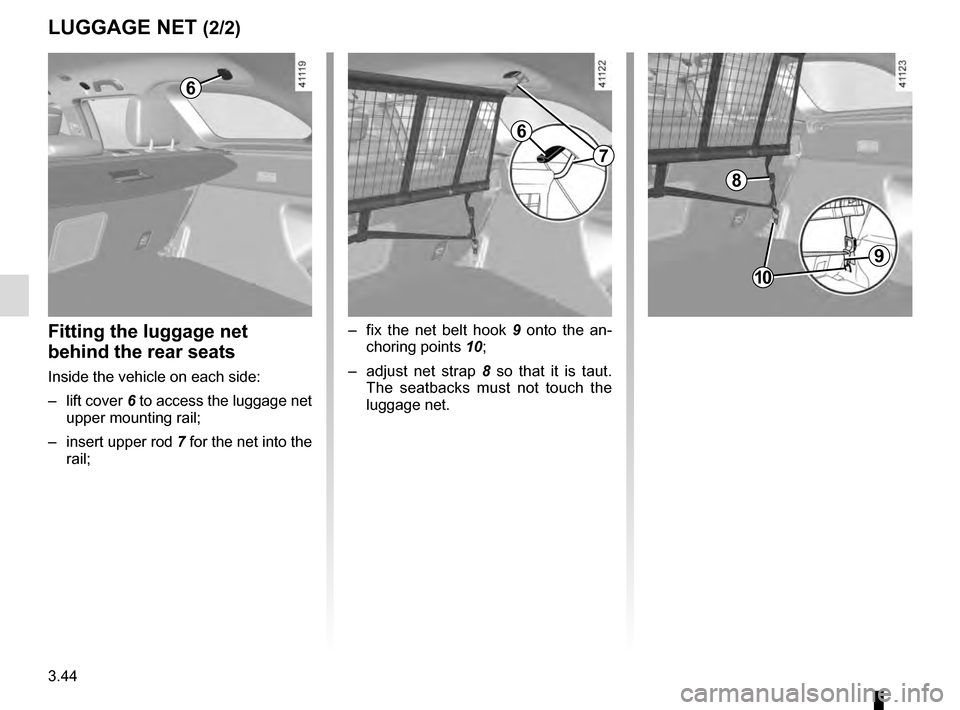
LUGGAGE NET (2/2)
6
– fix the net belt hook 9 onto the an-
choring points 10;
– adjust net strap 8 so that it is taut.
The seatbacks must not touch the
luggage net.Fitting the luggage net
behind the rear seats
Inside the vehicle on each side:
– lift cover 6 to access the luggage net
upper mounting rail;
– insert upper rod 7 for the net into the
rail;
7
6
8
10
9
Page 236 of 328
3.46
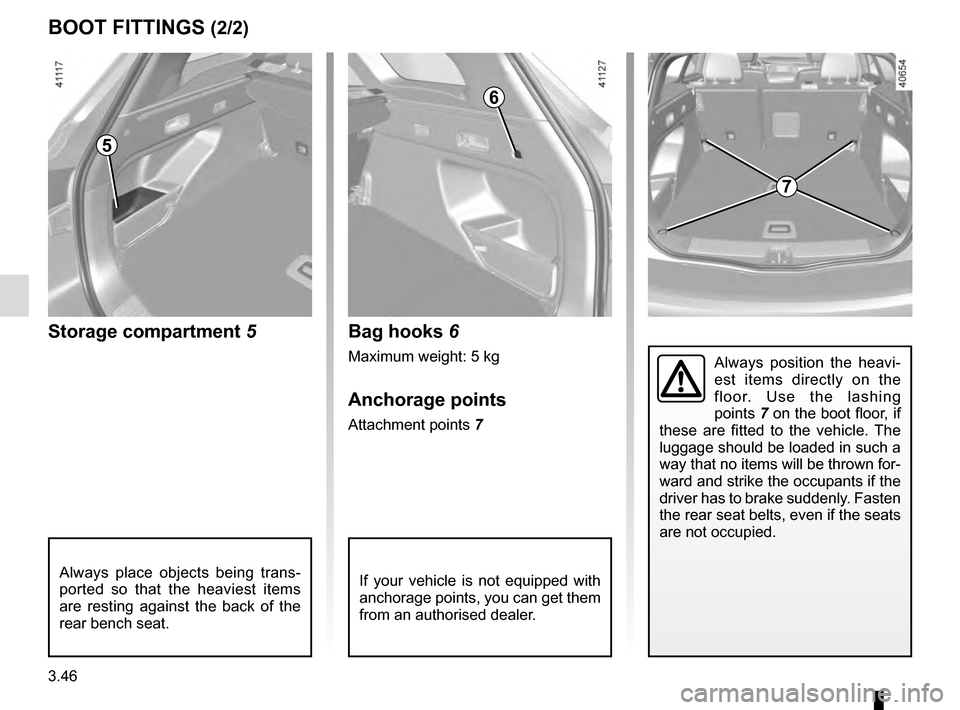
BOOT FITTINGS (2/2)
If your vehicle is not equipped with
anchorage points, you can get them
from an authorised dealer.
7
Bag hooks 6
Maximum weight: 5 kg
Anchorage points
Attachment points 7
Storage compartment 5
5
Always position the heavi-
est items directly on the
floor. Use the lashing
points 7 on the boot floor, if
these are fitted to the vehicle. The
luggage should be loaded in such a
way that no items will be thrown for-
ward and strike the occupants if the
driver has to brake suddenly. Fasten
the rear seat belts, even if the seats
are not occupied.
Always place objects being trans-
ported so that the heaviest items
are resting against the back of the
rear bench seat.
6
Page 237 of 328

3.47
Always position the objects transported
so that the largest surface is against:
– the back of the rear bench seat, for normal loading (example A).
– The front seatbacks with the rear seatbacks folded down, the
mobile floor in the flat-floor position
(example B).
If you have to place objects on the
folded seat back, it is vital that you
remove the headrests before folding
the seat back so that it can be folded as
flat as possible against the seat.
TRANSPORTING OBJECTS IN THE LUGGAGE COMPARTMENT
A
Always position the hea-
viest items directly on
the floor. Use the lashing
points 1 on the boot floor, if
these are fitted to the vehicle. The
luggage should be loaded in such
a way that no items will be thrown
forward and strike the occupants if
the driver has to brake suddenly.
Fasten the rear seat belts, even if
the seats are not occupied.
Anchorage points
Hooks 1 located on each corner of the
luggage compartment allow the load to
be secured.
Always position objects being trans-
ported so that the heaviest items
are resting against the back of the
rear seat.
1
B
Page 258 of 328

4.16
Glass instrument panel(e.g. instrument panel, clock, exterior
temperature display, radio display, etc.)
Use a soft cloth (or cotton wool).
If this does not clean them properly,
use a soft cloth (or cotton wool) slightly
moistened with soapy water and then
wipe clean with another soft damp cloth
or cotton wool.
Finally, carefully dry off with a soft dry
cloth.
Do not use products containing alco-
hol and/or spray fluids on the area.
Seat belts
These must be kept clean.
Use products selected by our Technical
Department (Approved outlets) or
warm, soapy water and a sponge and
wipe with a dry cloth.
Detergents or dyes must not be used
under any circumstances.
INTERIOR TRIM MAINTENANCE (1/2)
Textiles (seats, door trim, etc)
Vacuum-clean the textiles regularly.
Liquid stain
Use soapy water.
Dab lightly (never rub) with a soft cloth,
rinse and remove the excess.
Solid or pasty stain
Carefully remove the excess solid or
pasty material immediately with a
spatula (working from the edges to the
centre to avoid spreading the stain).
Clean as for a liquid stain.
Special instructions for sweets or
chewing gum
Put an ice cube on the stain to solidify
it, then proceed as for a solid stain.
A well-maintained vehicle will last
longer. It is therefore recommended to
maintain the interior of the vehicle regu-
larly.
A stain should always be dealt with
swiftly.
Whatever type of stain is on the trim,
use
cold (or warm) soapy water with
natural soap.
Detergents (washing-up liquid, pow-
dered products, alcohol-based prod-
ucts) should not be used.
Use a soft cloth.
Rinse and soak up the excess.
For further recommendations for
maintaining the interior, and/or for
any unsatisfactory results, please
see an authorised dealer.