2016 RENAULT TALISMAN steering wheel
[x] Cancel search: steering wheelPage 185 of 328

2.77
ASSISTED PARKING (4/4)
This function is an additional driving aid. However, this function is not under any circumstances intended to replace the
due care and attention of the driver, who should at all times be in control of the vehicle.
Make sure that the manoeuvre complies with the applicable traffic regulations at your location.
– The driver should always look out for sudden hazards during driving: alw\
ays ensure that there are no moving obstacles (such as a child, animal, pram, bicycle, etc.) or small, narrow object\
s such as stones or posts in your path when manoeu-
vring.
– The system cannot detect objects located in the sensor blind spots.
– During manoeuvring, the steering wheel may turn quickly: do not place yo\
ur hands inside the wheel, and ensure nothing is located in this space.
– Always visually check that the parking space proposed by the system is s\
till available and contains no obstacles.
– The system should be deactivated when towing a trailer.
Page 192 of 328
3.2
MULTI-SENSE (1/2)
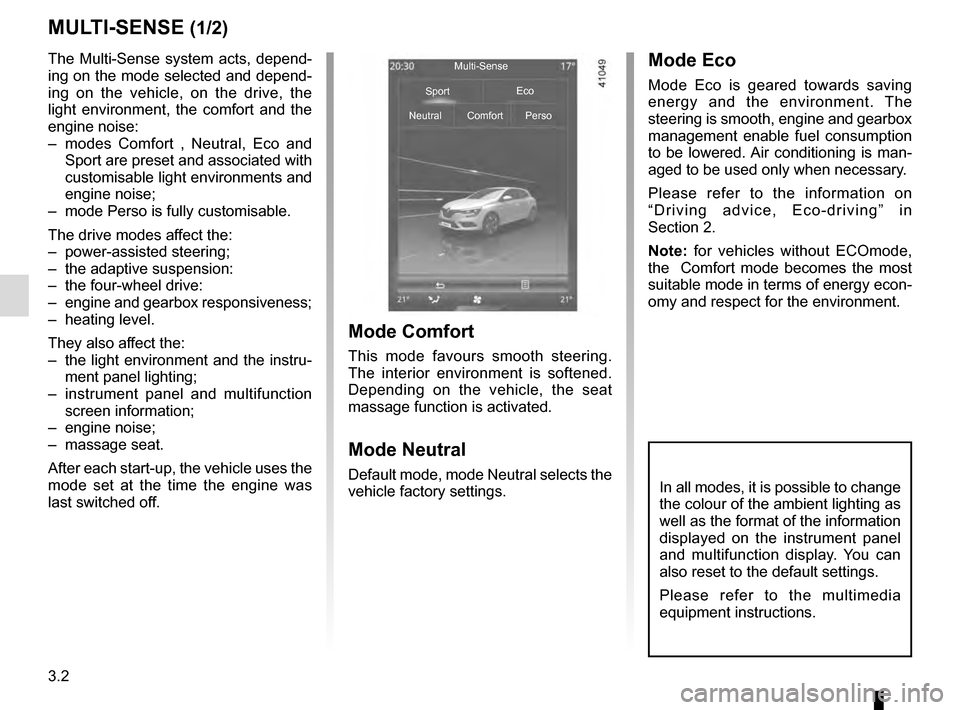
The Multi-Sense system acts, depend-
ing on the mode selected and depend-
ing on the vehicle, on the drive, the
light environment, the comfort and the
engine noise:
– modes Comfort , Neutral, Eco and Sport are preset and associated with
customisable light environments and
engine noise;
– mode Perso is fully customisable.
The drive modes affect the:
– power-assisted steering;
– the adaptive suspension:
– the four-wheel drive:
– engine and gearbox responsiveness;
– heating level.
They also affect the:
– the light environment and the instru- ment panel lighting;
– instrument panel and multifunction screen information;
– engine noise;
– massage seat.
After each start-up, the vehicle uses the
mode set at the time the engine was
last switched off.
Mode Comfort
This mode favours smooth steering.
The interior environment is softened.
Depending on the vehicle, the seat
massage function is activated.
Mode Neutral
Default mode, mode Neutral selects the
vehicle factory settings.
Mode Eco
Mode Eco is geared towards saving
energy and the environment. The
steering is smooth, engine and gearbox
management enable fuel consumption
to be lowered. Air conditioning is man-
aged to be used only when necessary.
Please refer to the information on
“Driving advice, Eco-driving” in
Section 2.
Note: for vehicles without ECOmode,
the Comfort mode becomes the most
suitable mode in terms of energy econ-
omy and respect for the environment.
Multi-Sense
Sport Eco
Neutral Comfort Perso
In all modes, it is possible to change
the colour of the ambient lighting as
well as the format of the information
displayed on the instrument panel
and multifunction display. You can
also reset to the default settings.
Please refer to the multimedia
equipment instructions.
Page 240 of 328

3.50
MULTIMEDIA EQUIPMENT (1/2)
Using the telephone
We remind you of the need
to conform to the legislation
in force concerning the use
of such equipment.
5
Hands-free telephone
integrated control
For equipped vehicles, use the steering
wheel controls 4.
Multimedia systems
1 Multimedia touchscreen display;
2 Central control;
3 Steering column controls;
4 Steering wheel controls;
5 Microphone.
1
2
4
Refer to the equipment instructions
for information on how to operate
this equipment.
3
Page 273 of 328
5.13
TYRES (3/3)
For safety reasons, this
operation must be carried
out by a specialist.
Fitting different tyres may
change your vehicle as follows:
– it may mean that your vehicle no longer conforms to current regu-
lations;
– it may change the way it handles when cornering;
– it may cause the steering to be heavy;
– It may affect the use of snow chains.
Use in winter
Chains
For safety reasons, fitting snow
chains to the rear axle is strictly for-
bidden.
Chains cannot be fitted to tyres which
are larger than those originally fitted to
the vehicle.
Snow or Winter tyres
We would recommend that these be
fitted to all four wheels to ensure that
your vehicle retains maximum adhe-
sion.
Warning : These tyres sometimes have
a specific direction of rotation and a
maximum speed index which may be
lower than the maximum speed of your
vehicle.
Snow chains may only be
fitted to tyres of the same
size as those originally
fitted to your vehicle.
In all cases, we would recommend
that you contact an authorised
dealer who will be able to advise you
on the choice of equipment which is
most suitable for your vehicle.
Changing a wheel
As the tyre pressure moni-
tor may take several min-
utes to correctly determine
the positions of the wheels and the
pressure values after driving, check
the tyre pressures following any op-
eration.
Studded tyres
This type of equipment may only be
used for a limited period and as laid
down by local legislation. It is neces-
sary to observe the speed specified by
current legislation.
These tyres must, at a minimum, be
fitted to the two front wheels.
18” wheels and larger
cannot be fitted with
chains.
If you wish to use special
equipment, consult an approved
dealer.
Fitting new tyres
Page 293 of 328

5.33
TOWING: breakdown (1/2)
Before towing, put the gearbox in neu-
tral, unlock the steering column and re-
lease the parking brake.
For vehicles fitted with an automatic
gearbox, if it is not possible to put the
gear lever into position N, please con-
sult an authorised dealer.
Steering column unlocking
Insert the key into the ignition or, de-
pending on the vehicle, with the
RENAULT card on you, press the
engine start button for approximately 2
seconds.
Reposition the lever to neutral (posi-
tion N for vehicles fitted with an auto-
matic gearbox).
The column is unlocked, the acces-
sory functions are supplied: the vehi-
cle lights can be used (indicators, brake
lights etc.). At night the vehicle must
have its lights on.
Depending on the vehicle, once you
have finished towing, press the engine
start button twice (risk of running down
the battery). The speed specified by current legis-
lation for towing must always be ob-
served. If your vehicle is the towing
vehicle, do not exceed the maximum
towing weight for your vehicle (refer to
the information on “Weights” in
Section 6).
Towing a vehicle with an
automatic gearbox
Transport the vehicle on a trailer or tow
it with the front wheels off the ground.
In exceptional circumstances
, you
may tow it with all four wheels on the
ground, only in a forward gear, with the
gear in neutral position N over a maxi-
mum distance of 50 miles and not ex-
ceeding a speed of 15 mph (25 km/h).
3
If the lever is stuck in P , even though
you are depressing the brake pedal, the
lever can be released manually.
To do this, unclip the flap 2, then insert a
tool (with a hard rod to it) into the hole 1
and press the button 3 at the same time
in order to unlock the lever.
Contact an authorised dealer as soon
as possible.
2
1
Page 294 of 328
5.34
Use the towing hitch 6 only (refer to the
information on “Tools” in Section 5).
TOWING: breakdown (2/2)
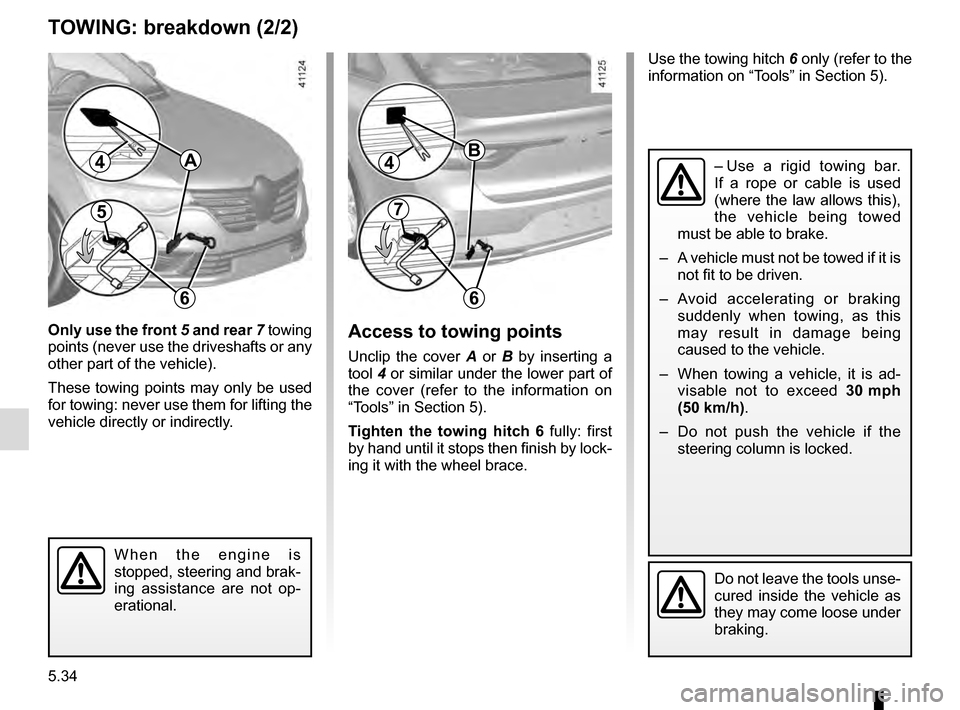
Only use the front 5 and rear 7 towing
points (never use the driveshafts or any
other part of the vehicle).
These towing points may only be used
for towing: never use them for lifting the
vehicle directly or indirectly.Access to towing points
Unclip the cover A or B by inserting a
tool 4 or similar under the lower part of
the cover (refer to the information on
“Tools” in Section 5).
Tighten the towing hitch 6 fully: first
by hand until it stops then finish by lock-
ing it with the wheel brace.
When the engine is
stopped, steering and brak-
ing assistance are not op-
erational.
AB44– Use a rigid towing bar.
If a rope or cable is used
(where the law allows this),
the vehicle being towed
must be able to brake.
– A vehicle must not be towed if it is not fit to be driven.
– Avoid accelerating or braking suddenly when towing, as this
may result in damage being
caused to the vehicle.
– When towing a vehicle, it is ad- visable not to exceed 30 mph
(50 km/h).
– Do not push the vehicle if the steering column is locked.
Do not leave the tools unse-
cured inside the vehicle as
they may come loose under
braking.
57
66
Page 296 of 328

5.36
OPERATING FAULTS (2/6)
The starter is activatedPOSSIBLE CAUSESWHAT TO DO
The instrument panel indicator lights
are weak or fail to light up and the
starter does not turn. Battery terminals not tight, bat-
tery terminals disconnected or
oxidised.Retighten or reconnect the terminals, or clean them
if they are oxidised.
Discharged battery or not opera-
tional. Connect another battery to the faulty battery. Refer
to the paragraph “Battery: troubleshooting” in sec-
tion 5 or replace the battery if necessary.
Do not push the vehicle if the steering column is
locked.
Faulty circuit. Consult an approved dealer.
The engine will not start. Starting conditions are not ful-
filled.Please refer to the information on “Starting, stopping
the engine” in Section 2.
The RENAULT “hands-free” card
does not work. Please refer to the information on “Starting, stopping
the engine” in Section 2.
The engine cannot be switched off. Card not detected. Press and hold the start button.
Electronic fault. Press the start button quickly five times.
The steering column remains locked. Steering wheel locked. Move the steering wheel while pressing the engine
start button (please refer to Section 2 “Starting, stop-
ping the engine”).
Faulty circuit. Consult an approved dealer.
Page 323 of 328

headrest................................................................\
............. 3.29
heated steering wheel .......................................................")
7.3
ALPHABETICAL INDEX (3/5)
headrest................................................................\
............. 3.29
heated steering wheel ....................................................... 1.79
heating and air conditioning system .................................. 3.16
heating system ........................................................3.6 → 3.15
Hill Start Assist..............................................2.28 → 2.39, 2.37
horn ...................................................................\
................ 1.84
horn: flash ..................................................................\
........... 1.84
sounding the horn ........................................................ 1.84
hubcap tool ................................................................. 5.7 – 5.8
I
ignition switch ...................................................................... 2.3
indicators ....................................................... 1.84, 5.14 – 5.15
indicators: direction indicators .............................................. 1.84, 5.16
exterior temperature indicator ...................................... 1.78
instrument panel ..............................................1.56 → 1.67
instrument panel ...........................................1.56 → 1.75, 1.85
instrument panel messages...................................1.68 → 1.75
interior trim maintenance ..................................................... 4.16 – 4.17
Isofix .................................................................\
.....1.48 → 1.50
J
jack ........................................................................\
..... 5.7 – 5.8
K
keys ...................................................................\
........1.2 → 1.4
L
lane departure warning ..........................................2.40 → 2.42
levels: brake fluid ...................................................................... 4.8
coolant ................................................................\
........... 4.7
engine oil ....................................................................... 4.4 windscreen washer reservoir ......................................... 4.9
lifting the vehicle changing a wheel ................................................ 5.9 – 5.10
lighting: exterior ......................................................1.6, 1.85 → 1.90
instrument panel .......................................................... 1.85
interior ..........................................3.22 – 3.23, 5.21 → 5.23
lights adjustment .............................................................\
...... 1.90
changing bulbs .................................................. 5.14 – 5.15
front ................................................................... 5.14 – 5.15
lights: adjusting ..............................................................\
........ 1.90
brake lights .................................................................. 5.16
dipped beam headlights ........................... 1.85, 5.14 – 5.15
direction indicators ..................................1.84, 5.14 → 5.16
fog lights ............................................................. 1.89, 5.16
hazard warning ............................................................ 1.84
main beam headlights ................... 1.86 – 1.87, 5.14 – 5.15
number plate lights ...................................................... 5.20
reversing lights ............................................................. 5.16
side lights ............................................................ 1.85, 5.16
locking the doors ............................... 1.2 → 1.11, 1.15 → 1.18
luggage compartment cover .............................................. 3.42
luggage retaining net .............................................. 3.43 – 3.44
M
maintenance ............................................................\
.......... 2.23
maintenance: bodywork .......................................................... 4.14 – 4.15
interior trim ........................................................ 4.16 – 4.17
mechanical .........................................4.2 – 4.3, 6.9 → 6.14
map reading lights .................................................. 3.22 – 3.23
menu for customising the vehicle settings .............. 1.76 – 1.77
methods of restraint in addition to the seat belts ...1.35 → 1.37
mobile floor ........................................................................\
3.45