2016 RENAULT TALISMAN fuel
[x] Cancel search: fuelPage 132 of 328

2.24
ENVIRONMENT
Emissions
Your vehicle has been designed to
emit fewer greenhouse gases (CO2)
while in use, and therefore to consume
less fuel (e.g. 140 g/km, equivalent to
1494.6 mpg (5.3 l/100 km) for a diesel
vehicle).
Our vehicles are also equipped with a
particle filter system including a cata-
lytic converter, an oxygen sensor and
an active carbon filter (the latter pre-
vents vapour from the fuel tank being
released into the open air).
For certain diesel vehicles, this system
also has a particle filter to reduce the
volume of soot particles emitted.
Please make your own
contribution towards
protecting the environment
too
– Worn parts replaced in the course of routine vehicle maintenance (vehi-
cle battery, oil filter, air filter, batter-
ies, etc.) and oil containers (empty or
filled with used oil) must be disposed
of through specialist organisations. – At the end of the vehicle’s service
life, it should be sent to approved
centres to ensure that it is recycled.
– In all cases, comply with local legis- lation.
Recycling
Your vehicle is 85% recyclable and
95% recoverable.
To achieve these objectives, many of
the vehicle components have been de-
signed to enable them to be recycled.
The materials and structures have
been carefully designed to allow these
components to be easily removed and
reprocessed by specialist companies.
In order to preserve raw material re-
sources, this vehicle incorporates nu-
merous parts made from recycled plas-
tics or renewable materials (vegetable
or animal-derived materials such as
cotton or wool).
Your vehicle has been designed with
respect for the environment in mind for
its entire service life: during production,
use and at the end of its life.
This commitment is illustrated by the
Renault eco² signature.Manufacture
Your vehicle has been manufactured at
a factory which complies with a policy
to reduce the environmental impact
on the surrounding areas (reduction of
water and energy consumption, visual
and noise pollution, atmospheric emis-
sions and waste water; sorting and re-
using waste).
Page 192 of 328
3.2
MULTI-SENSE (1/2)
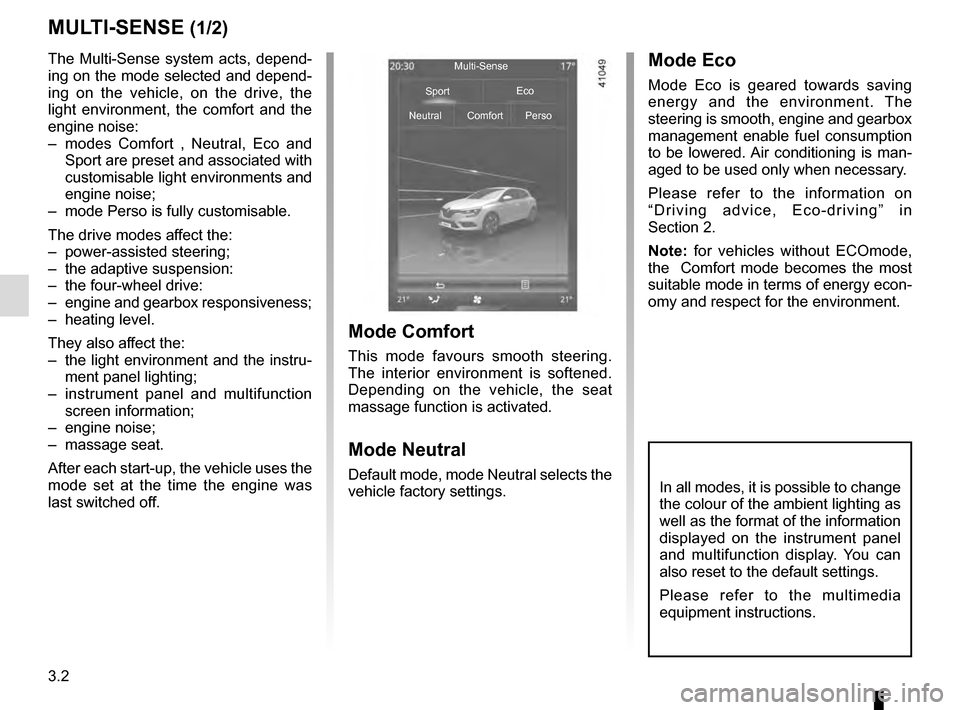
The Multi-Sense system acts, depend-
ing on the mode selected and depend-
ing on the vehicle, on the drive, the
light environment, the comfort and the
engine noise:
– modes Comfort , Neutral, Eco and Sport are preset and associated with
customisable light environments and
engine noise;
– mode Perso is fully customisable.
The drive modes affect the:
– power-assisted steering;
– the adaptive suspension:
– the four-wheel drive:
– engine and gearbox responsiveness;
– heating level.
They also affect the:
– the light environment and the instru- ment panel lighting;
– instrument panel and multifunction screen information;
– engine noise;
– massage seat.
After each start-up, the vehicle uses the
mode set at the time the engine was
last switched off.
Mode Comfort
This mode favours smooth steering.
The interior environment is softened.
Depending on the vehicle, the seat
massage function is activated.
Mode Neutral
Default mode, mode Neutral selects the
vehicle factory settings.
Mode Eco
Mode Eco is geared towards saving
energy and the environment. The
steering is smooth, engine and gearbox
management enable fuel consumption
to be lowered. Air conditioning is man-
aged to be used only when necessary.
Please refer to the information on
“Driving advice, Eco-driving” in
Section 2.
Note: for vehicles without ECOmode,
the Comfort mode becomes the most
suitable mode in terms of energy econ-
omy and respect for the environment.
Multi-Sense
Sport Eco
Neutral Comfort Perso
In all modes, it is possible to change
the colour of the ambient lighting as
well as the format of the information
displayed on the instrument panel
and multifunction display. You can
also reset to the default settings.
Please refer to the multimedia
equipment instructions.
Page 206 of 328

3.16
AIR CONDITIONING: information and advice on use
Do not add anything to the
vehicle’s ventilation circuit
(for example, to remove
bad odours).
There is a risk of damage or of
fire.
Do not open the refriger-
ant fluid circuit. The fluid
may damage eyes or skin.
Fuel consumption
You will normally notice an increase in
fuel consumption (especially in town)
when the air conditioning is operating.
For vehicles fitted with air conditioning
with no automatic mode, switch off the
system when it is not required.
Advice for reducing consumption
and helping to preserve the environ-
ment
Drive with the air vents open and the
windows closed.
If the vehicle has been parked in the
sun, open the doors for a few moments
to let the hot air escape before starting
the engine.
Maintenance
Refer to the Maintenance Document
for your vehicle for the inspection fre-
quency.
Operating faults
As a general rule, contact your ap-
proved dealer in the event of an oper-
ating fault.
– Reduction in de-icing, demisting or air conditioning performance.
This may be caused by the passen-
ger compartment filter cartridge be-
coming clogged.
– No cold air is being produced .
Check that the controls are set cor-
rectly and that the fuses are sound.
Otherwise, switch off the system.
Presence of water under the
vehicle
After prolonged use of the air condi-
tioning system, it is normal for water
to be present under the vehicle. This is
caused by condensation.
Advice on use
In some situations, (air conditioning
off, air recirculation activated, ventila-
tion speed at zero or low, etc.) you may
notice that condensation starts to form
on the windows and windscreen.
If there is condensation, use the “Clear
View” function to remove it, then use
the air conditioning in automatic mode
to stop it forming again.
Vehicles equipped with the
ECO mode: once activated, ECO
mode can reduce the perform-
ance of the automatic air condition-
ing. Please refer to the information
on “Driving advice, Eco-driving” in
Section 2.
Page 254 of 328
4.12
TYRE PRESSURE (1/2)
A
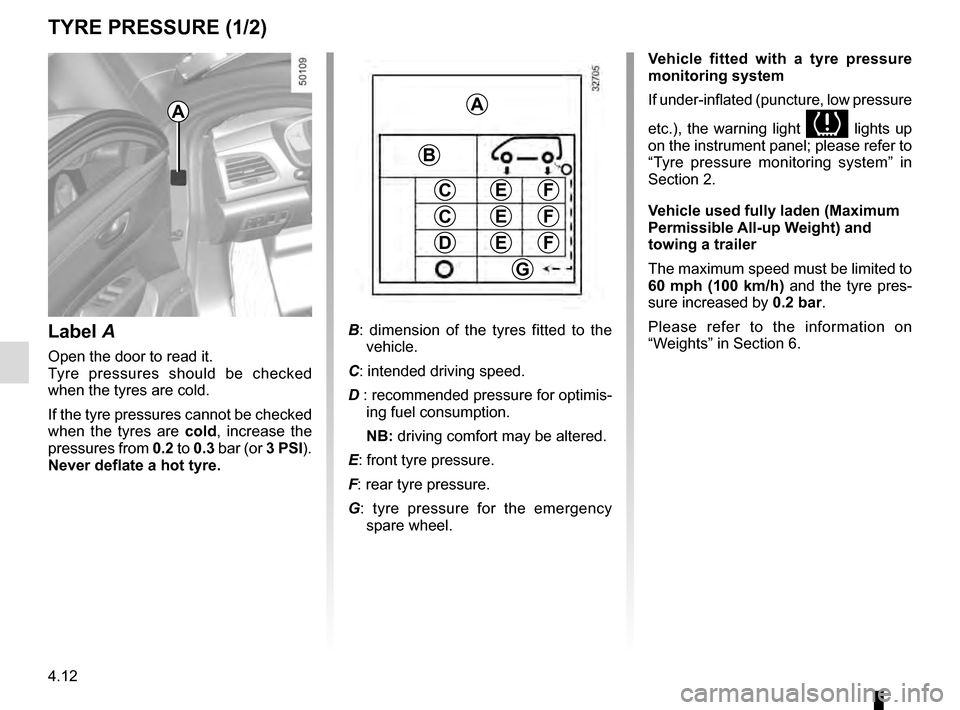
Label A
Open the door to read it.
Tyre pressures should be checked
when the tyres are cold.
If the tyre pressures cannot be checked
when the tyres are cold, increase the
pressures from 0.2 to 0.3 bar (or 3 PSI).
Never deflate a hot tyre.
Vehicle fitted with a tyre pressure
monitoring system
If under-inflated (puncture, low pressure
etc.), the warning light
lights up
on the instrument panel; please refer to
“Tyre pressure monitoring system” in
Section 2.
Vehicle used fully laden (Maximum
Permissible All-up Weight) and
towing a trailer
The maximum speed must be limited to
60 mph (100 km/h) and the tyre pres-
sure increased by 0.2 bar.
Please refer to the information on
“Weights” in Section 6.
A
C
D
FE
G
B
C
E
E
F
F
B : dimension of the tyres fitted to the
vehicle.
C: intended driving speed.
D : recommended pressure for optimis- ing fuel consumption.
NB: driving comfort may be altered.
E: front tyre pressure.
F: rear tyre pressure.
G : tyre pressure for the emergency
spare wheel.
Page 306 of 328
6.6
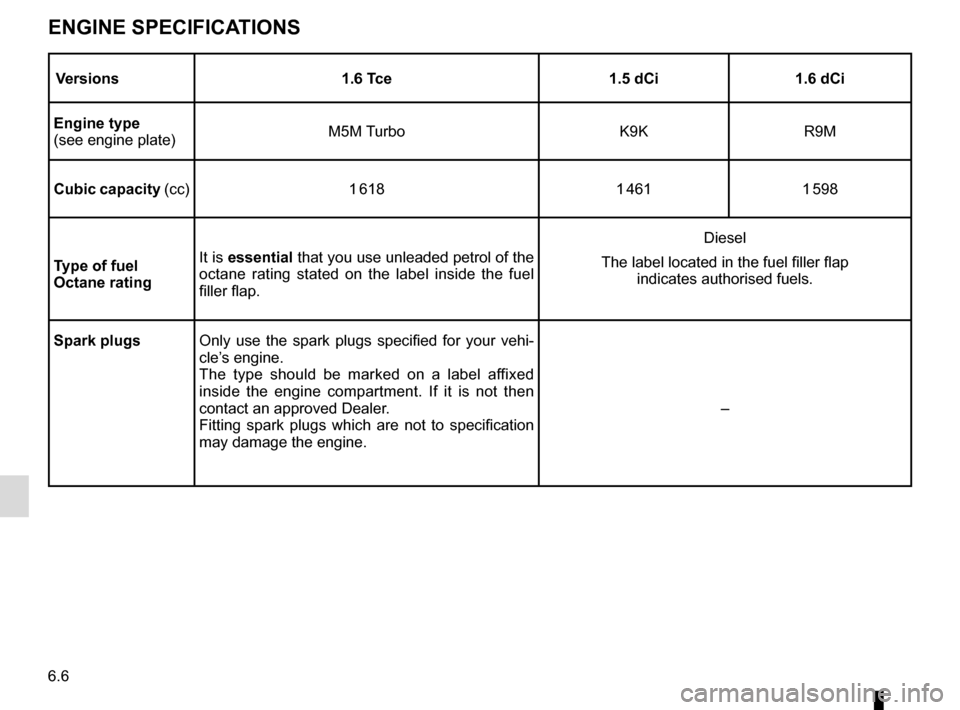
ENGINE SPECIFICATIONS
Versions1.6 Tce1.5 dCi1.6 dCi
Engine type
(see engine plate) M5M Turbo
K9KR9M
Cubic capacity (cc) 1 6181 4611 598
Type of fuel
Octane rating It is
essential that you use unleaded petrol of the
octane rating stated on the label inside the fuel
filler flap. Diesel
The label located in the fuel filler flap indicates authorised fuels.
Spark plugs Only use the spark plugs specified for your vehi-
cle’s engine.
The type should be marked on a label affixed
inside the engine compartment. If it is not then
contact an approved Dealer.
Fitting spark plugs which are not to specification
may damage the engine. –
Page 322 of 328

7.2
ALPHABETICAL INDEX (2/5)
driver’s position .....................................................1.54 → 1.61
driving ...... 2.2 → 2.7, 2.12 → 2.22, 2.25 → 2.39, 2.49 → 2.51,
2.55 → 2.70, 2.79 → 2.81
driving position settings ...............................................................\
......... 1.27
driving recommendations ......................................2.18 → 2.22
E
ECO driving ...........................................................2.18 → 2.22
ECO mode ........................................................................\
. 2.20
electric beam height adjustment ............................. 1.89 – 1.90
electric windows ..................................................... 3.17 – 3.18
electronic parking brake ........................................2.15 → 2.17
Electronic Stability Control: ESC ...........................2.28 → 2.39
emergency active braking................................................\
.. 2.33
emergency brake assist.........................................2.28 → 2.39
emergency braking ................................................2.28 → 2.39
emergency key ........................................................... 1.5 – 1.6
emergency spare wheel ...................................................... 5.2
engine technical specifications .................................................. 6.6
engine oil ...................................................................4.4 → 4.6
engine oil level ............................................................ 4.5 – 4.6
engine specifications ........................................................... 6.6
engine start/stop button .............................................2.5 → 2.7
environment ............................................................\
........... 2.24
ESC: electronic stability control .............................2.28 → 2.39
external temperature ......................................................... 1.78
F
faults operating faults ................................................5.35 → 5.40
filter air filter ........................................................................\
... 4.9
diesel filter ...................................................................... 4.9
oil filter ........................................................................\
... 4.9 passenger compartment filter ........................................ 4.9
fittings ...............................................................\
.....3.25 → 3.27
front passenger air bag deactivation ................................. 1.51
front seat driver’s position memory .............................................. 1.26
front seat adjustment .............................................. 1.20 – 1.21
front seats adjustment ........................................................ 1.20 – 1.21
with electric controls ......................................... 1.22 – 1.23
with manual controls .................................................... 1.20
fuel advice on fuel economy ...................................2.18 → 2.22
capacity ...............................................................\
......... 1.99
consumption ....................................................2.18 → 2.22
filling ...............................................................1\
.99 → 1.101
grade ..............................................................1.99\
→ 1.101
fuel consumption ...................................................2.18 → 2.22
fuel economy .........................................................2.18 → 2.22
fuel level ........................................................................\
.... 1.62
fuel repriming ................................................................... 1.100
fuel tank capacity ..........................................................1.99 \
→ 1.101
fuel tank capacity .................................................1.99 → 1.101
fuses ....................................................................... 5.24 – 5.25
G
gear lever..............................................................\
............. 2.14
grab handle.............................................................\
........... 3.26
H
handbrake...............................................................\
........... 2.15
hands-free telephone integrated control ................. 3.50 – 3.51
hazard warning lights signal ................................... 1.84 – 1.85
headlight beam adjustment ............................................... 1.90
headlight flashers .............................................................. 1.84
headlight washer ............................................................... 1.95