2016 RENAULT TALISMAN ECO mode
[x] Cancel search: ECO modePage 206 of 328

3.16
AIR CONDITIONING: information and advice on use
Do not add anything to the
vehicle’s ventilation circuit
(for example, to remove
bad odours).
There is a risk of damage or of
fire.
Do not open the refriger-
ant fluid circuit. The fluid
may damage eyes or skin.
Fuel consumption
You will normally notice an increase in
fuel consumption (especially in town)
when the air conditioning is operating.
For vehicles fitted with air conditioning
with no automatic mode, switch off the
system when it is not required.
Advice for reducing consumption
and helping to preserve the environ-
ment
Drive with the air vents open and the
windows closed.
If the vehicle has been parked in the
sun, open the doors for a few moments
to let the hot air escape before starting
the engine.
Maintenance
Refer to the Maintenance Document
for your vehicle for the inspection fre-
quency.
Operating faults
As a general rule, contact your ap-
proved dealer in the event of an oper-
ating fault.
– Reduction in de-icing, demisting or air conditioning performance.
This may be caused by the passen-
ger compartment filter cartridge be-
coming clogged.
– No cold air is being produced .
Check that the controls are set cor-
rectly and that the fuses are sound.
Otherwise, switch off the system.
Presence of water under the
vehicle
After prolonged use of the air condi-
tioning system, it is normal for water
to be present under the vehicle. This is
caused by condensation.
Advice on use
In some situations, (air conditioning
off, air recirculation activated, ventila-
tion speed at zero or low, etc.) you may
notice that condensation starts to form
on the windows and windscreen.
If there is condensation, use the “Clear
View” function to remove it, then use
the air conditioning in automatic mode
to stop it forming again.
Vehicles equipped with the
ECO mode: once activated, ECO
mode can reduce the perform-
ance of the automatic air condition-
ing. Please refer to the information
on “Driving advice, Eco-driving” in
Section 2.
Page 208 of 328
3.18
Operating faults
In case of a fault when closing a
window, the system reverts to normal
mode: pull the switch as many times as
necessary until the window closes com-
pletely, hold the switch (still on the clo-
sing side) for around one second, then
completely lower then raise the window
to reset the system.
If necessary, contact an approved
Dealer.
ELECTRIC WINDOWS (2/2)Remote control window
closing
(vehicles with 4 one-touch electric win-
dows).
When you lock the doors from the out-
side, press the locking button on the
RENAULTcard twice in quick suc-
cession, or on the driver’s door in
hands-free mode, and all the windows
will close automatically (and, depen-
ding on the vehicle, the sunroof).
It is recommended that the user only
operates the system when the vehi-
cle can be seen clearly and no one is
inside.
One-touch mode
This mode works in addition to the ope-
ration of the electric windows described
previously.
Briefly press or pull the window switch
fully: the window is fully lowered or
raised. Pressing the switch again stops
the window moving.
Note: if the window detects resistance
when closing (e.g.: branch of a tree,
etc.) it stops and then lowers again by a
few centimetres.
When closing the windows,
ensure that no part of the
body (arm, hand, etc.) is
protruding from the vehicle.
Risk of serious injury.
Page 230 of 328
3.40
AUTOMATIC TAILGATE (4/5)
Stopping the tailgate
manoeuvre
The automatic tailgate manoeuvre can
be stopped at any time by a short press
on one of the controls. Depending on
the opening position, the tailgate hatch
can however continue to be opened
manually.
If the tailgate is stationary in the inter-
mediate position, your next press will
move the tailgate in the opposite direc-
tion to when you stopped it.
Manual mode
After stopping the tailgate, you can per-
form the manoeuvre manually if you
wish.
You can switch to automatic movement
at any time by pressing one of the con-
trols.
Obstacle detection
When the tailgate window encounters
an obstacle (presence of an object or
person) when it is moving, it stops.
Depending on the opening position, the
tailgate hatch can however continue to
be opened manually.
Press the tailgate opening/closing con-
trol to reperform the tailgate movement
in the same direction as before encoun-
tering the obstacle.
Limiting the tailgate opening
angle
You can adjust the maximum tailgate
opening height It will always stop at the
chosen position:
– open the tailgate to an intermediate position;
– manually adjust the tailgate to the chosen position;
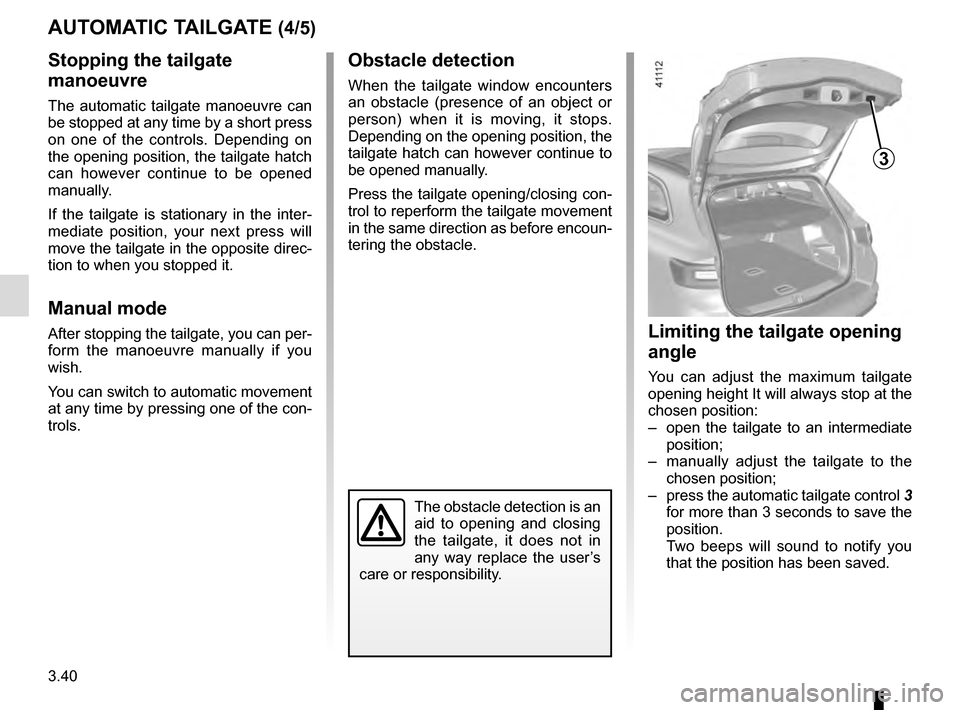
– press the automatic tailgate control 3
for more than 3 seconds to save the
position.
Two beeps will sound to notify you
that the position has been saved.
3
The obstacle detection is an
aid to opening and closing
the tailgate, it does not in
any way replace the user’s
care or responsibility.
Page 322 of 328

7.2
ALPHABETICAL INDEX (2/5)
driver’s position .....................................................1.54 → 1.61
driving ...... 2.2 → 2.7, 2.12 → 2.22, 2.25 → 2.39, 2.49 → 2.51,
2.55 → 2.70, 2.79 → 2.81
driving position settings ...............................................................\
......... 1.27
driving recommendations ......................................2.18 → 2.22
E
ECO driving ...........................................................2.18 → 2.22
ECO mode ........................................................................\
. 2.20
electric beam height adjustment ............................. 1.89 – 1.90
electric windows ..................................................... 3.17 – 3.18
electronic parking brake ........................................2.15 → 2.17
Electronic Stability Control: ESC ...........................2.28 → 2.39
emergency active braking................................................\
.. 2.33
emergency brake assist.........................................2.28 → 2.39
emergency braking ................................................2.28 → 2.39
emergency key ........................................................... 1.5 – 1.6
emergency spare wheel ...................................................... 5.2
engine technical specifications .................................................. 6.6
engine oil ...................................................................4.4 → 4.6
engine oil level ............................................................ 4.5 – 4.6
engine specifications ........................................................... 6.6
engine start/stop button .............................................2.5 → 2.7
environment ............................................................\
........... 2.24
ESC: electronic stability control .............................2.28 → 2.39
external temperature ......................................................... 1.78
F
faults operating faults ................................................5.35 → 5.40
filter air filter ........................................................................\
... 4.9
diesel filter ...................................................................... 4.9
oil filter ........................................................................\
... 4.9 passenger compartment filter ........................................ 4.9
fittings ...............................................................\
.....3.25 → 3.27
front passenger air bag deactivation ................................. 1.51
front seat driver’s position memory .............................................. 1.26
front seat adjustment .............................................. 1.20 – 1.21
front seats adjustment ........................................................ 1.20 – 1.21
with electric controls ......................................... 1.22 – 1.23
with manual controls .................................................... 1.20
fuel advice on fuel economy ...................................2.18 → 2.22
capacity ...............................................................\
......... 1.99
consumption ....................................................2.18 → 2.22
filling ...............................................................1\
.99 → 1.101
grade ..............................................................1.99\
→ 1.101
fuel consumption ...................................................2.18 → 2.22
fuel economy .........................................................2.18 → 2.22
fuel level ........................................................................\
.... 1.62
fuel repriming ................................................................... 1.100
fuel tank capacity ..........................................................1.99 \
→ 1.101
fuel tank capacity .................................................1.99 → 1.101
fuses ....................................................................... 5.24 – 5.25
G
gear lever..............................................................\
............. 2.14
grab handle.............................................................\
........... 3.26
H
handbrake...............................................................\
........... 2.15
hands-free telephone integrated control ................. 3.50 – 3.51
hazard warning lights signal ................................... 1.84 – 1.85
headlight beam adjustment ............................................... 1.90
headlight flashers .............................................................. 1.84
headlight washer ............................................................... 1.95