2016 RENAULT MEGANE COUPE lock
[x] Cancel search: lockPage 78 of 274

1.72
TRIP COMPUTER AND WARNING SYSTEM: information messages
Examples of messagesInterpreting the display selected
«Battery low start engine» Indicates that the vehicle must be started to recharge the battery (eg.\
after the engine has been
switched off for some time whilst listening to the radio).
«Please remove keycard» Request to remove the RENAULT card from the reader when you leave the vehicle.
«Checking control functions» Displayed with the ignition on when the vehicle is running self-diagnost\
ics.
«Traction control off» Indicates that you have deactivated the traction control function.
«Turn steering
wheel + START» Turn the steering wheel slightly whilst pressing the vehicle start button\
to unlock the steering
column.
«Auto Stop» Indicates that the engine is on standby (related to the Stop and Start \
function – please see the in-
formation on “Stop and Start function” in Section 2).
«Steering wheel not locked» Indicates that the steering column has not been locked.
«Stop vehicle» Indicates an electronic parking brake fault. Apply the electronic parking brake manually and ensure
that the vehicle is immobilised using a chock.
These can help in the vehicle starting phase, or give information about \
a selection or a driving status.
Examples of information messages are given in the following pages.
Page 80 of 274

1.74
TRIP COMPUTER AND WARNING SYSTEM: warning message
These appear with the ® warning light and require you to stop immediately, for your own safety, as soon as traffic
conditions allow. Stop your engine and do not restart it. Contact an approved Dealer.
Examples of warning messages are given in the following pages. Note: the messages appear on the display either individually
or alternately (when there are several messages to be displayed), and \
may be accompanied by a warning light and/or a beep.
Examples of messages Interpreting the display selected
“Engine failure hazard” Indicates engine overheating, or an injection or engine oil pressure fau\
lt.
“Power steering fault ” or
“Risk of steering locking ” Indicates a fault in the steering.
“Parking brake fault” Indicates an electronic parking brake fault. Apply the electronic parking brake manually
and ensure that the vehicle is immobilised using a chock.
“Battery charging fault” Indicates a fault in the vehicle battery charging circuit (alternator e\
tc.).
“Puncture” Indicates a puncture on the tyre displayed on the instrument panel.
Page 81 of 274

1.75
VEHICLE SETTINGS CUSTOMISATION MENU
i) Parking sensor volume;
j) Language.
= function activated
< function deactivated
Once a line has been selected, keep
pressing button 2 or 3 to change the
function. If you select either “Parking
sensor volume” or “Language”, you will
have to make a further selection (sound
volume of the parking distance control
or instrument panel language). In this
case, make your selection and confirm
it by holding either button 2 or 3, the
value selected is shown by a
~ in
front of the line.
To exit the menu, press either button 2
or 3. It may be necessary to carry out
this operation several times.
On equipped vehicles, this function,
which is integrated in the trip compu-
ter and warning system
1, allows you
to activate/deactivate some of the vehi-
cle’s functions.
Accessing the settings
customisation menu
With the vehicle stopped, press
button 2 or 3 several times until the
message “Settings menu: press and
hold” is shown on display 1. Press
either button 2 or 3 for longer than
2 seconds to enter the menu.
2
3
1
Adjusting the settings
Press one of buttons 2 or 3 to select a
function to change:
a) Auto door locking while driving;
b) Unlock driver’s door only;
c) Auto rear wipe with reverse gear;
d) Front parking sensor;
e) Automaticmain beam lights ;
f) Lane depart warn volume;
g) Lane depart warn sensitivity;
h) Rear parking sensor;
The vehicle settings personalisation
menu cannot be used when driv-
ing. At speed exceeding 12 mph
(20 km/h), the instrumental panel
display switches automatically back
to trip computer and warning system
mode.
Page 82 of 274
1.76
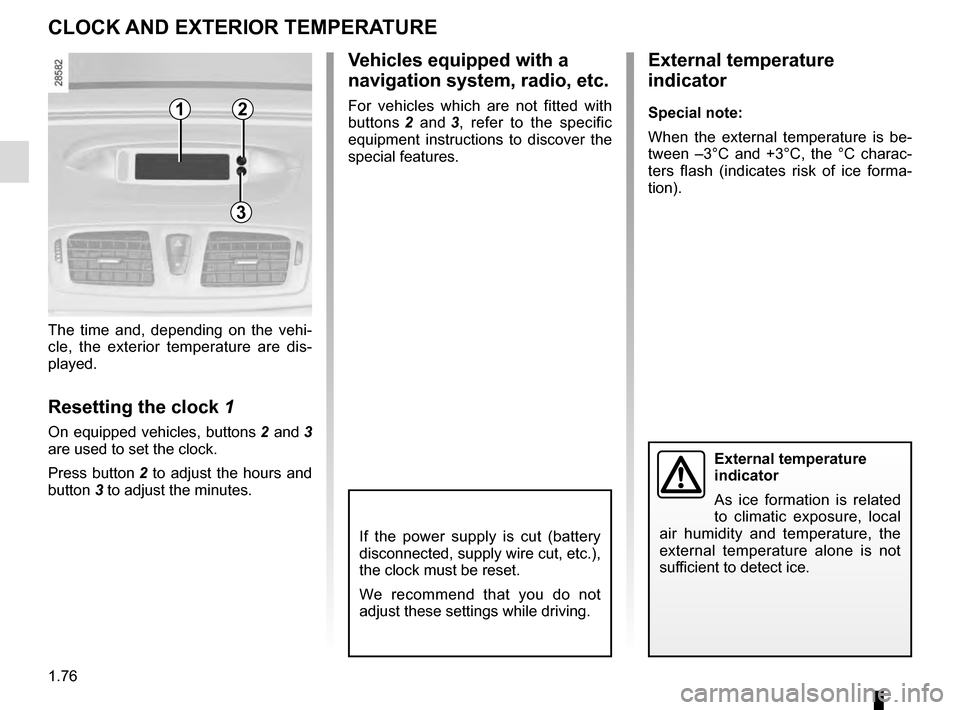
The time and, depending on the vehi-
cle, the exterior temperature are dis-
played.
Resetting the clock 1
On equipped vehicles, buttons 2 and 3
are used to set the clock.
Press button 2 to adjust the hours and
button 3 to adjust the minutes.
External temperature
indicator
As ice formation is related
to climatic exposure, local
air humidity and temperature, the
external temperature alone is not
sufficient to detect ice.
CLOCK AND EXTERIOR TEMPERATURE
External temperature
indicator
Special note:
When the external temperature is be-
tween –3°C and +3°C, the °C charac-
ters flash (indicates risk of ice forma-
tion).
Vehicles equipped with a
navigation system, radio, etc.
For vehicles which are not fitted with
buttons 2 and 3, refer to the specific
equipment instructions to discover the
special features.12
3
If the power supply is cut (battery
disconnected, supply wire cut, etc.),
the clock must be reset.
We recommend that you do not
adjust these settings while driving.
Page 86 of 274

1.80
EXTERIOR LIGHTING AND SIGNALS (3/4)
1
Special note:
– If the dipped beam headlights are manually switched on and if the light
is sufficient, the directional head-
lights will remain fixed;
– If the lights come on automatically when cornering, the directional
headlights will start working from the
next time the vehicle corners;
– When the dipped beam headlights are switched on with the engine
running and the vehicle stationary,
the lights move to reinitialise them-
selves. If not, there is a system fault.
Switching off the lights
There are two possibilities:
– manually, move ring 2 to position 0;
– automatically, the lights will go out when the engine is switched off, the
driver’s door is opened or the vehicle
is locked. In this case, the next time
the engine is started the lights will be
switched back on according to the
position of the ring 2.
NB: if the fog lights are lit, the lights are
not switched off automatically.
“See-me-home lighting”
function
This function allows you to briefly switch
on the dipped beam headlights (to pro-
vide light when opening a gate, etc.).
With the engine and lights off and
the ring 2 in the position 0, pull stalk 1
towards you: the dipped beam head-
lights come on for approximately thirty
seconds. To increase this duration, you
may pull the stalk up to four times (total
time restricted to two minutes). The
message “See-me-home” along with
the times the lights will be on for is dis-
played on the instrument panel to con-
firm this action.
To switch off the lights before they go
out automatically, turn ring 2 to any po-
sition, then return it to position 0.
Directional headlights
Depending on the vehicle, with the
dipped beam headlights on and under
certain conditions (speed, steering
wheel angle, forwards gear selected,
etc.) when cornering, the dipped beam
headlights move to light the inside of
the bend.
Operating faults
Depending on the vehicle, when the
message “Check lighting” appears on
the instrument panel along with the
© warning light, this indicates that
there is a lighting fault.
Consult an approved dealer.
2
Page 92 of 274
1.86
WINDSCREEN WASH/WIPE (4/5)
Specific front wiper position
(service position)
This position enables the blades to be
lifted to remove them from the winds-
creen.
This can be useful:
– to clean the blades;
– to release the blades from the winds- creen in winter;
– to replace the blades (please refer to the information on the “Wiper
blades” in Section 5).
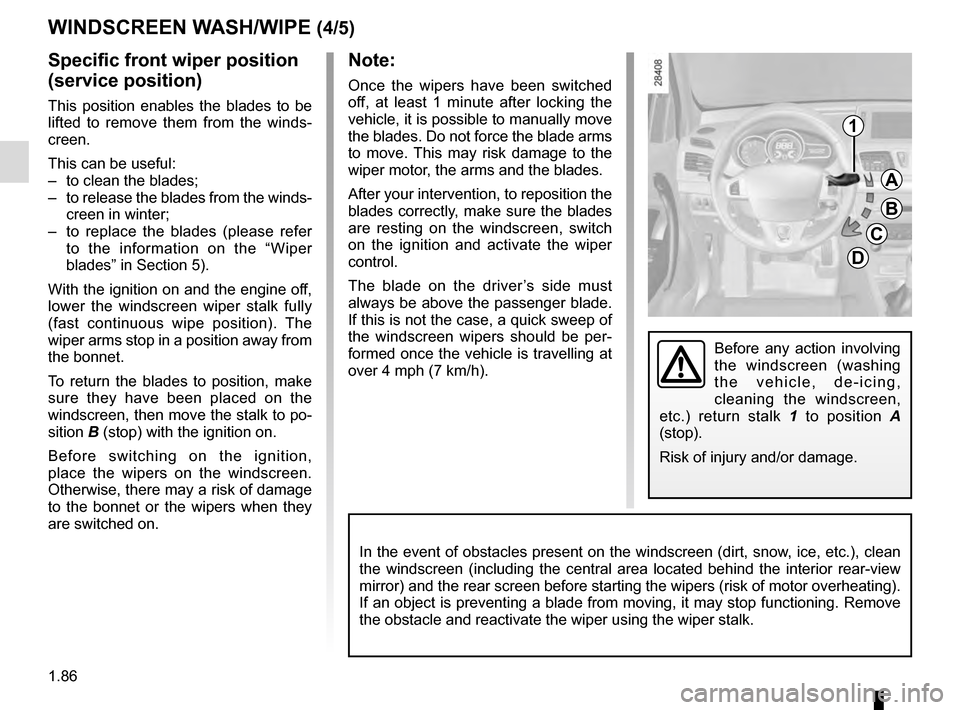
With the ignition on and the engine off,
lower the windscreen wiper stalk fully
(fast continuous wipe position). The
wiper arms stop in a position away from
the bonnet.
To return the blades to position, make
sure they have been placed on the
windscreen, then move the stalk to po-
sition B (stop) with the ignition on.
Before switching on the ignition,
place the wipers on the windscreen.
Otherwise, there may a risk of damage
to the bonnet or the wipers when they
are switched on.
Note:
Once the wipers have been switched
off, at least 1 minute after locking the
vehicle, it is possible to manually move
the blades. Do not force the blade arms
to move. This may risk damage to the
wiper motor, the arms and the blades.
After your intervention, to reposition the
blades correctly, make sure the blades
are resting on the windscreen, switch
on the ignition and activate the wiper
control.
The blade on the driver’s side must
always be above the passenger blade.
If this is not the case, a quick sweep of
the windscreen wipers should be per-
formed once the vehicle is travelling at
over 4 mph (7 km/h).
1
A
B
C
D
In the event of obstacles present on the windscreen (dirt, snow, ice, etc.), clean
the windscreen (including the central area located behind the interior \
rear-view
mirror) and the rear screen before starting the wipers (risk of motor \
overheating).
If an object is preventing a blade from moving, it may stop functioning.\
Remove
the obstacle and reactivate the wiper using the wiper stalk.
Before any action involving
the windscreen (washing
the vehicle, de-icing,
cleaning the windscreen,
etc.) return stalk 1 to position A
(stop).
Risk of injury and/or damage.
Page 95 of 274

1.89
Vehicles running on ethanol-based
fuel
It is essential to use unleaded petrol or
fuel containing a maximum of 85% eth-
anol (E85).
In very cold conditions, it may be very
difficult or even impossible to start the
engine. To avoid this problem, use un-
leaded petrol or, on equipped vehicles,
use the heater integrated in the engine:
connect the special end of the exten-
sion piece supplied into the socket in-
tegrated into the radiator grille and the
other end into a 220V socket for at least
6 hours before starting.
Note: you may notice an increase in
fuel consumption with this type of fuel.
Useable fuel tank capacity:
59 litres approximately.
With the vehicle unlocked, to open the
compartment B, place your finger into
the recess C.
Valve A is integrated into the filler pipe.
For details on filling the fuel tank, refer
to the information on “Filling with fuel”.
To close it, press on the fuel filler flap by
hand, as far as it will go.
Fuel gradeUse a high-grade fuel that complies
with the legislation in force in each
country and which must conform to the
specifications given on the label on the
cover B . Refer to the information on
“Engine specifications” in Section 6.
Diesel versions
It is essential to use diesel fuel that
conforms with the information given on
the label inside cover B.
Petrol versions
It is essential to use unleaded petrol.
The octane rating (RON) must conform
to the specifications on the label inside
fuel filler flap B. Refer to the information
on “Engine specifications” in Section 6.
FUEL TANK (1/3)
B
C
Never press valve A with your fingers.
Do not wash the filler area with a high pressure washer.
Do not mix even small
amounts of petrol (un-
leaded or E85) with diesel.
Do not use ethanol-based
fuel if your vehicle is not compatible
with this fuel.
Do not add additive to the fuel –
otherwise you risk damaging the
engine.
A
Page 101 of 274

2.3
STARTING, STOPPING THE ENGINE (1/3)
Remote control RENAULT
card
When you get into the vehicle, insert the
RENAULT card fully into card reader 2.
To start, press button 1. If a gear is en-
gaged, depress the clutch pedal to start
the vehicle.
Hands-free RENAULT card
The RENAULT card must be inserted
in card reader 2 or in detection zone 3.
To start, depress the brake or clutch
pedal and press button 1. If a gear is
engaged, the vehicle may only be star-
ted by depressing the clutch pedal.
Starting the vehicle
– For vehicles with automatic gear- boxes, set the lever to position P.
– If one of the starting conditions is not met, the message “Press brake +
START”, “Press clutch + START” or
“Gear leverto P” is displayed on the
instrument panel.
– In some cases it will be necessary to move the steering wheel while
pressing the start button 1 to help
unlock the steering column; the mes-
sage “Turn steering wheel + START”
warns you.
Special note: if starting the engine
when the outdoor temperature is very
low (below - 10 ° C): hold down the
clutch pedal until the engine starts.
“Hands-free” starting with
the tailgate open
In this case, the RENAULT card must
not be located in the luggage compart-
ment.
3
1
2