2016 RENAULT MEGANE COUPE roof
[x] Cancel search: roofPage 157 of 274
3.13
ELECTRIC WINDOWS/ELECTRIC SUNROOF (2/4)
Electric windows
Press or pull the switch to raise or lower
a window to the desired height (the rear
windows do not open fully);
One-touch mode
This mode works in addition to the ope-
ration of the electric windows descri-
bed previously. It either operates on the
front windows only, or on all the win-
dows.
Briefly press or pull the window switch
fully: the window is fully lowered or
raised. Pressing the switch again stops
the window moving.
Note: if the window detects resistance
when closing (e.g. tree branch, etc.), it
stops and then lowers again by a few
centimetres.
When closing the windows,
ensure that no part of the
body (arm, hand, etc.) is
protruding from the vehicle.
Risk of serious injury.
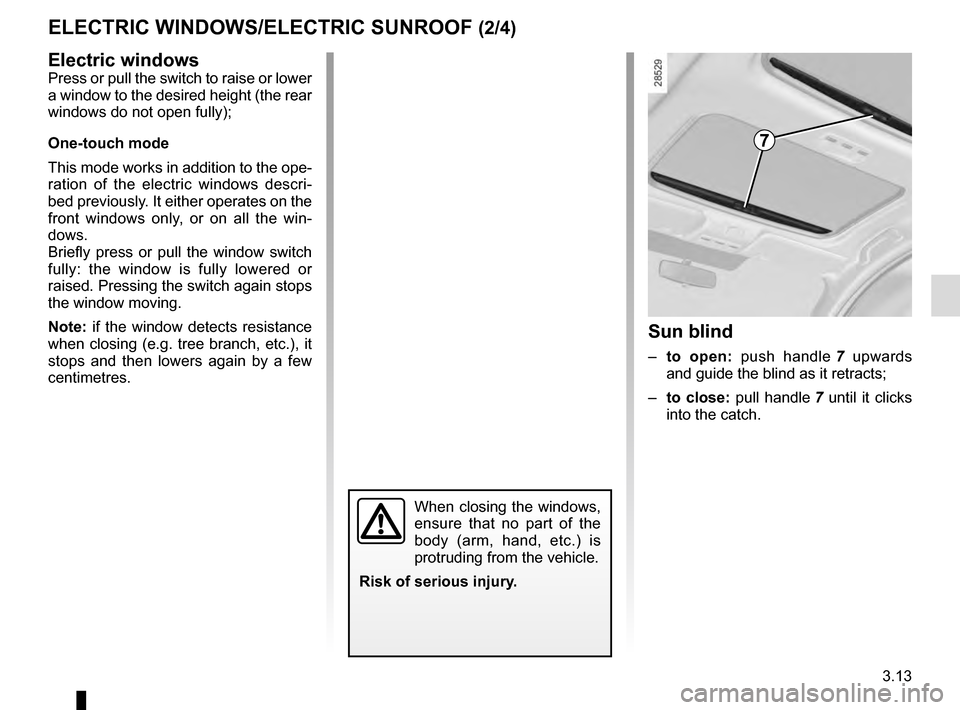
7
Sun blind
– to open: push handle 7 upwards
and guide the blind as it retracts;
– to close: pull handle 7 until it clicks
into the catch.
Page 158 of 274

3.14
ELECTRIC WINDOWS/ELECTRIC SUNROOF (3/4)
0
AB
C
D
98
Sunroof
– Open the sun blind
– To open slightly: turn button 9 to
position A;
– To open fully: turn button 9 to po-
sition B , C or D, depending on the
opening position required;
– To close: turn button 9 to position 0.
Special noteYour vehicle is equipped with an anti-
pinch facility: when the sunroof encoun-
ters resistance whilst closing, (some-
body’s fingers, etc.) it stops and then
moves back several centimetres.
Driver’s responsibility
Never leave your vehicle
with the RENAULT card
inside, and never leave a
child who is not self-sufficient or a
pet, even for a short while.
The reason for this is that the child
may endanger himself or others by
starting the engine, activating equip-
ment such as the window winders
for example, or locking the doors.
If something gets trapped, reverse
the direction of travel as soon as
possible by turning button 9 fully to
the right (position D).
Risk of serious injury.
Page 159 of 274
3.15
ELECTRIC WINDOWS/ELECTRIC SUNROOF (4/4)
Remote control window
closing
(for vehicles with one-touch windows
on all windows).
When you lock the doors from the out-
side, press the locking button on the
RENAULT card twice in quick suc-
cession, or on the driver's door in
hands-free mode, and all the windows
will close automatically.
It is recommended that the user only
operates the system when the vehi-
cle can be seen clearly and no one is
inside.
Note: locking the doors using the
RENAULT card deactivates hands-free
mode.
Closing windows can cause
serious injury.
If the vehicle is equipped
with this function, this action
will activate deadlocking.
Check that there is no-one
still inside the vehicle
Operating faults
Electric windows
In case of a fault when closing a window,
the system reverts to normal mode:
pull the switch concerned up as often
as necessary to fully close the window
(the window will close gradually), hold
the switch (still on the closure side) for
three seconds then lower and raise the
window fully to reinitialise the system.
If necessary, contact your approved
Dealer.
Electric sunroof
If the roof does not close, turn button 9
to the position 0 and then press button 8
until the roof is fully closed: consult an
approved Dealer.
Important: during this operation, the
sunroof anti-pinch facility is deac-
tivated. Contact your approved
dealer as soon as possible.
Precautions during use
– check that the sunroof is properly
closed before leaving your vehicle;
– clean the seal every three months using products recommended by our
Technical Department;
– do not open the sunroof immedia-
tely after the vehicle has been in
the rain or after your car has been
washed.
– Vehicle with roof bars As a general rule, if there is a load
on the roof, use of the sunroof is not
recommended.
Before using the sunroof, check the
objects and/or accessories (bike
racks, roof boxes, etc.) attached to
the roof bars: they should be pro-
perly arranged and secured and
should not interfere with the opera-
tion of the sunroof.
Contact your approved Dealer for
details of possible conversions.
Page 180 of 274
3.36
ROOF BARS: ACCESS TO FIXING POINTS
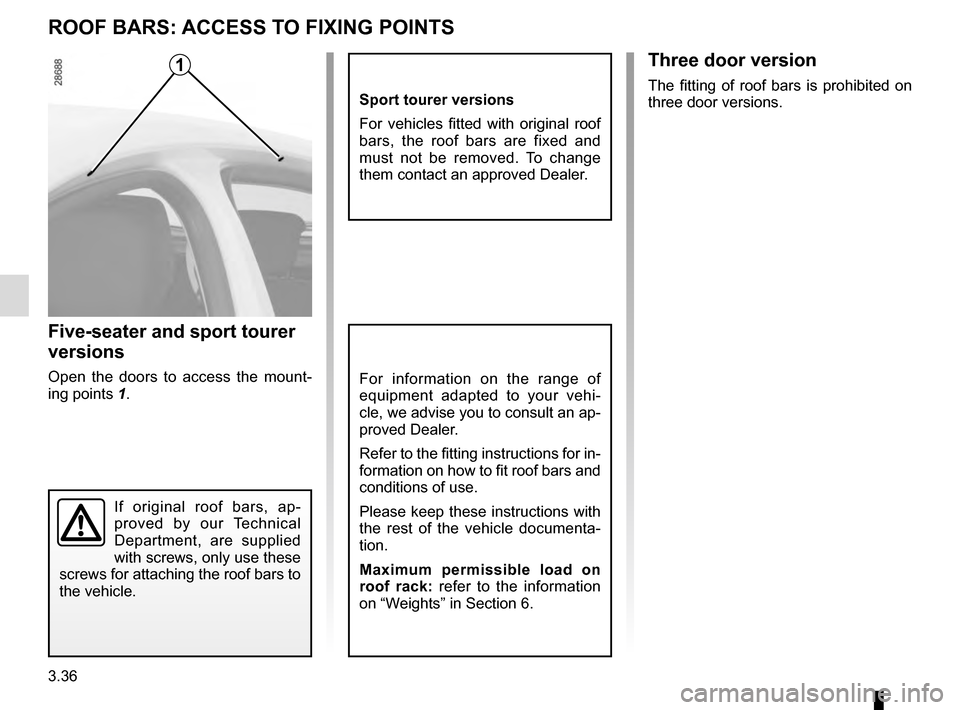
Five-seater and sport tourer
versions
Open the doors to access the mount-
ing points 1.For information on the range of
equipment adapted to your vehi-
cle, we advise you to consult an ap-
proved Dealer.
Refer to the fitting instructions for in-
formation on how to fit roof bars and
conditions of use.
Please keep these instructions with
the rest of the vehicle documenta-
tion.
Maximum permissible load on
roof rack: refer to the information
on “Weights” in Section 6.
1
Sport tourer versions
For vehicles fitted with original roof
bars, the roof bars are fixed and
must not be removed. To change
them contact an approved Dealer.
If original roof bars, ap-
proved by our Technical
Department, are supplied
with screws, only use these
screws for attaching the roof bars to
the vehicle.
Three door version
The fitting of roof bars is prohibited on
three door versions.
Page 253 of 274

The weights indicated for a basic vehicle without options: they vary dep\
ending on the your vehicle’s equipment. Consult
your approved Dealer.
Five doorEstateThree door
Maximum")
6.9
WEIGHTS (in kg)
The weights indicated for a basic vehicle without options: they vary dep\
ending on the your vehicle’s equipment. Consult
your approved Dealer.
Five doorEstateThree door
Maximum permissible all-up weight (MMAC)
Gross Train Weight (MTR) Weights are indicated on the vehicle identification plate (refer to
the information on “Vehicle identification plates” in Section 6)
Braked trailer weight* found by calculating: MTR - MMAC
Unbraked trailer weight* 635
Permissible nose weight* 75
Permissible load on the roof with the carrying device 80 kg (including the carrying device) Prohibited
* Towing weight (towing a caravan, boat, etc.)
Towing is prohibited when the MTR - MMAC calculation is equal to zero, or\
when the MTR is equal to zero (or is not listed) on t he
identification plate.
– It is important to comply with the towing weights, governed by local leg\
islation in each country and, in particular, laid down in the Road Traffic Regulations. Contact an approved Dealer about any towing equipment.
– When towing, under no circumstances may the total train weight (vehicle + trailer) be exceeded . However the following is
permitted:
– rear axle MMTA exceeded by no more than 15%,
– maximum MMAC exceeded by no more than 10% or 100 kg (whichever is reach\
ed first).
In either case, the maximum speed of the vehicle and trailer must not ex\
ceed 60 mph (100 km/h) and the tyre pressures must be increased by 0.2 bar (3 PSI).
– The engine output and climbing capability are reduced with altitude. We recommend that the maximum load be reduced by 10% at an altitude of 1,000 metres and by an additional 10% for each 1,000 m\
etres thereafter.
Load transfer Sport Tourer versions
If the Maximum Authorised Mass of the vehicle has not been reached, up to 200 kg can be\
transferred to the braked trailer, with in
the limits of the Gross Train Weight.
Page 270 of 274

N
navigation .............................................................\
............. 3.37
navigation system ..........................................................")
7.4
ALPHABETICAL INDEX (4/5)
N
navigation .............................................................\
............. 3.37
navigation system .............................................................. 3.37
O
oil change ..................................................................4.4 → 4.8
opening the doors ..................................................1.10 → 1.13
operating faults ................................ 1.58 → 1.61, 5.36 → 5.41
P
paintwork maintenance ..................................................... 4.16 – 4.17
parking distance control.........................................2.37 → 2.42
power-assisted steering.................................................\
.... 1.53
pretensioners ..........................................................\
........... 1.25
puncture.................................................... 5.2, 5.8, 5.10 – 5.11
R
radio...................................................................\
................ 3.37 fitting a radio ................................................................ 5.31
range with fuel ................................................................... 1.67
rear bench seat....................................................... 3.24 – 3.25
rear parcel shelf ...................................................... 3.27 – 3.28
rear screen de-icing/demisting ..................................... 3.5, 3.9
rear seats functions ........................................................... 3.24 – 3.25
rear view camera .................................................... 2.41 – 2.42
rear view mirrors ................................................................ 1.32
RENAULT ANTI-INTRUDER DEVICE (RAID) ................... 1.14
RENAULT card battery ................................................................\
.......... 5.30
use ....................................................................\
...1.2 → 1.9
RENAULT card battery ...................................................... 5.30
replacement parts .............................................................. 6.10
reverse gear selecting .................................................. 2.11, 2.43 → 2.45reversing sensor ....................................................2.37
→ 2.40
roof bars ........................................................................\
.... 3.36
roof rack roof bars ....................................................................... 3.36
running in ........................................................................\
..... 2.2
S
screen wash/wipe .............................................................. 1.88
seat belt pretensioners ..........................................1.25 → 1.28
front seat belt ...................................................1.25 → 1.28
seat belts ..................................1.22 → 1.28, 1.30 – 1.31, 1.61
see-me-home lighting ............................................... 1.80, 1.82
service sheets........................................................ 6.11 → 6.16
side indicator lights changing bulbs ............................................................. 5.23
side protection devices ...................................................... 1.30
signals and lights ...................................................1.78 → 1.82
speakers location ...............................................................\
......... 5.31
special features of diesel versions.....................................\
2.10
special features of petrol vehicles ....................................... 2.9
speed limiter .................................................1.59, 2.30 → 2.32
starting the engine .....................................................2.3 → 2.8
steering wheel adjustment .............................................................\
...... 1.53
Stop & Start ...............................................................2.6 → 2.8
Stop & Start function..................................................2.6 → 2.8
stopping the engine ...................................................2.3 → 2.5
storage compartment.............................................3.19 → 3.22
storage compartments ..................... 3.19 → 3.22, 3.29 → 3.31
storing the driver’s seat position ........................................ 1.20
sun visor ................................................................... 3.13, 3.16
sunroof.................................................................\
... 3.14 – 3.15
switching on the vehicle ignition .......................................... 2.4