Page 183 of 284
3.23
Note: make sure the tray is put back in
place correctly before lifting the back of
the centre seat. Check that the back of
the centre seat is properly locked.
PASSENGER COMPARTMENT STORAGE/FITTINGS (5/6)
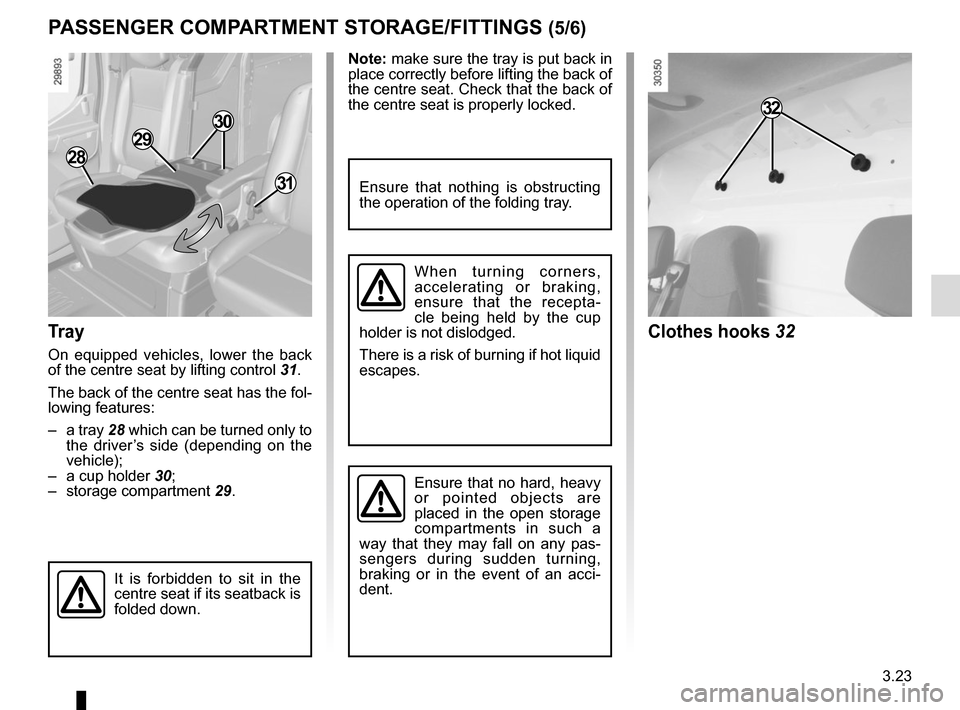
Tray
On equipped vehicles, lower the back
of the centre seat by lifting control 31.
The back of the centre seat has the fol-
lowing features:
– a tray 28 which can be turned only to
the driver’s side (depending on the
vehicle);
– a cup holder 30;
– storage compartment 29.
When turning corners,
accelerating or braking,
ensure that the recepta-
cle being held by the cup
holder is not dislodged.
There is a risk of burning if hot liquid
escapes.
It is forbidden to sit in the
centre seat if its seatback is
folded down.
Ensure that no hard, heavy
or pointed objects are
placed in the open storage
compartments in such a
way that they may fall on any pas-
sengers during sudden turning,
braking or in the event of an acci-
dent.
Ensure that nothing is obstructing
the operation of the folding tray.
28
29
30
31
Clothes hooks 32
32
Page 184 of 284
3.24
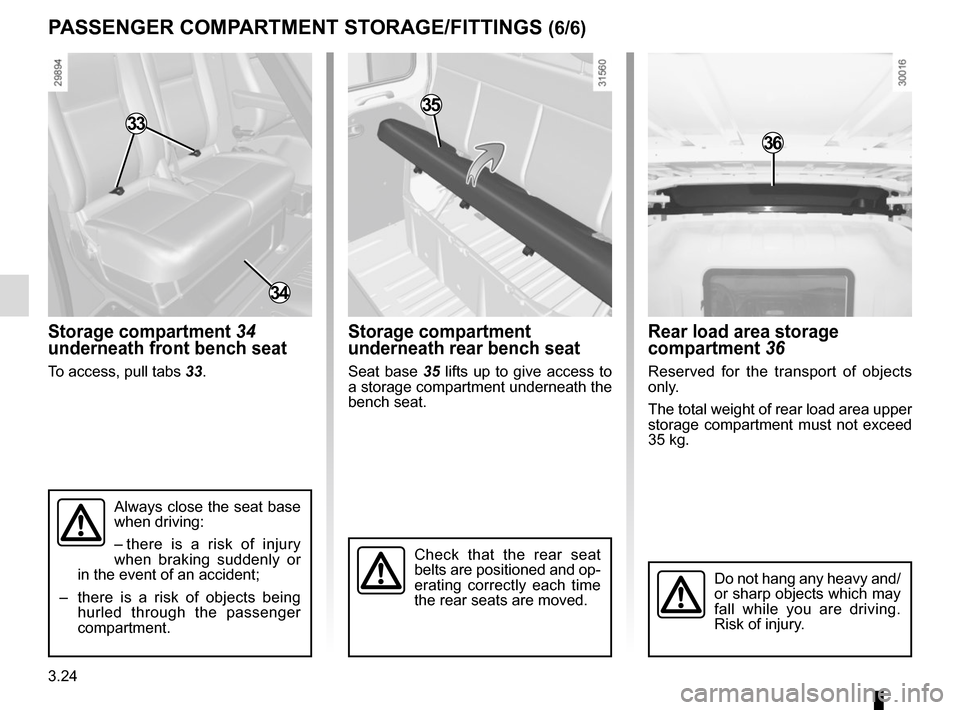
Storage compartment 34
underneath front bench seat
To access, pull tabs 33.
Rear load area storage
compartment 36
Reserved for the transport of objects
only.
The total weight of rear load area upper
storage compartment must not exceed
35 kg.
PASSENGER COMPARTMENT STORAGE/FITTINGS (6/6)
Do not hang any heavy and/
or sharp objects which may
fall while you are driving.
Risk of injury.
36
Storage compartment
underneath rear bench seat
Seat base 35 lifts up to give access to
a storage compartment underneath the
bench seat.
35
Check that the rear seat
belts are positioned and op-
erating correctly each time
the rear seats are moved.
Always close the seat base
when driving:
– there is a risk of injury
when braking suddenly or
in the event of an accident;
– there is a risk of objects being hurled through the passenger
compartment.
33
34
Page 185 of 284
3.25
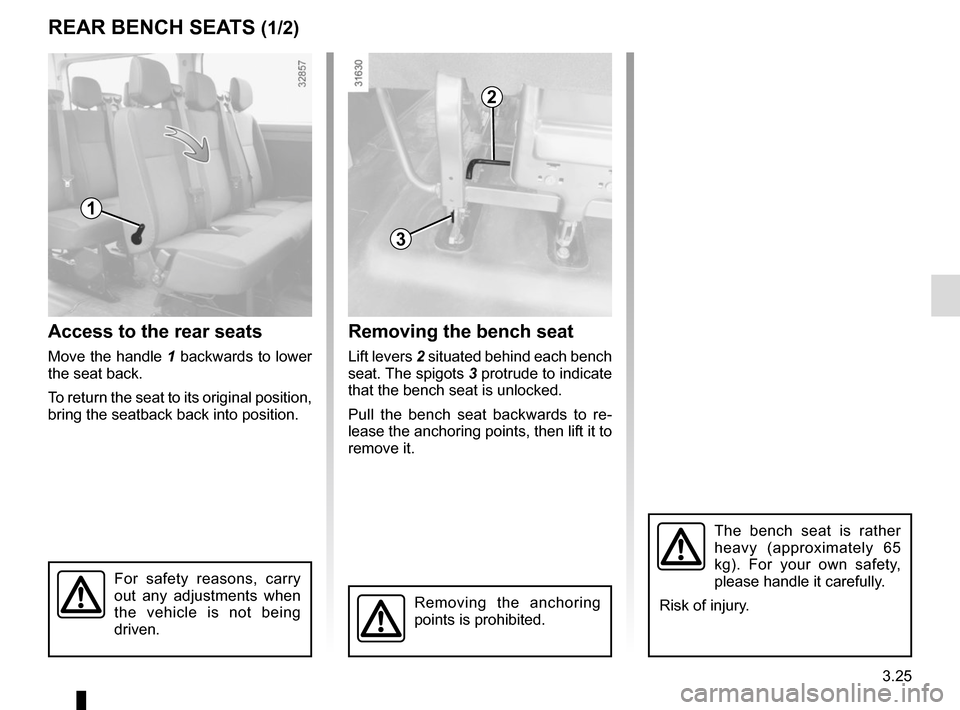
Access to the rear seats
Move the handle 1 backwards to lower
the seat back.
To return the seat to its original position,
bring the seatback back into position.
REAR BENCH SEATS (1/2)
Removing the bench seat
Lift levers 2 situated behind each bench
seat. The spigots 3 protrude to indicate
that the bench seat is unlocked.
Pull the bench seat backwards to re-
lease the anchoring points, then lift it to
remove it.
For safety reasons, carry
out any adjustments when
the vehicle is not being
driven.
Removing the anchoring
points is prohibited.
1
2
The bench seat is rather
heavy (approximately 65
kg). For your own safety,
please handle it carefully.
Risk of injury.
3
Page 186 of 284
3.26
REAR BENCH SEATS (2/2)
When moving the rear
bench seat, check that
the bench seat anchor-
age points are clean (they
should be free from grit, cloths or
any other item which may prevent
the bench seat from locking se-
curely).
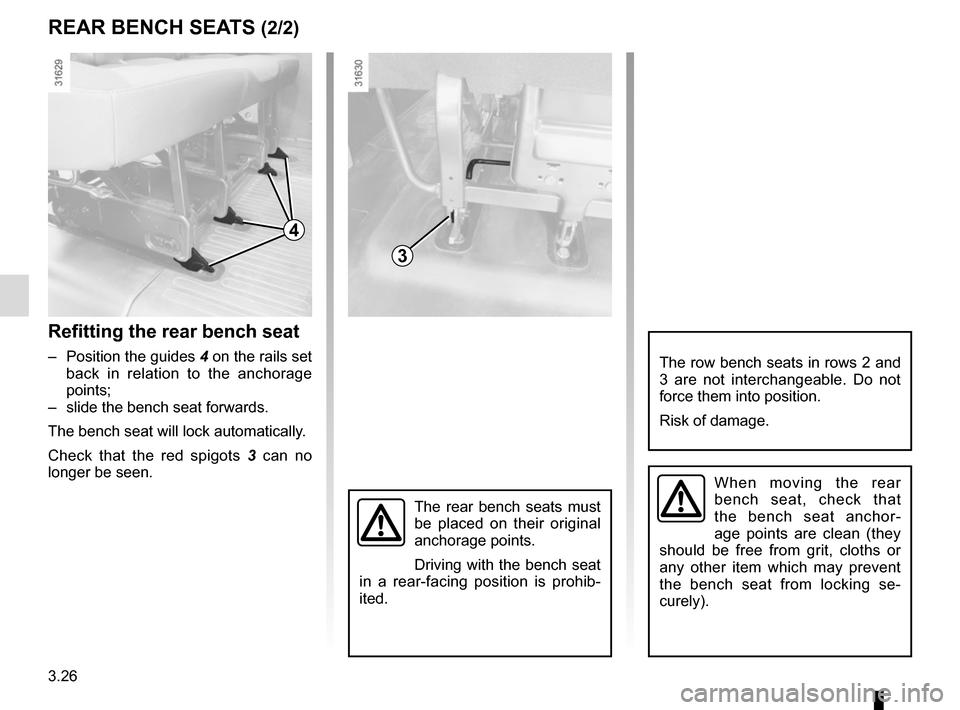
Refitting the rear bench seat
– Position the guides 4 on the rails set
back in relation to the anchorage
points;
– slide the bench seat forwards.
The bench seat will lock automatically.
Check that the red spigots 3 can no
longer be seen.
The rear bench seats must
be placed on their original
anchorage points.
Driving with the bench seat
in a rear-facing position is prohib-
ited.
4
3
The row bench seats in rows 2 and
3 are not interchangeable. Do not
force them into position.
Risk of damage.
Page 188 of 284
3.28
TRANSPORTING OBJECTS (1/2)
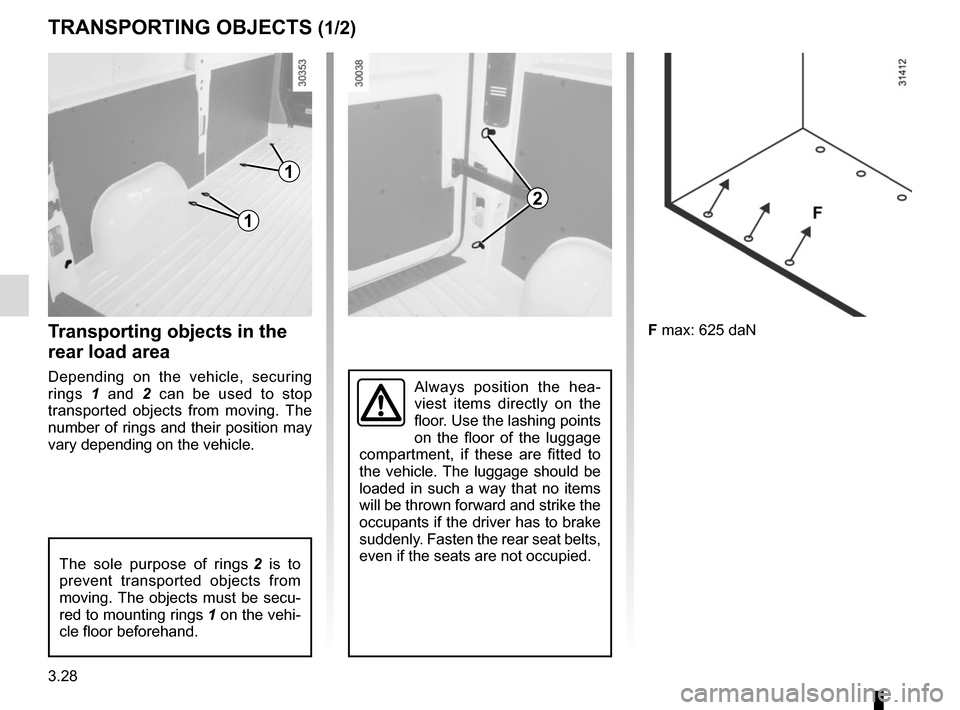
F max: 625 daN
Always position the hea-
viest items directly on the
floor. Use the lashing points
on the floor of the luggage
compartment, if these are fitted to
the vehicle. The luggage should be
loaded in such a way that no items
will be thrown forward and strike the
occupants if the driver has to brake
suddenly. Fasten the rear seat belts,
even if the seats are not occupied.
Transporting objects in the
rear load area
Depending on the vehicle, securing
rings 1 and 2 can be used to stop
transported objects from moving. The
number of rings and their position may
vary depending on the vehicle.
2
1
1
The sole purpose of rings 2 is to
prevent transported objects from
moving. The objects must be secu-
red to mounting rings 1 on the vehi-
cle floor beforehand.
Page 206 of 284

4.16
Glass instrument panel(e.g.: instrument panel, clock, exterior
temperature display, radio display, mul-
timedia or multifunction display etc.)
Use a soft cloth (or cotton wool).
If this does not clean them properly,
use a soft cloth (or cotton wool) slightly
moistened with soapy water and then
wipe clean with another soft damp cloth
or cotton wool.
Finally, carefully dry off with a soft dry
cloth.
Do not use products containing alco-
hol and/or spray fluids on the area.
Seat belts
These must be kept clean.
Use products selected by our Technical
Department (Approved outlets) or
warm, soapy water and a sponge and
wipe with a dry cloth.
Detergents or dyes must not be used
under any circumstances.
INTERIOR TRIM MAINTENANCE (1/2)
Textiles (seats, door trim, etc)
Vacuum-clean the textiles regularly.
Liquid stain
Use soapy water.
Dab lightly (never rub) with a soft cloth,
rinse and remove the excess.
Solid or pasty stain
Carefully remove the excess solid or
pasty material immediately with a
spatula (working from the edges to the
centre to avoid spreading the stain).
Clean as for a liquid stain.
Special instructions for sweets or
chewing gum
Put an ice cube on the stain to solidify
it, then proceed as for a solid stain.
A well-maintained vehicle will last
longer. It is therefore recommended to
maintain the interior of the vehicle regu-
larly.
A stain should always be dealt with
swiftly.
Whatever type of stain is on the trim,
use
cold (or warm) soapy water with
natural soap.
Detergents (washing-up liquid, pow-
dered products, alcohol-based prod-
ucts) should not be used.
Use a soft cloth.
Rinse and soak up the excess.
For further recommendations for
maintaining the interior, and/or for
any unsatisfactory results, please
see an authorised dealer.
Page 212 of 284
5.4
TOOL KIT
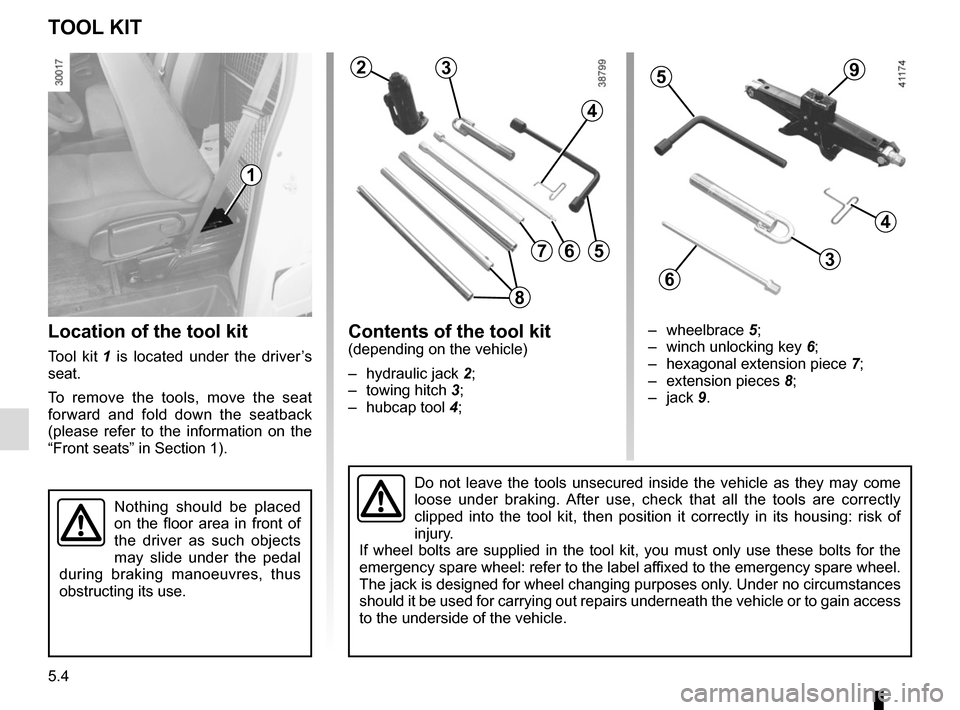
Location of the tool kit
Tool kit 1 is located under the driver’s
seat.
To remove the tools, move the seat
forward and fold down the seatback
(please refer to the information on the
“Front seats” in Section 1).
Contents of the tool kit(depending on the vehicle)
– hydraulic jack 2;
– towing hitch 3;
– hubcap tool 4;
1
Do not leave the tools unsecured inside the vehicle as they may come
loose under braking. After use, check that all the tools are correctly
clipped into the tool kit, then position it correctly in its housing: ri\
sk of
injury.
If wheel bolts are supplied in the tool kit, you must only use these bol\
ts for the
emergency spare wheel: refer to the label affixed to the emergency spare wheel.
The jack is designed for wheel changing purposes only. Under no circumstances
should it be used for carrying out repairs underneath the vehicle or to \
gain access
to the underside of the vehicle.
Nothing should be placed
on the floor area in front of
the driver as such objects
may slide under the pedal
during braking manoeuvres, thus
obstructing its use.
23
4
56
– wheelbrace 5;
– winch unlocking key 6;
– hexagonal extension piece 7;
– extension pieces 8;
– jack 9.
59
4
3
6
7
8
Page 214 of 284
5.6
TYRE INFLATION KIT (2/6)
Inflation kit C
Depending on the vehicle, in the event
of a puncture, use inflation kit 1 located
underneath the driver’s seat.
Move the driver’s seat forward and fold
down the seatback to access the infla-
tion kit.
Open it. Screw compressor adapter
3 to contai-
ner 2 and clip onto compressor D.
The bottle must remain in an upright
position.
Unscrew the valve cap on the tyre
concerned.
Screw inflation adapter 4 onto the
valve.
Before using this kit, park the vehicle at a sufficient distance from traffic,
switch on the hazard warning lights, apply the handbrake, ask all passen\
-
gers to leave the vehicle and keep them away from traffic.Do not pull out the foreign
body causing the puncture
if it is still in the tyre.
2
D
3
41
If the vehicle is parked on
the hard shoulder, you must
warn other road users of
your vehicle’s presence
with a warning triangle or with other
devices as per the legislation ap-
plying to the country you are in.C