Page 159 of 284

2.45
SEQUENTIAL GEARBOX (5/6)
Special circumstances
Snow mode
(depending on vehicle)
If you are driving on ground where you
are likely to skid (snow, mud, etc.),
press switch 7 and indicator light
â
on the instrument panel will come on.
Once these driving conditions no
longer apply, exit this position by
pressing switch again; the operat-
ing tell-tale goes out. Switching to snow mode selects the
gearbox automatic mode (switching to
manual deselects snow mode until au-
tomatic mode is selected again).
Snow mode is deselected every time
the engine is switched off. It will be nec-
essary to select it again.
Load position
When the vehicle is driven loaded,
press the 8
switch on the dashboard.
The indicator light
§ on the instru-
ment panel will light up.
Load mode is deselected every time
the engine is switched off. It will be nec-
essary to select it again.
Load mode may be used to equal effect
in both automatic and manual modes.
Accelerating and overtaking
– slowly depress the accelerator pedal to accelerate gradually;
– to obtain maximum vehicle per-
formance regardless of the mode
selected (automatic or manual),
quickly depress the accelerator
pedal beyond the kickdown point.
The speed with which you depress the
pedal will allow you to downshift ac-
cording to the vehicle’s capabilities.
Parking
It is possible to park in gear (for exam-
ple, on a slope):
– with the ignition on, select a gear with your foot on the brake ;
– check that a gear other than N is dis- played on the instrument panel, then
remove the ignition key;
– apply the handbrake.
To disengage the gear, switch on the
ignition without starting the engine and
shift the selector lever to neutral with
the brake pedal depressed . Check
that N is displayed on the instrument
panel.
7
8
Page 160 of 284

2.46
SEQUENTIAL GEARBOX (6/6)
Bleep
– If you hold the vehicle on a slope for too long without applying the
brakes or handbrake, you will strain
the system (risk of overheating the
clutch).
In this case, an intermittent beep-
ing sound will remind you that you
should put your foot on the brake
pedal or apply the handbrake.
– Never leave the vehicle with the engine running when in gear. For
safety reasons you will hear an in-
termittent beeping sound when you
open the door if you have not shifted
into neutral or you have not switched
off the ignition or depressed the
brake pedal.
Operating faults
i
If this warning light comes on
when the vehicle is in motion , it
indicates a fault in the system. In most
cases, you may still drive the vehicle,
although it will not function perfectly.
Contact an approved dealer as soon as
possible.
Towing a vehicle with a sequential
gearbox
If the gearbox is stuck in a gear:
– switch on the ignition;
– select neutral with the brake pedal
depressed;
– check that the gearbox is in neutral (by pushing the vehicle, for exam-
ple).
If you cannot find neutral you must tow
the vehicle with the front wheels raised.
The vehicle should always be towed
with the ignition switched off.
Page 174 of 284

3.14
WINDOWS (1/2)
Avoid resting any objects against a
half-open window: there is a risk that
the electric window winder could be
damaged.
1
2
3
Electric windows
With the ignition on:
– press the switch for the window concerned to lower it to the desired
height;
– lift the switch for the window concer- ned to raise it to the desired height.
From the driver’s seat
Operate the switches as follows:
– 1 for the driver’s side;
– 2 for the front passenger side. From the front passenger seat
Press switch 3.
Driver’s responsibility
Never leave your vehi-
cle with the key, remote
control or transmitter-recei-
ver inside, and never leave a child,
adult who is not self-sufficient or a
pet, even for a short while. They
may pose a risk to themselves or to
others by starting the engine or acti-
vating equipment (such as the gear
lever or electric windows). If any
part of the body becomes trapped,
reverse the direction of the window
immediately by pressing the rele-
vant switch.
Risk of serious injury.
Page 176 of 284
3.16
INTERIOR LIGHTING
12
Courtesy light
Use switch 1 to:
– permanent lighting;
– intermittent lighting, which comes on when a door is opened. It goes out
when the doors concerned are prop-
erly closed;
– immediate switching off.
Map reading lights(depending on the vehicle)
Move switch 2.
Note
Remote unlocking of the doors triggers
timed lighting of the passenger com-
partment.
If one of the front or rear doors is
opened, the timed lighting will start
again.
Then the courtesy light and the luggage
compartment light dim and go out. The
lighting timer will cut out for various rea-
sons:
– if a door has been open for 15 min- utes;
– if all the doors have been closed for 15 seconds:
– when the ignition is switched on.
Rear light 3
Turn switch 4 to:
– switch on continuous lighting;
– switch on intermittent lighting when one of the rear doors is opened. The
lights only go out when the doors are
correctly closed;
– force the lights off.
3
4
Page 178 of 284
3.18
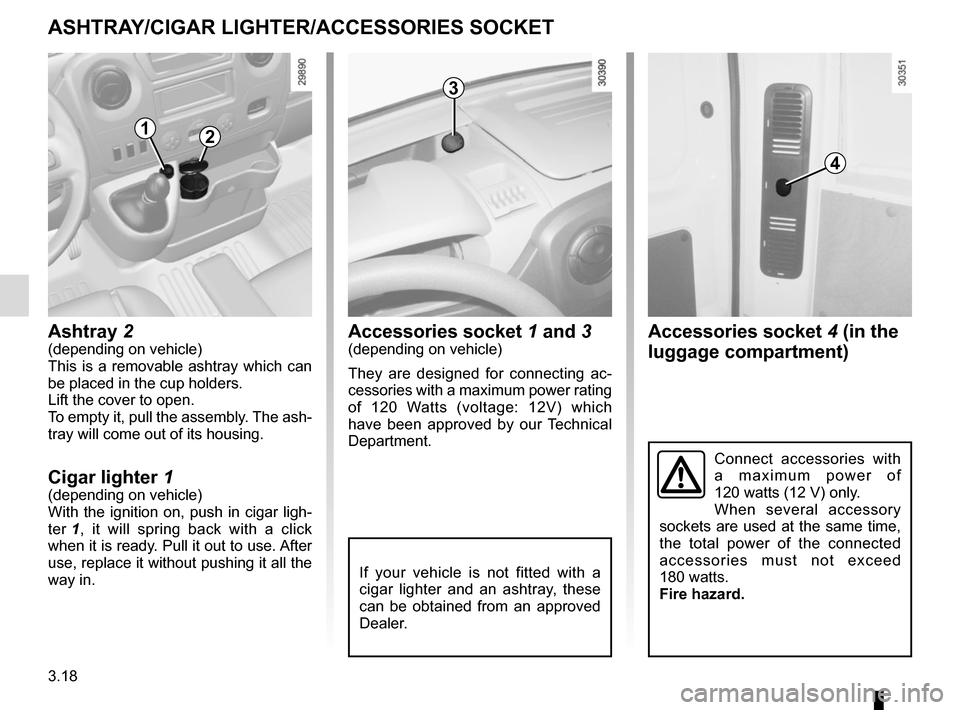
Accessories socket 4 (in the
luggage compartment)
ASHTRAY/CIGAR LIGHTER/ACCESSORIES SOCKET
Accessories socket 1 and 3(depending on vehicle)
They are designed for connecting ac-
cessories with a maximum power rating
of 120 Watts (voltage: 12V) which
have been approved by our Technical
Department.Ashtray 2(depending on vehicle)
This is a removable ashtray which can
be placed in the cup holders.
Lift the cover to open.
To empty it, pull the assembly. The ash-
tray will come out of its housing.
Cigar lighter 1(depending on vehicle)
With the ignition on, push in cigar ligh-
ter 1, it will spring back with a click
when it is ready. Pull it out to use. After
use, replace it without pushing it all the
way in.
If your vehicle is not fitted with a
cigar lighter and an ashtray, these
can be obtained from an approved
Dealer.
Connect accessories with
a maximum power of
120 watts (12 V) only.
When several accessory
sockets are used at the same time,
the total power of the connected
accessories must not exceed
180 watts.
Fire hazard.
12
4
3
Page 203 of 284

4.13
When the ignition is off, some consu-
mers may also be switched off (dipped
beam headlights, radio, ventilation,
etc.). On the instrument panel, the mes-
sage “BATTERY MODE: ECONOMY”
appears when switched off. When the
level is extremely low, the message
“BATTERY LOW START ENGINE” is
displayed.
The charge status of the battery can
decrease, especially if you use your
vehicle:
– for short journeys;
– for driving in town;
– when the temperature drops;
– with the vehicle stopped and the engine off.
Replacing the battery
As this operation is complex, we advise
you to contact an approved Dealer.
BATTERY
123
456
This is located behind step A and does
not require maintenance. You should
not open it or add any fluid .
Depending on the vehicle, a system
continuously checks the battery charge
status.
Handle the battery with care as it contains sulphuric acid, which must n\
ot
come into contact with eyes or skin. If it does, wash the affected area with
plenty of cold water. If necessary, consult a doctor.
Ensure that naked flames, red hot objects and sparks do not come into
contact with the battery as there is a risk of explosion.
Label B
Observe the indications on the battery:
– 1 naked flames and smoking are for-
bidden;
– 2 eye protection required;
– 3 keep away from children;
– 4 explosive materials;
– 5 refer to the handbook;
– 6 corrosive materials.
The battery is a speci-
fic type, please ensure it
is replaced with the same
type. Consult an approved
dealer.
B
A
Page 241 of 284

5.33
Connecting a battery charger
The battery charger must be com-
patible with a battery with nominal
voltage of 12 volts.
Do not disconnect the battery when the
engine is running. Follow the instruc-
tions given by the manufacturer of
the battery charger you are using.
When many accessories are fitted to
the vehicle, have them connected to
the + after ignition feed .
BATTERY: troubleshooting (1/2)
To avoid all risk of sparks:
– Ensure that any consumers (cour-
tesy lights, etc.) are switched off
before disconnecting or reconnect-
ing the battery;
– when charging, stop the charger before connecting or disconnecting
the battery;
– to avoid creating a short circuit be- tween the terminals, do not place
metal objects on the battery;
– always wait at least one minute after the engine has been switched off
before disconnecting a battery;
– make sure that you reconnect the battery terminals after refitting.
Special procedures may be
required to charge some
batteries. Contact your ap-
proved dealer.
Avoid all risk of sparks which may
cause an immediate explosion, and
charge the battery in a well-venti-
lated area. Risk of serious injury.
Handle the battery with care
as it contains sulphuric acid,
which must not come into
contact with eyes or skin. If
it does, wash the affected area with
plenty of cold water. If necessary,
consult a doctor.
Ensure that naked flames, red hot
objects and sparks do not come into
contact with the battery as there is a
risk of explosion.
The engine may be hot when car-
rying out operations in close prox-
imity. In addition, the engine cooling
fan can come on at any moment.
Risk of injury.
Page 242 of 284

5.34
BATTERY: troubleshooting (2/2)
Attach the positive lead (+) A to termi-
nal 3, then to terminal 2 (+) of the bat-
tery supplying the current.
Attach negative lead (–) B to terminal 1
(–) of the battery supplying the current,
then to earth 4 (–).
Start the engine as normal. As soon as
it is running, disconnect leads A and B
in the reverse order ( 4-3-2-1).
Starting the vehicle using the
battery from another vehicle
If you have to use the battery from an-
other vehicle to start, obtain suitable
jump leads (with a large cross section)
from an approved dealer or, if you al-
ready have jump leads, ensure that
they are in perfect condition.
The two batteries must have an iden-
tical nominal voltage of 12 volts. The
battery supplying the current should
have a capacity (amp-hours, Ah) which
is at least the same as that of the dis-
charged battery.
Ensure that there is no risk of contact
between the two vehicles (risk of short
circuiting when the positive terminals
are connected). Switch off your vehicle
ignition.
Start the engine of the vehicle supply-
ing the current and run it at a moderate
speed.
A
B
21
Check that there is no contact between leads A and B and that the posi-
tive lead A is not touching any metal parts on the vehicle supplying the
current.
Risk of injury and/or damage to the vehicle.
3
4
4
3
