Page 199 of 284

4.9
Coolant
With the engine switched off and on
level ground, the level when cold
must be between the “MIN” and “MAX”
marks on coolant reservoir 2.
Top this level up when cold before the
“MIN” mark is reached.
LEVELS (2/3)
Frequency of checking coolant level
Check the coolant level regularly
(very severe damage is likely to be
caused to the engine if it runs out of
coolant).
If the level needs to be topped up, only
use products approved by our Technical
Department which ensure:
– protection against freezing;
– anticorrosion protection of the cool- ing system.
Replacement intervals
Refer to the Maintenance Document for
your vehicle.
2
Windscreen washer
reservoir 4
Filling
With the engine switched off, open
cap 3, fill until you can see the fluid,
then refit the cap.
Fluid
Special windscreen washer fluid (prod-
uct with antifreeze in winter).
3
4
Consult your approved dealer at
once if you notice an abnormal or
repeated drop in any of the fluid
levels.
No operations should be
carried out on the cooling
circuit when the engine is
hot.
Risk of burns.
Page 203 of 284

4.13
When the ignition is off, some consu-
mers may also be switched off (dipped
beam headlights, radio, ventilation,
etc.). On the instrument panel, the mes-
sage “BATTERY MODE: ECONOMY”
appears when switched off. When the
level is extremely low, the message
“BATTERY LOW START ENGINE” is
displayed.
The charge status of the battery can
decrease, especially if you use your
vehicle:
– for short journeys;
– for driving in town;
– when the temperature drops;
– with the vehicle stopped and the engine off.
Replacing the battery
As this operation is complex, we advise
you to contact an approved Dealer.
BATTERY
123
456
This is located behind step A and does
not require maintenance. You should
not open it or add any fluid .
Depending on the vehicle, a system
continuously checks the battery charge
status.
Handle the battery with care as it contains sulphuric acid, which must n\
ot
come into contact with eyes or skin. If it does, wash the affected area with
plenty of cold water. If necessary, consult a doctor.
Ensure that naked flames, red hot objects and sparks do not come into
contact with the battery as there is a risk of explosion.
Label B
Observe the indications on the battery:
– 1 naked flames and smoking are for-
bidden;
– 2 eye protection required;
– 3 keep away from children;
– 4 explosive materials;
– 5 refer to the handbook;
– 6 corrosive materials.
The battery is a speci-
fic type, please ensure it
is replaced with the same
type. Consult an approved
dealer.
B
A
Page 215 of 284
5.7
TYRE INFLATION KIT (3/6)
To connect the compressor, open the
bonnet and connect black clamp 10
to earth 6 (refer to the information on
“Battery: troubleshooting” in Section 5).
Then connect red clamp 11 to termi-
nal 5.
Before starting the engine,
check that the handbrake is
applied and the gear lever
is in neutral or in position N
for sequential gearboxes.
With the engine running, press switch 7
to start inflating.
After a maximum of 15 minutes, stop in-
flating and read the pressure on pres-
sure gauge 9.
A pressure of at least 4.7 bar must be
reached.
Note: whilst the cylinder is emptying
(approximately 30 seconds), pressure
gauge 9 will briefly indicate a pressure
of up to 6 bar. Then the pressure drops.
1110
7
If the correct pressure cannot be
achieved, repair is impossible. Do
not drive the vehicle. Consult an ap-
proved dealer.
If the pressure is too high, press
button 8 to lower the pressure.
8
9
5
6
6
5
Page 236 of 284

5.28
FUSES (1/5)
1
If any electrical component does not
work, check the condition of the fuses.
Remove the fuse using tweezers 1, lo-
cated at the back of flap A.
To remove the fuse from the tweezers,
slide the fuse to the side.
It is not advisable to use the free fuse
locations.
To comply with legislation, or as a
precaution, you can obtain an emer-
gency kit containing a set of spare
bulbs and fuses from an approved
dealer.
Your vehicle is equipped with two fuse
boxes: in the passenger compartment
and in the engine compartment.
A
Fuses in the passenger
compartment
Unclip flap A using notch B to help you.
To identify the fuses, refer to the fuse
allocation label (see the next page for
details), located on the rear of flap A.
B
Check the fuse in question
and replace it, if neces-
sary, by a fuse of the same
rating.
If a fuse is fitted where the rating is
too high, it may cause the electrical
circuit to overheat (risk of fire) in the
event of an item of equipment using
an excessive amount of current.
Page 238 of 284
5.30
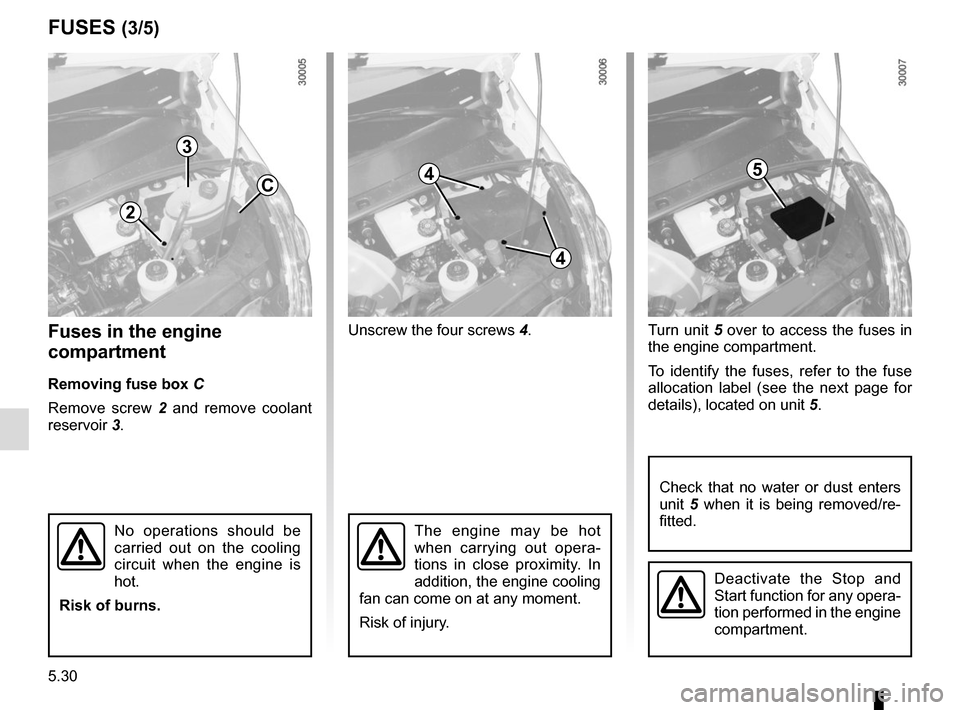
Fuses in the engine
compartment
Removing fuse box C
Remove screw 2 and remove coolant
reservoir 3. Unscrew the four screws
4.Turn unit 5 over to access the fuses in
the engine compartment.
To identify the fuses, refer to the fuse
allocation label (see the next page for
details), located on unit 5.
FUSES (3/5)
2
3
C4
4
5
The engine may be hot
when carrying out opera-
tions in close proximity. In
addition, the engine cooling
fan can come on at any moment.
Risk of injury.No operations should be
carried out on the cooling
circuit when the engine is
hot.
Risk of burns.
Check that no water or dust enters
unit 5 when it is being removed/re-
fitted.
Deactivate the Stop and
Start function for any opera-
tion performed in the engine
compartment.
Page 242 of 284

5.34
BATTERY: troubleshooting (2/2)
Attach the positive lead (+) A to termi-
nal 3, then to terminal 2 (+) of the bat-
tery supplying the current.
Attach negative lead (–) B to terminal 1
(–) of the battery supplying the current,
then to earth 4 (–).
Start the engine as normal. As soon as
it is running, disconnect leads A and B
in the reverse order ( 4-3-2-1).
Starting the vehicle using the
battery from another vehicle
If you have to use the battery from an-
other vehicle to start, obtain suitable
jump leads (with a large cross section)
from an approved dealer or, if you al-
ready have jump leads, ensure that
they are in perfect condition.
The two batteries must have an iden-
tical nominal voltage of 12 volts. The
battery supplying the current should
have a capacity (amp-hours, Ah) which
is at least the same as that of the dis-
charged battery.
Ensure that there is no risk of contact
between the two vehicles (risk of short
circuiting when the positive terminals
are connected). Switch off your vehicle
ignition.
Start the engine of the vehicle supply-
ing the current and run it at a moderate
speed.
A
B
21
Check that there is no contact between leads A and B and that the posi-
tive lead A is not touching any metal parts on the vehicle supplying the
current.
Risk of injury and/or damage to the vehicle.
3
4
4
3
Page 251 of 284

5.43
On the roadPOSSIBLE CAUSESWHAT TO DO
Vibrations. Tyres not inflated to the correct pres-
sure, incorrectly balanced or dam-
aged. Check the tyre pressures: if this is not the
problem, have them checked by an ap-
proved dealer.
Coolant boiling in the coolant reservoir . Mechanical fault: damaged cylinder
head gasket. Stop the engine.
Contact an approved Dealer.
Smoke under the bonnet. Short circuit or cooling system leak.Stop, switch off the ignition, stand away
from the vehicle and contact an approved
dealer.
The oil pressure warning light comes
on: while cornering or braking The level is too low. Top up the engine oil (refer to the informa-
tion on “Engine oil level – Topping up/refill-
ing” in Section 4).
is slow to go out or remains lit under
acceleration Loss of oil pressure.
Stop the vehicle and contact an approved
Dealer.
White smoke from the exhaust. This is not necessarily a fault. Smoke
may be caused by regeneration of
the particle filter. Refer to the information on “Special fea-
tures of diesel versions” in Section 2.
OPERATING FAULTS (2/4)
Page 252 of 284
5.44
On the roadPOSSIBLE CAUSESWHAT TO DO
Steering becomes heavy. Assistance overheating.Consult an approved Dealer.
The engine is overheating. The cool-
ant temperature warning light and the
STOP warning light come on. Engine cooling fan not working. Stop the vehicle, switch off the engine and
contact an approved Dealer.
Coolant leaks. Check the coolant reservoir: it should con-
tain fluid. If there is no coolant, consult an
approved Dealer as soon as possible.
OPERATING FAULTS (3/4)
Radiator: If there is a significant lack of coolant, remember that it must
never be topped up using cold coolant while the engine is very warm.
After any procedure on the vehicle which has involved even partial drain\
-
ing of the cooling system, it must be refilled with a new mixture prepar\
ed
in the correct proportions. Reminder: only products approved by our Technical
Department may be used for this purpose.