2016 RENAULT MASTER side door
[x] Cancel search: side doorPage 37 of 284

1.31
CHILD SAFETY: General information (1/2)
Carrying children
Children, and adults, must be correctly
seated and strapped in for all journeys.
The children being carried in your vehi-
cle are your responsibility.
A child is not a miniature adult. Children
are at risk of specific injuries as their
muscles and bones have not yet fin-
ished growing. The seat belt alone
would not provide suitable protection.
Use an approved child seat and ensure
you use it correctly.
A collision at 30 mph
(50 km/ h) is the same
as falling a distance of
10 metres. Transporting a
child without a restraint is the equiv-
alent of allowing him or her to play
on a fourth-floor balcony without
railings.
Never travel with a child held in your
arms. In the event of an accident,
you will not be able to keep hold of
the child, even if you yourself are
wearing a seat belt.
If your vehicle has been involved
in a road accident, replace the
child seat and have the seat belts
checked.
To prevent the doors being
opened, use the childproof
locks (please refer to the in-
formation on “Locking/un-
locking the doors” in Section 1).
Driver’s responsibility
when parking or stopping
the vehicle
Never leave an animal,
child or adult who is not self-suffi-
cient alone on your vehicle, even for
a short time.
They may pose a risk to themselves
or to others by starting the engine,
activating equipment such as the
electric windows or by locking the
doors.
Also, in hot and/or sunny weather,
please remember that the tempera-
ture inside the passenger compart-
ment increases very quickly.
RISK OF DEATH OR SERIOUS
INJURY.
Page 117 of 284

2.3
STARTING/STOPPING THE ENGINE
Starting the engine
Turn the ignition key to the “Ignition on”
position M and hold this position until
the engine preheating warning light
É goes out.
Stopping the engine
With the engine idling, turn the key to
the “Stop” position St.
Starting the vehicle
For rear-wheel drive versions on
level ground, with the vehicle un-
laden, we recommend that you start
in second gear.
Never switch off the igni-
tion before the vehicle has
stopped completely. Once
the engine has stopped, the
brake servo, power-assisted steer-
ing, etc. and the passive safety de-
vices such as air bags and preten-
sioners will no longer operate.
Driver’s responsibility
when parking or stopping
the vehicle
Never leave an animal,
child or adult who is not self-suffi-
cient alone in your vehicle, even for
a short time.
They may pose a risk to themselves
or to others by starting the engine,
activating equipment such as the
electric windows or locking the
doors, for example.
Also, in hot and/or sunny weather,
please remember that the tempera-
ture inside the passenger compart-
ment increases very quickly.
RISK OF DEATH OR SERIOUS
INJURY.
Never start your vehicle
while freewheeling on a
gradient. Risk of non-acti-
vation of power-assisted
steering.
There is a risk of accidents.
Depending on the vehicle, if a gear is
engaged, the message “Depress clutch
+ start” is displayed on the instrument
panel. Press the clutch pedal.
Turn the key to starter position D with-
out depressing the accelerator
pedal.
Release the key as soon as the engine
starts.
Page 164 of 284

3.4
MANUAL AIR CONDITIONING/HEATING SYSTEM (1/3)
Controls
A Adjusting the amount of air blown into the passenger compartment.
B Air recirculation operation (isolation of the passenger compartment)
C Adjusting the air temperature.
D Activating air conditioning (depend- ing on the vehicle).
E Rear screen and/or door mirror de- icing/demisting.
F Air distribution.
Information and advice for use
Refer to information on “Air condition-
ing: information and advice on use”.
Distribution of air in the
passenger compartment
Turn control F.
JAll the air flow is directed to the
dashboard vents.
This selection is not appropriate if all
the air vents are closed.
GThe air flow is directed to the
dashboard vents and the foot-
wells.
FThe air flow is directed mainly
towards the footwells.
iThe air flow is distributed be-
tween all the air vents, the
front side window demisting vents, the
windscreen demisting vents and the
footwells.
WThe air flow is directed to the
windscreen demisting/de-icing
outlets and the side windows. This po-
sition prevents the formation of conden-
sation. Use at the highest temperature.
VRear screen and/
or door mirror de-icing/
demisting.
Press button E: the integrated indicator
light comes on. This function demists
the rear screen and/or the heated door
mirrors quickly.
To exit this function, press the button
again; the integrated indicator goes
out. Demisting automatically stops by
default.
ABDFCE
Page 171 of 284

3.11
In automatic mode, depending on
the outside air conditions, the ven-
tilation may not start immediately at
maximum power but will increase
progressively until the engine tem-
perature is warm enough to heat the
passenger compartment air. This
may take from a few seconds to
several minutes.
Switching air conditioning on
or off
In automatic mode, the system switches
the air conditioning system on or off,
depending on the climate conditions.
Exit automatic mode by pressing
button 2: AUTO goes out on display 4
and AC OFF lights up.
Note: the “Clear View” function auto-
matically activates the air conditioning.
Press button 3 to return to automatic
mode.
Varying the ventilation speed
In automatic mode, the system uses
the most suitable amount of air to reach
and maintain the desired comfort level.
Exit automatic mode by pressing but-
tons 5 and 7.
These buttons allow you to increase or
decrease ventilation speed.
Rear screen and/or door
mirror de-icing/demisting.
Press button 11: the integrated indica-
tor light comes on.
This function allows electric demisting
of the rear screen and/or the electric
heated door mirrors, depending on the
vehicle.
To exit this function , press button 11
again. Demisting automatically stops
by default.
AUTOMATIC CLIMATE CONTROL (5/6)
23457
11
Page 172 of 284

3.12
Clear View function
Press button 1; the indicator lights in
buttons 1 and 11 come on.
AUTO goes out on display 4.
This function rapidly demists/de-ices
the windscreen, the front side windows
and the door mirrors.
It imposes automatic operation of the
air conditioning and heating of the rear
screen and/or heated door mirrors, and
inhibits air recirculation. Press button
11 if you do not wish to
switch on the heated rear screen and/
or heated door mirrors.
Note: if you wish to reduce the air flow
(which may produce a certain amount
of noise in the passenger compart-
ment), press button 5.
To exit this function , press:
– button 1 again;
– button 3 (AUTO lights up on the dis-
play).
Air recirculation
Pressing button 12 activates air recir-
culation (the symbol lights up on the
display).
During recirculation, air is taken from
the passenger compartment and is re-
cycled, with no air being taken from out-
side the vehicle.
Air recirculation allows the external at-
mosphere to be cut off (when driving in
polluted areas, etc.).
Prolonged use of the air recirculation
mode may cause the windows to mist
up or lead to odours, as the air is not
renewed.
We therefore advise you to return to
normal mode (external air) as soon as
the air recirculation function is no longer
required, by pressing button 12 again.
AUTOMATIC CLIMATE CONTROL (6/6)
35
12
4
11
1
Page 204 of 284
4.14
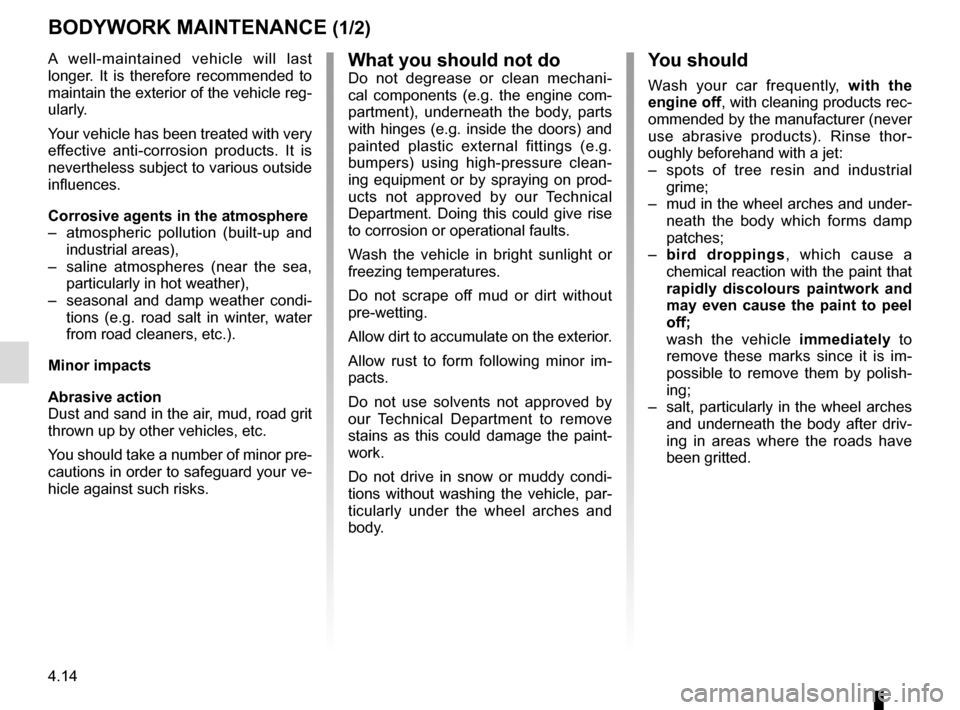
BODYWORK MAINTENANCE (1/2)
You should
Wash your car frequently, with the
engine off, with cleaning products rec-
ommended by the manufacturer (never
use abrasive products). Rinse thor-
oughly beforehand with a jet:
– spots of tree resin and industrial
grime;
– mud in the wheel arches and under-
neath the body which forms damp
patches;
– bird droppings , which cause a
chemical reaction with the paint that
rapidly discolours paintwork and
may even cause the paint to peel
off;
wash the vehicle immediately to
remove these marks since it is im-
possible to remove them by polish-
ing;
– salt, particularly in the wheel arches
and underneath the body after driv-
ing in areas where the roads have
been gritted.
What you should not doDo not degrease or clean mechani-
cal components (e.g. the engine com-
partment), underneath the body, parts
with hinges (e.g. inside the doors) and
painted plastic external fittings (e.g.
bumpers) using high-pressure clean-
ing equipment or by spraying on prod-
ucts not approved by our Technical
Department. Doing this could give rise
to corrosion or operational faults.
Wash the vehicle in bright sunlight or
freezing temperatures.
Do not scrape off mud or dirt without
pre-wetting.
Allow dirt to accumulate on the exterior.
Allow rust to form following minor im-
pacts.
Do not use solvents not approved by
our Technical Department to remove
stains as this could damage the paint-
work.
Do not drive in snow or muddy condi-
tions without washing the vehicle, par-
ticularly under the wheel arches and
body.
A well-maintained vehicle will last
longer. It is therefore recommended to
maintain the exterior of the vehicle reg-
ularly.
Your vehicle has been treated with very
effective anti-corrosion products. It is
nevertheless subject to various outside
influences.
Corrosive agents in the atmosphere
–
atmospheric pollution (built-up and
industrial areas),
– saline atmospheres (near the sea,
particularly in hot weather),
– seasonal and damp weather condi-
tions (e.g. road salt in winter, water
from road cleaners, etc.).
Minor impacts
Abrasive action
Dust and sand in the air, mud, road grit
thrown up by other vehicles, etc.
You should take a number of minor pre-
cautions in order to safeguard your ve-
hicle against such risks.
Page 277 of 284

A
ABS ....................................................................\
...2.16 → 2.20
accessories...................................................................")
7.1
ALPHABETICAL INDEX (1/4)
A
ABS ....................................................................\
...2.16 → 2.20
accessories........................................................................\
5.41
accessories socket ............................................................ 3.18
AdBlue ...............................................................1.103 → 1.108
AdBlue additive..................................................1.103 → 1.108
additional systems to the seat belts................................... 1.29
additive (tank) ....................................................1.103 → 1.108
additive tank ......................................................1.103 → 1.108
adjusting the seats............................................................. 1.22
adjusting your driving position ........................................... 1.22
advice on antipollution ....................................................... 2.12
air bag....................................................................1.26 → 1.29
activating the front passenger air bags ............1.68 → 1.70
deactivating the front passenger air bags ........1.68 → 1.70
air conditioning ........................................................3.2 → 3.13
air vents ...................................................................... 3.2 – 3.3
anti-corrosion check ..............................................6.16 → 6.21
anti-corrosion protection .................................................... 4.14
anti-lock braking system: ABS ...............................2.16 → 2.20
antipollution advice .................................................................\
......... 2.12
ashtrays ...............................................................\
.............. 3.18
audible and visual signals................................................ 1.100
B
battery........................................................................\
........ 4.13 troubleshooting ................................................. 5.33 – 5.34
bonnet........................................................................\
.......... 4.2
brake fluid ........................................................................\
.... 4.8
bulbs changing ......................................5.21 – 5.22, 5.25 → 5.27
C
capacity of mechanical components........................4.8 → 4.10
central door locking ........................... 1.2 → 1.11, 1.14 → 1.17changing a bulb .................................5.21 – 5.22, 5.25
→ 5.27
changing a wheel........................ 5.2 → 5.4, 5.11 → 5.15, 5.17
changing gear .................................................................... 2.14
child restraint/seat 1.28, 1.31 – 1.32, 1.36 → 1.55, 1.68 → 1.70
child safety............ 1.2, 1.31 – 1.32, 1.36 → 1.55, 1.68 → 1.70
child seats..........................................1.31 – 1.32, 1.36 → 1.55
children ............................................................ 1.2, 1.31 – 1.32
cigar lighter ........................................................................\
3.18
cleaning: inside the vehicle .............................................. 4.16 – 4.17
clock ..................................................................\
................ 1.92
control instruments ................................................1.76 → 1.83
coolant ................................................................\
............... 1.81
courtesy light ............................................................ 3.16, 5.27
cruise control .........................................................2.29 → 2.32
cruise control-speed limiter....................................2.26 → 2.32
D
demisting windscreen ..................................................3.4, 3.7 → 3.12
dimensions ................................................................. 6.6 – 6.7
dipstick................................................................\
........ 4.4 – 4.5
display .................................................................... 1.82 – 1.83
doors................................................... 1.12 – 1.13, 1.16 – 1.17
driver’s position .....................................................1.72 → 1.75
driving ...........................................2.2, 2.10, 2.16 → 2.23, 2.33
driving recommendations ........................................ 2.8 → 2.11
E
ECO driving ............................................................. 2.8 →
2.11
ECO mode ........................................................................\
... 2.9
electric beam height adjustment ........................................ 1.99
electric windows ..................................................... 3.14 – 3.15
electronic stability control: ESC .............................2.16 → 2.20
emergency brake assist.........................................2.16 → 2.20
emergency braking ................................................2.16 → 2.20
Page 279 of 284

coolant ................................................................\
........... 4.9
power-assisted steering pump ..................................... 4.10
lifting t")
7.3
ALPHABETICAL INDEX (3/4)
coolant ................................................................\
........... 4.9
power-assisted steering pump ..................................... 4.10
lifting the vehicle changing a wheel .............................5.4, 5.13 → 5.15, 5.17
lighting: interior ...............................................................\
........... 3.16
lights: adjustment of headlight beam height ........................... 1.99
brake lights ....................................................... 5.25 – 5.26
daytime running lights ....................................... 5.21 – 5.22
dipped beam headlights .................. 1.95, 5.21 – 5.22, 5.25
direction indicators ............................................ 5.21 – 5.22
fog lights ............................................................. 1.98, 5.25
hazard warning ............................................................ 5.25
main beam headlights .............................. 1.96, 5.21 – 5.22
reversing lights ............................................................. 5.25
side lights ................................................. 1.95, 5.21 – 5.22
lights-on warning buzzer.................................................... 1.96
locking the doors .......................... 1.2 → 1.8, 1.11, 1.14 – 1.15
M
maintenance ............................................................\
.......... 2.12
maintenance: bodywork .......................................................... 4.14 – 4.15
interior trim ........................................................ 4.16 – 4.17
mechanical .......................................................6.10 → 6.15
mileage before service .....................................6.10 → 6.15
manufacturer’s plates .......................................................... 6.2
methods of restraint in addition to the front seat belts ..............
1.26 → 1.28
N
navigation system ..................................................... 1.92, 3.27
O
oil change ................................................................... 4.6 – 4.7 operating faults ......................................................5.42
→ 5.45
P
paintwork maintenance ..................................................... 4.14 – 4.15
reference ..............................................................\
.......... 6.2
parking distance control.......................................... 2.34 – 2.35
power-assisted steering..................................................... 1.91
puncture.................................... 5.2 → 5.10, 5.13 → 5.15, 5.17
R
radio fitting a radio ................................................................ 5.40
rear bench seat....................................................... 3.25 – 3.26
rear view camera .................................................... 2.36 – 2.37
rear view mirrors ................................................................ 1.71
remote control door locking batteries ..............................................................\
......... 5.35
remote control door locking unit ................................1.2 → 1.6
RENAULT ANTI-INTRUDER DEVICE (RAID) ................... 1.11
replacement parts ................................................................ 6.9
reverse gear selecting ..............................................................\
......... 2.14
running in ........................................................................\
..... 2.2
S
screen wash/wipe ................................................... 1.93 – 1.94
seat belt pretensioners front seat belt ...................................................1.26 → 1.28
seat belts ......................................................1.22 → 1.24, 1.29
see-me-home lighting ........................................................ 1.96
sequential gearbox ................................................2.41 → 2.46
service sheets........................................................6.10 → 6.15
signals and lights ...................................................1.95 → 1.99
speakers location ...............................................................\
......... 5.40