2016 RENAULT KANGOO steering wheel
[x] Cancel search: steering wheelPage 118 of 173

5.6
ENG_UD7315_1
Pneumatiques (X76 - Renault)
ENG_NU_854-2_X76LL_Renault_5
Jaune NoirNoir texte
tyrEs (2/3)
Pressures should be checked when the
tyres are cold; ignore higher pressures
which may be reached in hot weather
or following a fast journey.
If tyre pressures cannot be checked
when the tyres are cold, the normal
pressures must be increased by 0.2 to
0.3 bar (or 3 P
si).
n
ever deflate a hot tyre.
special features: depending on the ve-
hicle, there is an adapter which must be
positioned on the valve before adding
air.
Fitting new tyres
Emergency spare wheel
Refer to the information on “Puncture”
and “Changing a wheel” in Section 5.
t yre pressuresRespect the tyre pressures (including
the emergency spare wheel). Check
them at least once a month and before
a long journey (refer to the label on the
edge of the driver’s door).
incorrect tyre pressures
lead to abnormal tyre wear
and unusually hot running.
These are factors which
may seriously affect safety and lead
to:
–
poor road holding;
– risk of bursting or tread separa -
tion.
The pressure depends on the load
and the speed of use. Adjust the
pressures according to the condi-
tions of use (refer to the information
on “Tyre pressures”).
Please be aware that a
poorly tightened or miss-
ing valve cap can make the
tyres less airtight and lead
to pressure loss.
Always use valve caps identical to
those fitted originally and tighten
them fully.
For safety reasons, this op-
eration must be carried out
by a specialist.
Fitting different tyres may
change your vehicle as follows:
–
may mean that your vehicle no
longer conforms to current regu-
lations;
–
it may change the way it handles
when cornering;
–
it may cause the steering to be
heavy;
–
It may affect the use of snow
chains.
Page 133 of 173

5.21
ENG_UD7323_1
Fusibles 800-1 (X76 - Renault)
ENG_NU_854-2_X76LL_Renault_5
Fuses
Remove the fuse using tweezers 2.
To remove the fuse from the tweez-
ers, slide the fuse in the direction of the
arrow.
In accordance with local legislation
or as a precautionary measure:
Obtain an emergency kit containing
a set of spare bulbs and fuses from
your approved Dealer.
incOrrEct
cOrrEct
FusEs (1/3)
Fuse box 1
If an electrical component does not
work, check the condition of the fuses. U nclip cover
3 (under the steering
wheel).
To identify the fuses, refer to fuse allo-
c
ation label 4 (shown on the page op-
posite).
It is not advisable to use the free fuse
locations.
Check the fuse in question and replace it, if necessary, with a fuse of
the
same rating .
If a fuse is fitted where the rating is too high, it may cause the electrical
circuit to overheat (risk of fire) in the event of an item of equipment using
an excessive amount of current.
4
32
1
3
2
Page 138 of 173

practical advice ..................................... (up to the end of the DU)
towing breakdown ...................................... (up to the end of the DU)
5.26
ENG_UD7325_1
Remorquage : dépannage (X76 - Renault)
ENG_NU_854-2_X76LL_Renault_5
Only use the front 1 and rear towing
points 2 (never use the drive shafts).
These towing points may only be used
for in-line traction: never use them for
lifting the vehicle directly or indirectly.
Towing: breakdown
When the engine is stopped,
steering and braking assist-
ance are not operational.
t he steering wheel must be un-
locked
and the ignition key must be
in
position m (ignition on) to provide
s
top lights and direction indicators
on
the towed vehicle. At night the ve-
hicle
must have its lights on.
You must observe the towing regu-
lations which apply in the country in
which you are driving: do not exceed
the towing weight for your vehicle.
Contact your approved Dealer.
tOWing: breakdown
1
2
– Use a rigid towing bar. If a
rope or cable is used (where
the law allows this), the ve-
hicle being towed must be
able to brake.
–
A vehicle must not be towed if it is
not fit to be driven.
–
Avoid accelerating or braking sud -
denly when towing, as this may
result in damage being caused to
the vehicle.
–
When towing a vehicle, it is ad -
visable not to exceed 1
5 mph
(25 km/h).
Do not leave the tools unse-
cured inside the vehicle as
they may come loose under
braking.
Page 145 of 173

5.33
ENG_UD7332_1
Anomalies de fonctionnement (X76 - Renault)
ENG_NU_854-2_X76LL_Renault_5
Operating faults
OPErA ting FAults (1/4)
the following advice will enable you to carry out quick, temporary repairs. For safety reasons, you should always contact
an
approved Dealer as soon as possible.
the starter is activated POssiBlE cAusEsWhAt tO DO
Warning lights dim or fail to come on;
the starter does not run. Battery terminals disconnected,
oxidised or incorrectly secured.Retighten, reconnect or clean them if they
are oxidised.
Battery discharged or worn. Connect another battery to the faulty bat-
tery. Refer to the paragraph “Battery: trou-
bleshooting” in Section 5 or replace the bat-
tery if necessary.
Do not push the vehicle if the steering
column is locked.
The engine will not start. Starting conditions are not fulfilled. Refer to the information on “Starting/stop-
ping the engine” in Section 2.
The steering column remains locked. Steering wheel locked. To unlock, move the key and the steer-
ing wheel (refer to the information on the
“Ignition switch” in Section 2).
Page 170 of 173
7.2
FRA_UD14024_2
Index (X76 - Renault)
ENG_NU_854-2_X76LL_Renault_7
Jaune NoirNoir texte
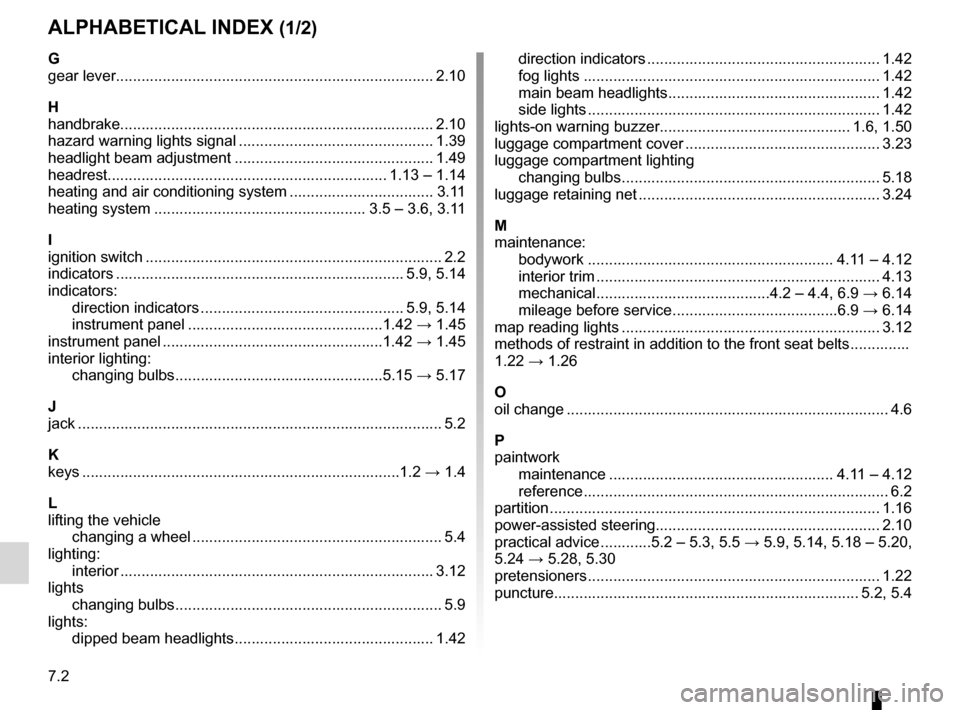
direction indicators ....................................................... 1.42
fog lights ...................................................................... 1.42
main beam headlights .................................................. 1.42
side lights ..................................................................... 1.42
lights-on warning buzzer............................................. 1.6,
1.50
luggage compartment cover .............................................. 3.23
luggage compartment lighting changing bulbs ............................................................. 5.18
luggage retaining net ......................................................... 3.24
M
maintenance: bodywork .......................................................... 4.1
1 – 4.12
interior trim ................................................................... 4.13
mechanical ......................................... 4.2 – 4.4,
6.9 → 6.14
mileage before service ....................................... 6.9 → 6.14
map reading lights ............................................................. 3.12
methods of restraint in addition to the front seat belts ..............
1.22 → 1.26
O
oil change ........................................................................\
.... 4.6
p
paintwork maintenance ..................................................... 4.1
1 – 4.12
reference ........................................................................\
6.2
partition ........................................................................\
...... 1.16
power-assisted steering..................................................... 2.10
practical advice ............ 5.2 – 5.3,
5.5 → 5.9, 5.14, 5.18 – 5.20,
5.24 → 5.28, 5.30
pretensioners ..................................................................... 1.22
puncture........................................................................\
5.2,
5.4
G
gear lever........................................................................\
... 2.10
h
handbrake........................................................................\
.. 2.10
hazard warning lights signal
.............................................. 1.39
headlight beam adjustment ............................................... 1.49
headrest.................................................................. 1.13
– 1.14
heating and air conditioning system .................................. 3.11
heating system .................................................. 3.5 – 3.6,
3.11
i
ignition switch ...................................................................... 2.2
indicators .................................................................... 5.9,
5.14
indicators: direction indicators ................................................ 5.9,
5.14
instrument panel .............................................. 1.42 → 1.45
instrument panel .................................................... 1.42 → 1.45
interior lighting: changing bulbs ................................................. 5.15 → 5.17
J
jack ........................................................................\
.............. 5.2
K
keys ........................................................................\
... 1.2 → 1.4
l
lifting the vehicle changing a wheel ........................................................... 5.4
lighting: interior ........................................................................\
.. 3.12
lights changing bulbs ............................................................... 5.9
lights: dipped beam headlights ............................................... 1.42
AlphABEtiCAl inDEx (1/2)