2016 RENAULT KADJAR park
[x] Cancel search: parkPage 231 of 300
4.15
Respect local regulations about wash-
ing vehicles (e.g. do not wash your ve-
hicle on a public highway).
Observe the vehicle stopping distances
when driving on gravelled surfaces to
prevent paint damage.
Repair, or have repaired quickly, areas
where the paint has been damaged, to
prevent corrosion spreading.
Remember to visit the body shop pe-
riodically in order to maintain your
anti-corrosion warranty. Refer to the
Maintenance Document.
If it is necessary to clean mechani-
cal components, hinges, etc., spray
them with products approved by our
Technical Department to protect them
after they have been cleaned.
BODYWORK MAINTENANCE (2/2)
We have selected special products
to care for your vehicle and you can
obtain these from the manufactur-
er’s accessory outlets.
Using a roller type car wash
Return the windscreen wiper stalk to
the Park position (refer to the informa-
tion on the “Windscreen washer, wiper”
in Section 1). Check the mounting of
external accessories, additional lights
and mirrors, and ensure that the wiper
blades are secured with adhesive tape.
Remove the radio aerial mast if your
vehicle is fitted with this equipment.
Remember to remove the tape and refit
the antenna after washing.
Cleaning the headlights
As the headlights are made of plastic
“glass”, use a soft cloth or cotton wool
to clean them. If this does not clean
them properly, moisten the cloth with
soapy water, then wipe clean with a soft
damp cloth or cotton wool.
Finally, carefully dry off with a soft dry
cloth.
Cleaning products containing alco-
hol must not be used.
Vehicles with a matte paint
finish
This type of paint requires certain pre-
cautions.
Do not do the following
– use wax-based products (polishing);
– rub hard;
– wash the vehicle in a roller-type car
wash;
– wash the vehicle using a high-pres-
sure device;
– attach stickers to the paintwork (risk
of leaving marks).
You should do the following
Wash the vehicle by hand using plenty
of water, using a soft cloth or a gentle
sponge.
Page 237 of 300
5.3
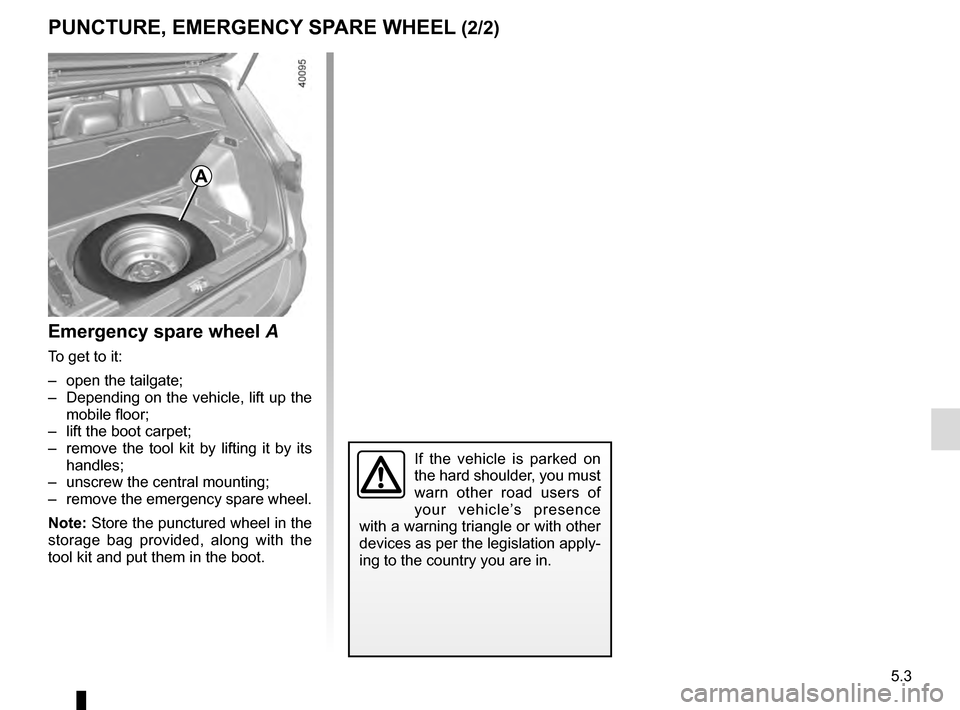
Emergency spare wheel A
To get to it:
– open the tailgate;
– Depending on the vehicle, lift up the mobile floor;
– lift the boot carpet;
– remove the tool kit by lifting it by its handles;
– unscrew the central mounting;
– remove the emergency spare wheel.
Note: Store the punctured wheel in the
storage bag provided, along with the
tool kit and put them in the boot.
PUNCTURE, EMERGENCY SPARE WHEEL (2/2)
If the vehicle is parked on
the hard shoulder, you must
warn other road users of
your vehicle’s presence
with a warning triangle or with other
devices as per the legislation apply-
ing to the country you are in.
A
Page 239 of 300
5.5
TYRE PRESSURE KIT (2/3)
In the event of a puncture, use the kit
located in the boot, underneath the
boot carpet.
With the engine running and the
parking brake applied,
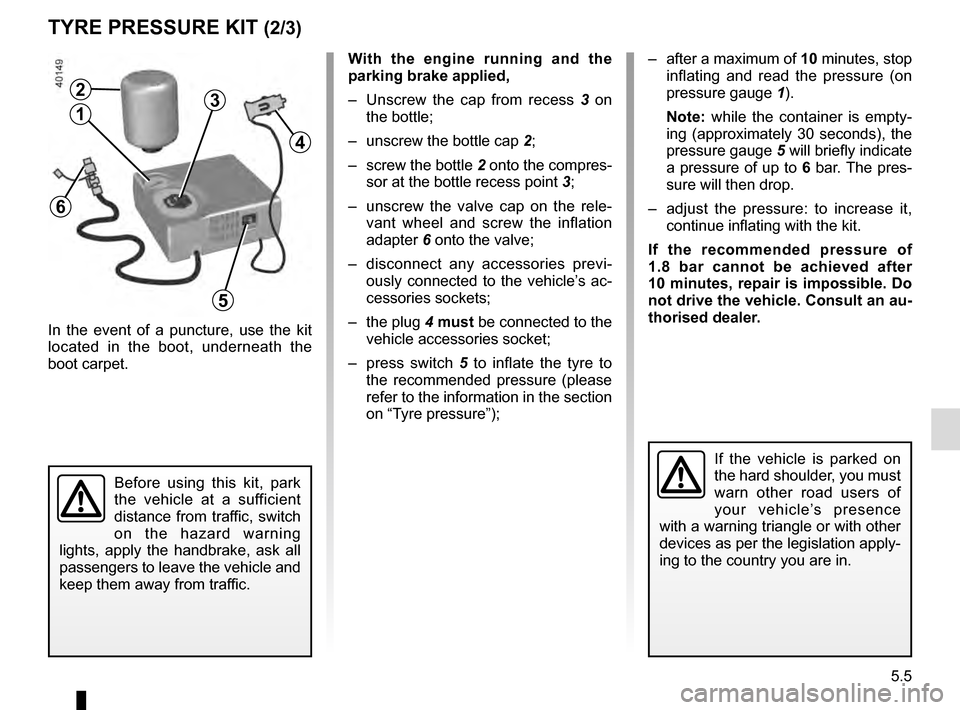
– Unscrew the cap from recess 3 on
the bottle;
– unscrew the bottle cap 2;
– screw the bottle 2 onto the compres- sor at the bottle recess point 3;
– unscrew the valve cap on the rele- vant wheel and screw the inflation
adapter 6 onto the valve;
– disconnect any accessories previ- ously connected to the vehicle’s ac-
cessories sockets;
– the plug 4 must be connected to the
vehicle accessories socket;
– press switch 5 to inflate the tyre to
the recommended pressure (please
refer to the information in the section
on “Tyre pressure”);
Before using this kit, park
the vehicle at a sufficient
distance from traffic, switch
on the hazard warning
lights, apply the handbrake, ask all
passengers to leave the vehicle and
keep them away from traffic.
If the vehicle is parked on
the hard shoulder, you must
warn other road users of
your vehicle’s presence
with a warning triangle or with other
devices as per the legislation apply-
ing to the country you are in.
– after a maximum of 10 minutes, stop inflating and read the pressure (on
pressure gauge 1).
Note: while the container is empty-
ing (approximately 30 seconds), the
pressure gauge 5 will briefly indicate
a pressure of up to 6 bar. The pres-
sure will then drop.
– adjust the pressure: to increase it, continue inflating with the kit.
If the recommended pressure of
1.8 bar cannot be achieved after
10 minutes, repair is impossible. Do
not drive the vehicle. Consult an au-
thorised dealer.
4
2
13
5
6
Page 243 of 300

5.9
Continue to crank the jack so that the
baseplate is correctly positioned (it
should be underneath the vehicle and
aligned with the jack head).
Switch on the hazard warn-
ing lights.
Keep the vehicle away from
traffic and on a level surface
where it will not slip.
Apply the parking brake and engage
a gear (first or reverse, or P for auto-
matic transmissions).
Ask all the passengers to leave the
vehicle and keep them away from
traffic.
CHANGING A WHEEL (1/2)
Vehicles equipped with a jack
and wheelbrace
If necessary, remove the wheel trim.
Use the wheelbrace 1 to slacken off the
wheel bolts. Position it so as to be able
to push from above.
Crank up the jack 3 by hand to align
the jack head between the 2 jacking
points 2 closest to the relevant wheel.
If the vehicle is not equipped with a
jack or wheelbrace, you can obtain
these from your approved dealer.
If the vehicle is parked on
the hard shoulder, you must
warn other road users of
your vehicle’s presence
with a warning triangle or with other
devices as per the legislation apply-
ing to the country you are in.
1
2
3
Page 260 of 300
5.26
BATTERY: troubleshooting (1/2)
To avoid all risk of sparks:
– Ensure that any consumers (cour-tesy lights, etc.) are switched off
before disconnecting or reconnect-
ing the battery;
– when charging, stop the charger before connecting or disconnecting
the battery;
– to avoid creating a short circuit be- tween the terminals, do not place
metal objects on the battery;
– always wait at least one minute after the engine has been switched off
before disconnecting a battery;
– make sure that you reconnect the battery terminals after refitting.
Connecting a battery charger
The battery charger must be com-
patible with a battery with nominal
voltage of 12 volts.
Do not disconnect the battery when the
engine is running. Follow the instruc-
tions given by the manufacturer of
the battery charger you are using.
Special procedures may be
required to charge some
batteries. Contact your ap-
proved dealer.
Avoid all risk of sparks which may
cause an immediate explosion, and
charge the battery in a well-venti-
lated area. Risk of serious injury.
Handle the battery with care
as it contains sulphuric acid,
which must not come into
contact with eyes or skin. If
it does, wash the affected area with
plenty of cold water. If necessary,
consult a doctor.
Ensure that naked flames, red hot
objects and sparks do not come into
contact with the battery as there is a
risk of explosion.
The engine may be hot when car-
rying out operations in close prox-
imity. In addition, the engine cooling
fan can come on at any moment.
Risk of injury.
Before performing any
action in the engine com-
partment, the ignition must
be switched off by pressing
the engine stop button (please see
the information on “Starting, stop-
ping the engine” in Section 2).
Page 265 of 300
5.31
TOWING: breakdown recovery (1/2)
Before towing, put the gearbox in neu-
tral, unlock the steering column and re-
lease the parking brake.
For vehicles fitted with an automa-
tic gearbox, if it is not possible to put
the gear lever into position N, please
consult an authorised dealer.
Steering column unlocking
Insert the key into the ignition or, de-
pending on the vehicle, having the
RENAULT card on you, press the
engine start button for approximately
2 seconds.
Reposition the lever to neutral (posi-
tion N for vehicles fitted with an auto-
matic gearbox).
The steering column unlocks, the ac-
cessory functions are powered: you
can use the vehicle’s lights (direction
indicators, brake lights, etc.). At night
the vehicle must have its lights on.
Depending on the vehicle, once you
have finished towing, press the engine
start button twice (risk of running down
the battery). The speed specified by current legisla-
tion for towing must always be obser-
ved. If your vehicle is the towing vehi-
cle, do not exceed the maximum towing
weight for your vehicle (refer to the in-
formation on “Weights” in Section 6).
Towing a vehicle with an
automatic gearbox
Transport the vehicle on a trailer or tow
it with the front wheels off the ground.
In exceptional circumstances
, you
may tow it with all four wheels on the
ground, only in a forward gear, with the
gear in neutral position N over a maxi-
mum distance of 50 miles and not ex-
ceeding a speed of 15 mph (25 km/h).
1
2
Do not remove the key from
the ignition when the vehi-
cle is being towed.
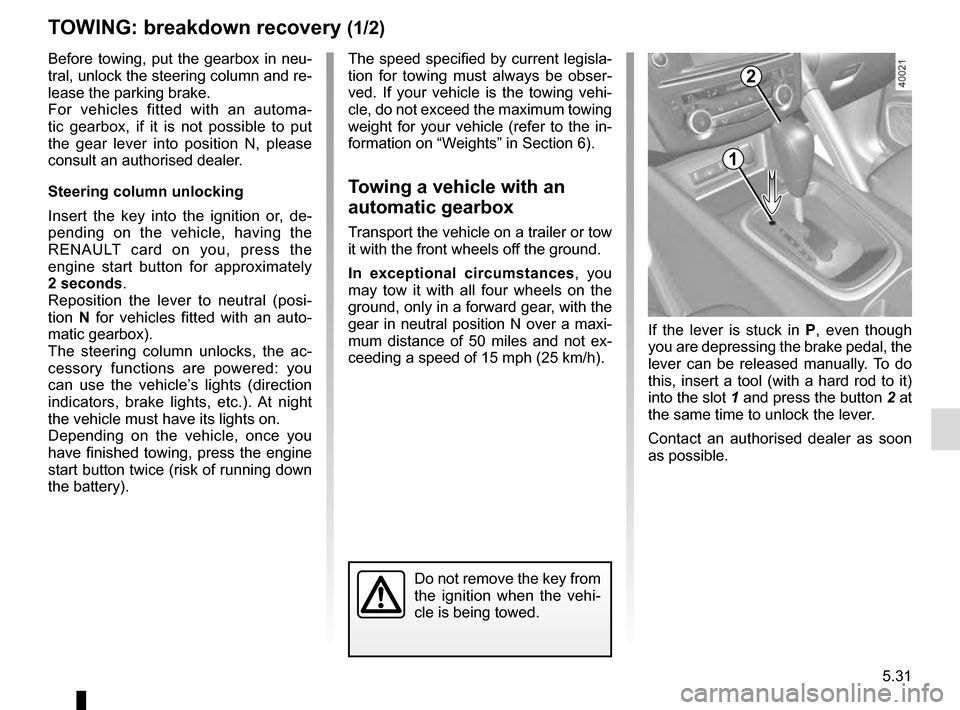
If the lever is stuck in P , even though
you are depressing the brake pedal, the
lever can be released manually. To do
this, insert a tool (with a hard rod to it)
into the slot 1 and press the button 2 at
the same time to unlock the lever.
Contact an authorised dealer as soon
as possible.
Page 279 of 300
6.5
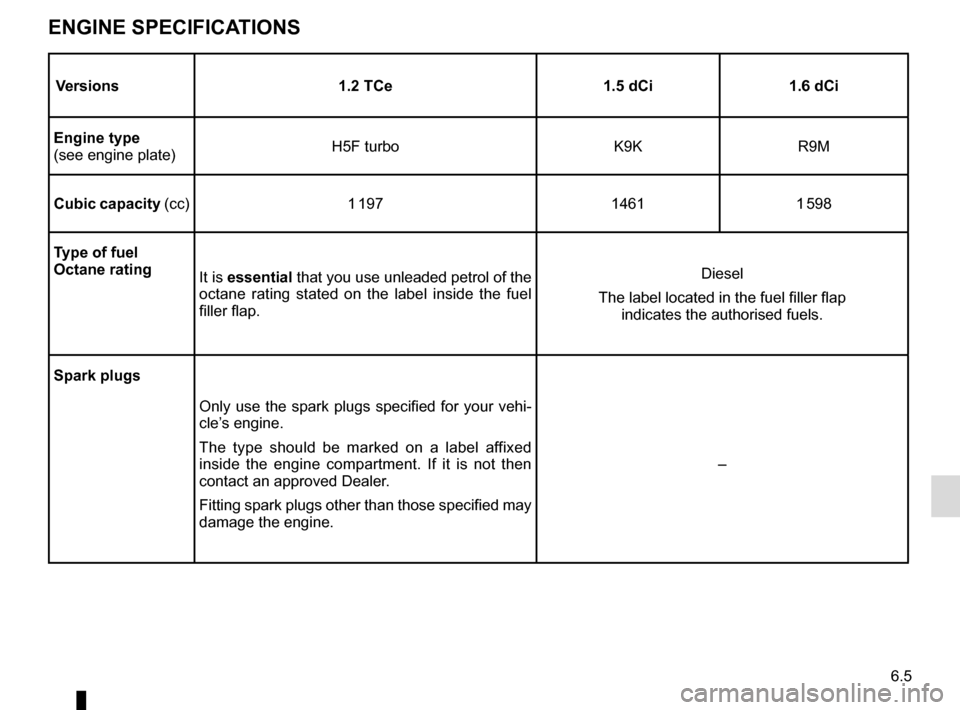
ENGINE SPECIFICATIONS
Versions1.2 TCe1.5 dCi1.6 dCi
Engine type
(see engine plate) H5F turbo
K9KR9M
Cubic capacity (cc) 1 19714611 598
Type of fuel
Octane rating It is essential that you use unleaded petrol of the
octane rating stated on the label inside the fuel
filler flap. Diesel
The label located in the fuel filler flap indicates the authorised fuels.
Spark plugs Only use the spark plugs specified for your vehi-
cle’s engine.
The type should be marked on a label affixed
inside the engine compartment. If it is not then
contact an approved Dealer.
Fitting spark plugs other than those specified may
damage the engine. –
Page 293 of 300

A
ABS ..............................................................1.56, \
2.29 → 2.38
accessories.............................................................\
......")
7.1
ALPHABETICAL INDEX (1/5)
A
ABS ..............................................................1.56, \
2.29 → 2.38
accessories.............................................................\
........... 5.28
accessories socket ............................................................ 3.23
additional methods of restraint .......................................... 1.33 side protection ............................................................. 1.32
to the front seat belts .......................................1.27 → 1.30
to the rear seat belts .................................................... 1.31
adjusting your driving position ..1.19 – 1.21, 1.23 → 1.26, 3.24
advice on antipollution ....................................................... 2.24
air bag...........................................................1.27 → 1.33, 1.54
activating the front passenger air bags ........................ 1.49
deactivating the front passenger air bags .................... 1.47
air conditioning ........................................................3.4 → 3.13
air vents ...................................................................... 3.2 – 3.3
anti-corrosion check ..............................................6.14 → 6.18
anti-corrosion protection .................................................... 4.14
anti-lock braking system: ABS ...............................2.29 → 2.38
antipollution advice .................................................................\
......... 2.24
armrest: front ..................................................................\
............ 3.19
ashtray ................................................................\
............... 3.23
ASR (traction control) ............................................2.29 → 2.38
assisted parking.....................................................2.6\
7 → 2.70
audible and visual signals.................................................. 1.84
automatic gearbox (use) ........................................2.71 → 2.73
automatic gearbox selector lever...........................2.71 → 2.73
B
battery................................................. 4.12 – 4.13, 5.26 – 5.27 troubleshooting ................................................. 5.26 – 5.27
battery (remote control) ..................................................... 5.22
blind spot warning signal .......................................2.46 → 2.49
blind spot: warning signal ......................................2.46 → 2.49
bonnet..................................................................\
....... 4.2 – 4.3 brake fluid ........................................................................\
.... 4.8
bulbs changing ..........................................................5.14 \
→ 5.20
C
catalytic converter................................................... 2.12 – 2.13
central door locking .................1.2 – 1.3, 1.5, 1.8 → 1.15, 1.18
changing a bulb .....................................................5.14 → 5.20
changing a wheel...................................................... 5.9 – 5.10
changing gear ...............................................2.14, 2.71 → 2.73
child restraint/seat ....................1.34 – 1.35, 1.37 → 1.43, 1.47
child safety...............1.30, 1.34 – 1.35, 1.37 → 1.43, 1.47, 2.5,
3.15 – 3.16
child seats..........................................1.34 – 1.35, 1.3\
7 → 1.43
children ........................................ 1.6, 1.34 – 1.35, 3.15 – 3.16
children (safety) ................................................................... 1.6
cigar lighter ........................................................................\
3.23
cleaning: inside the vehicle .............................................. 4.16 – 4.17
clock ..................................................................\
................ 1.75
closing the doors ...................................................1.13 → 1.18
control instruments .......................................1.54 → 1.63, 1.75
controls ...............................................................\
...1.50 → 1.53
courtesy light ............................................................ 3.17, 5.20
courtesy mirrors ................................................................. 3.18
cruise control ................................................1.57, 2.56 → 2.59
cruise control-speed limiter.............. 2.50 → 2.52, 2.56 → 2.59
customised vehicle settings ................................... 1.72 – 1.73
customising the vehicle settings ............................ 1.72 – 1.73
D
dashboard..............................................................1\
.50 → 1.53
deadlocking the doors ................................................ 1.5, 1.12
demisting rear screen .........................................................3.4 → 3.12
windscreen .........................................................3.4 → 3.12