Page 8 of 256
1.2
KEYS, RADIO FREQUENCY REMOTE CONTROL: general information (1/2)
Radio frequency remote
control B or C
2 Locks all the opening elements.
3 Unlocks all the opening elements.
Driver’s responsibility when parking or stopping the vehicle
Never leave an animal, child or adult who is not self-sufficient alone on
your vehicle, even for a short time.
They may pose a risk to themselves or to others by starting the engine, \
activating
equipment such as the electric windows or by locking the doors.
Also, in hot and/or sunny weather, please remember that the temperature inside
the passenger compartment increases very quickly.
RISK OF DEATH OR SERIOUS INJURY.
Key A
1 Coded key for ignition switch, doors and fuel filler cap.
The key must not be used for any
function other than those described
in the handbook (removing the cap
from a bottle, etc.).
3
2
5
C
4 Coded key for ignition switch, driv- er’s door and fuel filler cap.
5 Remote engine start-up.
4
1
2
3
4AB
Page 57 of 256

1.51
Interpreting some of the
values displayed after
resetting
The values showing average fuel
consumption, range and average
speed will become more stable and re-
liable the further you travel after pres-
sing the reset button.
For the first few miles after pressing
the reset key you will notice that the
range increases as you travel. This
range takes into account the average
fuel consumption since the last time the
reset button was pressed. Therefore,
the fuel consumption may decrease
when:– the vehicle stops accelerating,
– the engine reaches its operating
temperature (engine cold when
reset button pressed),
– when driving from a built-up area
onto the open road.
Therefore, if the average fuel
consumption decreases, the
range will increase. – You may also notice that the ave-
rage fuel consumption increases
when the vehicle is stationary and
the engine idling.
This is normal, since the computer
takes account of fuel used during
idling.
Manually resetting the journey para-
meters: with the display showing one
of the journey parameters, press the
button 2 until the display is reset.
Automatically resetting the journey
parameters: the reset is automatic
when the capacity of one of the memo-
ries is exceeded.
ON-BOARD COMPUTER (2/6)
The display of information shown below DEPENDS ON THE VEHICLE EQUIPMENT \
AND COUNTRY.
Page 71 of 256

1.65
FUEL TANK (1/6)
Petrol and diesel versions
Usable capacity of the fuel tank:
50 litres approximately.
Depending on the vehicle, to open the
fuel filler flap A, place your finger in
opening B and pull.
To close, push the fuel filler flap A by
hand as far as it will go. Depending
on the vehicle, the cap 1 is unlocked
using the ignition key. If not, it will be
connected to the vehicle by a strip of
plastic. For details on filling the fuel
tank, please refer to the information on
“Filling with fuel”.
Fuel filler cap: this is spe-
cific to the vehicle type. If
you have to replace it, make
sure the new cap is of the
same type. Contact an approved
dealer.
Never place the cap near a source
of heat or flame.
Do not wash the filler area with a
high-pressure washer.
A
3
C
B
There is a cap holder 3 on the fuel filler
flap for holding the cap when the tank is
being filled.
Depending on the vehicle, lift lever 2 to
unlock the fuel filler flap A. Open it, then
unscrew fuel filler cap 1.
1
2
Page 74 of 256
1.68
LPG versions
Useful capacity of fuel tank: approx.
34 litres.
Filling up with LPG
Engage the handbrake, stop the engine,
switch off the ignition and switch off the
lights.
Always respect the safety instructions
given at filling stations.
It is always advisable to completely fill
the tank.
When the pump stops delivering LPG,
or when the pump flow reduces sig-
nificantly, the maximum LPG level has
been reached.
At this point, do not attempt to carry on
filling.
If you exceed the LPG tank capacity when filling completely, please go
to an accredited garage or your authorised dealer to check the automatic\
filler device.
FUEL TANK (4/6)
Filling stations without self-service
If service station staff fill your vehicle
with LPG, give them a filling adapter 4,
as supplied in a pouch in the glovebox.
IMPORTANT:
The adapter 4 depends on the
country in which the vehicle is sold.
Before travelling to another country,
please consult an authorised dealer.
44
4
Page 75 of 256
1.69
FUEL TANK (5/6)
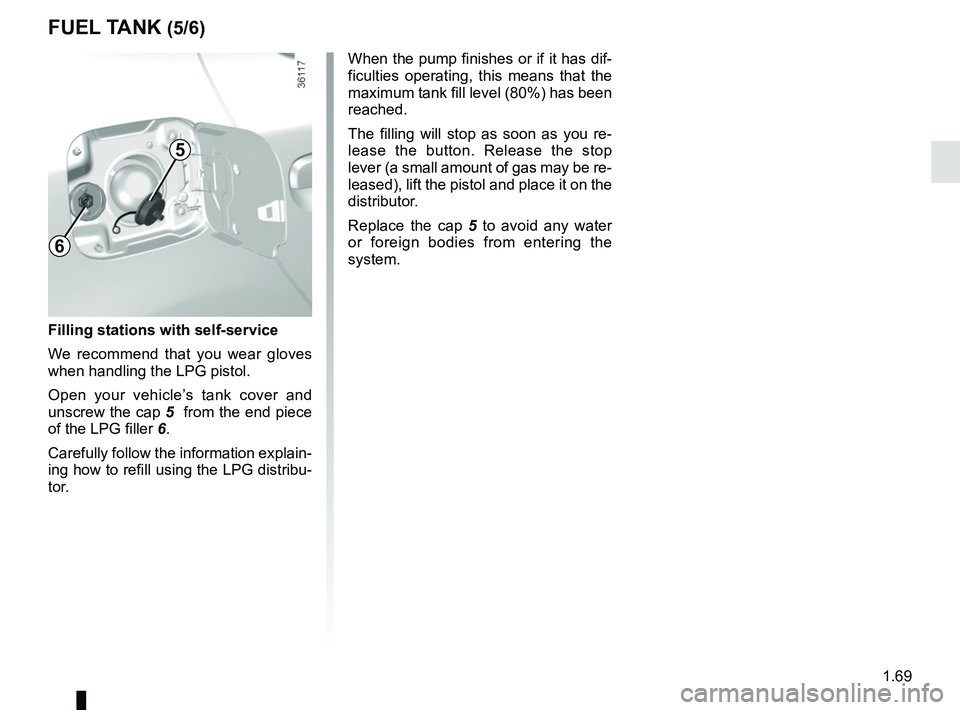
Filling stations with self-service
We recommend that you wear gloves
when handling the LPG pistol.
Open your vehicle’s tank cover and
unscrew the cap 5 from the end piece
of the LPG filler 6.
Carefully follow the information explain-
ing how to refill using the LPG distribu-
tor. When the pump finishes or if it has dif-
ficulties operating, this means that the
maximum tank fill level (80%) has been
reached.
The filling will stop as soon as you re-
lease the button. Release the stop
lever (a small amount of gas may be re-
leased), lift the pistol and place it on the
distributor.
Replace the cap 5
to avoid any water
or foreign bodies from entering the
system.
5
6
Page 88 of 256

2.12
Fuel gauge warning light A
The warning lights A (4 green lights and
1 red light) indicate the level in the LPG
tank.
The red warning light indicates the fuel
tank.
The amount of LPG indicated is an in-
dicative value.
The red warning light indicates that
the tank is almost empty and that the
engine is operating using the fuel tank
(approximately 11 to 13 litres).
SPECIAL FEATURES OF LPG VERSIONS (1/3)
LPG vehicles
These vehicles operate using petrol or
LPG.
They have two separate tanks.
What is LPG?
LPG stands for Liquefied Petroleum
Gas.
It can be readily identified by its charac-
teristic smell.
An LPG installation on
a vehicle may lead to
changes to the vehicle’s
features, compared to
petrol versions. This may relate to
the number of seats, mass (usable
capacity) and towing capacity.
Contact an authorised dealer.
LPG/petrol fuel mode selection
control C
This enables the driver to switch from
one fuel to another.
Green warning light D
A lit warning light indicates that LPG
mode is active.
Rapid flashing of the warning light D
indicates that the system is waiting for
the necessary conditions to switch to
LPG mode.
Yellow warning light B
A lit warning light indicates that petrol
mode is active.
If the yellow warning light is
on while the green warning
light flashes slowly and a
beep is heard, please take
your vehicle to an authorised dealer
for inspection.
A
DCB
Page 95 of 256

2.19
DRIVING ADVICE, ECO-DRIVING (5/5)
– In vehicles fitted with air condi-
tioning, it is normal to observe an
increase in fuel consumption (es-
pecially in urban conditions) when
it is used. For vehicles fitted with
manual air conditioning, switch off
the system when it is not required.
Advice for reducing consumption
and therefore helping to preserve
the environment:
If the vehicle has been parked in the
sun, open the doors for a few mo-
ments to let the hot air escape before
starting the engine.
– Do not leave an empty roof rack fitted to the vehicle.
– It is better to fit a trailer for bulky ob- jects.
– When towing a caravan, fit a wind deflector and adjust it carefully.
– Avoid using the car for door-to-door calls (short journeys with long waits
in between) because the engine
never reaches its normal operating
temperature.
Advice on use
– Favour ECO mode.
– Electricity is fuel; switch off all the
electrical components which are
not really needed. However (safety
first), keep your lights on when the
visibility is bad (“see and be seen”).
– Use the air vents. Driving with the windows open at 60 mph (100 km/h)
will increase fuel consumption by
4%.
– Never fill the fuel tank right to the brim to avoid overflow.
Page 135 of 256

3.7
AIR CONDITIONING: information and advice on use
Fuel consumption
You will normally notice an increase
in fuel consumption (especially
when driving in town) when the air
conditioning is operating.
For vehicles fitted with air condition-
ing with no automatic mode, switch
off the system when it is not re-
quired.
Advice for reducing consumption
and helping to preserve the envi-
ronment
Drive with the air vents open and
the windows closed.
If the vehicle has been parked in
the sun, open the doors for a few
moments to let the hot air escape
before starting the engine. Operating faults
As a general rule, contact your ap-
proved dealer in the event of an op-
erating fault.
– Reduction in de-icing, demist-
ing or air conditioning per-
formance.
This may be caused by the pas-
senger compartment filter car-
tridge becoming clogged.
– No cold air is being produced .
Check that the controls are set
correctly and that the fuses are
sound. Otherwise, switch off the
system.
Do not open the refriger-
ant fluid circuit. The fluid
may damage eyes or skin.Presence of water under the ve-
hicle. After prolonged use of the air
conditioning system, it is normal for
water to be present under the vehi-
cle. This is caused by condensation.Maintenance
Refer to the Maintenance Document
for your vehicle for the inspection
frequency.