2016 RENAULT DUSTER Starter
[x] Cancel search: StarterPage 78 of 256

2.2
Petrol version
For the first 600 miles (1,000 km), do
not exceed 78 mph (130 km/h) in the
highest gear, or 3,000 to 3,500 rpm.
You may only expect top performance
from your vehicle after approximately
1,800 miles (3,000 km).
Service intervals: refer to the
Maintenance Document for the vehicle.
Diesel version
For the first 1,000 miles (1,500 km),
do not exceed 80 mph (130 km/h) in
the highest gear, or 2,500 rpm. After
completing this mileage you may drive
faster, although you may only expect
top performance after approximately
3,600 miles (6,000 km).
During the running in period, do not ac-
celerate hard while the engine is still
cold and do not let the engine over-rev.
Service intervals: refer to the
Maintenance Document for your vehi-
cle.
RUNNING IN, IGNITION SWITCH
Stop and steering lock
position St
To lock: remove the key and turn the
steering wheel until the steering column
locks.
To unlock: turn the key and the steering
wheel slightly.
Accessories position A
When the ignition is switched off, any
accessories (radio, etc.) will continue to
function.
Ignition on position M
The ignition is switched on:
– petrol version: the engine may be
started.
– diesel version: the engine is pre-
heating.
Start position D
If the engine fails to start at the first at-
tempt, turn the key back before activat-
ing the starter again.
Release the key as soon as the engine
starts.
Special note on vehicles with
an automatic gearbox
Refer to the information on the
“Automatic gearbox” in Section 2.
Page 79 of 256

2.3
LPG versions
The engine is always started using
petrol:
– activate the starter without accelerat-ing;
– release the key as soon as the engine starts.
The system will automatically deter-
mine the switchover from petrol to LPG.
When operating on LPG, the fuel gauge
may indicate a drop in the petrol level
and the on-board computer will not op-
erate.
Under certain winter conditions the
system may delay or disable operation
with LPG.
After stopping the engine, if the envi-
ronmental conditions are once again
suitable, the system may once again
permit LPG mode.
Starting the engineIn very cold conditions (temperatures
below –20°C): so that it is easier to
start the engine, switch on the ignition
for several seconds before starting the
engine.
When starting the engine, if the outdoor
temperature is very low (below -10°C):
hold down the clutch pedal until the
engine starts.
Make sure the engine immobiliser is not
activated. Refer to the information on
the “Engine immobiliser” in Section 1.
Petrol injection
– Turn the key to the start position without depressing the accelera-
tor.
– Release the key as soon as the engine starts.
ÉDiesel injection
Turn the ignition key to ignition “On” po-
sition M, and hold this position until the
preheating warning light goes out.
Turn the key to starter position D with-
out depressing the accelerator
pedal.
Release the key as soon as the engine
starts.
STARTING, STOPPING THE ENGINE (1/4)
At temperatures close to 0°C or less, it
is recommended to use ECO mode to
maximise the use of LPG. Please refer
to the information on “Driving advice,
Eco-driving” in Section 2.
To enable the system to operate
smoothly and to prevent any wear to
the vehicle’s electric petrol pump, the
petrol tank should always be around
1/4 full.
Page 209 of 256

5.31
Number Allocation
A Driver’s side window
winder
B 4-wheel drive (4WD)
transmission
C LPG
D Rear accessories socket
E Passenger compartment
ECU, starter
1 Front electric window
2 Left-hand main beam
headlight
3 Right-hand main beam
headlight
4 Left-hand dipped beam
headlight
5 Right-hand dipped beam
headlight
6 Rear lights
7 Front side lights
8 Rear electric windowsNumber Allocation
9 Rear fog lights
10 Horn
11 Automatic door locking
12 ABS-ESC, brake switch,
clutch switch
13 Interior lights, boot light,
glovebox light
14 Empty location
15 Windscreen wiper
16 Cruise control/Speed
limiter, unfastened
seat belt warning,
parking distance
control, multimedia, air
conditioning, heated seats,
automatic gearbox lever,
UCHNumber Allocation
17 Daytime running lights
18 Brake lights
19 Injection, instrument panel
or dashboard, passenger
compartment, sequential
gearbox lever
20 Airbag
21 4-wheel drive transmission
(4WD), LPG, automatic
gearbox, sequential
gearbox, reverse gear
22 Power-assisted steering
23 Heated rear windscreen,
heated seats, seatbelt
alarm, parking distance
control, additional
passenger compartment
heating, cruise control/
speed limiter, heated
windscreen
FUSES (4/8)
Page 210 of 256

5.32
FUSES (5/8)
Number Allocation
24 Passenger compartment
ECU
25 Passenger compartment
ECU
26 Direction indicator lights
27 and
29 Steering column control
28 Not used
30 Not used
31 Instrument panel
32 Radio, passenger
compartment air
conditioning control panel,
passenger compartment
ventilation, rear
accessories socket
33 Cigar lighter
34 Diagnostics and radio
socket
35 Defrosting rearview mirror
36 Electric door mirrors
37 Passenger compartment
ECU, starterNumber Allocation
38 Front windscreen wiper
39 Passenger compartment
ventilation
Check the fuse in question
and
replace it, if necessary,
with a fuse of the same
rating.
If a fuse is fitted where the rating is
too high, it may cause the electrical
circuit to overheat (risk of fire) in the
event of an item of equipment using
an excessive amount of current.
To comply with current legislation,
or as a precaution, you can obtain
an emergency kit from your appro-
ved Dealer containing a set of spare
bulbs and fuses.
Page 212 of 256

5.34
FUSES (7/8)
Number Allocation
A Driver’s side window
winder
B 4-wheel drive (4WD)
transmission
C Rear air conditioning
D Rear accessories socket
E Passenger compartment
ECU, starter
1 Front electric window
2 Left-hand main beam
headlight
3 Right-hand main beam
headlight
4 Left-hand dipped beam
headlight
5 Right-hand dipped beam
headlight
6 Rear lights
7 Front side lightsNumber Allocation
8 Rear electric windows
9 Rear fog lights
10 Horn
11 Automatic door locking
12 ABS-ESC, brake switch
13 Interior lights, boot light,
glovebox light
14 Not used
15 Windscreen wiper
16 Multimedia
17 Daytime running lightsNumber Allocation
18 Brake lights
19 Injection, instrument panel
or dashboard, passenger
compartment, sequential
gearbox lever
20 Airbag
21 4-wheel drive transmission
(4WD), reverse gear
22 Power-assisted steering
23 Cruise control/Speed
limiter, rear windscreen,
unfastened seatbelt
warning, parking distance
control, additional
passenger compartment
heating
Page 213 of 256
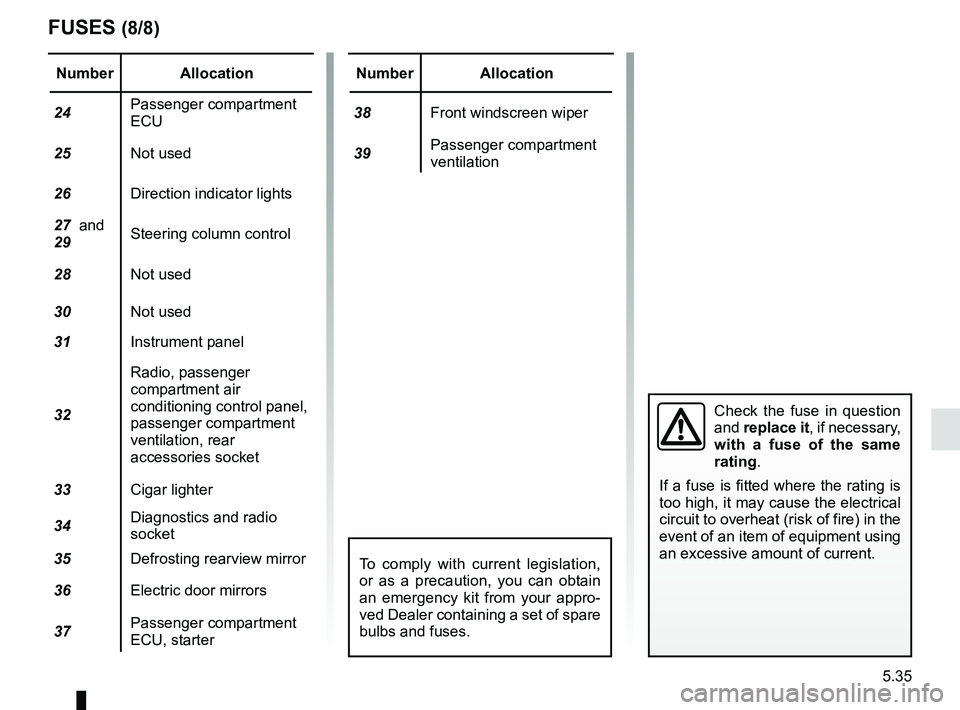
5.35
FUSES (8/8)
Number Allocation
24 Passenger compartment
ECU
25 Not used
26 Direction indicator lights
27 and
29 Steering column control
28 Not used
30 Not used
31 Instrument panel
32 Radio, passenger
compartment air
conditioning control panel,
passenger compartment
ventilation, rear
accessories socket
33 Cigar lighter
34 Diagnostics and radio
socket
35 Defrosting rearview mirror
36 Electric door mirrors
37 Passenger compartment
ECU, starterNumber Allocation
38 Front windscreen wiper
39 Passenger compartment
ventilation
Check the fuse in question
and
replace it, if necessary,
with a fuse of the same
rating.
If a fuse is fitted where the rating is
too high, it may cause the electrical
circuit to overheat (risk of fire) in the
event of an item of equipment using
an excessive amount of current.
To comply with current legislation,
or as a precaution, you can obtain
an emergency kit from your appro-
ved Dealer containing a set of spare
bulbs and fuses.
Page 223 of 256

The following advice will enable you to carry out quick, temporary repai\
rs. For safety reasons you should always contact
an approved dealer as soon as possible.
The star")
5.45
OPERATING FAULTS (1/5)
The following advice will enable you to carry out quick, temporary repai\
rs. For safety reasons you should always contact
an approved dealer as soon as possible.
The starter is activatedPOSSIBLE CAUSESWHAT TO DO
Warning lights dim or fail to come on;
the starter does not run. Battery terminals disconnected,
oxidised or incorrectly secured.Retighten them, reconnect them or clean
them if they are oxidised.
Battery discharged or worn. Connect another battery to the faulty bat-
tery. Refer to the information on “Battery:
troubleshooting” in Section 5 or replace the
battery if necessary.
Do not push the vehicle if the steering
column is locked.
The engine will not start. Starting conditions are not fulfilled.Refer to the information on “Starting/stop-
ping the engine in Section 2.
The steering column remains locked. Steering wheel locked. To unlock, gently move the key and the
steering wheel (refer to the information on
the “Ignition switch” in Section 2).