Page 34 of 256
1.28
CHILD SAFETY: fitting a child seat (2/6)
Rear centre seat
A child seat may only be fitted in this
seat if it is equipped with an inertia-reel
seat belt. For any additional informa-
tion, contact an approved dealer.In the rear side seat
A carrycot can be installed across the
vehicle and will take up at least two
seats. Position the child with his or her
feet nearest the door.
Before installing a child seat in the
ISOFIX anchoring points on a rear side
seat, check that the seat belt buckles
are not placed between the two ISOFIX
anchorage points in this seat. If neces-
sary, move the buckle from the seat in
question towards the centre of the ve-
hicle.
Move the front seat as far forward as
possible to install a rear-facing child
seat, then move back the seat in front
as far as it will go, although without al-
lowing it to come into contact with the
child seat.
For the safety of the child in the for-
ward-facing seat, do not move the seat
in front back past the middle of the
runner, do not tilt the seatback too far
(maximum of 25° ) and raise the seat as
much as possible.
Check that the forward-facing child seat
is resting against the back of the vehi-
cle seat and that the headrest of the ve-
hicle is not obstructing its use.
Ensure that the child seat or
the child’s feet do not pre-
vent the front seat from loc-
king correctly. Refer to the
information on the «Front seats» in
Section 1 or «Rear seat operation»
in Section 3.
A child seat with support
struts must never be in-
stalled on the rear centre
seat. RISK OF DEATH OR
SERIOUS INJURY.
When fitting a child seat
(Group 2 or 3 booster seat),
check that the seat belts op-
erate (wind) correctly: refer
to Section 1 “Rear seat belts”. If
necessary, adjust the position of the
vehicle seat.
Page 35 of 256
1.29
CHILD SAFETY: fitting a child seat (3/6)
Using a child safety system
which is not approved for
this vehicle will not correctly
protect the baby or child.
They risk serious or even fatal injury.
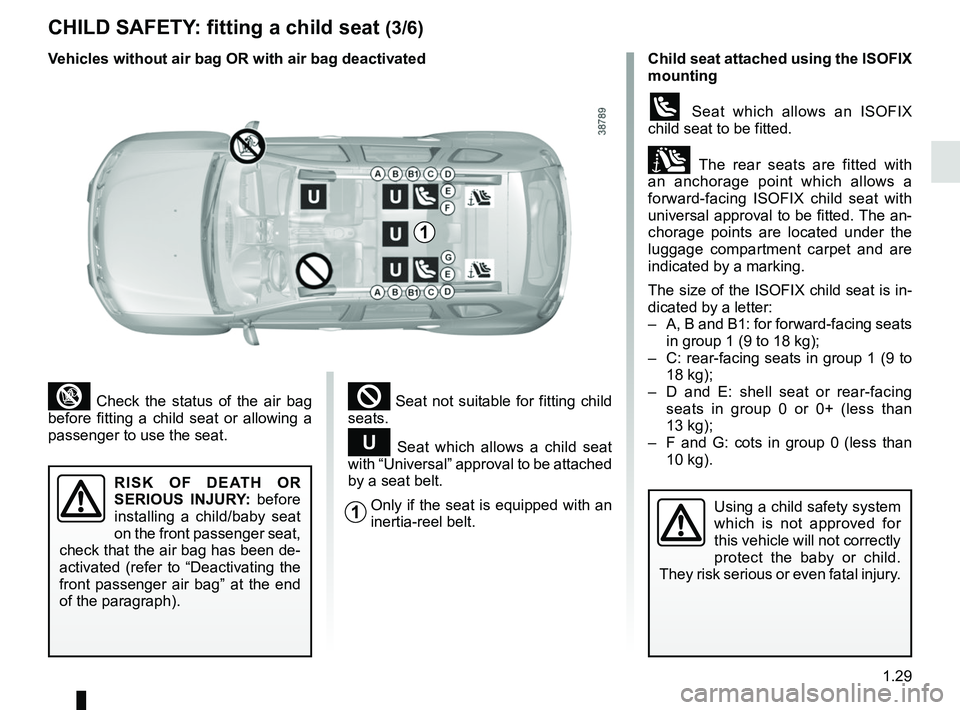
³ Check the status of the air bag
before fitting a child seat or allowing a
passenger to use the seat. Vehicles without air bag OR with air bag deactivated
RISK OF DEATH OR
SERIOUS INJURY: before
installing a child/baby seat
on the front passenger seat,
check that the air bag has been de-
activated (refer to “Deactivating the
front passenger air bag” at the end
of the paragraph).
Child seat attached using the ISOFIX
mounting
ü Seat which allows an ISOFIX
child seat to be fitted.
± The rear seats are fitted with
an anchorage point which allows a
forward-facing ISOFIX child seat with
universal approval to be fitted. The an-
chorage points are located under the
luggage compartment carpet and are
indicated by a marking.
The size of the ISOFIX child seat is in-
dicated by a letter:
– A, B and B1: for forward-facing seats in group 1 (9 to 18 kg);
– C: rear-facing seats in group 1 (9 to 18 kg);
– D and E: shell seat or rear-facing seats in group 0 or 0+ (less than
13 kg);
– F and G: cots in group 0 (less than 10 kg).
² Seat not suitable for fitting child
seats.
¬ Seat which allows a child seat
with “Universal” approval to be attached
by a seat belt.
Only if the seat is equipped with an
inertia-reel belt.
1
1
Page 36 of 256
1.30
CHILD SAFETY: fitting a child seat (4/6)
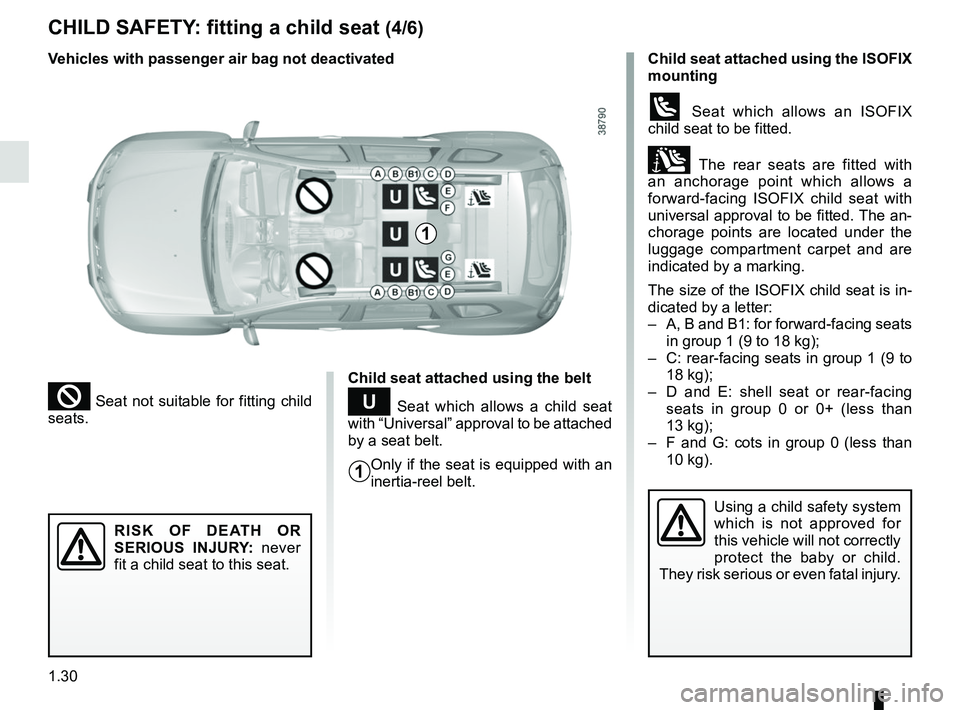
Child seat attached using the belt
¬ Seat which allows a child seat
with “Universal” approval to be attached
by a seat belt.
Only if the seat is equipped with an
inertia-reel belt.
Using a child safety system
which is not approved for
this vehicle will not correctly
protect the baby or child.
They risk serious or even fatal injury.
² Seat not suitable for fitting child
seats. Vehicles with passenger air bag not deactivated
RISK OF DEATH OR
SERIOUS INJURY: never
fit a child seat to this seat.
Child seat attached using the ISOFIX
mounting
ü Seat which allows an ISOFIX
child seat to be fitted.
± The rear seats are fitted with
an anchorage point which allows a
forward-facing ISOFIX child seat with
universal approval to be fitted. The an-
chorage points are located under the
luggage compartment carpet and are
indicated by a marking.
The size of the ISOFIX child seat is in-
dicated by a letter:
– A, B and B1: for forward-facing seats in group 1 (9 to 18 kg);
– C: rear-facing seats in group 1 (9 to 18 kg);
– D and E: shell seat or rear-facing seats in group 0 or 0+ (less than
13 kg);
– F and G: cots in group 0 (less than 10 kg).
1
1
Page 38 of 256

X = Seat not suitable for fitting child seats.
U = Seat which allows a child seat with “Universal” approval to be ins\
talled using a seat belt; ch")
1.32
CHILD SAFETY: fitting a child seat (6/6)
X = Seat not suitable for fitting child seats.
U = Seat which allows a child seat with “Universal” approval to be ins\
talled using a seat belt; check that it can be fitted.
IUF = Seat which, on equipped vehicles, allows forward-facing child seats with\
“Universal” approval to be attached by the ISOFIX
system: check that it can be fitted.
IL = On equipped vehicles, seat which allows an approved “semi-universal”\
or “vehicle specific” child seat to be attached using the
ISOFIX system; check that it can be fitted.
Refer to the brochure “Child safety equipment” available from the Network to choose the \
seat suited to your child and
recommended for your vehicle.
(1) Only a rear-facing child seat can be fitted in this seat: raise the seat\
to the maximum and position it as far back as possible ,
tilting the seatback slightly (approximately 25°).
(2) A carrycot can be installed across the vehicle and will take up two seats\
. Position the child with his or her feet nearest the door.
(3) Move the front seat as far forward as possible to install a rear-facing \
child seat, then move back the seat in front as far as it will
go, although without allowing it to come into contact with the child sea\
t.
(4) Forward-facing child seat; position the seatback of the child seat in co\
ntact with the seatback of the vehicle seat. Adjust the
headrest, or remove it if necessary. Do not push the seat in front of the child more than halfway back on i\
ts runners and do no t
recline the seatback more than 25°.
(7) A child seat may only be fitted in this seat if it is equipped with an in\
ertia-reel seat belt. For any additional information, please
contact an authorised dealer.
Page 53 of 256
1.47
WARNING LIGHTS (7/7)
Warning lights on console B
]Front passenger air bag de-
activation warning light.
Refer to the information on “Child
safety: deactivating, activating the front
passenger airbag".
B
ßSeat belt reminder light
It comes on when the engine
is started if the driver and/or passenger
seat belt is not fastened (depending on
the vehicle). When the vehicle is being
driven, it comes on and a beep sounds
for approximately 2 minutes until the
driver’s seat belt is fastened.
The presence and operation of the warning lights DEPEND ON THE EQUIPMENT\
AND COUNTRY.
Page 80 of 256

2.4
vehicles with an automatic
gearbox
Before starting, move the lever to posi-
tion P.
Refer to the information on the
“Automatic gearbox” in Section 2.
Stopping the engine
With the engine idling, turn the key
back to “Stop” position St.
Special note
Depending on the vehicle, accessories
(e.g. radio) stop working either when
the engine is switched off or when the
driver’s door is opened or when the
doors are locked.Driver’s responsibility
Never leave an animal,
child or adult who is not
self-sufficient alone on your
vehicle, even for a short time.
They may pose a risk to themselves
or to others by starting the engine,
activating equipment such as the
electric windows or locking the
doors, for example.
Also, in hot and/or sunny weather,
please remember that the tempera-
ture inside the passenger compart-
ment increases very quickly.
Never switch off the ignition
before the vehicle has stopped
completely . Switching off the
engine disables the assistance
equipment: brakes, steering, etc.,
and additional seatbelt devices.
The steering is locked when the key
is removed.
RISK OF DEATH OR SERIOUS
INJURY.
STARTING, STOPPING THE ENGINE (2/4)
Do not park the vehicle or
run the engine in locations
where combustible sub-
stances or materials such
as grass or leaves can come into
contact with a hot exhaust system.
Page 94 of 256
2.18
DRIVING ADVICE, ECO-DRIVING (4/5)
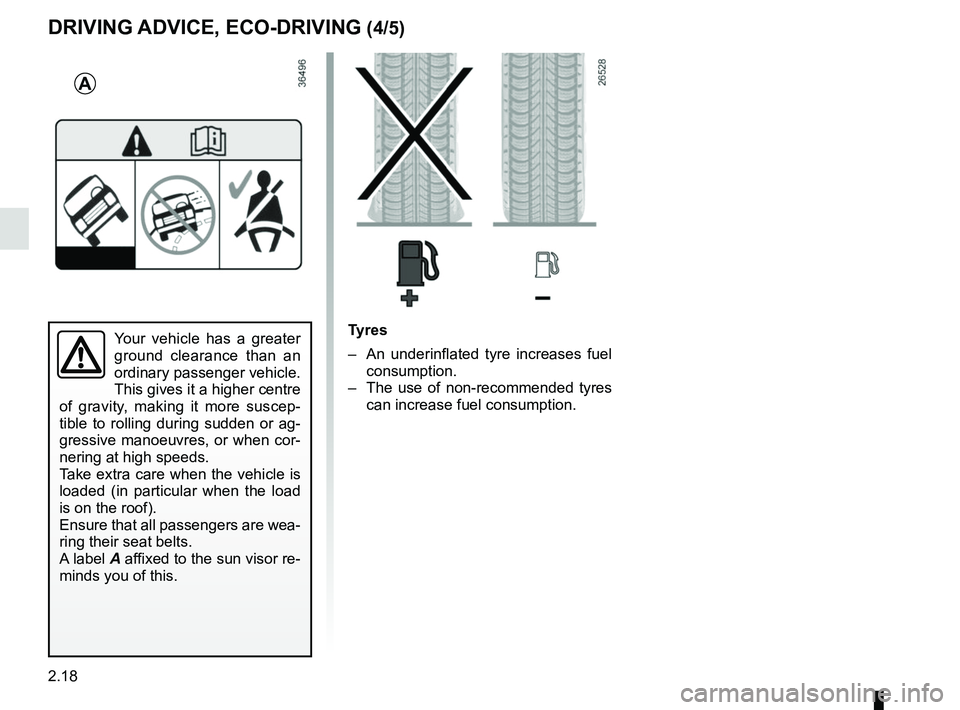
Your vehicle has a greater
ground clearance than an
ordinary passenger vehicle.
This gives it a higher centre
of gravity, making it more suscep-
tible to rolling during sudden or ag-
gressive manoeuvres, or when cor-
nering at high speeds.
Take extra care when the vehicle is
loaded (in particular when the load
is on the roof).
Ensure that all passengers are wea-
ring their seat belts.
A label A affixed to the sun visor re-
minds you of this.
A
Tyres
– An underinflated tyre increases fuel consumption.
– The use of non-recommended tyres can increase fuel consumption.
Page 148 of 256
3.20
Lower the rear headrests completely
(refer to the information on the “Rear
headrests” in Section 3).
Lower handle(s) 3.
Lower the seatback B or C.Depending on the vehicle, the seat A
and the seatback B or C may be folded
away to allow bulky objects to be car-
ried.
To fold the back B or C
Ensure that the front seats are far
enough forward.
Insert buckles 1 into housings 2 before
moving the seatback(s).
For safety reasons, carry
out any adjustments when
the vehicle is not being
driven.
REAR BENCH SEAT (1/3)
When moving the rear
bench seat, ensure that
nothing obstructs the an-
chorage points (part of the
body, a pet, gravel, cloth, toys, etc.).
B
C3
1
2
A
Check that the rear seat
belts are positioned and
operating correctly each
time the rear bench seat is
moved.
![RENAULT DUSTER 2016 Owners Manual 1.47
WARNING LIGHTS (7/7)
Warning lights on console B
]Front passenger air bag de-
activation warning light.
Refer to the information on “Child
safety: deactivating, activating the front
passenger](/manual-img/7/58396/w960_58396-52.png "RENAULT DUSTER 2016 Owners Manual 1.47
WARNING LIGHTS (7/7)
Warning lights on console B
]Front passenger air bag de-
activation warning light.
Refer to the information on “Child
safety: deactivating, activating the front
passenger")