2016 RENAULT DUSTER light
[x] Cancel search: lightPage 27 of 256

1.21
The airbag is designed to complement the action of the seat belt. Both t\
he
airbags and seat belts are integral parts of the same protection system.\
It is therefore essential to wear the seat belt at all times. If seat be\
lts are
not worn, the occupants are exposed to the risk of serious injury in the\
event of an accident. It may also increase the risk of minor superficial\
injuries
occurring when the airbag is deployed, although such minor injuries are \
always
possible with airbags.
If the vehicle should overturn or suffer a rear impact, however severe, the pre-
tensioners and air bags are not always triggered. Impacts to the undersi\
de of the
vehicle, e.g. from pavements, potholes or stones, can all trigger these \
systems.
– No work or modification whatsoever may be carried out on any part of the
driver or passenger air bag system (air bag, electronic unit, wiring, e\
tc.), except
by qualified personnel from our Network.
– To ensure that the system is in good working order and to avoid accidenta\
l trig- gering of the system which could cause injury, only qualified personnel from
our Network may work on the air bag system.
– As a safety precaution, have the air bag system checked if your vehicle \
has been involved in an accident, or is stolen or broken into.
– When selling or lending the vehicle, inform the user of these points and\
hand over this driver’s handbook with the vehicle.
– When scrapping your vehicle, contact your approved Dealer for disposal o\
f the gas generator(s).
All of the warnings below are given so that the air bag is not obstructe\
d in any way when it is inflated and also to prevent
the risk of serious injuries caused by items which may be dislodged when\
the air bag inflates.
ADDITIONAL METHODS OF RESTRAINT
Operating faults
This warning light å will light up on
the instrument panel when the ignition
is switched on and then go out after a
few seconds.
If it does not light up when the ignition
is switched on, or if it lights up when the
engine is running, it indicates a fault in
the system. In this case, fitting a child
seat in the front passenger seat is
PROHIBITED.
Contact an approved dealer as soon
as possible. Your protection will be re-
duced until this fault is rectified.
Page 38 of 256

X = Seat not suitable for fitting child seats.
U = Seat which allows a child seat with “Universal” approval to be ins\
talled using a seat belt; ch")
1.32
CHILD SAFETY: fitting a child seat (6/6)
X = Seat not suitable for fitting child seats.
U = Seat which allows a child seat with “Universal” approval to be ins\
talled using a seat belt; check that it can be fitted.
IUF = Seat which, on equipped vehicles, allows forward-facing child seats with\
“Universal” approval to be attached by the ISOFIX
system: check that it can be fitted.
IL = On equipped vehicles, seat which allows an approved “semi-universal”\
or “vehicle specific” child seat to be attached using the
ISOFIX system; check that it can be fitted.
Refer to the brochure “Child safety equipment” available from the Network to choose the \
seat suited to your child and
recommended for your vehicle.
(1) Only a rear-facing child seat can be fitted in this seat: raise the seat\
to the maximum and position it as far back as possible ,
tilting the seatback slightly (approximately 25°).
(2) A carrycot can be installed across the vehicle and will take up two seats\
. Position the child with his or her feet nearest the door.
(3) Move the front seat as far forward as possible to install a rear-facing \
child seat, then move back the seat in front as far as it will
go, although without allowing it to come into contact with the child sea\
t.
(4) Forward-facing child seat; position the seatback of the child seat in co\
ntact with the seatback of the vehicle seat. Adjust the
headrest, or remove it if necessary. Do not push the seat in front of the child more than halfway back on i\
ts runners and do no t
recline the seatback more than 25°.
(7) A child seat may only be fitted in this seat if it is equipped with an in\
ertia-reel seat belt. For any additional information, please
contact an authorised dealer.
Page 39 of 256
![RENAULT DUSTER 2016 Owners Manual 1.33
To deactivate the passenger airbag,
with the ignition off, press and turn
button 1 to the OFF position.
With the ignition switched back on, it is
essential to check that warning light 2,
], i](/manual-img/7/58396/w960_58396-38.png "RENAULT DUSTER 2016 Owners Manual 1.33
To deactivate the passenger airbag,
with the ignition off, press and turn
button 1 to the OFF position.
With the ignition switched back on, it is
essential to check that warning light 2,
], i")
1.33
To deactivate the passenger airbag,
with the ignition off, press and turn
button 1 to the OFF position.
With the ignition switched back on, it is
essential to check that warning light 2,
], is lit up on the instrument panel.
This warning light remains conti-
nuously lit to let you know that you
can fit a child seat.
Deactivating the front
passenger air bag
(depending on vehicle)
To fit a rear-facing child seat on the
front passenger seat, you must deacti-
vate the front passenger air bag if your
vehicle is fitted with air bag deactiva-
tion.
CHILD SAFETY: deactivating/activating the front passenger air bag (1/3)
The passenger air bag must
be activated or deactivated
with the ignition off .
If handled when the igni-
tion is on, the warning light
å
comes on.
Switch the ignition off then on again
to reset the air bag in accordance
with the lock position.
2
1
Page 41 of 256
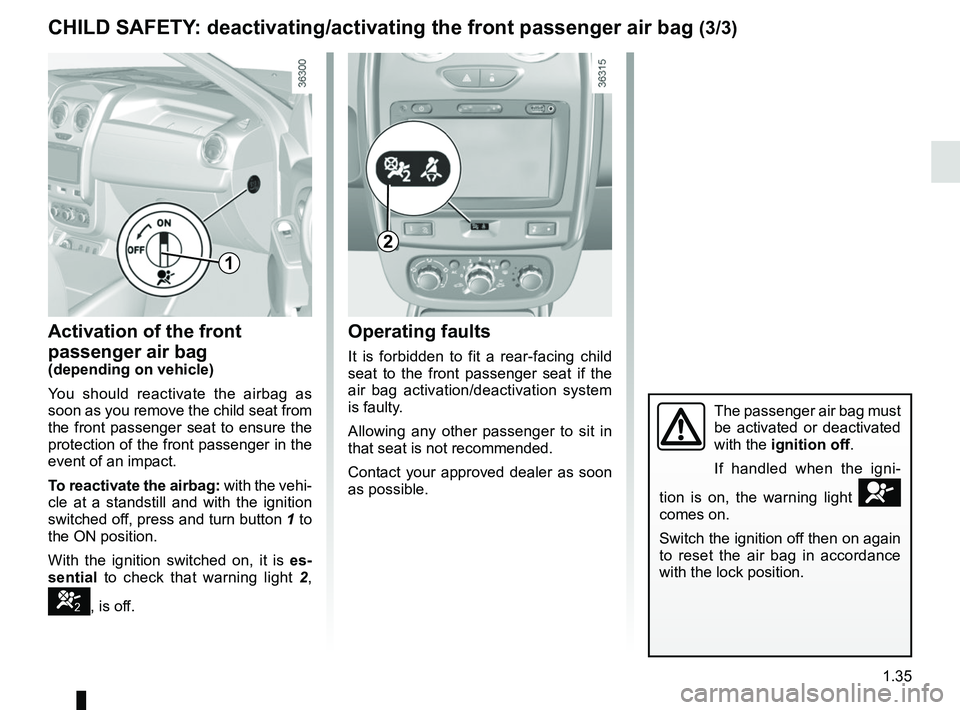
1.35
Operating faults
It is forbidden to fit a rear-facing child
seat to the front passenger seat if the
air bag activation/deactivation system
is faulty.
Allowing any other passenger to sit in
that seat is not recommended.
Contact your approved dealer as soon
as possible.
Activation of the front
passenger air bag
(depending on vehicle)
You should reactivate the airbag as
soon as you remove the child seat from
the front passenger seat to ensure the
protection of the front passenger in the
event of an impact.
To reactivate the airbag: with the vehi-
cle at a standstill and with the ignition
switched off, press and turn button 1 to
the ON position.
With the ignition switched on, it is es-
sential to check that warning light 2 ,
], is off.
CHILD SAFETY: deactivating/activating the front passenger air bag (3/3)
2
1
The passenger air bag must
be activated or deactivated
with the ignition off.
If handled when the igni-
tion is on, the warning light
å
comes on.
Switch the ignition off then on again
to reset the air bag in accordance
with the lock position.
Page 42 of 256

1.36
REAR VIEW MIRRORS
Door mirrors with electrical
adjustment:
With the ignition on, move button 1:
– position A to adjust the left-hand
door mirror;
– position B to adjust the right-hand
door mirror;
0 is the neutral centre position.
Heated door mirrors
With the engine running, de-icing is per-
formed when the rear screen is de-iced/
demisted; refer to the information in the
paragraph on “Heated rear screen”.
Interior rear view mirror
The interior rear-view mirror is adjusta-
ble. When driving at night, tilt lever 3 to
avoid being dazzled by the headlights
of the vehicle behind.
Door mirrors with manual
adjustment
To adjust the door mirror, move
switch 2.
Folding door mirrors
Fold the door mirror manually against
the door window.
For safety reasons, carry
out any adjustments when
the vehicle is not being
driven.
0
B
A
13
2
Objects observed in the
door mirror glass are actu-
ally closer than they appear.
For your safety, take this
into account in order to correctly
assess the distance before any ma-
noeuvre.
Page 44 of 256

1.38
DRIVER’S POSITION, LEFT-HAND DRIVE (2/2)
The fittings described DEPEND ON THE VEHICLE VERSION AND COUNTRY.
1 Side air vent.
2 Side demister outlet.
3 Stalk for:
– direction indicator lights,
– exterior lights,
– front fog lights,
– rear fog light,
– horn.
4 Audible warning
5 Instrument panel.
6 Location for driver’s airbag.
7 – Steering column stalk for winds-
creen and rear screen wash/
wiper.
– On-board computer information
readout control.
8 Ignition switch.
9 Hazard warning lights switch.
10 Centre air vents.
11 Electric central locking switch. 12 Central demister outlet.
13 Location for radio, navigation system
or storage compartments.
14 Location for passenger airbag.
15 Side demister outlet.
16 Side air vent.
17 Passenger airbag activation/deacti-
vation switch.
18 Glove compartment
19 Activation/deactivation control for
the parking distance control.
20 Rear screen and door mirror de-
icing control
21 ECO mode switch.
22 ESC control (4x4 (4WD) version).
23 Activation/deactivation controls for
the Stop and Start function.
24 4x2 ( 2WD), 4x4 (4WD) mode selec-
tor or storage compartment. 25
Cigarette lighter or accessories
socket.
26 Handbrake.
27 Door mirror adjustment control.
28 Gearstick. 29 LPG control
30 Accessories socket.
31 Bottle holders.
32 Heating and ventilation controls.
33 Cruise control/speed limiter main
control.
34
Radio remote control.
35 Cruise control/speed limiter controls.
36 Beam height adjustment control.
37 Bonnet release control.
38 Fuse box.
Page 46 of 256

1.40
DRIVING POSITION, RIGHT-HAND DRIVE (2/2)
The presence of the equipment DEPENDS ON THE VEHICLE VERSION AND COUNTRY.
1 Side air vent.
2 Side demister outlet.
3 Location for passenger airbag or storage compartment.
4 Activation/deactivation control for the
parking distance control.
5 Hazard warning lights switch.
6 Electric central locking switch.
7 Central demister outlet.
8 Centre air vents.
9 Location for radio, navigation system or storage compartments.
10 Stalk for: – direction indicator lights,
– exterior lights,
– front fog lights,
– rear fog light,
– horn. 11
Instrument panel.
12 Cruise control/speed limiter controls.
13 – Steering column stalk for wind-
screen and rear screen wash/
wiper.
– On-board computer information
readout control.
14 Side demister outlet.
15 Side air vent.
16 Ignition switch.
17 Bonnet release control.
18 Beam height adjustment control.
19 Radio remote control.
20 Cruise control/speed limiter main
control.
21 ECO mode switch.
22ESC control.
23 Not used.
24 4x2 ( 2WD), 4x4 (4WD) mode selec-
tor or storage compartment.
25 Gearstick.
26 Door mirror adjustment control.
27 Handbrake.
28 Cigarette lighter or accessories
socket.
29 Heating and ventilation controls.
30 Accessories socket.
31 Bottle holder
32 Rear screen and door mirror de-icing control
33 Glove compartment
34 Fuse box.
35 Passenger airbag activation/deacti-
vation switch.
Page 47 of 256

1.41
Instrument panel A
WARNING LIGHTS (1/7)
A
If no lights or sounds are ap-
parent, this indicates a fault
in the instrument panel. This
indicates that it is essential
to stop immediately (as soon as traf-
fic conditions allow). Ensure that the
vehicle is correctly immobilised and
contact an approved Dealer.
If the orange warning light Ò
comes on while you are driving,
drive carefully to an authorised
dealer as soon as possible. Failure
to follow this recommendation risks
damaging your vehicle.
The red warning light Ò
requires you to stop imme-
diately, for your own safety,
as soon as traffic conditions allow.
Switch off the engine and do not
restart it. Contact an Authorised
Dealer.
The presence and operation of the warning lights DEPEND ON THE EQUIPMENT\
AND COUNTRY.
These warning lights require you
to stop immediately, for your own
safety, as soon as traffic conditions
allow. Switch off the engine and do
not restart it. Contact an authorised
dealer.
ÚÀÔ
D
+x