2016 RENAULT DUSTER door lock
[x] Cancel search: door lockPage 28 of 256

1.22
CHILD SAFETY: General information (1/2)
Carrying children
Children, and adults, must be correctly
seated and strapped in for all journeys.
The children being carried in your vehi-
cle are your responsibility.
A child is not a miniature adult. Children
are at risk of specific injuries as their
muscles and bones have not yet fin-
ished growing. The seat belt alone
would not provide suitable protection.
Use an approved child seat and ensure
you use it correctly.
A collision at 30 mph
(50 km/h) is the same
as falling a distance of
10 metres. Transporting a
child without a restraint is the equi-
valent of allowing him or her to play
on a fourthfloor balcony without rail-
ings.
Never travel with a child held in your
arms. In the event of an accident,
you will not be able to keep hold of
the child, even if you yourself are
wearing a seat belt.
If your vehicle has been involved in
a road accident, replace the child
seat and have the seat belts and
ISOFIX fittings checked.
Never leave a child unat-
tended in the vehicle.
Check that your child is
always strapped in and that
the belt or safety harness used is
correctly set and adjusted. Avoid
wearing bulky clothing which could
cause the belts to slacken.
Never let your child put their head or
arms out of the window.
Check that the child is in the correct
position for the entire journey, espe-
cially if asleep.
To prevent the doors being
opened, use the childproof
locks (refer to the informa-
tion on “Locking/unlocking
the doors” in Section 1).
Page 44 of 256

1.38
DRIVER’S POSITION, LEFT-HAND DRIVE (2/2)
The fittings described DEPEND ON THE VEHICLE VERSION AND COUNTRY.
1 Side air vent.
2 Side demister outlet.
3 Stalk for:
– direction indicator lights,
– exterior lights,
– front fog lights,
– rear fog light,
– horn.
4 Audible warning
5 Instrument panel.
6 Location for driver’s airbag.
7 – Steering column stalk for winds-
creen and rear screen wash/
wiper.
– On-board computer information
readout control.
8 Ignition switch.
9 Hazard warning lights switch.
10 Centre air vents.
11 Electric central locking switch. 12 Central demister outlet.
13 Location for radio, navigation system
or storage compartments.
14 Location for passenger airbag.
15 Side demister outlet.
16 Side air vent.
17 Passenger airbag activation/deacti-
vation switch.
18 Glove compartment
19 Activation/deactivation control for
the parking distance control.
20 Rear screen and door mirror de-
icing control
21 ECO mode switch.
22 ESC control (4x4 (4WD) version).
23 Activation/deactivation controls for
the Stop and Start function.
24 4x2 ( 2WD), 4x4 (4WD) mode selec-
tor or storage compartment. 25
Cigarette lighter or accessories
socket.
26 Handbrake.
27 Door mirror adjustment control.
28 Gearstick. 29 LPG control
30 Accessories socket.
31 Bottle holders.
32 Heating and ventilation controls.
33 Cruise control/speed limiter main
control.
34
Radio remote control.
35 Cruise control/speed limiter controls.
36 Beam height adjustment control.
37 Bonnet release control.
38 Fuse box.
Page 46 of 256

1.40
DRIVING POSITION, RIGHT-HAND DRIVE (2/2)
The presence of the equipment DEPENDS ON THE VEHICLE VERSION AND COUNTRY.
1 Side air vent.
2 Side demister outlet.
3 Location for passenger airbag or storage compartment.
4 Activation/deactivation control for the
parking distance control.
5 Hazard warning lights switch.
6 Electric central locking switch.
7 Central demister outlet.
8 Centre air vents.
9 Location for radio, navigation system or storage compartments.
10 Stalk for: – direction indicator lights,
– exterior lights,
– front fog lights,
– rear fog light,
– horn. 11
Instrument panel.
12 Cruise control/speed limiter controls.
13 – Steering column stalk for wind-
screen and rear screen wash/
wiper.
– On-board computer information
readout control.
14 Side demister outlet.
15 Side air vent.
16 Ignition switch.
17 Bonnet release control.
18 Beam height adjustment control.
19 Radio remote control.
20 Cruise control/speed limiter main
control.
21 ECO mode switch.
22ESC control.
23 Not used.
24 4x2 ( 2WD), 4x4 (4WD) mode selec-
tor or storage compartment.
25 Gearstick.
26 Door mirror adjustment control.
27 Handbrake.
28 Cigarette lighter or accessories
socket.
29 Heating and ventilation controls.
30 Accessories socket.
31 Bottle holder
32 Rear screen and door mirror de-icing control
33 Glove compartment
34 Fuse box.
35 Passenger airbag activation/deacti-
vation switch.
Page 50 of 256
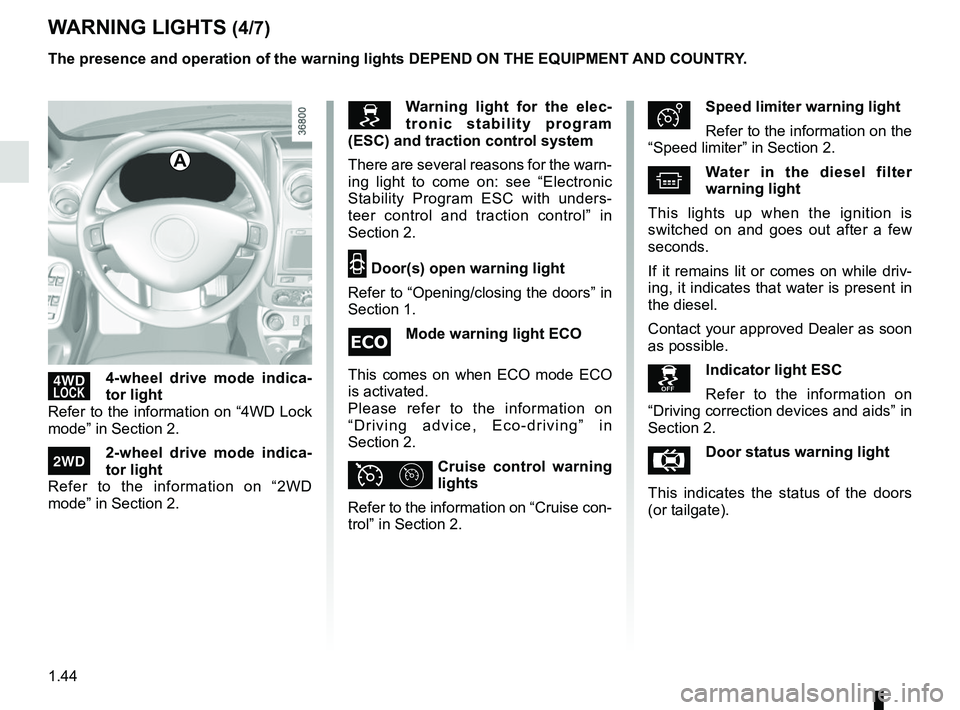
1.44
’4-wheel drive mode indica-
tor light
Refer to the information on “4WD Lock
mode” in Section 2.
‘2-wheel drive mode indica-
tor light
Refer to the information on “2WD
mode” in Section 2.
ÐSpeed limiter warning light
Refer to the information on the
“Speed limiter” in Section 2.
^Water in the diesel filter
warning light
This lights up when the ignition is
switched on and goes out after a few
seconds.
If it remains lit or comes on while driv-
ing, it indicates that water is present in
the diesel.
Contact your approved Dealer as soon
as possible.
Indicator light ESC
Refer to the information on
“Driving correction devices and aids” in
Section 2.
ÅDoor status warning light
This indicates the status of the doors
(or tailgate).
WARNING LIGHTS (4/7)
A
Warning light for the elec-
tronic stability program
(ESC) and traction control system
There are several reasons for the warn-
ing light to come on: see “Electronic
Stability Program ESC with unders-
teer control and traction control” in
Section 2.
2 Door(s) open warning light
Refer to “Opening/closing the doors” in
Section 1.
Mode warning light ECO
This comes on when ECO mode ECO
is activated.
Please refer to the information on
“Driving advice, Eco-driving” in
Section 2.
ϦCruise control warning
lights
Refer to the information on “Cruise con-
trol” in Section 2.
The presence and operation of the warning lights DEPEND ON THE EQUIPMENT\
AND COUNTRY.
Page 80 of 256

2.4
vehicles with an automatic
gearbox
Before starting, move the lever to posi-
tion P.
Refer to the information on the
“Automatic gearbox” in Section 2.
Stopping the engine
With the engine idling, turn the key
back to “Stop” position St.
Special note
Depending on the vehicle, accessories
(e.g. radio) stop working either when
the engine is switched off or when the
driver’s door is opened or when the
doors are locked.Driver’s responsibility
Never leave an animal,
child or adult who is not
self-sufficient alone on your
vehicle, even for a short time.
They may pose a risk to themselves
or to others by starting the engine,
activating equipment such as the
electric windows or locking the
doors, for example.
Also, in hot and/or sunny weather,
please remember that the tempera-
ture inside the passenger compart-
ment increases very quickly.
Never switch off the ignition
before the vehicle has stopped
completely . Switching off the
engine disables the assistance
equipment: brakes, steering, etc.,
and additional seatbelt devices.
The steering is locked when the key
is removed.
RISK OF DEATH OR SERIOUS
INJURY.
STARTING, STOPPING THE ENGINE (2/4)
Do not park the vehicle or
run the engine in locations
where combustible sub-
stances or materials such
as grass or leaves can come into
contact with a hot exhaust system.
Page 81 of 256

2.5
STARTING, STOPPING THE ENGINE (3/4)
Remote engine start-up
Activation
If the vehicle is so equipped, press the
unlocking button 1 briefly, then press
the remote start button 3 twice for about
3 seconds each time.
Operation
This function allows remote starting of
the engine.
To do this, press the locking button 2,
followed by the remote start button 3
for about 3 seconds.
2
3
The remote engine start-up operates if:
– the lever is in neutral for vehicles with a manual or sequential gearbox;
– the lever is in position P for vehicles
with an automatic gearbox;
– the ignition is off and no key is in- serted into the ignition switch;
– the bonnet is closed;
– all of the opening elements (doors and luggage compartment) are
closed and locked when you leave
the vehicle.
This function also lets you programme
the engine to start, in order to heat or
ventilate the passenger compartment
up to 24 hours before using the vehicle.
The configuration and the program-
ming are done using the multimedia
display 4, : refer to the multimedia in-
structions for your vehicle.
1
4
Special note for vehicles fitted
with the “Wake up every 2 hours ”
function.
In the event of use of the function
two days in succession, you must
drive at least 10 minutes between
the two uses. Risk of engine oil
wear.
Please see your vehicle’s multime-
dia instructions.
Page 84 of 256

2.8
STOP AND START function (2/3)
Conditions preventing the
standby of the engine
Certain conditions prevent the system
from using the engine standby function,
including when:
– reverse gear is engaged;
– the bonnet is not locked;
– the outdoor temperature is too low or too high (less than around 0 °C or
higher than around 30 °C);
– the battery is not sufficiently char- ged;
– if available, the vehicle is in “4WD Lock” mode (please see the section
“Transmission: 4-wheel drive (4WD)”
in Section 2);
– for vehicles with an automatic or sequential gearbox, the gradient is
steeper than approximately 12%;
– the engine temperature is too low;
– the anti-pollution system is required;
or
– ...
The warning light
lights up on
the instrument panel to alert you that
engine standby is not available.
To fill up with fuel, the engine must
be stopped (and not on standby):
always stop the engine (please see
“Starting, stopping the engine”).
Deactivate the Stop and
Start function for any opera-
tion performed in the engine
compartment.
Preventing the engine from
standing by
In certain situations, when negotiating
a junction for instance, it is possible to
keep the engine running so as to be
ready to move off quickly.
Automatic or sequential gearbox
Keep the vehicle stationary without
pressing too hard on the brake pedal.
Manual gearbox
Keep the clutch pedal pressed right
down.
Conditions for coming out of
engine standby
For automatic or sequential gear-
box:
– The brake pedal is released, position D or M engaged or,
– the brake pedal is released with the gear lever in position N and the
handbrake off, or
– the brake pedal is pressed again, with position N engaged and the
handbrake applied, or
– position R is engaged, or
– the accelerator pedal is pressed.
For manual gearboxes:
– The gearbox is in neutral and the clutch pedal is slightly depressed, or
– the engine is in gear and the clutch pedal is pressed right down.
Page 140 of 256

3.12
INTERIOR LIGHTING (2/2)
Automatic operation of interior
lighting
(depending on the vehicle)
– if the doors are unlocked using the remote control, the lighting
is switched on for approximately
30 seconds.
– If a door is open (or not properly closed), the lighting is switched
on for approximately 3 to 30 mi-
nutes.
– if all the doors are closed, the lighting start to dim when the ig-
nition is switched on.
43
Boot light 4
The light 4 comes on when the boot is
opened.
Glovebox light 3
Light 3 comes on when the cover is
opened.