2016 RENAULT CAPTUR lever
[x] Cancel search: leverPage 188 of 246

5.6
Jack 2Fold it correctly before refitting it in its
housing (ensure that the wheelbrace is
correctly positioned).
Hubcap tool 3
This tool is used to remove the wheel
trims.
Wheel bolt guide 4To finish loosening or starting to tighten
the wheel bolts.
Tow eye 5Please see “Towing: breakdown recov-
ery” in Section 5.
Lever 6This tightens or releases the tow eye 5.
Storage bagSupplied with the tool kit, this allows
you to store a punctured wheel in the
boot.
Wheelbrace 1Locks or unlocks the wheel bolts and
tow eye 5.
The tools included in the tool kit depend
on the vehicle.
Tool kit
A is located in the tray under
the luggage compartment carpet.
Lift the cover and remove it.Wheel bolt bag
TOOLS
A
Do not leave the tools unsecured inside the vehicle as they may come loo\
se under braking. After use, check that all the
tools are correctly clipped into the tool kit, then position it correctl\
y in its housing: there is a risk of injury.
If wheel bolts are supplied in the tool kit, only use these bolts for th\
e emergency spare wheel: refer to the label affixed
to the emergency spare wheel.
The jack is designed for wheel changing purposes only. Under no circumstances should it be used for carrying out repairs un-
derneath the vehicle or to gain access to the underside of the vehicle.
2
1
3
5
4
6
Page 212 of 246

5.30
TOWING: breakdown recovery (1/2)
Before towing, unlock the steering
column: with the clutch depressed,
engage first gear (lever in position N
or R for vehicles with automatic gear-
boxes), insert the RENAULT card in the
card reader, then press the engine start
button for two seconds.
Reposition the lever to neutral (posi-
tion N for vehicles fitted with an auto-
matic gearbox).
The column is unlocked, the acces-
sory functions are supplied: the vehi-
cle lights can be used (indicators, brake
lights etc.). At night the vehicle must
have its lights on.
Once you have finished towing, press
the engine start button twice (risk of
running down the battery). The speed specified by current legis-
lation for towing must always be ob-
served. If your vehicle is the towing
vehicle, do not exceed the maximum
towing weight for your vehicle (refer to
the information on “Weights” in Section
6).
Towing a vehicle with an
automatic gearbox
With the engine switched off, the trans-
mission is no longer lubricated. It is
preferable to tow this type of vehicle on
a trailer or tow it with the front wheels
off the ground.
Under
exceptional circumstances, you
may tow the vehicle with all four wheels
on the ground, only going forward, with
the gear lever in the neutral N position,
and for a distance not exceeding
30 miles (50 km).
Do not remove the
RENAULT card from the
reader when the vehicle is
being towed.
1
2
If the lever is stuck in P , even though
you are depressing the brake pedal, the
lever can be released manually. To do
this, unclip the base of the lever, then
insert a tool (with a hard rod to it) into
the slot 1 and press the button 2 at the
same time in order to unlock the lever.
Contact an authorised dealer as soon
as possible.
Page 213 of 246
5.31
TOWING: breakdown recovery (2/2)
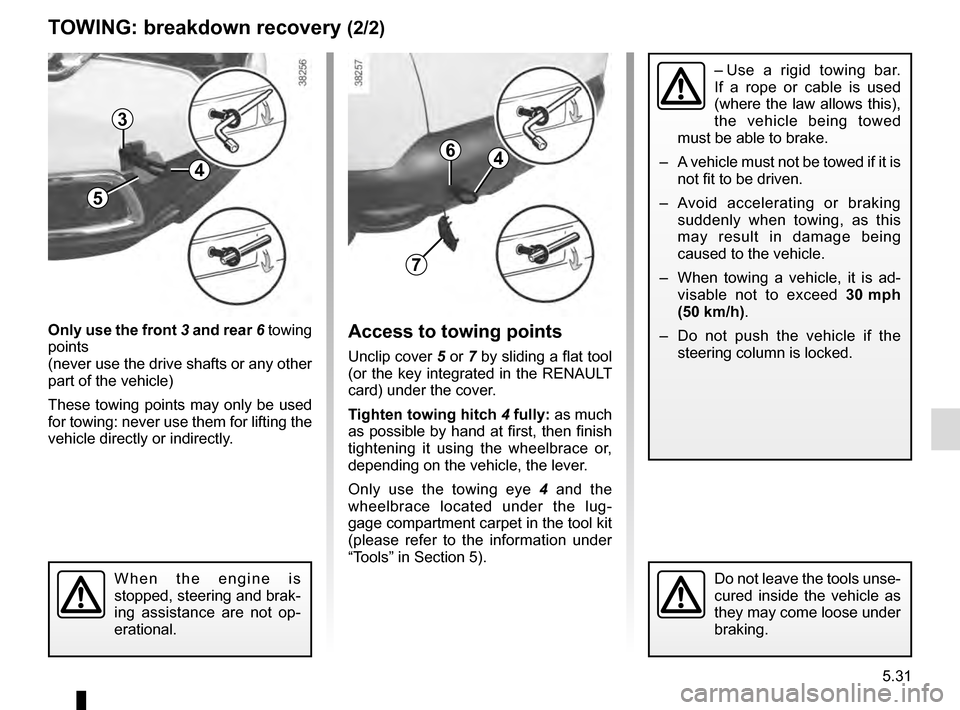
Only use the front 3 and rear 6 towing
points
(never use the drive shafts or any other
part of the vehicle)
These towing points may only be used
for towing: never use them for lifting the
vehicle directly or indirectly.Access to towing points
Unclip cover 5 or 7 by sliding a flat tool
(or the key integrated in the RENAULT
card) under the cover.
Tighten towing hitch 4 fully: as much
as possible by hand at first, then finish
tightening it using the wheelbrace or,
depending on the vehicle, the lever.
Only use the towing eye 4 and the
wheelbrace located under the lug-
gage compartment carpet in the tool kit
(please refer to the information under
“Tools” in Section 5).
When the engine is
stopped, steering and brak-
ing assistance are not op-
erational.Do not leave the tools unse-
cured inside the vehicle as
they may come loose under
braking.
6
7
4
– Use a rigid towing bar.
If a rope or cable is used
(where the law allows this),
the vehicle being towed
must be able to brake.
– A vehicle must not be towed if it is not fit to be driven.
– Avoid accelerating or braking suddenly when towing, as this
may result in damage being
caused to the vehicle.
– When towing a vehicle, it is ad- visable not to exceed 30 mph
(50 km/h).
– Do not push the vehicle if the steering column is locked.
5
4
3
Page 239 of 246

A
ABS ..............................................................1.46, \
2.27 → 2.31
accessories.............................................................\
......")
7.1
ALPHABETICAL INDEX (1/5)
A
ABS ..............................................................1.46, \
2.27 → 2.31
accessories.............................................................\
........... 5.27
accessories socket ............................................................ 3.20
additional methods of restraint .......................................... 1.27 side protection ............................................................. 1.26
to the front seat belts .......................................1.21 → 1.24
to the rear seat belts .................................................... 1.25
adjusting your driving position ......................1.16 → 1.20, 3.21
advice on antipollution ....................................................... 2.18
air bag...........................................................1.21 → 1.27, 1.44
activating the front passenger air bags ........................ 1.39
deactivating the front passenger air bags .................... 1.37
air conditioning ........................................................ 3.4 → 3.11
air vents ...................................................................... 3.2 – 3.3
anti-corrosion check ..............................................6.14 → 6.18
anti-corrosion protection .................................................... 4.13
anti-lock braking system: ABS ...............................2.27 → 2.31
antipollution advice .................................................................\
......... 2.18
armrest: front ..................................................................\
............ 3.16
ashtray ................................................................\
............... 3.20
ASR (traction control) ............................................2.27 → 2.31
audible and visual signals.................................................. 1.68
automatic gearbox (use) ........................................2.43 → 2.45
automatic gearbox selector lever...........................2.43 → 2.45
B
battery............................................................ 4.12, 5.24 – 5.25 troubleshooting ................................................. 5.24 – 5.25
bonnet..................................................................\
....... 4.2 – 4.3
brake fluid ........................................................................\
.... 4.8
bulbs changing ..........................................................5.13 \
→ 5.19C
catalytic converter................................................... 2.10 – 2.11
central door locking ........................... 1.5
→ 1.10, 1.13 → 1.15
changing a bulb .....................................................5.13 → 5.19
changing a wheel........................................................\
5.8 – 5.9
changing gear ...............................................2.12, 2.43 → 2.45
child restraint/seat .............................1.28 – 1.29, 1.31 → 1.37
child safety......1.8 – 1.9, 1.12, 1.24, 1.28 – 1.29, 1.31 → 1.37,
2.3, 3.12 – 3.13
child seats..........................................1.28 – 1.29, 1.3\
1 → 1.36
children ........................ 1.2, 1.8 – 1.9, 1.28 – 1.29, 3.12 – 3.13
children (safety) .......................................................... 1.2, 1.12
cigar lighter ........................................................................\
3.20
cleaning: inside the vehicle .............................................. 4.15 – 4.16
clock ....................................................................... 1.62 – 1.63
closing the doors ................................................... 1.11 → 1.15
control instruments ............................1.44 → 1.52, 1.62 – 1.63
controls ...............................................................\
...1.40 → 1.43
courtesy light ............................................................ 3.14, 5.18
courtesy mirrors ................................................................. 3.19
cruise control ................................................1.47, 2.35 → 2.38
cruise control-speed limiter....................................2.32 → 2.38
D
dashboard..............................................................1\
.40 → 1.43
deadlocking the doors ....................................................... 1.10
demisting rear screen ..................................................3.4, 3.7 → 3.10
windscreen ..................................................3.5, 3.7 → 3.10
dimensions .............................................................\
............. 6.4
dipstick................................................................\
................. 4.4
display ................................................................\
...1.44 → 1.50
doors/tailgate .........................................................\
..1.2 → 1.15
driver assistance....................................................2.2\
7 → 2.42
driver’s position .....................................................1.40 →
1.48
Page 240 of 246

7.2
ALPHABETICAL INDEX (2/5)
driving ........2.2 → 2.5, 2.10 – 2.11, 2.13 → 2.17, 2.20 → 2.26,
2.24 → 2.40, 2.43 → 2.45
driving aids ............................................................2.27 → 2.42
driving position settings ............................................................1.1\
8 → 1.20
driving recommendations ......................................2.13 → 2.17
E
ECO driving ...........................................................2.13 → 2.17
ECO mode ........................................................................\
. 2.15
electric beam height adjustment ............................. 1.69 – 1.70
electric windows ..................................................... 3.12 – 3.13
electronic stability control: ESC .............................2.27 → 2.31
emergency brake assist.........................................2.27 → 2.31
emergency braking ................................................2.27 → 2.31
emergency key ..........................................................1.2 → 1.4
emergency spare wheel ...................................................... 5.2
engine technical specifications .................................................. 6.5
engine coolant ..................................................................... 4.7
engine oil ...................................................................4.4 → 4.6
engine oil capacity ...................................................... 4.5 – 4.6
engine oil level ...........................................................4.4 → 4.6
engine specifications .................................................... 6.3, 6.5
engine standby ..........................................................2.6 → 2.9
engine start/stop button .............................................2.3 → 2.5
environment ............................................................\
........... 2.19
ESC: electronic stability control ....................1.46, 2.27 → 2.31
external temperature ......................................................... 1.63
F
faults operating faults ................................................5.32 → 5.37
filter air filter ........................................................................\
... 4.9
oil filter .................................................................. 4.5 – 4.6 passenger compartment filter ........................................ 4.9
fitting a radio ...................................................................... 5.26
fittings ...............................................................\
.....3.15 → 3.19
front passenger air bag deactivation ................................. 1.37
front seat adjustment ......................................................... 1.17
front seats ........................................................................\
.. 4.17 adjustment .......................................................1.16 → 1.18
fuel advice on fuel economy ...................................2.13 → 2.17
consumption ....................................................2.13 → 2.17
filling ........................................................1.44, 1.74 → 1.76
grade ................................................................1.\
74 → 1.76
fuel consumption ...................................................2.13 → 2.17
fuel economy .........................................................2.13 → 2.17
fuel filler cap ..........................................................1.74 → 1.76
fuel level ................................................................1.44 → 1.49
fuel tank capacity ...............................................................\
......... 1.74
fuel tank capacity ...................................................1.74 → 1.76
fuses ..................................................................\
....5.21 → 5.23
G
gear lever..............................................................\
............. 2.12
H
handbrake...............................................................\
........... 2.12
hands-free telephone integrated control ............................
3.31
hazard warning lights signal .............................................. 1.68
headlight beam adjustment .................................... 1.69 – 1.70
headrest................................................................\
.... 1.16, 3.21
heated seats ...................................................................... 1.17
heated windscreen ..................................................3.7 → 3.10
heating and air conditioning system ........................ 3.4 → 3.11
heating system ........................................................ 3.4 → 3.11
Hill Start Assist.......................................................2.27 → 2.31
horn ...................................................................\
................ 1.68