Page 274 of 448

These indicators are molded into the bottom of the tread
grooves. They will appear as bands when the tread depth
becomes a 1/16 of an inch (1.6 mm). When the tread is
worn to the tread wear indicators, the tire should be
replaced. Refer to “Replacement Tires” in this section for
further information.
Life Of Tire
The service life of a tire is dependent upon varying
factors including, but not limited to:
•Driving style.
• Tire pressure - Improper cold tire inflation pressures
can cause uneven wear patterns to develop across the
tire tread. These abnormal wear patterns will reduce
tread life, resulting in the need for earlier tire replace-
ment.
• Distance driven. •
Performance tires, tires with a speed rating of V or
higher, and Summer tires typically have a reduced
tread life. Rotation of these tires per the vehicle main-
tenance schedule is highly recommended.
WARNING!
Tires and the spare tire should be replaced after six
years, regardless of the remaining tread. Failure to
follow this warning can result in sudden tire failure.
You could lose control and have a collision resulting
in serious injury or death.
Keep dismounted tires in a cool, dry place with as little
exposure to light as possible. Protect tires from contact
with oil, grease, and gasoline.
272 STARTING AND OPERATING
Page 277 of 448

WARNING!
Using tires of different size and type (M+S, Snow)
between front and rear axles can cause unpredictable
handling. You could lose control and have a collision.
CAUTION!
To avoid damage to your vehicle or tires, observe the
following precautions:
•Because of restricted traction device clearance be-
tween tires and other suspension components, it is
important that only traction devices in good condi-
tion are used. Broken devices can cause serious
damage. Stop the vehicle immediately if noise
occurs that could indicate device breakage. Remove
the damaged parts of the device before further use.
(Continued)
CAUTION! (Continued)
•Install device as tightly as possible and then re-
tighten after driving about ½ mile (0.8 km).
• Do not exceed 30 mph (48 km/h).
• Drive cautiously and avoid severe turns and large
bumps, especially with a loaded vehicle.
• Do not drive for a prolonged period on dry pave-
ment.
• Observe the traction device manufacturer ’s instruc-
tions on the method of installation, operating
speed, and conditions for use. Always use the
suggested operating speed of the device manufac-
turer ’s if it is less than 30 mph (48 km/h).
• Do not use traction devices on a compact spare tire.
5
STARTING AND OPERATING 275
Page 283 of 448

2. Installing some form of aftermarket window tintingthat affects radio wave signals.
3. Snow or ice around the wheels or wheel housings.
4. Using tire chains on the vehicle.
5. Using wheels/tires not equipped with TPM sensors.
NOTE: Your vehicle is equipped with a regular size
spare wheel.
1. The spare tire has a tire pressure monitoring sensor, but it is not monitored until it is mounted in place of
any of the existing four road tires.
2. If you install the spare tire in place of a road tire that has a pressure below the low-pressure warning limit,
upon the next ignition key cycle, a chime will sound
and the Tire Pressure Monitoring Telltale Light will
turn ON due to the low tire condition. Then, after driving the vehicle for up to 20 minutes above 15mph
(24km/h), the system will recognize the new sensor, so
turn off the telltale.
3. If a spare tire not equipped with tire pressure moni- toring sensor is used, then the Tire Pressure Monitor-
ing Telltale Light will turn ON, flashing for 75 seconds
and then remaining solid for each subsequent ignition
key cycle.
NOTE: For a correct Tire Pressure Monitoring behavior,
please wait for about 20 minutes in key-off during each
tire substitution.
General Information
This device complies with Part 15 of the FCC rules and
RSS-210 of Industry Canada. Operation is subject to the
following two conditions:
(1) This device may not cause harmful interference.
5
STARTING AND OPERATING 281
Page 301 of 448
WARNING!(Continued)
•Total weight must be distributed between the tow
vehicle and the trailer such that the following four
ratings are not exceeded:
1. GVWR
2. GTW
3. GAWR
4. Tongue weight rating for the trailer hitch uti-
lized.
Towing Requirements — Tires
• Do not attempt to tow a trailer while using a compact
spare tire.
• Proper tire inflation pressures are essential to the safe
and satisfactory operation of your vehicle. Refer to
“Tires – General Information” in “Starting And Oper-
ating” for proper tire inflation procedures.
• Check the trailer tires for proper tire inflation pres-
sures before trailer usage.
• Check for signs of tire wear or visible tire damage
before towing a trailer. Refer to “Tires – General
Information” in “Starting And Operating” for the
proper inspection procedure.
5
STARTING AND OPERATING 299
Page 309 of 448
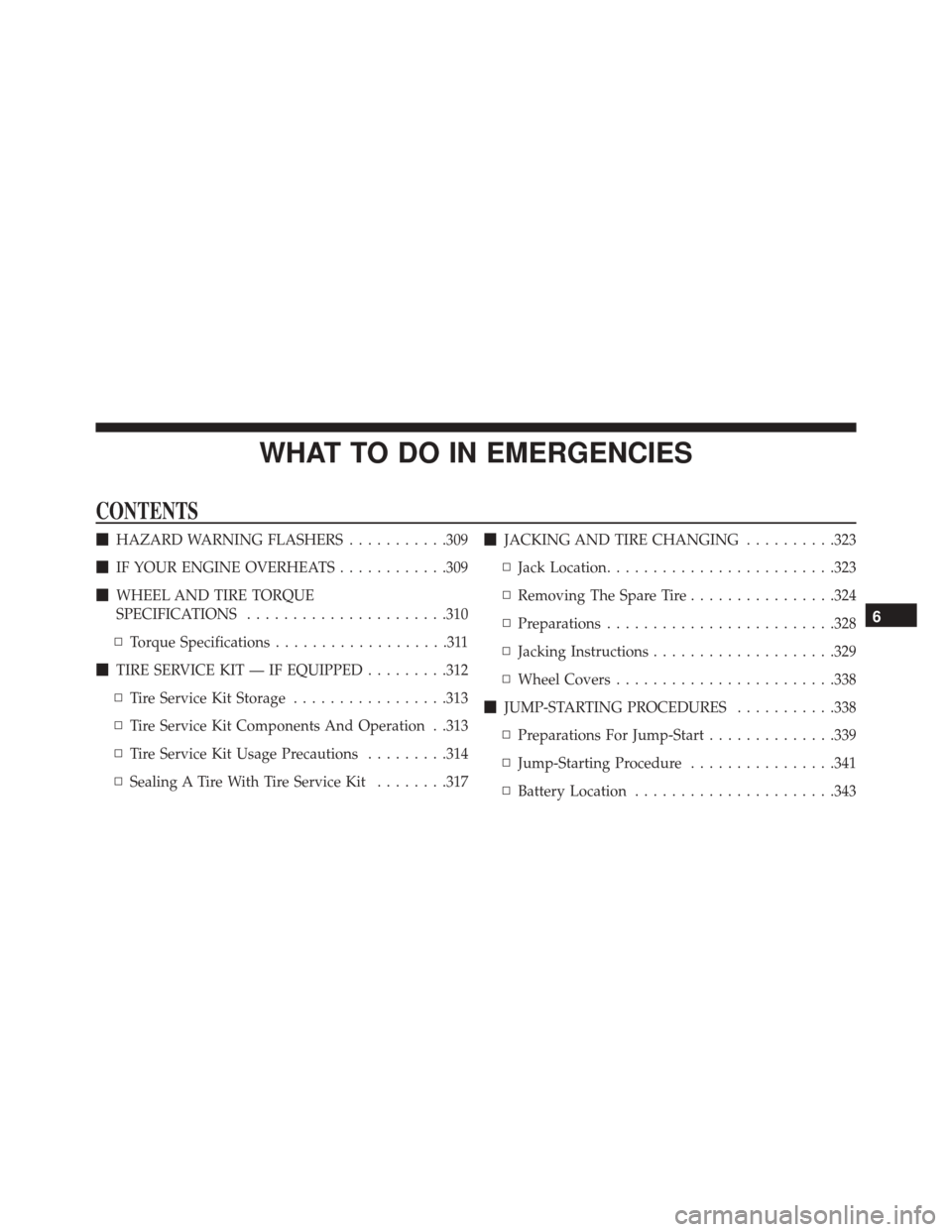
WHAT TO DO IN EMERGENCIES
CONTENTS
�HAZARD WARNING FLASHERS ...........309
� IF YOUR ENGINE OVERHEATS ............309
� WHEEL AND TIRE TORQUE
SPECIFICATIONS ..................... .310
▫ Torque Specifications ...................311
� TIRE SERVICE KIT — IF EQUIPPED .........312
▫ Tire Service Kit Storage .................313
▫ Tire Service Kit Components And Operation . .313
▫ Tire Service Kit Usage Precautions .........314
▫ Sealing A Tire With Tire Service Kit ........317�
JACKING AND TIRE CHANGING ..........323
▫ Jack Location ........................ .323
▫ Removing The Spare Tire ................324
▫ Preparations ........................ .328
▫ Jacking Instructions ....................329
▫ Wheel Covers ....................... .338
� JUMP-STARTING PROCEDURES ...........338
▫ Preparations For Jump-Start ..............339
▫ Jump-Starting Procedure ................341
▫ Battery Location ..................... .343
6
Page 326 of 448
Removing The Spare Tire
1. Remove the spare tire before attempting to jack up thevehicle. Attach the lug bolt adapter to the winch
extension and insert it into the winch mechanism.
Jack Tools1 — Winch Extension
2 — Lug Bolt Adapter
3 — Wrench Handle
324 WHAT TO DO IN EMERGENCIES
Page 327 of 448
The winch mechanism is located under the rear of the
vehicle to the right of the spare tire.
2. Rotate the wheel wrench handle counterclockwiseuntil the spare tire is on the ground with enough cable
slack to allow you to pull it out from under the vehicle.
Winch Location
Winch Extension
6
WHAT TO DO IN EMERGENCIES 325
Page 328 of 448
NOTE:The winch mechanism is designed for use with
the winch extension tube only. Use of an air wrench or
other power tools is not recommended and can damage
the winch. 3. Pull the spare tire out from under the vehicle to gain
access to the spare tire retainer.
Lowering Spare Tire
Spare Tire
326 WHAT TO DO IN EMERGENCIES