Page 68 of 338

3. The system will automatically engage the starter tocrank the engine. If the vehicle fails to start, the starter
will disengage automatically after 25 seconds.
4. If you wish to stop the cranking of the engine prior to the engine starting, push the button again.
5. Check that the oil pressure warning light has turned off.
6. Release the parking brake.
Extreme Cold Weather
The engine block heater is a resistance heater installed in
the water jacket of the engine. It requires a 110–115 Volt
AC electrical outlet with a grounded, three-wire exten-
sion cord. Its use is recommended for environments that
routinely fall below -10°F (-23°C). It should be used when
the vehicle has not been running overnight or longer periods and should be plugged in two hours prior to
start. Its use is required for cold starts with temperatures
under -20°F (-28°C).
NOTE: The engine block heater cord is a factory in-
stalled option. If your vehicle is not equipped, heater
cords are available from your authorized MOPAR
dealer.
•
A 12 Volt heater built into the fuel filter housing aids in
preventing fuel gelling. It is controlled by a built-in
thermostat.
• A Diesel Pre-Heat system both improves engine start-
ing and reduces the amount of white smoke generated
by a warming engine.
66 STARTING AND OPERATING
Page 69 of 338

Starting Fluids
The engine is equipped with a glow plug preheating
system. If the instructions in this manual are followed,
the engine should start in all conditions and no type of
starting fluid should be used.
WARNING!
•Do not leave children or animals inside parked
vehicles in hot weather. Interior heat build up may
cause serious injury or death.
• When leaving the vehicle, always make sure the
keyless ignition node is in the “OFF” mode, re-
move the key fob from the vehicle and lock the
vehicle.
(Continued)
WARNING! (Continued)
•Never leave children alone in a vehicle, or with
access to an unlocked vehicle. Allowing children to
be in a vehicle unattended is dangerous for a
number of reasons. A child or others could be
seriously or fatally injured. Children should be
warned not to touch the parking brake, brake pedal
or the gear selector.
• Do not leave the key fob in or near the vehicle, or
in a location accessible to children, and do not
leave the ignition of a vehicle equipped with
Keyless Enter-N-Go in the ACC or ON/RUN mode.
A child could operate power windows, other con-
trols, or move the vehicle.
4
STARTING AND OPERATING 67
Page 91 of 338
MAINTAINING YOUR VEHICLE
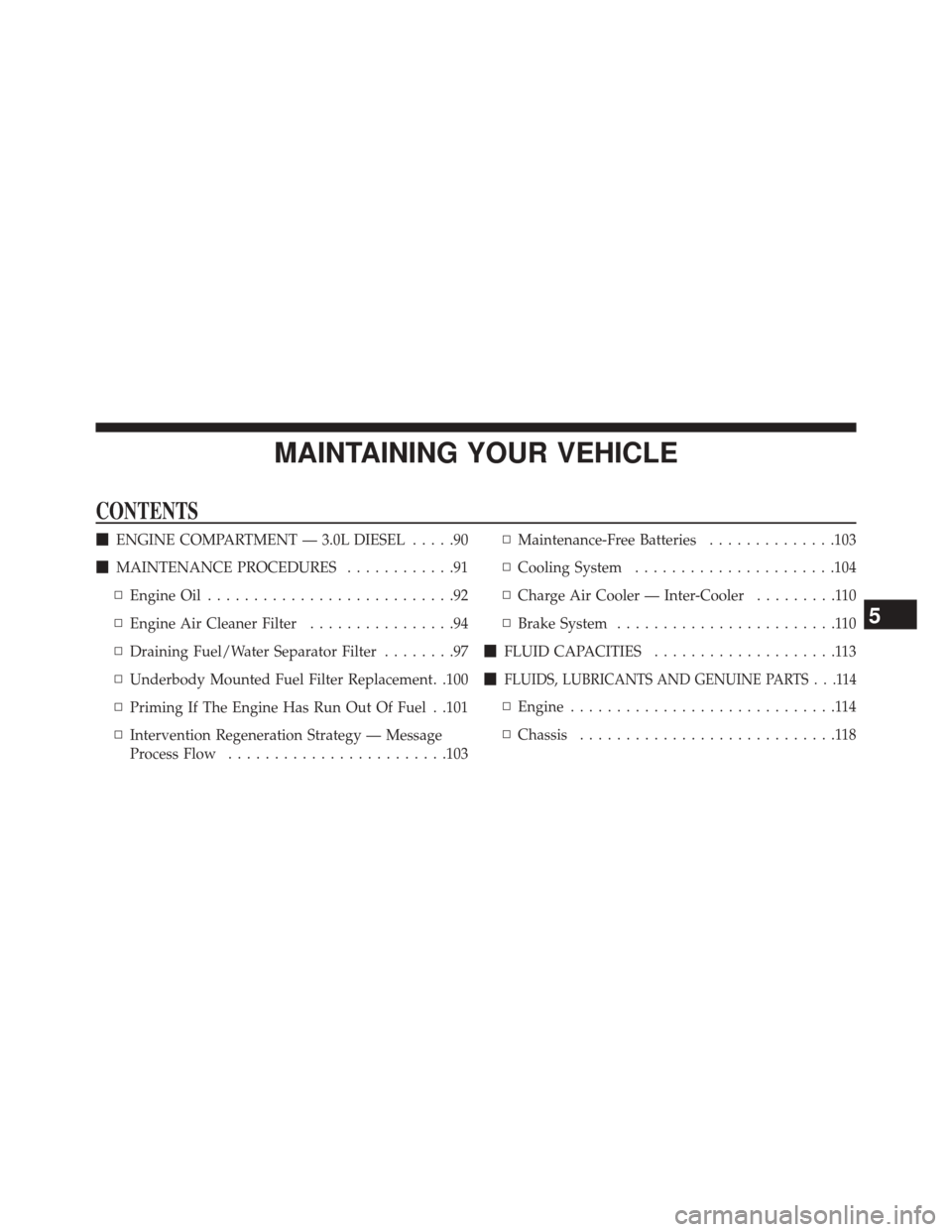
CONTENTS
�ENGINE COMPARTMENT — 3.0L DIESEL .....90
� MAINTENANCE PROCEDURES ............91
▫ Engine Oil ...........................92
▫ Engine Air Cleaner Filter ................94
▫ Draining Fuel/Water Separator Filter ........97
▫ Underbody Mounted Fuel Filter Replacement. .100
▫ Priming If The Engine Has Run Out Of Fuel . .101
▫ Intervention Regeneration Strategy — Message
Process Flow ....................... .103▫
Maintenance-Free Batteries ..............103
▫ Cooling System ..................... .104
▫ Charge Air Cooler — Inter-Cooler .........110
▫ Brake System ........................110
� FLUID CAPACITIES ....................113
�
FLUIDS, LUBRICANTS AND GENUINE PARTS . . .114
▫ Engine .............................114
▫ Chassis ............................118
5
Page 92 of 338
ENGINE COMPARTMENT — 3.0L DIESEL
1 — Air Cleaner Filter5 — Battery
2 — Engine Oil Dipstick 6 — Power Distribution Center (PDC)
3 — Engine Oil Fill 7 — Washer Fluid Reservoir
4 — Brake Fluid Reservoir 8 — Engine Coolant
90 MAINTAINING YOUR VEHICLE
Page 103 of 338

3. Open the water drain valve, and let any accumulatedwater drain.
4. Close the water drain valve.
5. Remove bottom cover using a strap wrench. Rotate counterclockwise for removal. Remove the used o-ring
and discard it.
6. Remove the used filter cartridge from the housing and dispose of it according to your local regulations.
7. Wipe the sealing surfaces of the lid and housing clean.
8. Install a new o-ring into the ring groove on the filter housing and lubricate with clean engine oil.
NOTE: WIF (Water In Fuel) sensor is re-usable. Service
kit comes with new o-ring for filter canister and WIF
sensor.Priming If The Engine Has Run Out Of Fuel
WARNING!
Do not open the high pressure fuel system with the
engine running. Engine operation causes high fuel
pressure. High pressure fuel spray can cause serious
injury or death.
1. Add a substantial amount of fuel to the tank, approxi- mately 2 to 5 gal (8L to 19L).
2. Press ignition switch twice without your foot on brake to put vehicle in Run position. This will activate the in
tank fuel pump for approximately 30 seconds. Repeat
this process twice.
3. Start the engine using the “Normal Starting” proce- dure. Refer to “Starting Procedures” in “Starting and
Operating” for further information.
5
MAINTAINING YOUR VEHICLE 101
Page 112 of 338

•Do not change the thermostat for Summer or Winter
operation. If replacement is ever necessary, install
ONLY the correct type thermostat. Other designs may
result in unsatisfactory engine coolant (antifreeze)
performance, poor gas mileage, and increased emis-
sions.
Charge Air Cooler — Inter-Cooler
The charge air cooler is positioned in front of the radiator
and the air conditioner condenser. Air enters the engine
through the air cleaner and passes through the turbo-
charger, where it is pressurized. This pressurized air
rapidly reaches high temperature. The air is then directed
through a hose to the charge air cooler and through
another hose to the intake manifold of the engine. This
cooling process enables more efficient burning of fuel
resulting in fewer emissions.
To guarantee optimum performance of the system, keep
the surfaces of the charge air cooler, condenser and radiator clean and free of debris. Periodically check the
hoses leading to and from the charge air cooler for cracks
or loose clamps resulting in loss of pressure and reduced
engine performance.
Brake System
Brake Master Cylinder — Brake Fluid Level Check
The fluid level of the master cylinder should be checked
when performing under the hood service, or immedi-
ately if the “Brake System Warning Light” indicates
system failure.
The brake master cylinder has a translucent plastic
reservoir. On the outboard side of the reservoir, there is a
“MAX” mark and a “MIN” mark. The fluid level must be
kept within these two marks. Do not add fluid above the
full mark because leakage may occur at the cap.
110 MAINTAINING YOUR VEHICLE
Page 113 of 338
With disc brakes, the fluid level can be expected to fall as
the brake linings wear. However, an unexpected drop in
fluid level may be caused by a leak and a system check
should be conducted.
Refer to “Fluids, Lubricants, And Genuine Parts” in
“Maintaining Your Vehicle” for further information.WARNING!
•Use only manufacturer’s recommended brake fluid.
Refer to “Fluids, Lubricants, and Genuine Parts” in
“Maintaining Your Vehicle” for further information.
Using the wrong type of brake fluid can severely
damage your brake system and/or impair its perfor-
mance. The proper type of brake fluid for your vehicle
is also identified on the original factory installed
hydraulic master cylinder reservoir.
(Continued)
5
MAINTAINING YOUR VEHICLE 111
Page 114 of 338
WARNING!(Continued)
•To avoid contamination from foreign matter or
moisture, use only new brake fluid or fluid that has
been in a tightly closed container. Keep the master
cylinder reservoir cap secured at all times. Brake
fluid in a open container absorbs moisture from the
air resulting in a lower boiling point. This may
cause it to boil unexpectedly during hard or pro-
longed braking, resulting in sudden brake failure.
This could result in a accident.
• Overfilling the brake fluid reservoir can result in
spilling brake fluid on hot engine parts, causing
the brake fluid to catch fire. Brake fluid can also
damage painted and vinyl surfaces, care should be
taken to avoid its contact with these surfaces.
(Continued)
WARNING! (Continued)
•Do not allow petroleum based fluid to contaminate
the brake fluid. Brake seal components could be
damaged, causing partial or complete brake failure.
This could result in an accident.
112 MAINTAINING YOUR VEHICLE