Page 597 of 669

EVIC/DID display (refer to “Electronic Vehicle Informa-
tion Center (EVIC)/Driver Information Display (DID)” in
“Understanding Your Instrument Panel” for further in-
formation).
Use the following procedure to check the transmission
fluid level properly:
1. Monitor the transmission temperature using theEVIC/DID display, and operate the vehicle as re-
quired to reach the normal operating temperature. If
the transmission is not functioning properly, or the
vehicle cannot be driven, see the NOTE and CAU-
TION below about checking the fluid level at colder
temperatures.
2. Park the vehicle on level ground.
3. Run the engine at normal idle speed for at least 60 seconds, and leave the engine running for the rest of
this procedure. 4. Fully apply the parking brake and press the brake
pedal.
5. Place the shift lever momentarily into each gear posi- tion (allowing time for the transmission to fully en-
gage in each position), ending with the transmission in
PARK.
6. Wipe the area around the dipstick clean to prevent dirt from entering the transmission.
7. Remove the dipstick, wipe it clean and reinsert it until seated.
8. Remove the dipstick again and note the fluid level on both sides. The fluid level reading is only valid if there
is a solid coating of oil on both sides of the dipstick.
Note that the holes in the dipstick will be full of fluid
if the actual level is at or above the hole. The fluid level
should be between the “HOT” (upper) reference holes
on the dipstick at normal operating temperature. If the
7
MAINTAINING YOUR VEHICLE 595
Page 598 of 669

fluid level is low, add fluid through the dipstick tube
to bring it to the proper level.Do not overfill.Use
ONLY the specified fluid (see �Fluids, Lubricants, and
Genuine Parts� for fluid specifications). After adding
any quantity of oil through the dipstick tube, wait a
minimum of two minutes for the oil to fully drain into
the transmission before rechecking the fluid level.
NOTE: If it is necessary to check the transmission below
the operating temperature, the fluid level should be
between the two “COLD” (lower) holes on the dipstick
with the fluid at 60-70°F / 16-21°C for 66RFE transmis-
sion, or 68-86°F / 20-30°C for AS66RC transmission. Only
use the COLD region of the dipstick as a rough reference
when setting the fluid level after a transmission service
or fluid change. Re-check the fluid level, and adjust as
required, once the transmission reaches normal operating
temperature.CAUTION!
If the fluid temperature is below 50°F (10°C) it may
not register on the dipstick. Do not add fluid until
the temperature is elevated enough to produce an
accurate reading. Run the engine at idle, in PARK, to
warm the fluid.
9. Reinsert the dipstick. Check for leaks. Release the parking brake.
NOTE: To prevent dirt and water from entering the
transmission after checking or replenishing fluid, make
sure that the dipstick cap is properly reseated. It is
normal for the dipstick cap to spring back slightly from
its fully seated position, as long as its seal remains
engaged in the dipstick tube.
596 MAINTAINING YOUR VEHICLE
Page 599 of 669

Fluid And Filter Changes — Six Speed
Transmission
Refer to the “Maintenance Schedule” for the proper
maintenance intervals.
In addition, change the fluid and filter(s) if the fluid
becomes contaminated (with water, etc.), or if the trans-
mission is disassembled for any reason.
Appearance Care And Protection From Corrosion
Protection Of Body And Paint From Corrosion
Vehicle body care requirements vary according to geo-
graphic locations and usage. Chemicals that make roads
passable in snow and ice, and chemicals that are sprayed
on trees and road surfaces during other seasons, are
highly corrosive to the metal in your vehicle. Outside
parking, which exposes your vehicle to airborne contami-
nants, road surfaces on which the vehicle is operated,extreme hot or cold weather and other extreme condi-
tions will have an adverse effect on paint, metal trim, and
underbody protection.
The following maintenance recommendations will enable
you to obtain maximum benefit from the corrosion
resistance built into your vehicle.
What Causes Corrosion?
Corrosion is the result of deterioration or removal of
paint and protective coatings from your vehicle.
The most common causes are:
•
Road salt, dirt and moisture accumulation.
• Stone and gravel impact.
• Insects, tree sap and tar.
• Salt in the air near seacoast localities.
• Atmospheric fallout/industrial pollutants.
7
MAINTAINING YOUR VEHICLE 597
Page 626 of 669

Chassis
ComponentFluid, Lubricant, or Genuine Part
Automatic Transmission (6.4L Engine with
66RFE Transmission) (For Diesel Engine
See Diesel Supplement) Use only ATF+4 Automatic Transmission Fluid. Failure to use ATF+4
fluid may affect the function or performance of your transmission.
We recommend MOPAR ATF+4 fluid.
Automatic Transmission (6.4L Engine with
AS66RC Transmission) Use only MOPAR ASRC Automatic Transmission Fluid or equivalent.
Failure to use the proper fluid may affect the function or performance
of your transmission.
Transfer Case We recommend you use MOPAR BW44-44 Transfer Case Fluid.
Front and Rear Axle Fluid (4500/5500) We recommend you use GL-5 SAE 75W-90 Synthetic (MS-9763).
Brake Master Cylinder We recommend you use MOPAR DOT 3 and SAE J1703. If DOT 3
brake fluid is not available, then DOT 4 is acceptable.
Power Steering Reservoir We recommend you use MOPAR Power Steering Fluid +4, MOPAR
ATF+4 Automatic Transmission Fluid.
624 MAINTAINING YOUR VEHICLE
Page 629 of 669

Once A Month Or Before A Long Trip:
•Check engine oil level
• Check windshield washer fluid level
• Check the tire inflation pressures and look for unusual
wear or damage
• Check the fluid levels of the coolant reservoir, brake
master cylinder, power steering and automatic trans-
mission and fill as needed.
• Check function of all interior and exterior lights
Required Maintenance
Refer to the Maintenance Schedules on the following
pages for required maintenance.
At Every Oil Change Interval As Indicated By Oil Change Indicator System:
•Change oil and filter.
At Every Oil Change Interval As Indicated By Oil
Change Indicator System:
•Rotate the tires. Rotate at the first sign of irregu-
lar wear, even if it occurs before the oil indicator
system turns on.
• Inspect battery and clean and tighten terminals as
required.
• Inspect automatic transmission fluid if equipped
with dipstick.
• Inspect brake pads, shoes, rotors, drums, hoses
and park brake.
• Inspect engine cooling system protection and
hoses.
• Inspect exhaust system.
• Inspect engine air cleaner if using in dusty or
off-road conditions.
• Lube the front drive shaft fitting. 8
MAINTENANCE SCHEDULES 627
Page 631 of 669
Mileage or time passed
(whichever comes first)
20,000
30,000
40,000
50,000
60,000
70,000
80,000
90,000
100,000
110,000
120,000
130,000
140,000
150,000
Or Years: 2 3 4 5 6 7 8 9 10 11 12 13 14 15
Or Kilometers:
32,000
48,000
64,000
80,000
96,000
112,000
128,000
144,000
160,000
176,000
192,000
208,000
224,000
240,000
Inspect the brake linings, parking
brake function. XXX X X X X
Additional Maintenance
Replace engine air filter. XX X XX
Replace spark plugs.** X
Flush and replace the engine
coolant at 10 years or 150,000
miles (240,000 km) whichever
comes first. XX
Change the automatic transmis-
sion fluid (AS66RC Transmission
Only). XX X
8
MAINTENANCE SCHEDULES 629
Page 632 of 669
Mileage or time passed
(whichever comes first)
20,000
30,000
40,000
50,000
60,000
70,000
80,000
90,000
100,000
110,000
120,000
130,000
140,000
150,000
Or Years: 2 3 4 5 6 7 8 9 10 11 12 13 14 15
Or Kilometers:
32,000
48,000
64,000
80,000
96,000
112,000
128,000
144,000
160,000
176,000
192,000
208,000
224,000
240,000
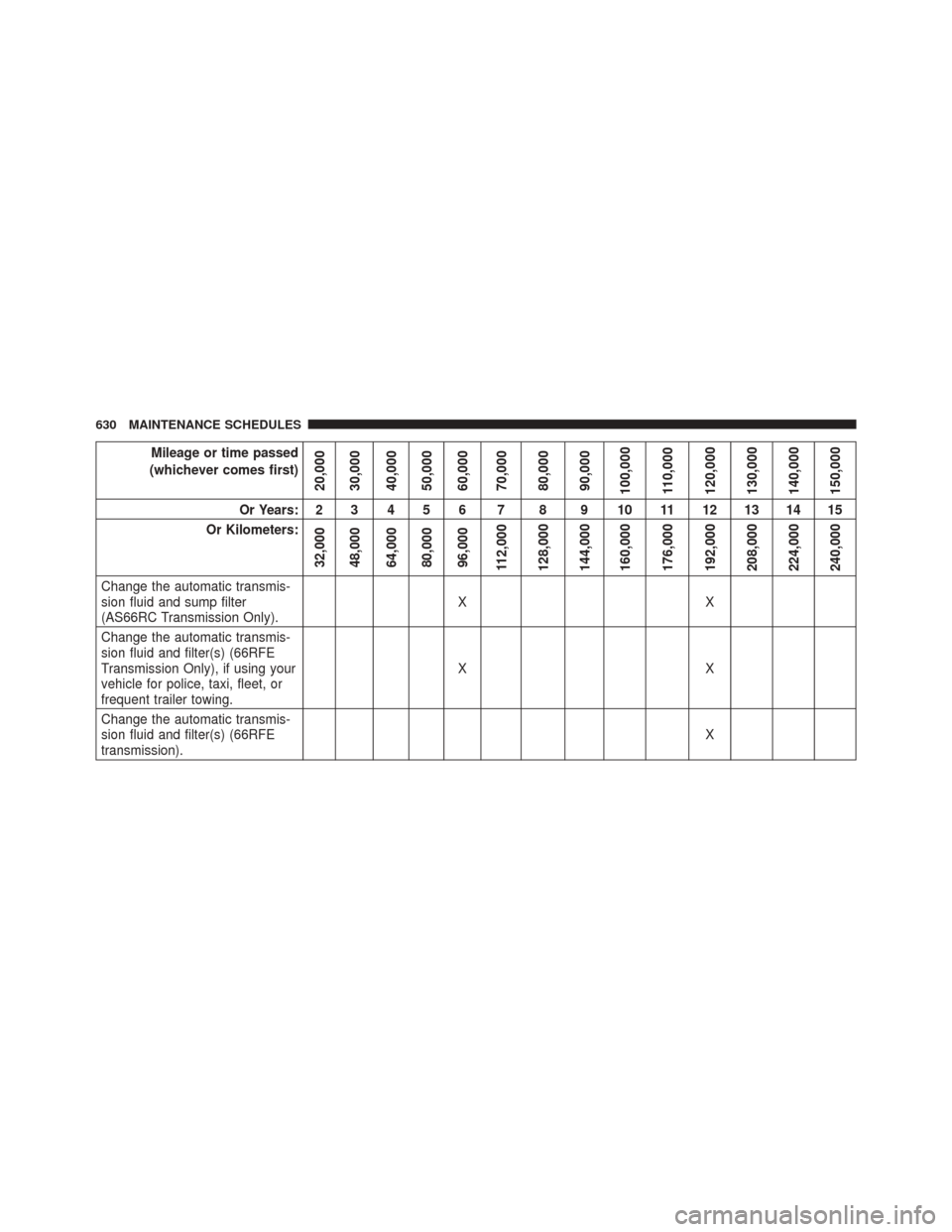
Change the automatic transmis-
sion fluid and sump filter
(AS66RC Transmission Only). XX
Change the automatic transmis-
sion fluid and filter(s) (66RFE
Transmission Only), if using your
vehicle for police, taxi, fleet, or
frequent trailer towing. XX
Change the automatic transmis-
sion fluid and filter(s) (66RFE
transmission). X
630 MAINTENANCE SCHEDULES
Page 649 of 669

Disposal............................. .587
Anti-Lock Brake System (ABS) ................439
Appearance Care ........................ .597
Ashtray ................................211
Assist, Hill Start ......................... .442
Auto Down Power Windows ..................46
Automatic Door Locks ......................38
Automatic Headlights ..................... .159
Automatic High Beams .....................161
Automatic Temperature Control (ATC) ..........363
Automatic Transmission ....................593
Adding Fluid ......................... .595
Fluid And Filter Changes ..................597
Fluid Level Check ...................... .594
Fluid Type ........................ .593, 624
Shifting ............................. .404
Special Additives ...................... .594
Axle Fluid ....................... .591, 592, 624Axle Lubrication
..................... .591, 592
Back-Up Camera ......................... .201
Battery ............................ .242, 572
Charging System Light ...................242
Keyless Transmitter Replacement (RKE) ........29
Belts, Seat ...............................115
Body Builders Guide ........................6
Body Mechanism Lubrication .................576
B-Pillar Location ......................... .462
Brake Assist System ...................... .442
Brake Control System, Electronic ..............438
Brake Fluid ......................... .590, 624
Brake System ........................ .438, 589
Fluid Check .......................... .590
Master Cylinder ....................... .590
Parking ............................. .435
Warning Light ........................ .238
Brake/Transmission Interlock .................404
10
INDEX 647