Page 360 of 919
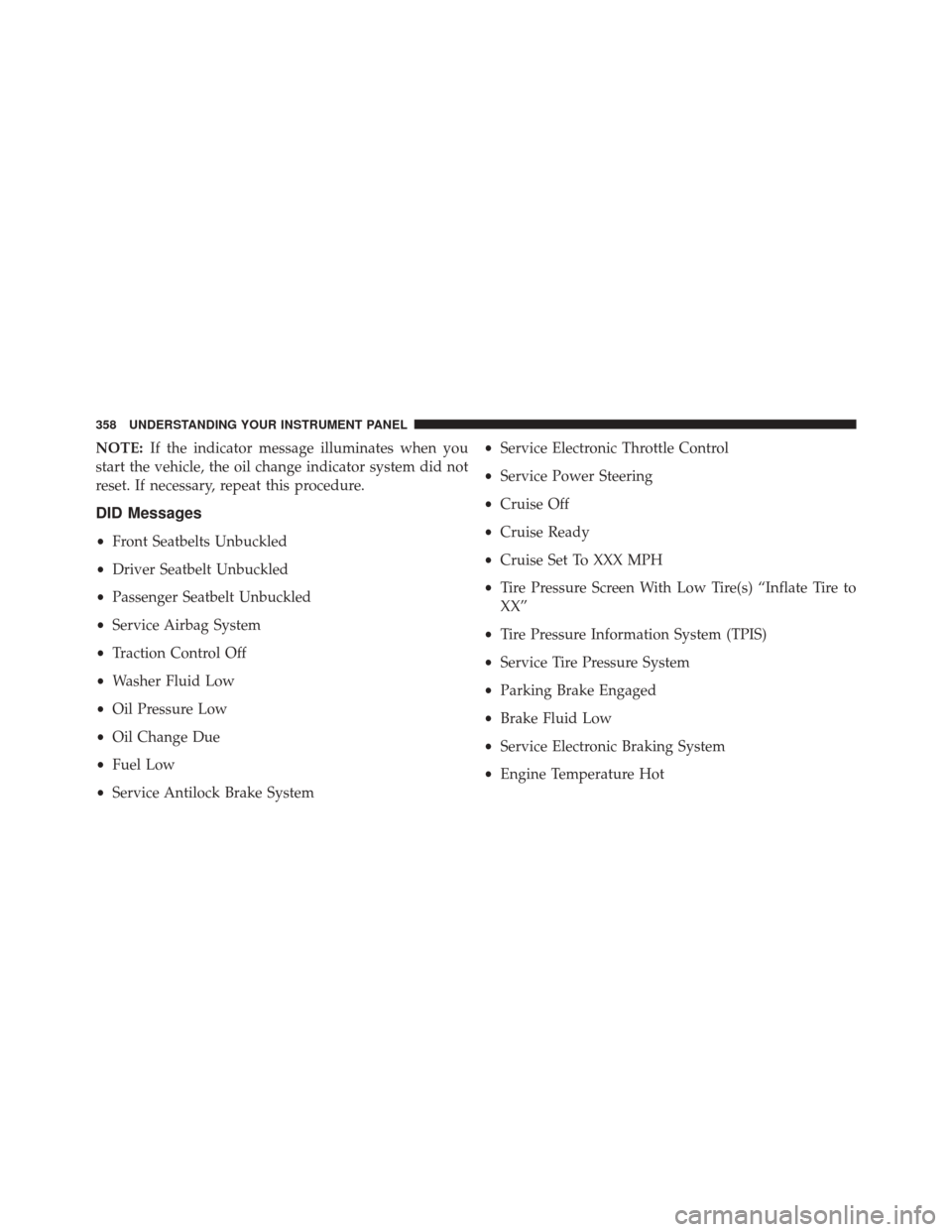
NOTE:If the indicator message illuminates when you
start the vehicle, the oil change indicator system did not
reset. If necessary, repeat this procedure.
DID Messages
• Front Seatbelts Unbuckled
• Driver Seatbelt Unbuckled
• Passenger Seatbelt Unbuckled
• Service Airbag System
• Traction Control Off
• Washer Fluid Low
• Oil Pressure Low
• Oil Change Due
• Fuel Low
• Service Antilock Brake System •
Service Electronic Throttle Control
• Service Power Steering
• Cruise Off
• Cruise Ready
• Cruise Set To XXX MPH
• Tire Pressure Screen With Low Tire(s) “Inflate Tire to
XX”
• Tire Pressure Information System (TPIS)
• Service Tire Pressure System
• Parking Brake Engaged
• Brake Fluid Low
• Service Electronic Braking System
• Engine Temperature Hot
358 UNDERSTANDING YOUR INSTRUMENT PANEL
Page 365 of 919

DID Selectable Menu Items
Push and release theUPorDOWNarrow but-
tons until the desired Selectable Menu icon/title is
highlighted in the DID.
Digital Speedometer
Push and release the UPorDOWNar-
row button until the Digital display icon is
highlighted in the DID. Push and release the
RIGHT
arrow button to change the dis-
play between mph and km/h.
Vehicle Info
Push and release the UPorDOWNar-
row button until the Vehicle Info icon is
highlighted in the DID. Push and release the RIGHT
arrow button to enter the submenus items
of Vehicle Info. follow the directional prompts to
access or reset any of the following Vehicle Info
submenu items:
Tire Pressure Monitoring System (1500 & 2500 Series)
A vehicle ICON is displayed with tire pressure values in
each corner of the ICON.
• Tire Pressure:
– Tire Pressure Information System (3500 Series Heavy Duty Ram Trucks)
– A vehicle ICON is displayed with the tire pressure values in each corner of the ICON.
– If the Tire Pressure system requires service, “Service Tire Pressure System” is displayed.
4
UNDERSTANDING YOUR INSTRUMENT PANEL 363
Page 366 of 919
– Tire Pressure is an information only function andcannot be reset.
– Refer to the �Tire Pressure Information System
(TPIS)” under �Starting and Operating� for further
information.
• Transmission Temperature – Automatic Transmission
Only
• Oil Temperature
• Oil Life
• Battery Voltage — If Equipped
• Gauge Summary:
– Coolant Temperature
– Transmission Temperature (automatic only)
– Oil Temperature
– Oil Pressure
• Engine HoursFuel Economy
Push and release the UPorDOWN arrow
button until the Fuel Economy Menu icon/title
is highlighted. Push and hold the RIGHT arrow
button to reset feature.
• Range
• Current MPG or L/100 km
• Average MPG or L/100 km
Trip A
Push and release the UPorDOWNar-
row button until the Trip A icon/title is
highlighted in the DID. The Trip A informa-
tion will display the following:
• Distance MI or km
364 UNDERSTANDING YOUR INSTRUMENT PANEL
Page 475 of 919

▫Electronic Brake Force Distribution (EBD) . . . .620
▫ Brake System Warning Light ..............620
▫ Anti-Lock Brake System (ABS) ............620
▫ Anti-Lock Brake Warning Light ............622
▫ Brake Assist System (BAS) ...............622
▫ Hill Start Assist (HSA) .................623
▫ Traction Control System (TCS) ............626
▫ Electronic Stability Control (ESC) ..........626
▫ Electronic Roll Mitigation (ERM) ..........631
▫ Trailer Sway Control (TSC) ..............632
▫ Hill Descent Control (HDC) — If Equipped . . .632
� TIRE SAFETY INFORMATION .............636
▫ Tire Markings ....................... .636▫
Tire Identification Number (TIN) ...........640
▫ Tire Terminology And Definitions ..........642
▫ Tire Loading And Tire Pressure ...........643
� TIRES — GENERAL INFORMATION ........648
▫ Tire Pressure ....................... .648
▫ Tire Inflation Pressures .................649
▫ Tire Pressures For High Speed Operation . . . .651
▫ Radial Ply Tires ..................... .651
▫ Tire Types .......................... .652
▫ Run Flat Tires — If Equipped .............654
▫ Spare Tires — If Equipped ...............654
▫ Tire Spinning ....................... .657
▫ Tread Wear Indicators ..................657
5
STARTING AND OPERATING 473
Page 476 of 919

▫Life Of Tire ........................ .658
▫ Replacement Tires .....................658
� SUPPLEMENTAL TIRE PRESSURE INFORMATION
— IF EQUIPPED ...................... .660
� TIRE CHAINS (TRACTION DEVICES) .......660
� TIRE ROTATION RECOMMENDATIONS .....663
▫ Directional Tires — If Equipped ...........664
▫ Dual Rear Wheels — If Equipped ..........664
� TIRE PRESSURE MONITOR SYSTEM (TPMS) . .666
▫ Premium System ..................... .668
▫ Tire Pressure Information System (TPIS) 3500
Series Trucks ........................ .673
▫ General Information ...................675
� FUEL REQUIREMENTS ..................675 ▫
3.6L Engine ......................... .675
▫ 5.7L Engine ......................... .676
▫ 6.4L Engine ......................... .676
▫ Reformulated Gasoline .................677
▫ Gasoline/Oxygenate Blends ..............677
▫ E-85 Usage In Non-Flex Fuel Vehicles .......678
▫ MMT In Gasoline .....................678
▫ Materials Added To Fuel ................679
▫ Fuel System Cautions ...................679
▫ Carbon Monoxide Warnings .............680
� FLEXIBLE FUEL (3.6L ENGINE ONLY) — IF
EQUIPPED .......................... .681
▫ E-85 General Information ...............681
474 STARTING AND OPERATING
Page 526 of 919

NOTE:Do not attempt to make a shift while only the
front or rear wheels are spinning. The front and rear
driveshaft speeds must be equal for the shift to take
place. Shifting while only the front or rear wheels are
spinning can cause damage to the transfer case.
Because four-wheel drive provides improved traction,
there is a tendency to exceed safe turning and stopping
speeds. Do not go faster than road conditions permit.
NOTE: Delayed shifts out of four-wheel drive may be
experienced due to uneven tire wear, low or uneven tire
pressures, excessive vehicle loading, or cold tempera-
tures.
WARNING!
You or others could be injured or killed if you leave
the vehicle unattended with the transfer case in the
(Continued)
WARNING! (Continued)
NEUTRAL position without first fully engaging the
parking brake. The transfer case NEUTRAL position
disengages both the front and rear drive shafts from
the powertrain and will allow the vehicle to roll,
even if the transmission is in PARK. The parking
brake should always be applied when the driver is
not in the vehicle.
For additional information on the appropriate use of each
transfer case mode position, see the information below:
2H
Rear-Wheel Drive High Range — This range is for
normal street and highway driving on dry hard surfaced
roads.
524 STARTING AND OPERATING
Page 552 of 919

NOTE:If equipped with a touch screen radio all
enabling/disabling of air suspension features must be
done through the radio. Refer to “Uconnect Settings” in
“Understanding Your Instrument Panel” for further in-
formation.
WARNING!
The air suspension system uses a high pressure
volume of air to operate the system. To avoid per-
sonal injury or damage to the system, see your
authorized dealer for service.
Air Suspension Modes
The Air Suspension system has multiple modes to protect
the system in unique situations:
Tire/Jack Mode
To assist with changing a spare tire, the air suspension
system has a feature which allows the automatic leveling to be disabled. Refer to “Electronic Vehicle Information
Center (EVIC) or Driver Information Display (DID)” in
“Understanding Your Instrument Panel” or “Uconnect
Settings” in “Understanding Your Instrument Panel” if
equipped with a touch screen radio for further informa-
tion.
NOTE:
This mode is intended to be enabled with engine
running.
Transport Mode
To assist with flat bed towing, the air suspension system
has a feature which will put the vehicle into Entry/Exit
height and disable the automatic load leveling system.
Refer to “Electronic Vehicle Information Center (EVIC) or
Driver Information Display (DID)” in “Understanding
Your Instrument Panel” or “Uconnect Settings” in “Un-
derstanding Your Instrument Panel” if equipped with a
touch screen radio for further information.
550 STARTING AND OPERATING
Page 558 of 919

WARNING!
The air suspension system uses a high pressure
volume of air to operate the system. To avoid per-
sonal injury or damage to the system, see your
authorized dealer for service.
Air Suspension Modes
The Air Suspension system has multiple modes to protect
the system in unique situations:
Tire/Jack Mode
To assist with changing a spare tire, the air suspension
system has a feature which allows the automatic leveling
to be disabled. This mode is intended to be used with
engine running. Refer to “Electronic Vehicle Information
Center (EVIC) or Driver Information Display (DID)” in
“Understanding Your Instrument Panel” or “UconnectSettings” in “Understanding Your Instrument Panel” if
equipped with a touch screen radio for further informa-
tion.
NOTE:
This mode is intended to be enabled with engine
running.
Transport Mode
To assist with flat bed towing, the air suspension system
has a feature which will put the vehicle below Normal
Ride Height (NRH) and disable the automatic load
leveling system. This mode is intended to be used with
engine running. Refer to “Electronic Vehicle Information
Center (EVIC) or Driver Information Display (DID)” in
“Understanding Your Instrument Panel” or “Uconnect
Settings” in “Understanding Your Instrument Panel” if
equipped with a touch screen radio for further informa-
tion.
NOTE: This mode is intended to be enabled with engine
running.
556 STARTING AND OPERATING