Page 156 of 406
Maintenance Chart — Diesel Fuel Up To B5 Biodiesel
Mileage or time passed (whichever comesfirst)
10,000
20,000
30,000
40,000
50,000
60,000
70,000
80,000
90,000
100,000
110,000
120,000
130,000
140,000
150,000
Or Years: 1 2 3 4 5 6 7 8 9 10 11 12 13 14 15
Or Kilometers:
16,000
32,000
48,000
64,000
80,000
96,000
112,000
128,000
144,000
160,000
176,000
192,000
208,000
224,000
240,000
Additional Inspections
Completely fill the Diesel Exhaust Fluid tank. X X X X X X X X X X X X X X X
Inspect the CV/Universal joints. XX X X X
Inspect front suspension, tie rod ends, and re-
place if necessary. XXX X X X X
Inspect the front and rear axle fluid. If gear oil
leakage is suspected, check the fluid level. If us-
ing your vehicle for police, taxi, fleet, off-road or
frequent trailer towing change the axle fluid. XXX X X X X
Inspect the brake linings, parking brake function. X X X X X X X
154 MAINTENANCE SCHEDULE
Page 157 of 406
Mileage or time passed (whichever comesfirst)
10,000
20,000
30,000
40,000
50,000
60,000
70,000
80,000
90,000
100,000
110,000
120,000
130,000
140,000
150,000
Or Years: 1 2 3 4 5 6 7 8 9 10 11 12 13 14 15
Or Kilometers:
16,000
32,000
48,000
64,000
80,000
96,000
112,000
128,000
144,000
160,000
176,000
192,000
208,000
224,000
240,000
Inspect the transfer case fluid. XX X
Additional Maintenance
Drain water from fuel filter assembly. X X X X X X X X X X
Replace fuel filter and drain water from the fuel
filter assembly. XX X X X
Replace engine air filter. XX X X X
Flush and replace the engine coolant at 10 years
or 150,000 miles (240,000 km) whichever comes
first. XX
Replace accessory drive belt(s). X
6
MAINTENANCE SCHEDULE 155
Page 159 of 406
WARNING!
•You can be badly injured working on or around a
motor vehicle. Do only service work for which you
have the knowledge and the right equipment. If
you have any doubt about your ability to perform a
service job, take your vehicle to a competent me-
chanic.
• Failure to properly inspect and maintain your ve-
hicle could result in a component malfunction and
effect vehicle handling and performance. This
could cause an accident.
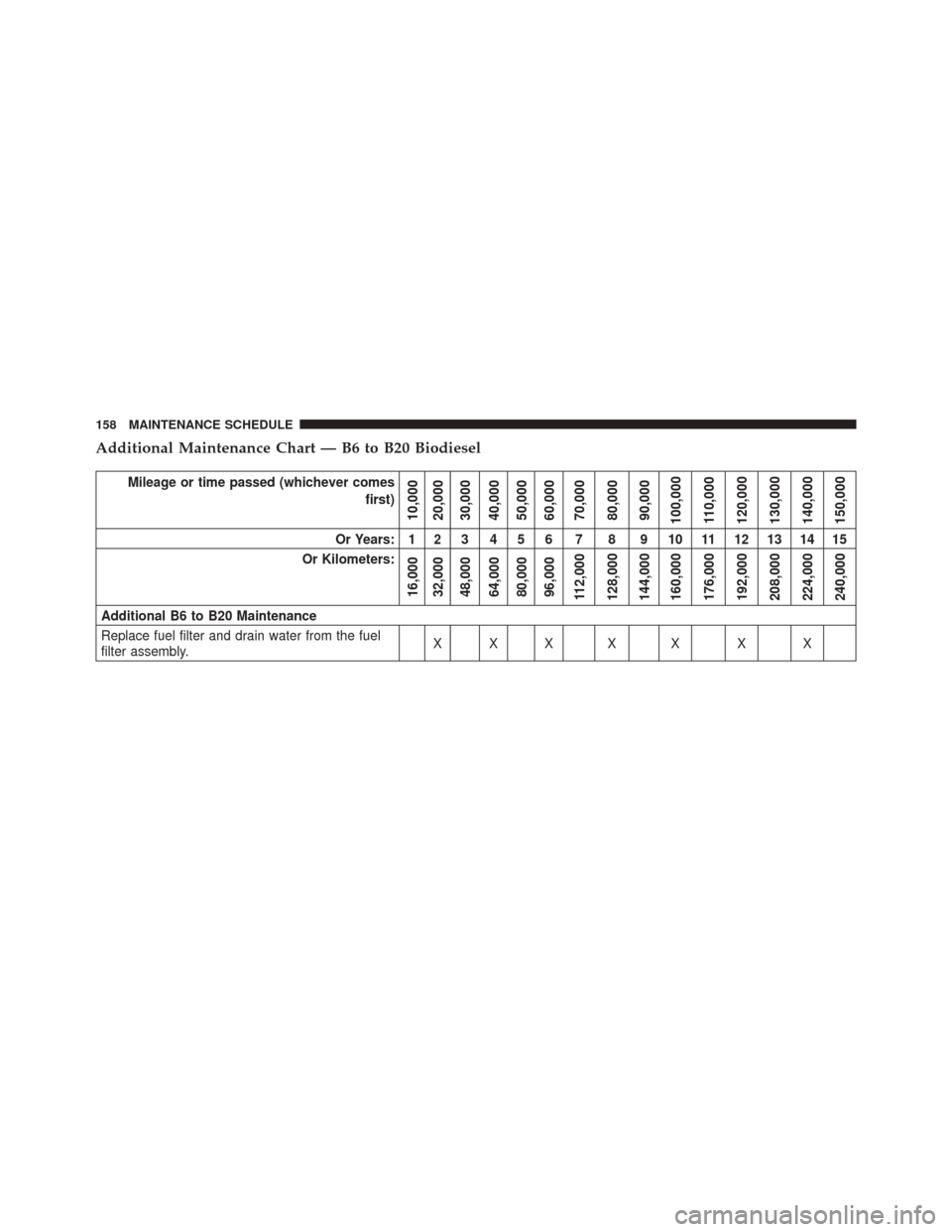
Additional Maintenance — B6 To B20 Biodiesel
NOTE:
• Under no circumstances should oil change intervals
exceed 8,000 miles (12 875 km) or six months, which-
ever comes first when using Biodiesel blends greater
than 5% (B5).
• The owner is required to monitor mileage for B6-B20
biodiesel, the automatic oil change indicator system
does not reflect the use of biofuels.
6
MAINTENANCE SCHEDULE 157
Page 160 of 406
Additional Maintenance Chart — B6 to B20 Biodiesel
Mileage or time passed (whichever comesfirst)
10,000
20,000
30,000
40,000
50,000
60,000
70,000
80,000
90,000
100,000
110,000
120,000
130,000
140,000
150,000
Or Years: 1 2 3 4 5 6 7 8 9 10 11 12 13 14 15
Or Kilometers:
16,000
32,000
48,000
64,000
80,000
96,000
112,000
128,000
144,000
160,000
176,000
192,000
208,000
224,000
240,000
Additional B6 to B20 Maintenance
Replace fuel filter and drain water from the fuel
filter assembly. XXX X X X X
158 MAINTENANCE SCHEDULE
Page 168 of 406

A MESSAGE FROM FCA US LLC
FCA US LLC and Cummins welcome you as a Cummins
turbocharged diesel-powered truck owner. Your diesel
truck will sound, feel, drive, and operate differently from
a gasoline-powered truck. It is important that you read
and understand this manual.
Almost 100% of the heavy duty trucks in the United
States and Canada are diesel-powered because of the fuel
economy, rugged durability, and high torque which per-
mits pulling heavy loads. Cummins engines power well
over half of these trucks. Now this same technology and
proven performance is yours in your truck equipped
with the Cummins turbocharged diesel engine.You may find that some of the starting, operating, and
maintenance procedures are different. However, they are
simple to follow and careful adherence to them will
ensure that you take full advantage of the features of this
engine.
NOTE:
Some aftermarket products may cause severe
engine/transmission and/or exhaust system damage.
Your vehicle’s Powertrain Control Systems can detect
and store information about vehicle modifications that
increase horsepower and torque output such as whether
or not performance-enhancing powertrain components,
commonly referred to as downloaders, power boxes, or
performance chips have been used.
166 INTRODUCTION
Page 173 of 406

•Fuel meets minimum requirement
• Water In Fuel Indicator Light is not illuminated
• Wait To Start Light is not illuminated
WARNING!
•Do not start or run an engine in a closed garage or
confined area. Exhaust gas contains Carbon Mon-
oxide (CO) which is odorless and colorless. Carbon
Monoxide is poisonous and can cause serious in-
jury or death when inhaled.
• Keep Remote Keyless Entry (RKE) transmitters
away from children. Operation of the Remote Start
System, windows, door locks or other controls
could cause serious injury or death.
Remote Start Abort Message
The following messages will display in the EVIC/DID if
the vehicle fails to remote start or exits remote start
prematurely:
• Remote Start Aborted - Door Ajar
• Remote Start Aborted - Hood Ajar
• Remote Start Aborted - Fuel Low
• Remote Start Aborted - System Fault
The EVIC/DID message stays active until the ignition is
turned to the ON/RUN position.
To Enter Remote Start Mode
Push and release the REMOTE START button
on the RKE transmitter twice, within five sec-
onds. The parking lights will flash and the horn
2
THINGS TO KNOW BEFORE STARTING YOUR VEHICLE 171
Page 174 of 406

will chirp twice (if programmed). In cold ambient tem-
perature conditions, the diesel vehicle may delay crank
up to 30 seconds for the fuel and grid heater. Once the
vehicle has started, the engine will run for 15 minutes or
75 seconds in extreme cold and high elevation.
NOTE:
•The park lamps will turn on and remain on during
Remote Start mode.
• For security, power window and power sunroof op-
eration (if equipped) are disabled when the vehicle is
in the Remote Start mode.
• The engine can be started two consecutive times (two
15-minute cycles) with the RKE transmitter. However,
the ignition switch must be cycled to the ON position
before you can repeat the start sequence for a third
cycle.To Exit Remote Start Mode Without Driving The
Vehicle
Push and release the REMOTE START button one time or
allow the engine to run for the entire fifteen minute cycle.
NOTE: To avoid unintentional shut downs, the system
will disable the one time push of the REMOTE START
button for two seconds after receiving a valid Remote
Start request.
To Exit Remote Start Mode And Drive The Vehicle
To exit Remote Start Mode and drive the vehicle before
the end of the 15-minute cycle, push and release the
unlock button on the RKE transmitter to unlock the door
and disarm the Vehicle Security Alarm System (if
equipped). Then, prior to the end of the 15-minute cycle,
cycle the ignition to the ON/RUN position.
172 THINGS TO KNOW BEFORE STARTING YOUR VEHICLE
Page 176 of 406
•Use the appropriate transmission gear to prevent
engine lugging.
• Observe vehicle oil pressure and temperature indica-
tors.
• Check the coolant and oil levels frequently.
• Vary throttle position at highway speeds when carry-
ing or towing significant weight.
NOTE: Light duty operation such as light trailer towing
or no load operation will extend the time before the
engine is at full efficiency. Reduced fuel economy and
power may be seen at this time. For additional vehicle break-in requirements, refer to
“Trailer Towing” in “Starting And Operating” of the
Owners Manual.
Because of the construction of the Cummins turbo-
charged diesel engine, engine run-in is enhanced by
loaded operating conditions which allow the engine
parts to achieve final finish and fit during the first 6,000
miles (10 000 km).
174 THINGS TO KNOW BEFORE STARTING YOUR VEHICLE