Page 333 of 406
MAINTAINING YOUR VEHICLE
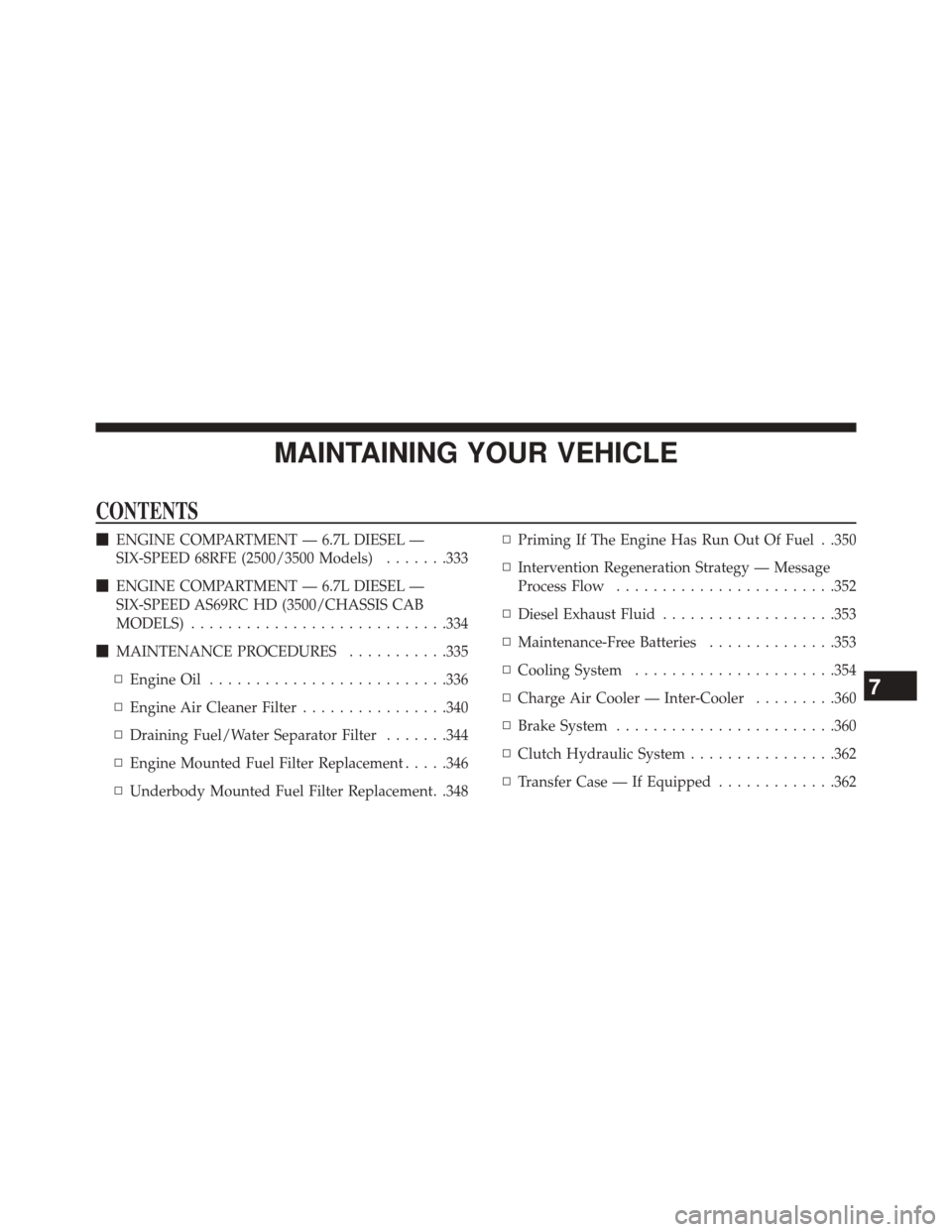
CONTENTS
�ENGINE COMPARTMENT — 6.7L DIESEL —
SIX-SPEED 68RFE (2500/3500 Models) .......333
� ENGINE COMPARTMENT — 6.7L DIESEL —
SIX-SPEED AS69RC HD (3500/CHASSIS CAB
MODELS) ........................... .334
� MAINTENANCE PROCEDURES ...........335
▫ Engine Oil ......................... .336
▫ Engine Air Cleaner Filter ................340
▫ Draining Fuel/Water Separator Filter .......344
▫ Engine Mounted Fuel Filter Replacement .....346
▫ Underbody Mounted Fuel Filter Replacement. .348 ▫
Priming If The Engine Has Run Out Of Fuel . .350
▫ Intervention Regeneration Strategy — Message
Process Flow ....................... .352
▫ Diesel Exhaust Fluid ...................353
▫ Maintenance-Free Batteries ..............353
▫ Cooling System ..................... .354
▫ Charge Air Cooler — Inter-Cooler .........360
▫ Brake System ....................... .360
▫ Clutch Hydraulic System ................362
▫ Transfer Case — If Equipped .............362
7
Page 334 of 406
▫Manual Transmission — If Equipped ........362
▫ Automatic Transmission — If Equipped ......363
▫ Noise Control System Required Maintenance &
Warranty .......................... .366
� FLUID CAPACITIES ....................373 �
FLUIDS, LUBRICANTS AND GENUINE
PARTS ............................. .374
▫ Engine ............................ .374
▫ Chassis ........................... .377
332 MAINTAINING YOUR VEHICLE
Page 337 of 406
MAINTENANCE PROCEDURES
The pages that follow contain therequiredmaintenance
services determined by the engineers who designed your
vehicle.
Besides those maintenance items specified in the fixed
maintenance schedule, there are other components which
may require servicing or replacement in the future.
CAUTION!
• Failure to properly maintain your vehicle or per-
form repairs and service when necessary could
result in more costly repairs, damage to other
components or negatively impact vehicle perfor-
mance. Immediately have potential malfunctions
examined by an authorized dealership or qualified
repair center.
(Continued)
CAUTION! (Continued)
•Your vehicle has been built with improved fluids
that protect the performance and durability of your
vehicle and also allow extended maintenance inter-
vals. Do not use chemical flushes in these compo-
nents as the chemicals can damage your engine,
transmission, power steering or air conditioning.
Such damage is not covered by the New Vehicle
Limited Warranty. If a flush is needed because of
component malfunction, use only the specified
fluid for the flushing procedure.
7
MAINTAINING YOUR VEHICLE 335
Page 339 of 406

only when the level on the dipstick is below the “ADD”
mark. The total capacity from the ADD mark to the Full
mark is 2 qts (1.9L).
CAUTION!
Overfilling or underfilling the crankcase will cause
oil aeration or loss of oil pressure. This could damage
your engine.
Never operate the engine with oil level below the “ADD”
mark or above the upper “SAFE” mark.
Change Engine Oil
Refer to the “Maintenance Schedule” for the proper
maintenance intervals.
Engine Oil Selection
For best performance and maximum protection under all
types of operating conditions, the manufacturer only recommends engine oils that are API CJ-4 certified and
meet the requirements of FCA LLC. Use MOPAR or an
equivalent oil meeting FCA Material Standard MS-10902.
Products meeting Cummins CES 20081 may also be used.
The identification of these engine oils are typically lo-
cated on the back of the oil container.
American Petroleum Institute (API) Engine Oil
Identification Symbol
This symbol means that the oil has
been certified by the American Petro-
leum Institute (API). The manufac-
turer only recommends API Certified
engine oils.
7
MAINTAINING YOUR VEHICLE 337
Page 341 of 406
Engine oil not designated by the FCA or Cummins
Material Standards and API CJ-4 should not be used, asengine and exhaust system durability may be compro-
mised. The engine oil filler cap also shows the recom-
mended engine oil viscosity for your engine. For infor-
mation on engine oil filler cap location, refer to “Engine
Compartment” in “Maintaining Your Vehicle” for further
information.
Synthetic Engine Oils
You may use synthetic engine oils if the recommended oil
quality requirements are met and the recommended
maintenance intervals for oil and filter changes are
followed.
Materials Added To Engine Oil
The manufacturer strongly recommends against the ad-
dition of any additives (other than leak detection dyes) to
the engine oil. Engine oil is an engineered product and its
performance may be impaired by supplemental addi-
tives.
7
MAINTAINING YOUR VEHICLE 339
Page 342 of 406
Engine Oil Filter
Refer to “Fluids, Lubricants, And Genuine Parts” in
“Maintaining Your Vehicle” for further information. The
engine oil filter should be changed at every engine oil
change.
Disposing Of Used Engine Oil And Oil Filters
Care should be taken in disposing of used engine oil and
oil filters from your vehicle. Used oil and oil filters,
indiscriminately discarded, can present a problem to the
environment. Contact your authorized dealer, service
station or governmental agency for advice on how and
where used oil and oil filters can be safely discarded in
your area.
Engine Air Cleaner Filter
CAUTION!
All air entering the engine intake must be filtered.
The abrasive particles in unfiltered air will cause
rapid wear to engine components.
WARNING!
The air induction system (air cleaner, hoses, etc.)
provides a measure of protection. Do not remove the
air induction system (air cleaner, hoses, etc.) unless
such removal is necessary for repair or maintenance.
Make sure that no one is near the engine compart-
ment before starting the vehicle with the air induc-
tion system (air cleaner, hoses, etc.) removed. Failure
to do so can result in serious personal injury.
340 MAINTAINING YOUR VEHICLE
Page 354 of 406

•Use of biodiesel mixture in excess of 20% can nega-
tively impact the fuel filter’s ability to separate water
from the fuel, resulting in high pressure fuel system
corrosion or damage.
• Ethanol blends are not recommended or approved for
use with your Cummins diesel engine.
• In addition, commercially available fuel additives are
not necessary for the proper operation of your Cum-
mins diesel engine.
Intervention Regeneration Strategy — Message
Process Flow
The Cummins diesel engine meets all EPA Heavy Duty
Diesel Engine Emissions Standards, resulting in one of
the lowest emitting diesel engines ever produced.
To achieve these emissions standards, your vehicle is
equipped with a state-of-the-art engine and exhaust
system. The engine and exhaust after-treatment system work together to achieve the EPA Heavy Duty Diesel
Engine Emissions Standards. These systems are seam-
lessly integrated into your vehicle and managed by the
Cummins Powertrain Control Module (PCM). The PCM
manages engine combustion to allow the exhaust sys-
tem’s catalyst to trap and burn Particulate Matter (PM)
pollutants, with no input or interaction on your part.
Additionally, your vehicle has the ability to alert you to
additional maintenance required on your truck or engine.
Refer to “Electronic Vehicle Information Center (EVIC)”
or “Driver Information Display (DID)” in “Understand-
ing Your Instrument Panel” for further information.
WARNING!
A hot exhaust system can start a fire if you park over
materials that can burn. Such materials might be
(Continued)
352 MAINTAINING YOUR VEHICLE
Page 355 of 406

WARNING!(Continued)
grass or leaves coming into contact with your exhaust
system. Do not park or operate your vehicle in areas
where your exhaust system can contact anything that
can burn.
Diesel Exhaust Fluid
Diesel Exhaust Fluid (DEF) sometimes known simply by
the name of its active component, UREA—is a key
component of selective catalytic reduction (SCR) systems,
which help diesel vehicles meet stringent emission regu-
lations. DEF is a liquid reducing agent that reacts with
engine exhaust in the presence of a catalyst to convert
smog-forming nitrogen oxides (NOx) into harmless ni-
trogen and water vapor.
Refer to “Fluids, Lubricants, and Genuine Parts” in
“Maintaining Your Vehicle” for further information. You can receive assistance in locating DEF in the United
States by calling 866-RAM-INFO (866-726-4636). In
Canada call 1–800–465–2001 (English) or 1–800–387–9983
(French)
Maintenance-Free Batteries
The top of the maintenance-free batteries are perma-
nently sealed. You will never have to add water, nor is
periodic maintenance required.
NOTE:
Replacement batteries should both be of equal
capacity to prevent damage to the vehicle’s charging
system.
CAUTION!
It is essential when replacing the cables on the
battery that the positive cable is attached to the
positive post and the negative cable is attached to the
(Continued)
7
MAINTAINING YOUR VEHICLE 353