Page 300 of 406

NOTE:
•The torque converter clutch will not engage (and
68RFE-equipped trucks will not shift to sixth gear),
until the transmission fluid and engine coolant are
warm [usually after 1 to 3 miles (2 to 5 km) of driving].
Because the engine speed is higher when the torque
converter clutch is not engaged, it may seem as if the
transmission is not shifting properly when cold. This is
normal. Using the Electronic Range Select (ERS) shift
control, when the transmission is sufficiently warm,
will demonstrate that the transmission is able to shift
into and out of Overdrive.
•
If the vehicle has not been driven for several days, the
first few seconds of operation after shifting the transmis-
sion into gear may seem sluggish. This is due to the fluid
partially draining from the torque converter into the
transmission. This condition is normal and will not cause damage to the transmission. The torque converter will
refill within five seconds after starting the engine.
MANUAL TRANSMISSION — IF EQUIPPED
WARNING!
You or others could be injured if you leave the
vehicle unattended without having the parking
brake fully applied. The parking brake should al-
ways be applied when the driver is not in the vehicle,
especially on an incline.
CAUTION!
Never drive with your foot resting on the clutch
pedal, or attempt to hold the vehicle on a hill with the
clutch pedal partially engaged, as this will cause
abnormal wear on the clutch.
298 STARTING AND OPERATING
Page 328 of 406

JUMP STARTING
WARNING!
•To prevent personal injury or damage to clothing,
do not allow battery fluid to contact eyes, skin or
fabrics. Do not lean over a battery when connecting
jumper cables or allow cable clamps to touch each
other. Keep open flames or sparks away from
battery vent holes. Always wear eye protection
when working with batteries.
• Do not use a booster battery or any other booster
source that has a greater than 12 Volt system, i.e., do
not use a 24 Volt power source.
NOTE: Replacement batteries should both be of equal
size to prevent damage to the vehicle’s charging system.
Your vehicle is equipped with two 12 Volt batteries. If it
becomes necessary to use a booster battery with jumper cables to start a vehicle’s engine because its batteries are
discharged, the following procedure should be used:
Set the parking brake and place an automatic transmis-
sion in PARK (or NEUTRAL for a manual transmission).
Turn off lights, heater and other electrical loads. Observe
charge indicator (if equipped) in both batteries. If the
indicator (if equipped) is light or yellow on either battery,
replace that battery.
CAUTION!
Use the jump start procedure only when the charge
indicator (if equipped) in both batteries is dark in the
center. Do not attempt jump starting when either
battery charge indicator (if equipped) is bright or
yellow. If the charge indicator (if equipped) has a
green dot in the center, failure to start is not due to a
discharged battery and cranking system should be
checked.
326 WHAT TO DO IN EMERGENCIES
Page 333 of 406
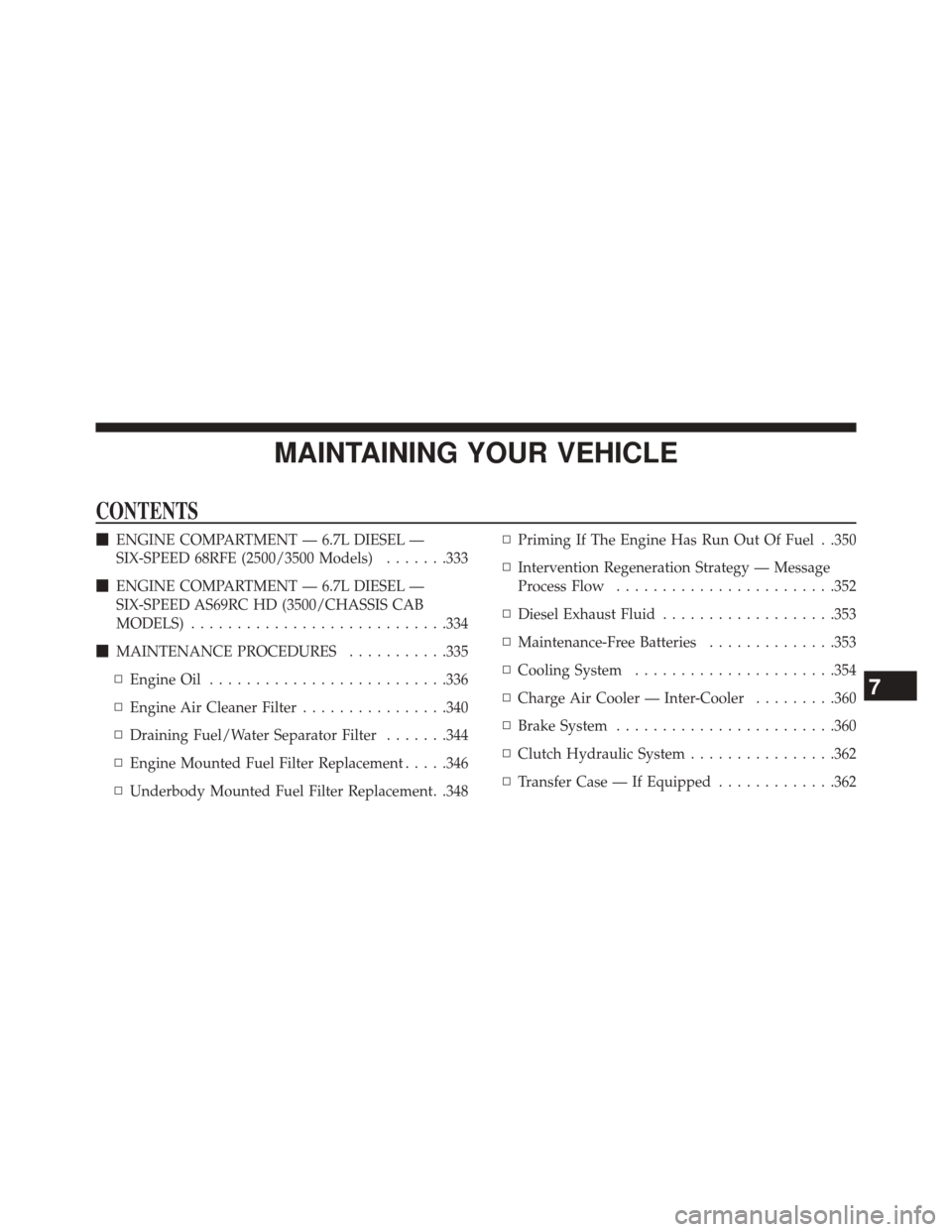
MAINTAINING YOUR VEHICLE
CONTENTS
�ENGINE COMPARTMENT — 6.7L DIESEL —
SIX-SPEED 68RFE (2500/3500 Models) .......333
� ENGINE COMPARTMENT — 6.7L DIESEL —
SIX-SPEED AS69RC HD (3500/CHASSIS CAB
MODELS) ........................... .334
� MAINTENANCE PROCEDURES ...........335
▫ Engine Oil ......................... .336
▫ Engine Air Cleaner Filter ................340
▫ Draining Fuel/Water Separator Filter .......344
▫ Engine Mounted Fuel Filter Replacement .....346
▫ Underbody Mounted Fuel Filter Replacement. .348 ▫
Priming If The Engine Has Run Out Of Fuel . .350
▫ Intervention Regeneration Strategy — Message
Process Flow ....................... .352
▫ Diesel Exhaust Fluid ...................353
▫ Maintenance-Free Batteries ..............353
▫ Cooling System ..................... .354
▫ Charge Air Cooler — Inter-Cooler .........360
▫ Brake System ....................... .360
▫ Clutch Hydraulic System ................362
▫ Transfer Case — If Equipped .............362
7
Page 335 of 406
ENGINE COMPARTMENT — 6.7L DIESEL — SIX-SPEED 68RFE (2500/3500 Models)
1 — Battery7 — Washer Fluid Reservoir
2 — Engine Coolant Reservoir 8 — Power Steering Fluid Reservoir
3 — Automatic Transmission Dipstick 9 — Power Distribution Center
4 — Brake Fluid Reservoir 10 — Engine Oil Dipstick
5 — Battery 11 — Engine Oil Fill
6 — Aux Power Distribution Center 12 — Air Cleaner Filter7
MAINTAINING YOUR VEHICLE 333
Page 336 of 406
ENGINE COMPARTMENT — 6.7L DIESEL — SIX-SPEED AS69RC HD (3500/CHASSIS CAB MODELS)
1 — Battery7 — Washer Fluid Reservoir
2 — Engine Coolant Reservoir 8 — Power Steering Fluid Reservoir
3 — Automatic Transmission Dipstick 9 — Power Distribution Center
4 — Brake Fluid Reservoir 10 — Engine Oil Dipstick
5 — Battery 11 — Engine Oil Fill
6 — Aux Power Distribution Center 12 — Air Cleaner Filter
334 MAINTAINING YOUR VEHICLE
Page 362 of 406

•Do not change the thermostat for Summer or Winter
operation. If replacement is ever necessary, install
ONLY the correct type thermostat. Other designs may
result in unsatisfactory engine coolant (antifreeze)
performance, poor gas mileage, and increased emis-
sions.
Charge Air Cooler — Inter-Cooler
The charge air cooler is positioned below the radiator and
the air conditioner condenser. Air enters the engine
through the air cleaner and passes through the turbo-
charger, where it is pressurized. This pressurized air
rapidly reaches high temperature. The air is then directed
through a hose to the charge air cooler and through
another hose to the intake manifold of the engine. The air
entering the engine has been cooled by about 50° to 100°F
(10° to 38°C). This cooling process enables more efficient
burning of fuel resulting in fewer emissions. To guarantee optimum performance of the system, keep
the surfaces of the charge air cooler, condenser and
radiator clean and free of debris. Periodically check the
hoses leading to and from the charge air cooler for cracks
or loose clamps resulting in loss of pressure and reduced
engine performance.
Brake System
Brake Master Cylinder — Brake Fluid Level Check
The fluid level of the master cylinder should be checked
when performing under the hood service, or immedi-
ately if the “Brake System Warning Light” indicates
system failure.
The brake master cylinder has a translucent plastic
reservoir. On the outboard side of the reservoir, there is a
“MAX” mark and a “MIN” mark. The fluid level must be
kept within these two marks. Do not add fluid above the
full mark because leakage may occur at the cap.
360 MAINTAINING YOUR VEHICLE
Page 363 of 406

With disc brakes, the fluid level can be expected to fall as
the brake linings wear. However, an unexpected drop in
fluid level may be caused by a leak and a system check
should be conducted.
Refer to “Fluids, Lubricants, And Genuine Parts” in
“Maintaining Your Vehicle” for further information.
WARNING!
•Use only manufacturer’s recommended brake
fluid. Refer to “Fluids, Lubricants, and Genuine
Parts” in “Maintaining Your Vehicle” for further
information. Using the wrong type of brake fluid
can severely damage your brake system and/or
impair its performance. The proper type of brake
fluid for your vehicle is also identified on the
original factory installed hydraulic master cylinder
reservoir.
(Continued)
WARNING! (Continued)
•To avoid contamination from foreign matter or
moisture, use only new brake fluid or fluid that has
been in a tightly closed container. Keep the master
cylinder reservoir cap secured at all times. Brake
fluid in a open container absorbs moisture from the
air resulting in a lower boiling point. This may
cause it to boil unexpectedly during hard or pro-
longed braking, resulting in sudden brake failure.
This could result in a accident.
• Overfilling the brake fluid reservoir can result in
spilling brake fluid on hot engine parts, causing
the brake fluid to catch fire. Brake fluid can also
damage painted and vinyl surfaces, care should be
taken to avoid its contact with these surfaces.
(Continued)
7
MAINTAINING YOUR VEHICLE 361
Page 364 of 406

WARNING!(Continued)
•Do not allow petroleum based fluid to contaminate
the brake fluid. Brake seal components could be
damaged, causing partial or complete brake failure.
This could result in an accident.
Clutch Hydraulic System
The clutch hydraulic system is a sealed maintenance-free
system. In the event of leakage or other malfunction, the
system must be replaced.
Transfer Case — If Equipped
Drain And Refill
Refer to the “Maintenance Schedule” for the proper
maintenance intervals.
Selection of Lubricant
Refer to “Fluids, Lubricants, and Genuine Parts” in
“Maintaining Your Vehicle” for fluid specifications.
Fluid Level Check
This fluid level can be checked by removing the filler
plug. The fluid level should be to the bottom edge of the
filler plug hole with the vehicle in a level position.
Manual Transmission — If Equipped
Selection of Lubricant
Refer to “Fluids, Lubricants, and Genuine Parts” in
“Maintaining Your Vehicle” for fluid specifications.
Fluid Level Check
The fluid level can be checked by removing the filler
plug. If the level of the lubricant is more than 1/2 in
(12 mm) below the bottom of the filler hole while the
362 MAINTAINING YOUR VEHICLE