Page 303 of 406
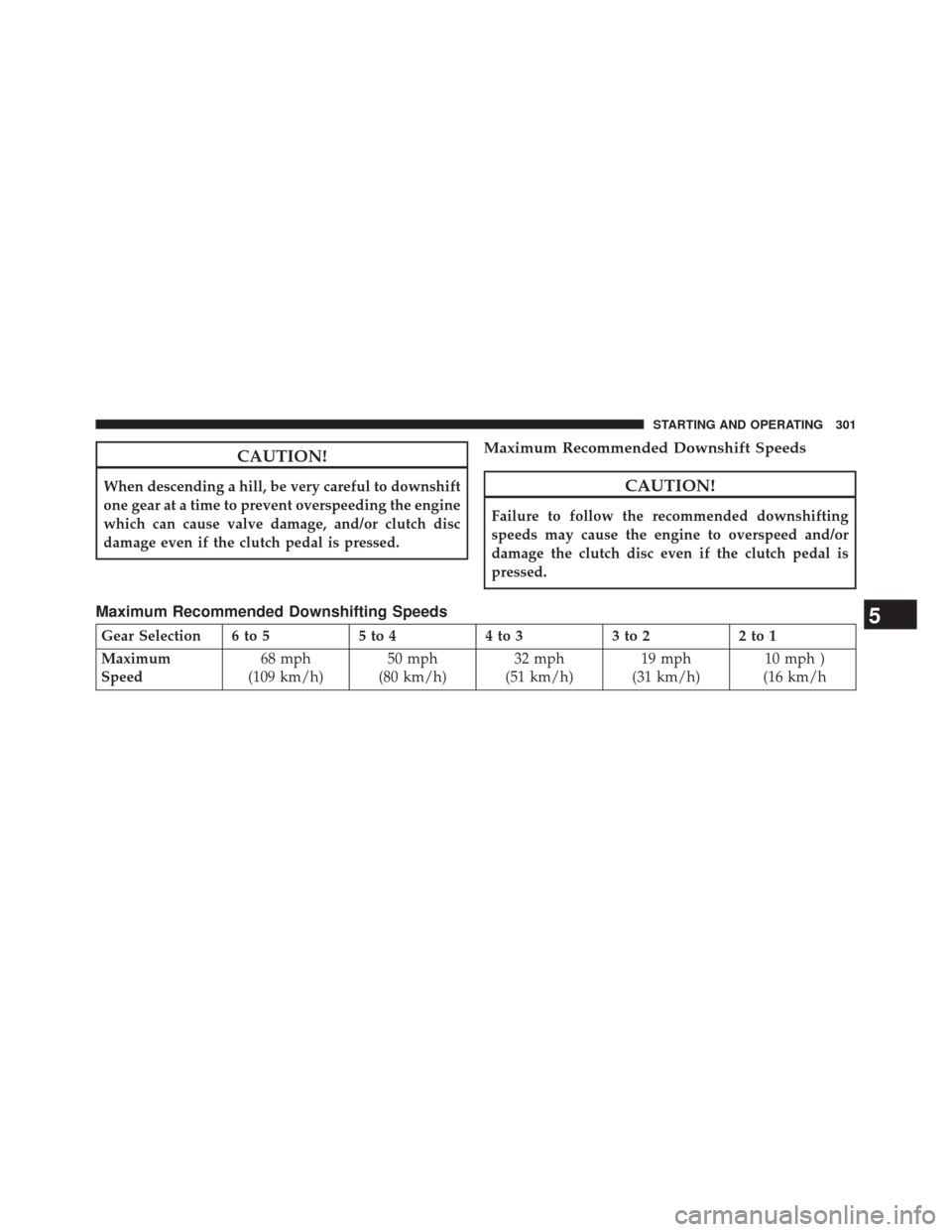
CAUTION!
When descending a hill, be very careful to downshift
one gear at a time to prevent overspeeding the engine
which can cause valve damage, and/or clutch disc
damage even if the clutch pedal is pressed.
Maximum Recommended Downshift Speeds
CAUTION!
Failure to follow the recommended downshifting
speeds may cause the engine to overspeed and/or
damage the clutch disc even if the clutch pedal is
pressed.
Maximum Recommended Downshifting Speeds
Gear Selection 6 to 55 to 44 to 33 to 22 to 1
Maximum
Speed 68 mph
(109 km/h) 50 mph
(80 km/h) 32 mph
(51 km/h) 19 mph
(31 km/h) 10 mph )
(16 km/h
5
STARTING AND OPERATING 301
Page 304 of 406

CAUTION!
If you skip a gear while downshifting or downshift
at too high of a vehicle speed, these conditions may
cause the engine to overspeed if too low of a gear is
selected and the clutch pedal is released. Damage to
the clutch and the transmission can result from
skipping a gear while downshifting or downshifting
at too high of a vehicle speed even if the clutch pedal
is held pressed (i.e., not released).
Reverse Shifting
To shift into REVERSE (R), bring the vehicle to a com-
plete stop. Press the clutch and pause briefly to allow the
gear train to stop rotating. Beginning from the NEUTRAL
(N) position, move the shift lever in one quick smooth
motion straight across and into the REVERSE (R) area(the driver will feel a firm “click” as the shifter passes the
“knock-over”). Complete the shift by pulling the shift
lever into REVERSE (R).
The “knock-over” prevents the driver from accidentally
entering the REVERSE (R) shift area and warns the driver
that they are about to shift the transmission into RE-
VERSE (R). Due to this feature, a slow shift to REVERSE
(R) can be perceived as a high shift effort.
To shift out of REVERSE bring the vehicle to a complete
stop and press the clutch. Shifting out of REVERSE prior
to a complete stop may cause high shift effort.AUXILIARY SWITCHES — IF EQUIPPED
There can be up to five auxiliary switches located in the
lower switch bank of the instrument panel which can be
used to power various electronic devices and PTO
(Power Take Off) – If Equipped. If Power Take Off is
equipped, it will take the place of the fifth Auxiliary
302 STARTING AND OPERATING
Page 306 of 406

less than engine speed when the torque converter clutch
is not engaged and will be same as engine speed when
the torque converter clutch is engaged.
Stationary Mode
To operate the PTO in this mode the vehicle must meet
the following conditions:
•Be in PARK position (vehicles equipped with auto-
matic transmission.)
• PTO switch has been activated.
• Parking brake applied (vehicles equipped with
manual transmission).
• Brake pedal must not be applied.
• Vehicle engine must be running.
• No vehicle, brake or clutch switch faults present. •
PTO must be correctly installed using the vehicle
provided circuits.
The Electronic Vehicle Information Center (EVIC) or
Driver Information Display (DID) will display a �PTO
On� message for five seconds if the above conditions are
met. Otherwise, the EVIC/DID will display a message
�To Operate PTO Shift To Park� indicating what operator
action should be taken to engage the PTO mode.
The customer has the choice to operate the PTO by
utilizing the cruise control switches or by utilizing a
remote control (provided by the PTO supplier). To oper-
ate the feature using the cruise control switches, the
customer must first activate the PTO switch which will
turn on the PTO. In order to increase or decrease the
engine idle speed, to optimize the PTO function, the
“RESUME/ACCEL” and “DECEL” cruise switches can
304 STARTING AND OPERATING
Page 307 of 406

be used respectively. To disengage PTO operation and
return to “standard vehicle operation” simply toggle the
PTO switch to the OFF position.
The torque converter clutch (TCC) will automatically
engage at engine speeds above 1,200 RPM (engine speed)
in PTO stationary mode. Once engaged, the TCC will
remain applied and will not disengage until the engine
speed falls below 1,000 RPM. TCC engagement is desir-
able for certain types of PTO applications (Automatic
Transmission Only).
To operate the PTO via a remote switch, the customer
must make sure the above conditions are met. It is vital
for proper operation that the PTO and remote have been
installed correctly, paying special attention to ensure the
vehicle provided wiring has been connected properly.
This is the responsibility of the installer of the PTO and
switches/remote system. It is the responsibility of the
PTO manufacturer to ensure that their electrical (switchesand remote) system is compatible with the vehicle’s
electrical architecture and software functionality.
NOTE:
Single set speed can be programmed via the PTO
menu on the EVIC/DID screen. Further details are avail-
able at the Ram Truck Bodybuilders web site located
at
www.rambodybuilder.com.
Mobile Mode
To operate the PTO in this mode the vehicle must meet
the following conditions:
• Mobile mode is activated via the menu on the EVIC/
DID screen.
• (ON/OFF) switch has been activated.
• Vehicles with automatic transmission must be in PARK
or DRIVE.
• Parking brake must not be applied.5
STARTING AND OPERATING 305
Page 308 of 406
•Brake pedal must not be applied.
• No vehicle, brake or clutch switch faults present.
• Vehicle engine must be running.
• PTO must be correctly installed using the vehicle
provided circuits.
The customer may choose to use the PTO while the
vehicle is moving. To do so, the PTO function must be
activated prior to taking the vehicle out of PARK. This is
accomplished by activating the upfitter-provided PTO
on/off switch. At this point, the customer may place the
vehicle in a forward or reverse gear and have PTO
operation once the vehicle begins to move. To disengage
PTO operation and return to “standard vehicle opera-
tion” simply toggle the on/off switch to the OFF position. NOTE:
For application specific information with respect
to PTO and pump requirements and additional vehicle
information (wiring schematics, preset idle values, en-
gine speed limits, and vehicle hardware and software
requirements) please refer to the Body Builders Guide by
accessing www.rambodybuilder.com and choosing the
appropriate links.
ENGINE RUNAWAY
Diesel engine runaway is a rare condition affecting diesel
engines, where the engine consumes its own lubrication
oil and runs at higher and higher RPM until it overspeeds
to a point where it destroys itself due to either mechani-
cal failure or engine seizure through lack of lubrication.
306 STARTING AND OPERATING
Page 333 of 406
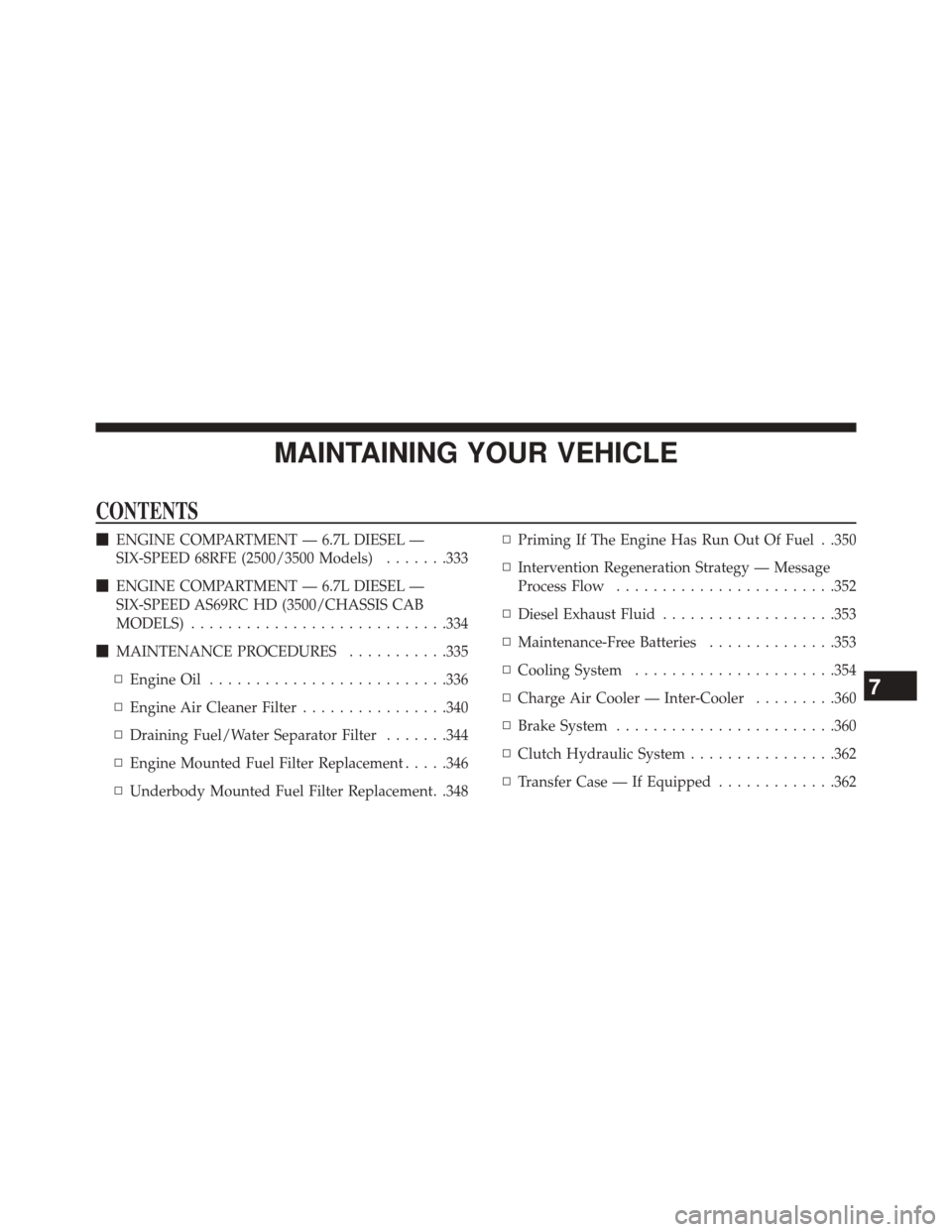
MAINTAINING YOUR VEHICLE
CONTENTS
�ENGINE COMPARTMENT — 6.7L DIESEL —
SIX-SPEED 68RFE (2500/3500 Models) .......333
� ENGINE COMPARTMENT — 6.7L DIESEL —
SIX-SPEED AS69RC HD (3500/CHASSIS CAB
MODELS) ........................... .334
� MAINTENANCE PROCEDURES ...........335
▫ Engine Oil ......................... .336
▫ Engine Air Cleaner Filter ................340
▫ Draining Fuel/Water Separator Filter .......344
▫ Engine Mounted Fuel Filter Replacement .....346
▫ Underbody Mounted Fuel Filter Replacement. .348 ▫
Priming If The Engine Has Run Out Of Fuel . .350
▫ Intervention Regeneration Strategy — Message
Process Flow ....................... .352
▫ Diesel Exhaust Fluid ...................353
▫ Maintenance-Free Batteries ..............353
▫ Cooling System ..................... .354
▫ Charge Air Cooler — Inter-Cooler .........360
▫ Brake System ....................... .360
▫ Clutch Hydraulic System ................362
▫ Transfer Case — If Equipped .............362
7
Page 364 of 406

WARNING!(Continued)
•Do not allow petroleum based fluid to contaminate
the brake fluid. Brake seal components could be
damaged, causing partial or complete brake failure.
This could result in an accident.
Clutch Hydraulic System
The clutch hydraulic system is a sealed maintenance-free
system. In the event of leakage or other malfunction, the
system must be replaced.
Transfer Case — If Equipped
Drain And Refill
Refer to the “Maintenance Schedule” for the proper
maintenance intervals.
Selection of Lubricant
Refer to “Fluids, Lubricants, and Genuine Parts” in
“Maintaining Your Vehicle” for fluid specifications.
Fluid Level Check
This fluid level can be checked by removing the filler
plug. The fluid level should be to the bottom edge of the
filler plug hole with the vehicle in a level position.
Manual Transmission — If Equipped
Selection of Lubricant
Refer to “Fluids, Lubricants, and Genuine Parts” in
“Maintaining Your Vehicle” for fluid specifications.
Fluid Level Check
The fluid level can be checked by removing the filler
plug. If the level of the lubricant is more than 1/2 in
(12 mm) below the bottom of the filler hole while the
362 MAINTAINING YOUR VEHICLE
Page 370 of 406
Tampering With Noise Control System Prohibited
Federal law prohibits the following acts or the causing
thereof: (1) the removal or rendering inoperative by any
person, other than for purposes of maintenance, repair, or
replacement, of any device or element of design incorpo-
rated into any new vehicle for the purpose of noise
control prior to its sale or delivery to the ultimate
purchaser or while it is in use, or (2) the use of the vehicle
after such device or element of design has been removed
or rendered inoperative by any person.
Among those acts presumed to constitute tampering are
the acts listed below.AIR CLEANER
•
Removal of the air cleaner.
• Removal of the air cleaner filter element from the air
cleaner housing.
• Removal of the air ducting.
EXHAUST SYSTEM
• Removal or rendering inoperative exhaust system
components including the muffler or tailpipe.
ENGINE COOLING SYSTEM
• Removal or rendering inoperative the fan clutch.
• Removal of the fan shroud.
368 MAINTAINING YOUR VEHICLE