Page 367 of 406

5. Place the shift lever momentarily into each gear posi-tion (allowing time for the transmission to fully en-
gage in each position), ending with the transmission in
PARK.
6. Remove the dipstick, wipe it clean and reinsert it until seated.
7. Remove the dipstick again and note the fluid level on both sides. The fluid level reading is only valid if there
is a solid coating of oil on both sides of the dipstick.
Note that the holes in the dipstick will be full of fluid
if the actual level is at or above the hole. The fluid level
should be between the “HOT” (upper) reference holes
on the dipstick at normal operating temperature. If the
fluid level is low, add fluid through the dipstick tube
to bring it to the proper level. Do not overfill.Use
ONLY the specified fluid (see �Fluids, Lubricants, and
Genuine Parts� for fluid specifications). After adding
any quantity of oil through the dipstick tube, wait a minimum of two minutes for the oil to fully drain into
the transmission before rechecking the fluid level.
NOTE: If it is necessary to check the transmission below
the operating temperature, the fluid level should be
between the two “COLD” (lower) holes on the dipstick
with the fluid at 60-70°F / 16-21°C for 68RFE transmis-
sion, or 68-86°F / 20-30°C for AS69RC transmission. Only
use the COLD region of the dipstick as a rough reference
when setting the fluid level after a transmission service
or fluid change. Re-check the fluid level, and adjust as
required, once the transmission reaches normal operating
temperature.
CAUTION!
If the fluid temperature is below 50°F (10°C) it may
not register on the dipstick. Do not add fluid until
the temperature is elevated enough to produce an
(Continued)
7
MAINTAINING YOUR VEHICLE 365
Page 369 of 406
Required Maintenance For Noise Control Systems
The following maintenance services must be performed
every six months or 7,500 miles (12 000 km) whichever
comes first, to assure proper operation of the noise
control systems. In addition, inspection and service
should be performed anytime a malfunction is observedor suspected. Proper maintenance of the entire vehicle
will help the effectiveness of the noise control systems.
Exhaust System
Inspect the entire exhaust system for leaks and damaged
parts. Devices such as hangers, clamps, and U-bolts
should be tight and in good condition. Damaged compo-
nents, burned or blown out mufflers, burned or rusted
out exhaust pipes should be replaced according to the
procedures and specifications outlined in the appropriate
service manual.
Air Cleaner Assembly
Inspect air cleaner housing for proper assembly and fit.
Make certain that the air cleaner is properly positioned
and that the cover is tight. Check all hoses leading to the
air cleaner for tightness. The air filter element must also
be clean and serviced according to the instructions out-
lined in the Maintenance Schedule section of this manual.7
MAINTAINING YOUR VEHICLE 367
Page 372 of 406
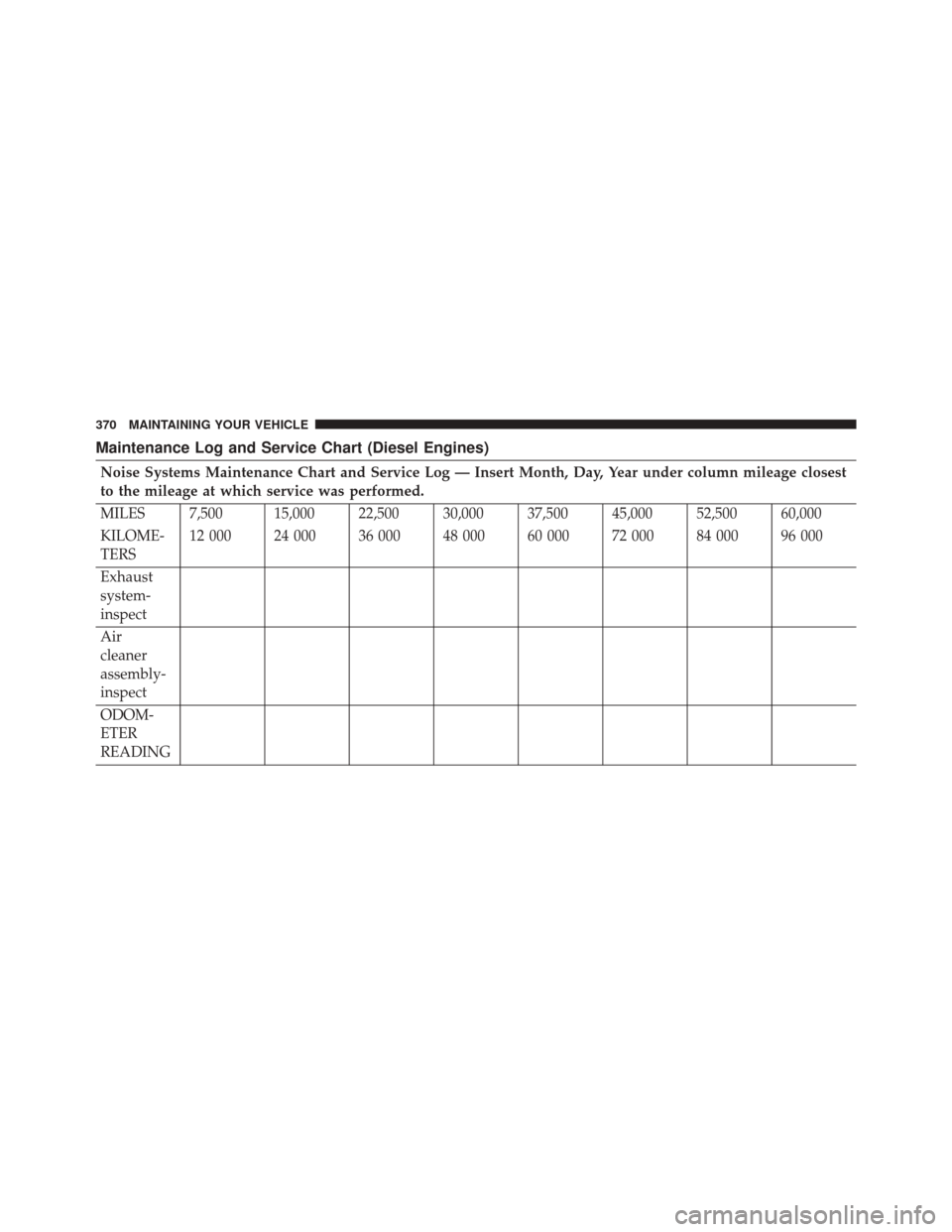
Maintenance Log and Service Chart (Diesel Engines)
Noise Systems Maintenance Chart and Service Log — Insert Month, Day, Year under column mileage closest
to the mileage at which service was performed.
MILES 7,500 15,000 22,500 30,000 37,500 45,000 52,500 60,000
KILOME-
TERS12 000 24 000 36 000 48 000 60 000 72 000 84 000 96 000
Exhaust
system-
inspect
Air
cleaner
assembly-
inspect
ODOM-
ETER
READING
370 MAINTAINING YOUR VEHICLE
Page 373 of 406
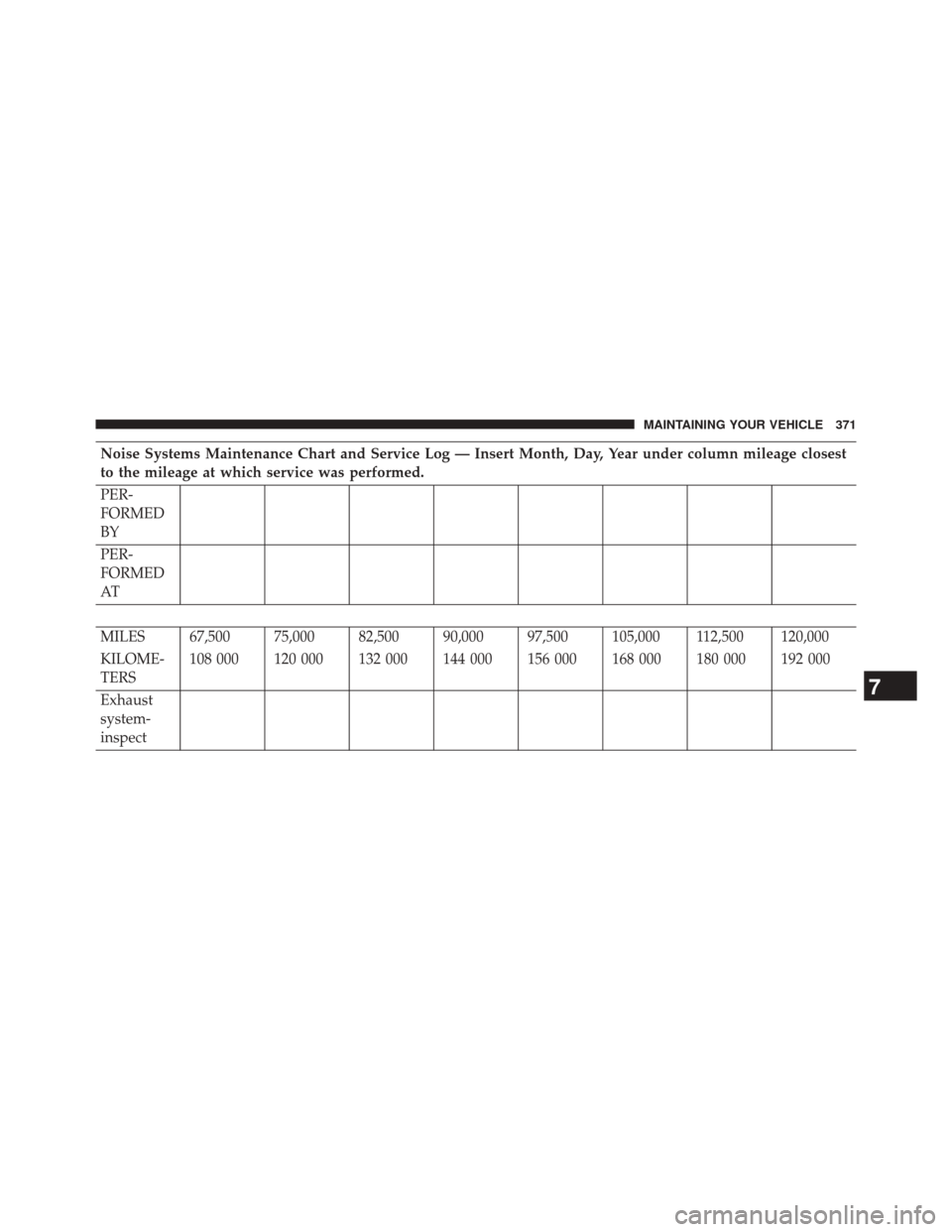
Noise Systems Maintenance Chart and Service Log — Insert Month, Day, Year under column mileage closest
to the mileage at which service was performed.
PER-
FORMED
BY
PER-
FORMED
AT
MILES 67,500 75,000 82,500 90,000 97,500 105,000 112,500 120,000
KILOME-
TERS108 000 120 000 132 000 144 000 156 000 168 000 180 000 192 000
Exhaust
system-
inspect
7
MAINTAINING YOUR VEHICLE 371
Page 374 of 406
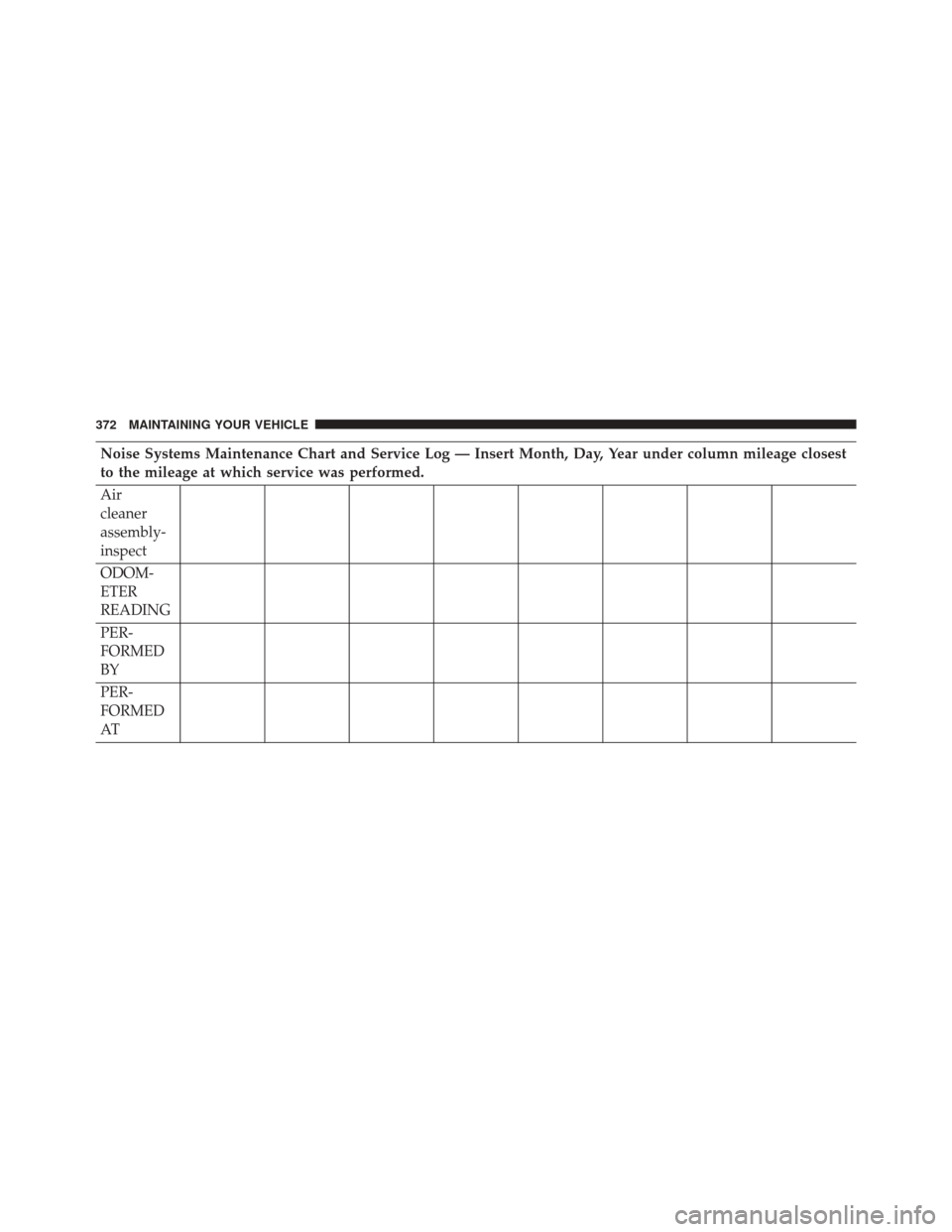
Noise Systems Maintenance Chart and Service Log — Insert Month, Day, Year under column mileage closest
to the mileage at which service was performed.
Air
cleaner
assembly-
inspect
ODOM-
ETER
READING
PER-
FORMED
BY
PER-
FORMED
AT
372 MAINTAINING YOUR VEHICLE
Page 378 of 406
ComponentFluid, Lubricant, or Genuine Part
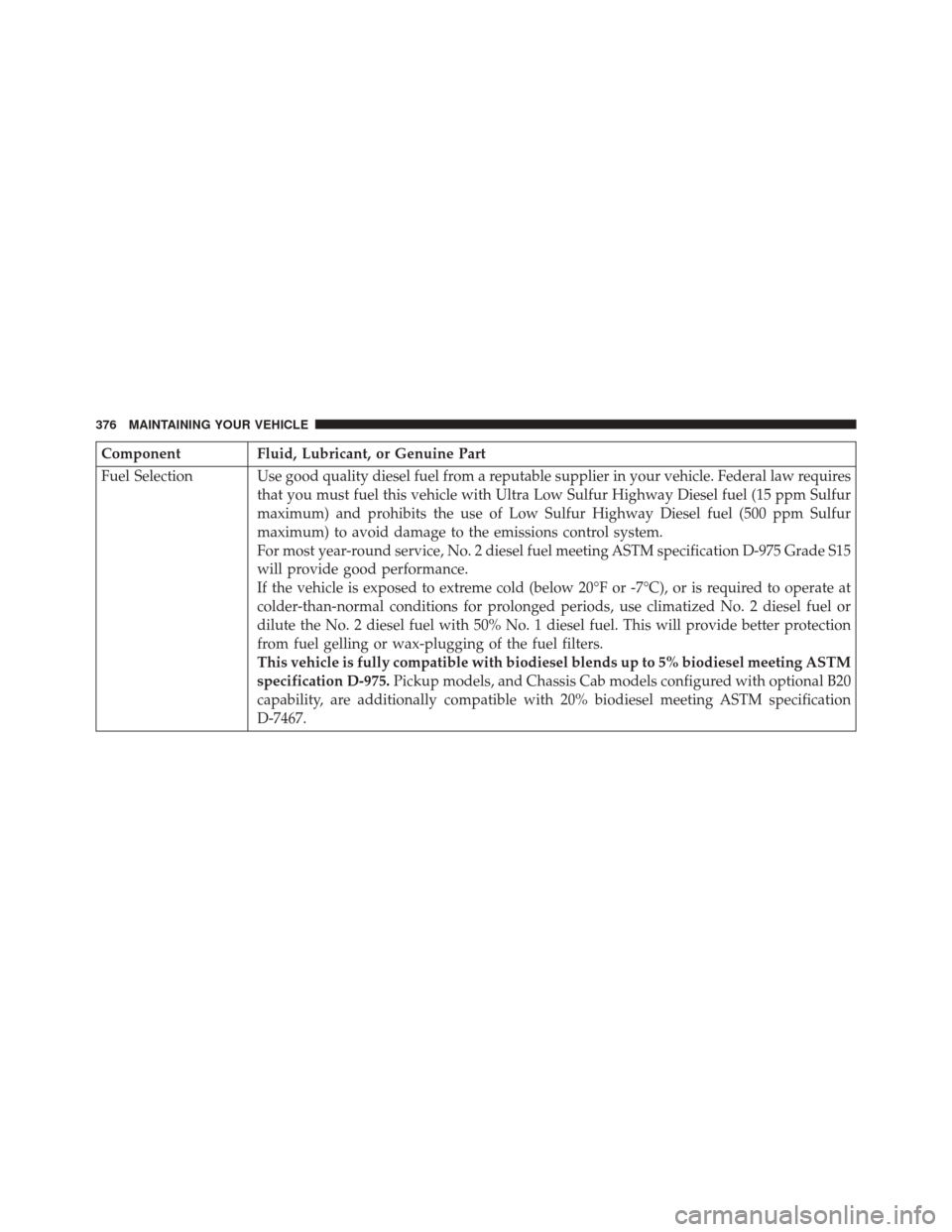
Fuel Selection Use good quality diesel fuel from a reputable supplier in your vehicle. Federal law requires that you must fuel this vehicle with Ultra Low Sulfur Highway Diesel fuel (15 ppm Sulfur
maximum) and prohibits the use of Low Sulfur Highway Diesel fuel (500 ppm Sulfur
maximum) to avoid damage to the emissions control system.
For most year-round service, No. 2 diesel fuel meeting ASTM specification D-975 Grade S15
will provide good performance.
If the vehicle is exposed to extreme cold (below 20°F or -7°C), or is required to operate at
colder-than-normal conditions for prolonged periods, use climatized No. 2 diesel fuel or
dilute the No. 2 diesel fuel with 50% No. 1 diesel fuel. This will provide better protection
from fuel gelling or wax-plugging of the fuel filters.
This vehicle is fully compatible with biodiesel blends up to 5% biodiesel meeting ASTM
specification D-975.Pickup models, and Chassis Cab models configured with optional B20
capability, are additionally compatible with 20% biodiesel meeting ASTM specification
D-7467.
376 MAINTAINING YOUR VEHICLE
Page 381 of 406
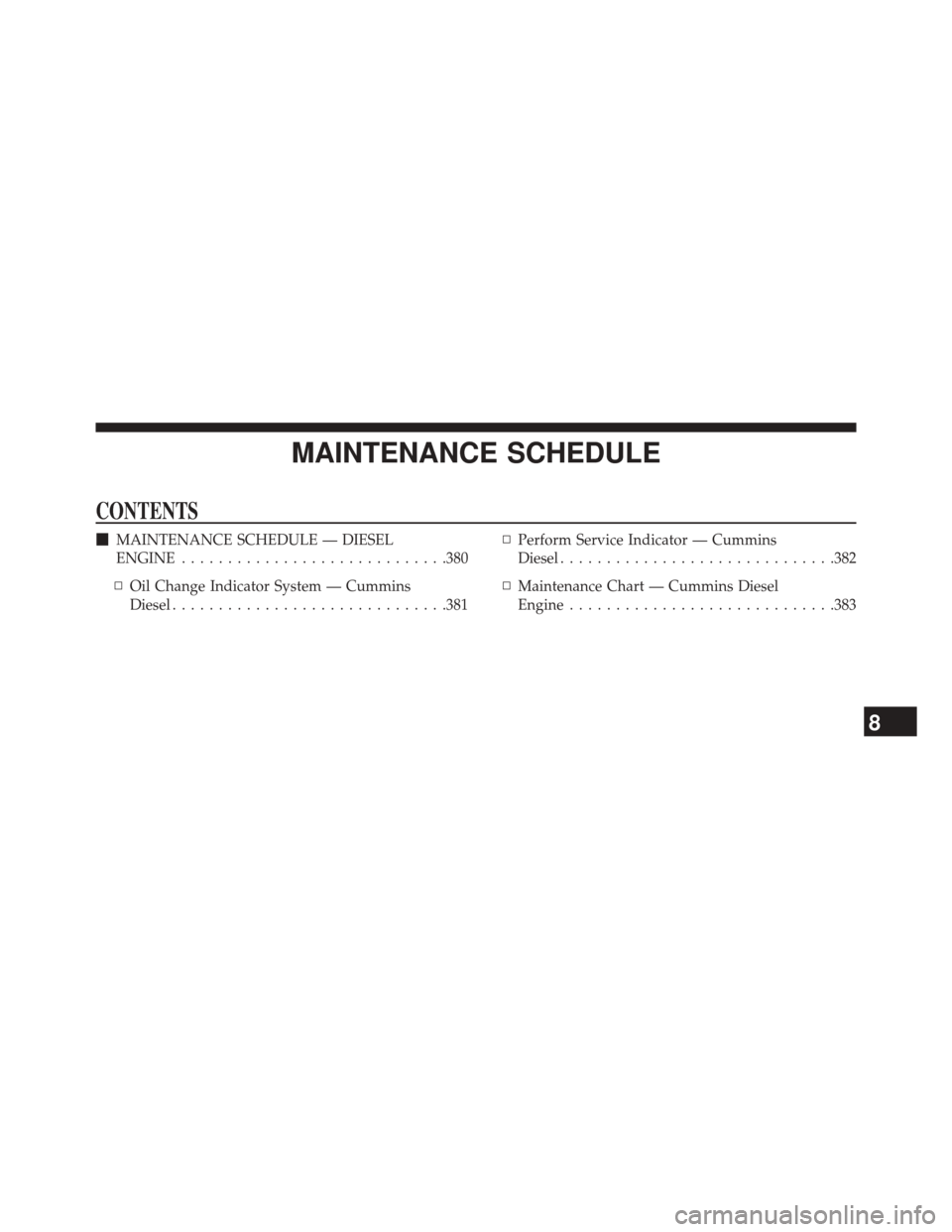
MAINTENANCE SCHEDULE
CONTENTS
�MAINTENANCE SCHEDULE — DIESEL
ENGINE ............................ .380
▫ Oil Change Indicator System — Cummins
Diesel ............................. .381▫
Perform Service Indicator — Cummins
Diesel ............................. .382
▫ Maintenance Chart — Cummins Diesel
Engine ............................ .383
8
Page 382 of 406
MAINTENANCE SCHEDULE — DIESEL ENGINE
CAUTION!
Failure to perform the required maintenance items
may result in damage to the vehicle.
At Each Stop For Fuel
Check the engine oil level at least 30 minutes after a fully
warmed engine is shut off. Checking the oil level while
the vehicle is on level ground will improve the accuracy
of the oil level reading. Add oil only when the level is at
or below the ADD or MIN mark.
Once A Month
• Inspect the batteries, and clean and tighten the termi-
nals as required. •
Check the fluid levels of the coolant reservoir, brake
master cylinder, and automatic transmission (if
equipped), and add as needed.
At Each Oil Change
• Change the engine oil filter.
• Inspect the exhaust system.
• Inspect engine air filter.
• Check the coolant level, hoses, and clamps.
• Lubricate outer tie rod ends.
Inspection and service should also be performed anytime
a malfunction is observed or suspected. Retain all re-
ceipts.
380 MAINTENANCE SCHEDULE