Page 695 of 916
Recommended Distribution Hitch Adjustment
Towing With 1500 Air Suspension
1. Set air suspension to normal ride height. No action is
required if already in normal ride height.
NOTE:The vehicle must remain in the engine running
position while attaching a trailer for proper leveling of
the air suspension system.
2. Position the truck to be ready to connect to the trailer
(do not connect the trailer).
3. Under radio suspension settings, turn on jack mode.
Jack mode will be canceled and procedure must be
restarted if the vehicle is driven at speeds above 5mph
(8kph).
4. Measure the height of the top of the front wheel
opening on the fender to ground, this is height H1.
Improper Adjustment Of Weight-Distributing Hitch
(Incorrect)
5
STARTING AND OPERATING 693
Page 696 of 916
5. Attach the trailer to the vehicle without the weight
distribution bars connected.
6. Measure the height of the top of the front wheel
opening on the fender to ground, this is height H2.7. Install and adjust the tension in the weight distribut-
ing bars so that the height of the front fender is
approximately (H2-H1)/3+H1 (about 1/3 the differ-
ence between H2 and H1 above normal ride height
[H1]).
8. The truck can now be driven. Jack mode will be
canceled and vehicle will return to normal ride height
when drive at speeds above 5mph (8kph).
Measurement ExampleExample 1500 Height
(mm)
H1 925
H2 946
H2-H1 21
(H2-H1)/3 7
(H2-H1)/3 + H1 932
Measuring Height (H)
694 STARTING AND OPERATING
Page 697 of 916

NOTE:For all towing conditions, we recommend towing
with tow haul mode engaged.
All Other 1500(Non-Air Suspension)/2500/3500 Trucks
1. Position the truck to be ready to connect to the trailer
(do not connect the trailer).
NOTE:For Ram 2500/3500 trucks equipped with rear air
suspension, normal ride height or alternate ride height
can be used. The vehicle must remain in the engine
running position while attaching a trailer for proper
leveling of the air suspension system. It may not be
possible to enter alternate ride height while lightly
loaded.
2. Measure the height of the top of the front wheel
opening on the fender to ground, this is height H1.
3. Attach the trailer to the vehicle without the weight
distribution bars connected.4. Measure the height of the top of the front wheel
opening on the fender to ground, this is height H2.
5. Install and adjust the tension in the weight distribut-
ing bars so that the height of the front fender is
approximately (H2-H1)/2+H1 (about 1/2 the differ-
ence between H2 and H1 above normal ride height
[H1]).
Measurement ExampleExample 2500/3500
Height (mm)
H1 1030
H2 1058
H2-H1 28
(H2-H1)/2 14
(H2-H1)/2 + H1 1044
NOTE:For all towing conditions, we recommend towing
with tow haul mode engaged.
5
STARTING AND OPERATING 695
Page 709 of 916
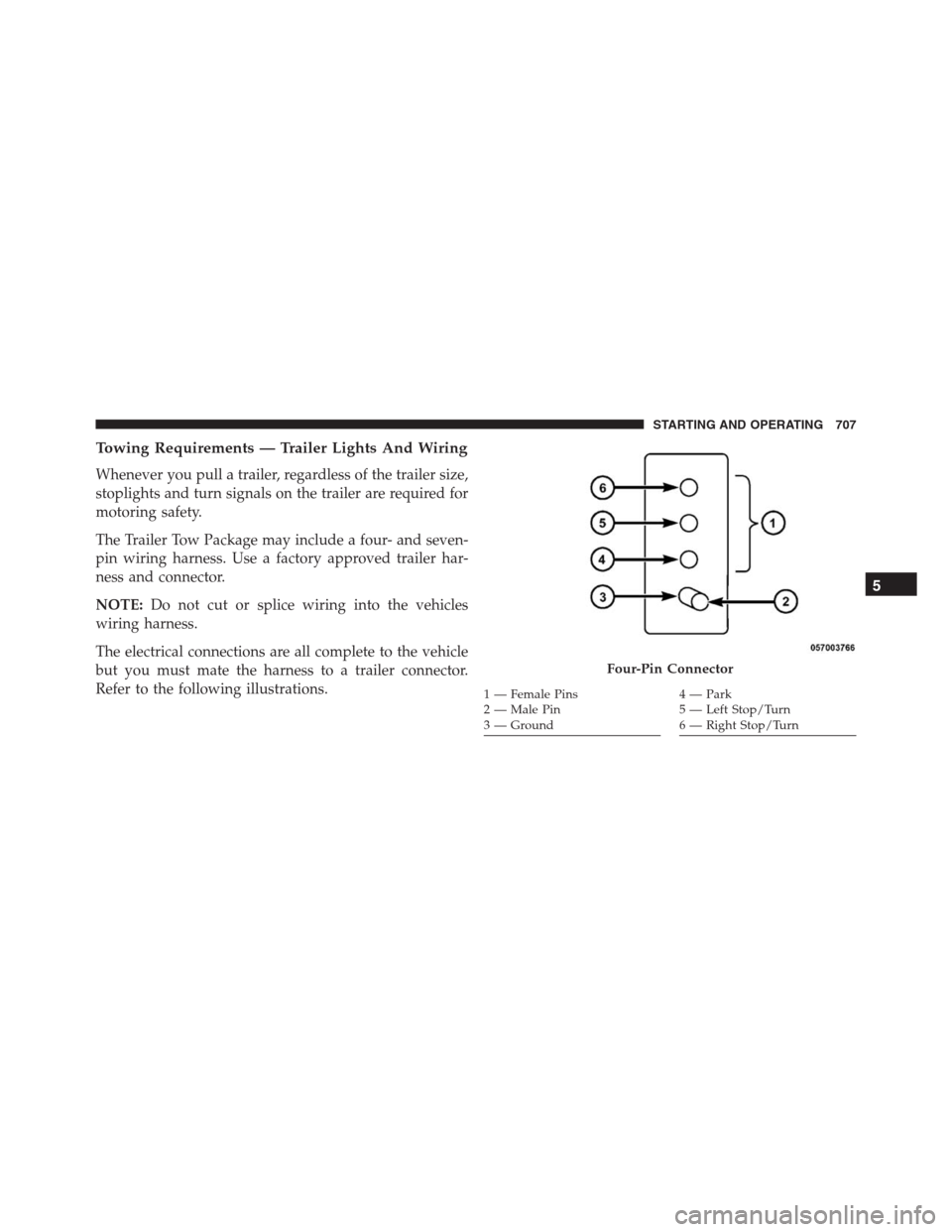
Towing Requirements — Trailer Lights And Wiring
Whenever you pull a trailer, regardless of the trailer size,
stoplights and turn signals on the trailer are required for
motoring safety.
The Trailer Tow Package may include a four- and seven-
pin wiring harness. Use a factory approved trailer har-
ness and connector.
NOTE:Do not cut or splice wiring into the vehicles
wiring harness.
The electrical connections are all complete to the vehicle
but you must mate the harness to a trailer connector.
Refer to the following illustrations.
Four-Pin Connector
1 — Female Pins
2 — Male Pin
3 — Ground4 — Park
5 — Left Stop/Turn
6 — Right Stop/Turn
5
STARTING AND OPERATING 707
Page 710 of 916
Towing Tips
Before setting out on a trip, practice turning, stopping
and backing the trailer up in an area away from heavy
traffic.
Automatic Transmission
The DRIVE range can be selected when towing. The
transmission controls include a drive strategy to avoid
frequent shifting when towing. However, if frequent
shifting does occur while in DRIVE, select TOW/HAUL
mode or select a lower gear range (using the Electronic
Range Select (ERS) shift control).
NOTE:Using TOW/HAUL mode or selecting a lower
gear range (using the ERS shift control) while operating
the vehicle under heavy loading conditions will improve
performance and extend transmission life by reducing
excessive shifting and heat build up. This action will also
provide better engine braking.
Seven-Pin Connector
1 — Battery
2 — Backup Lamps
3 — Right Stop/Turn
4 — Electric Brakes5 — Ground
6 — Left Stop/Turn
7 — Running Lamps 708 STARTING AND OPERATING
Page 714 of 916

•Check the runners and cutting edge for excessive wear.
The cutting edge should be ¼ to ½ in (6 cm to 1.2 cm)
above ground in snow plowing position.
•Check that snowplow lighting is connected and func-
tioning properly.
Snowplow Prep Package Model Availability
For Information about snowplow applications visit
www.ramtrucks.com or refer to the current Body Build-
ers Guide.
1. The maximum number of occupants in the truck
should not exceed two.
2. The total GVWR or the Front GAWR or the Rear
GAWR should never be exceeded.
3. Cargo capacity will be reduced by the addition of
options or passengers, etc.The loaded vehicle weight, including the snowplow
system, all aftermarket accessories, driver, passengers,
options, and cargo, must not exceed either the Gross
Vehicle Weight (GVWR) or Gross Axle Weight (GAWR)
ratings. These weights are specified on the Safety Com-
pliance Certification Label on the driver’s side door
opening.
NOTE:Detach the snowplow when transporting pas-
sengers.
Vehicle front end wheel alignment was set to specifica-
tions at the factory without consideration for the weight
of the plow. Front end toe-in should be checked and reset
if necessary at the beginning and end of the snowplow
season. This will help prevent uneven tire wear.
The blade should be lowered whenever the vehicle is
parked.
712 STARTING AND OPERATING
Page 716 of 916
RECREATIONAL TOWING (BEHIND MOTORHOME, ETC.)
Towing This Vehicle Behind Another Vehicle
Towing Condition Wheels OFF
The GroundTwo-Wheel
Drive ModelsFour-Wheel Drive Models
Flat Tow NONENOT AL-
LOWEDSee Instructions
•Automatic transmission in PARK
•Manual transmission in gear (NOT in NEU-
TRAL)
•Transfer case in NEUTRAL (N)
•Tow in forward direction
Dolly Tow FrontNOT AL-
LOWEDNOT ALLOWED
Rear OKNOT ALLOWED
On Trailer ALL OK OK
714 STARTING AND OPERATING
Page 717 of 916

NOTE:
•When recreational towing your vehicle, always follow
applicable state and provincial laws. Contact state and
provincial Highway Safety offices for additional de-
tails.
•Vehicles equipped with air suspension must be placed
in Transport mode before tying them down (from the
body) on a trailer or flatbed truck. Refer to “Air
Suspension – If Equipped” for more information. If the
vehicle cannot be placed in Transport mode (for ex-
ample, engine will not run), tie-downs must be fas-
tened to the axles (not to the body). Failure to follow
these instructions may cause fault codes to be set
and/or cause loss of proper tie-down tension.
Recreational Towing — Two-Wheel Drive Models
DO NOT flat tow this vehicle. Damage to the drivetrain
will result.Recreational towing (for two-wheel drive models) is
allowedONLYif the rear wheels areOFFthe ground.
This may be accomplished using a tow dolly or vehicle
trailer. If using a tow dolly, follow this procedure:
1. Properly secure the dolly to the tow vehicle, following
the dolly manufacturer’s instructions.
2. Drive the rear wheels onto the tow dolly.
3. Firmly apply the parking brake. Place automatic trans-
mission in PARK, manual transmission in gear (not in
NEUTRAL).
4. Properly secure the rear wheels to the dolly, following
the dolly manufacturer’s instructions.
5. Turn the ignition switch to the OFF position and
remove the Key Fob.
6. Install a suitable clamping device, designed for tow-
ing, to secure the front wheels in the straight position.
5
STARTING AND OPERATING 715