Page 706 of 916

Adjusting GAIN
NOTE:This should only be performed in a traffic free
environment at speeds of approximately 20–25 mph
(30–40 km/h).
1. Make sure the trailer brakes are in good working
condition, functioning normally and properly ad-
justed. See your trailer dealer if necessary.
2. Hook up the trailer and make the electrical connec-
tions according to the trailer manufacturer’s instruc-
tions.
3. When a trailer with electric/EOH brakes is plugged
in, the trailer connected message should appear in the
EVIC/DID (if the connection is not recognized by the
ITBM, braking functions will not be available), the
GAIN setting will illuminate and the correct type of
trailer must be selected from the EVIC/DID options.4. Push the UP or DOWN button on the steering wheel
until “TRAILER TOW” appears on the screen.
5. Push the RIGHT arrow on the steering wheel to enter
“TRAILER TOW”.
6. Push the UP or DOWN buttons until Trailer Brake
Type appears on the screen.
7. Push the RIGHT arrow and then push the UP or
DOWN buttons until the proper Trailer Brake Type
appears on the screen.
8. In a traffic-free environment, tow the trailer on a dry,
level surface at a speed of 20–25 mph (30–40 km/h)
and squeeze the manual brake control lever com-
pletely.
9. If the trailer wheels lockup (indicated by squealing
tires), reduce the GAIN setting; if the trailer wheels
turn freely, increase the GAIN setting.
704 STARTING AND OPERATING
Page 707 of 916

Repeat steps 8 and 9 until the GAIN setting is at a point
just below trailer wheel lockup. If towing a heavier
trailer, trailer wheel lockup may not be attainable even
with the maximum GAIN setting of 10.
Light Electric Heavy Electric Light EOH Heavy EOH
Type of Trailer
BrakesElectric Trailer
BrakesElectric Trailer
BrakesElectric over Hy-
draulic Trailer
BrakesElectric over Hy-
draulic Trailer
Brakes
Load *Under 10,000 lbs *Above 10,000 lbs *Under 10,000 lbs *Above 10,000 lbs
* The suggested selection depends and may change
depending on the customer preferences for braking per-
formance. Condition of the trailer brakes, driving and
road state may also affect the selection.
Display Messages
The trailer brake control interacts with the Electronic
Vehicle Information Center (EVIC) or Driver InformationDisplay (DID). Display messages, along with a single
chime, will be displayed when a malfunction is deter-
mined in the trailer connection, trailer brake control, or
on the trailer. Refer to “Electronic Vehicle Information
Center” or “Driver Information Display” in “Under-
standing Your Instrument Panel” for further information.
5
STARTING AND OPERATING 705
Page 732 of 916
(EVIC)” or “Driver Information Display (DID)” in “Un-
derstanding Your Instrument Panel” for further informa-
tion.
Jack Location
The jack and jack tools are stored under the front
passenger seat.
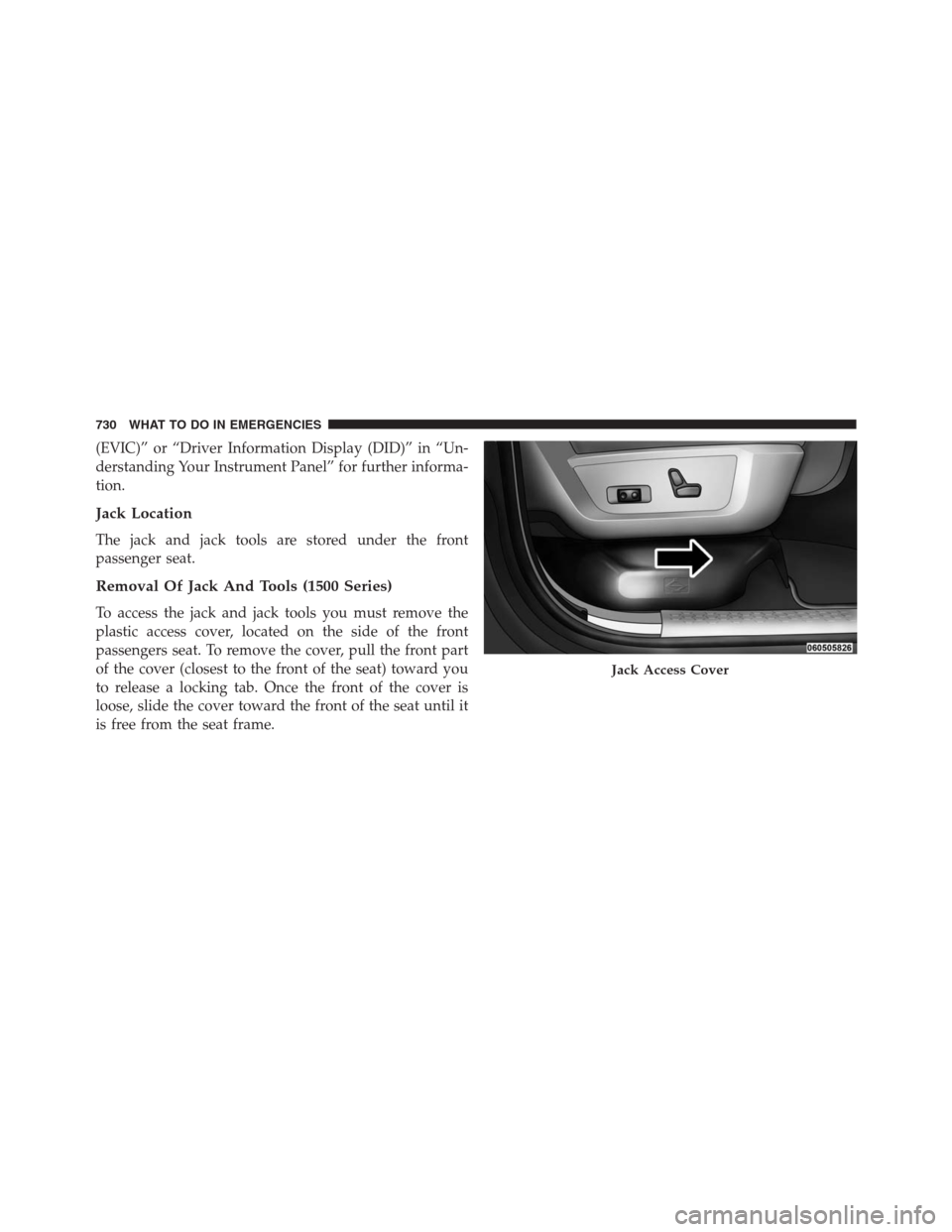
Removal Of Jack And Tools (1500 Series)
To access the jack and jack tools you must remove the
plastic access cover, located on the side of the front
passengers seat. To remove the cover, pull the front part
of the cover (closest to the front of the seat) toward you
to release a locking tab. Once the front of the cover is
loose, slide the cover toward the front of the seat until it
is free from the seat frame.
Jack Access Cover
730 WHAT TO DO IN EMERGENCIES
Page 733 of 916
Remove the jack and tools by turning the wing bolt
counterclockwise, remove the wing bolt and then slide
the assembly out from under the seat.Release the tool bag straps from the jack and remove
tools from bag.
Jack And Tools (1500 Series)
Jack And Tool Bag
6
WHAT TO DO IN EMERGENCIES 731
Page 737 of 916
2. Rotate the wheel wrench handle counterclockwise
until the spare tire is on the ground with enough cable
slack to allow you to pull it out from under the vehicle.3. Pull the spare tire out from under the vehicle to gain
access to the spare tire retainer.
Rotating The Wheel Wrench Handle
Pulling The Spare Tire Out
6
WHAT TO DO IN EMERGENCIES 735
Page 739 of 916

Preparations
1. Park the vehicle on a firm, level surface. Avoid ice or
slippery areas.
WARNING!
Do not attempt to change a tire on the side of the
vehicle close to moving traffic, pull far enough off
the road to avoid the danger of being hit when
operating the jack or changing the wheel.
2. Turn on the Hazard Warning flasher.
3. Set the parking brake.
4. Place the shift lever into PARK. On four-wheel drive
vehicles, shift the transfer case to the 4L position.
5. Turn the ignition OFF.Block both the front and rear of the wheel diagonally
opposite the jacking position. For example, if the right
front wheel is being changed, block the left rear wheel.
NOTE:Passengers should not remain in the
vehicle when the vehicle is being jacked.
Jack Instructions (1500 Series)
WARNING!
Carefully follow these tire changing warnings to
help prevent personal injury or damage to your
vehicle:
•Always park on a firm, level surface as far from the
edge of the roadway as possible before raising the
vehicle.
(Continued)
6
WHAT TO DO IN EMERGENCIES 737
Page 740 of 916
WARNING!(Continued)
•Turn on the Hazard Warning flasher.
•Block the wheel diagonally opposite the wheel to
be raised.
•Set the parking brake firmly and set an automatic
transmission in PARK; a manual transmission in
REVERSE.
•Never start or run the engine with the vehicle on a
jack.
•Do not let anyone sit in the vehicle when it is on a
jack.
•Do not get under the vehicle when it is on a jack. If
you need to get under a raised vehicle, take it to a
service center where it can be raised on a lift.
•Only use the jack in the positions indicated and for
lifting this vehicle during a tire change.
(Continued)
WARNING!(Continued)
•If working on or near a roadway, be extremely
careful of motor traffic.
•To assure that spare tires, flat or inflated, are
securely stowed, spares must be stowed with the
valve stem facing the ground.
Jack Warning Label
738 WHAT TO DO IN EMERGENCIES
Page 741 of 916
CAUTION!
Do not attempt to raise the vehicle by jacking on
locations other than those indicated in the Jacking
Instructions for this vehicle.
1. Remove the spare wheel, jack, and tools from storage.
2. Using the wheel wrench, loosen, but do not remove,
the wheel nuts by turning them counterclockwise one
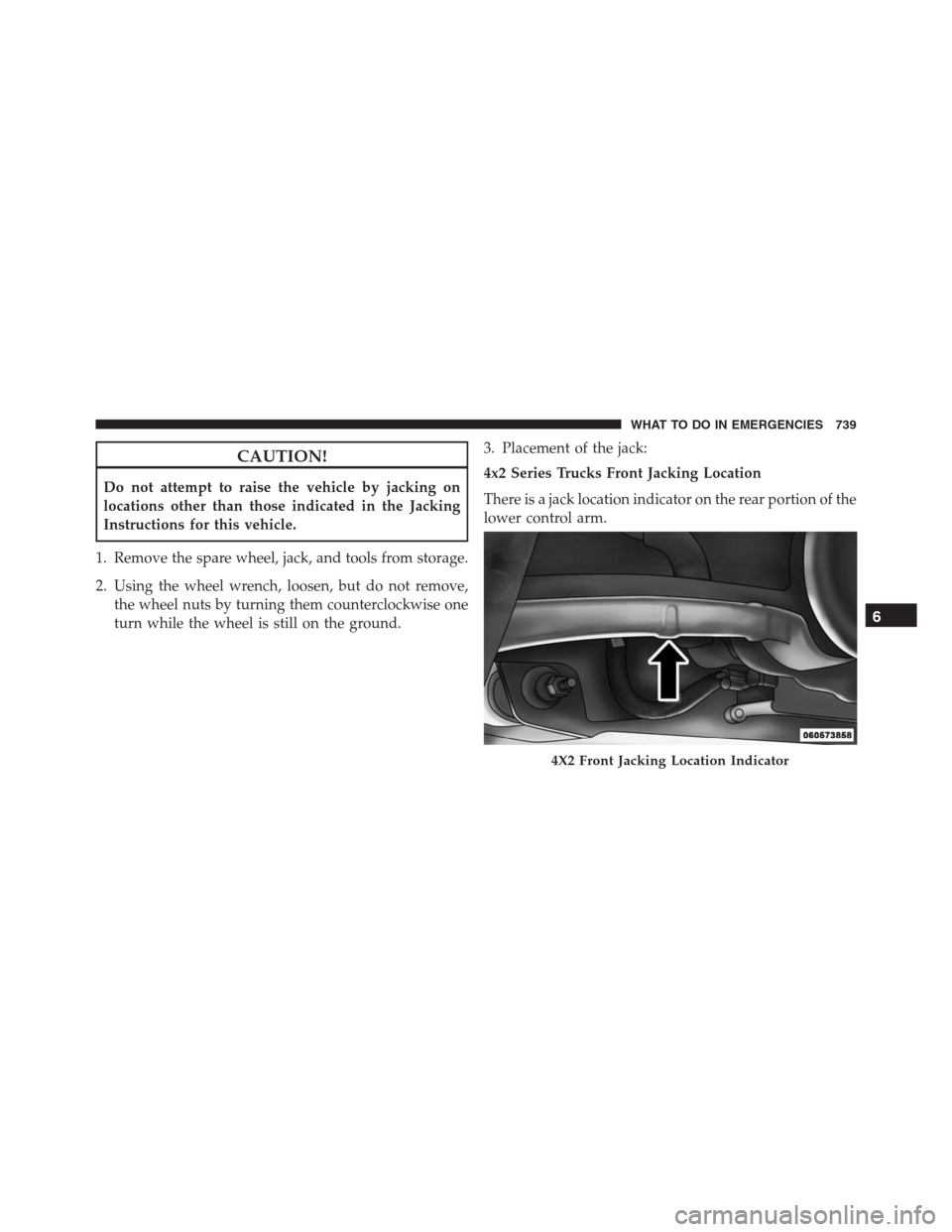
turn while the wheel is still on the ground.3. Placement of the jack:
4x2 Series Trucks Front Jacking Location
There is a jack location indicator on the rear portion of the
lower control arm.
4X2 Front Jacking Location Indicator
6
WHAT TO DO IN EMERGENCIES 739