Page 759 of 916

Block both the front and rear of the wheel diagonally
opposite the jacking position. For example, if the right
front wheel is being changed, block the left rear wheel.
NOTE:Passengers should not remain in the
vehicle when the vehicle is being jacked.
Jack Instructions (2500, 3500 Series)
WARNING!
Carefully follow these tire changing warnings to
help prevent personal injury or damage to your
vehicle:
•Always park on a firm, level surface as far from the
edge of the roadway as possible before raising the
vehicle.
(Continued)
WARNING!(Continued)
•Turn on the Hazard Warning flasher.
•Block the wheel diagonally opposite the wheel to
be raised.
•Set the parking brake firmly and set an automatic
transmission in PARK; a manual transmission in
REVERSE.
•Never start or run the engine with the vehicle on a
jack.
•Do not let anyone sit in the vehicle when it is on a
jack.
•Do not get under the vehicle when it is on a jack. If
you need to get under a raised vehicle, take it to a
service center where it can be raised on a lift.
•Only use the jack in the positions indicated and for
lifting this vehicle during a tire change.
(Continued)
6
WHAT TO DO IN EMERGENCIES 757
Page 760 of 916
WARNING!(Continued)
•If working on or near a roadway, be extremely
careful of motor traffic.
•To assure that spare tires, flat or inflated, are
securely stowed, spares must be stowed with the
valve stem facing the ground.
Jack Warning Label
Lug Wrench Adaptor Shown In Jack And Tools
Assembly
758 WHAT TO DO IN EMERGENCIES
Page 761 of 916
CAUTION!
Do not attempt to raise the vehicle by jacking on
locations other than those indicated in the Jacking
Instructions for this vehicle.
1. Remove the spare wheel, jack, and tools from storage.
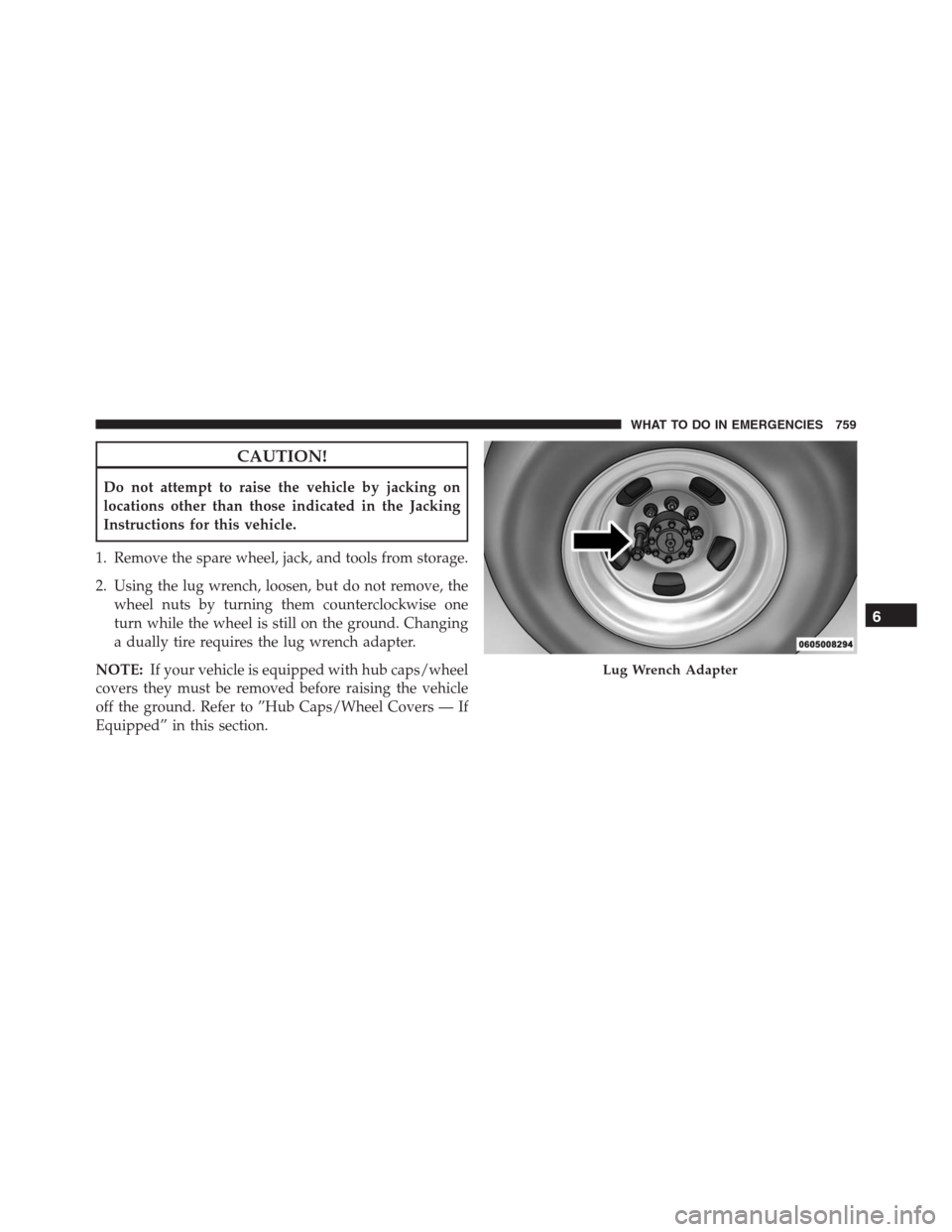
2. Using the lug wrench, loosen, but do not remove, the
wheel nuts by turning them counterclockwise one
turn while the wheel is still on the ground. Changing
a dually tire requires the lug wrench adapter.
NOTE:If your vehicle is equipped with hub caps/wheel
covers they must be removed before raising the vehicle
off the ground. Refer to ”Hub Caps/Wheel Covers — If
Equipped” in this section.
Lug Wrench Adapter
6
WHAT TO DO IN EMERGENCIES 759
Page 762 of 916
3. Placement of the jack:
Front Jacking Location
When changing the front wheel, assemble the jack drive
tube to the jack and connect the drive tube to the
extension tube. Place the jack under the axle as close tothe tire as possible with the drive tubes extending to the
front. Connect the jack tube extension and wheel wrench.
Rear Jacking Location
When changing a rear wheel, assemble the jack drive
tube to the jack and connect the drive tube to the
Lug Wrench Adapter And Wrench
Front Jacking Location
760 WHAT TO DO IN EMERGENCIES
Page 763 of 916
extension tube. Place the jack under the axle between the
spring and the shock absorber with the drive tubes
extending to the rear.
Connect the jack tube extension and wheel wrench.CAUTION!
Before raising the wheel off the ground, make sure
that the jack will not damage surrounding truck parts
and adjust the jack position as required.
NOTE:If the bottle jack will not lower by turning the dial
(thumbwheel) by hand, it may be necessary to use the
jack drive tube in order to lower the jack.
4. By rotating the wheel wrench clockwise, raise the
vehicle until the wheel just clears the surface.
WARNING!
Raising the vehicle higher than necessary can make
the vehicle unstable and cause a collision. It could
slip off the jack and hurt someone near it. Raise the
vehicle only enough to remove the tire.
Rear Jacking Location
6
WHAT TO DO IN EMERGENCIES 761
Page 764 of 916
5. Remove the wheel nuts and pull the wheel off. On
single rear-wheel (SRW) trucks, install the spare wheel
and wheel nuts with the cone shaped end of the wheel
nuts toward the wheel. On 3500 dual rear-wheel
models (DRW) trucks, if the outer tire is being re-
placed then leave the inner wheel on the vehicle. If the
inner wheel is being replaced remove the outer wheel
and replace the inner wheel. The wheel nuts are a
two-piece assembly with a flat face. Lightly tighten the
wheel nuts. To avoid the risk of forcing the vehicle off
the jack, do not fully tighten the wheel nuts until the
vehicle has been lowered.
Rear Inner Wheel Proper Placement (Dual Rear Wheel
Equipped)
762 WHAT TO DO IN EMERGENCIES
Page 765 of 916

6. Finish tightening the lug nuts. Push down on the
wrench while at the end of the handle for increased
leverage. Tighten the lug nuts in a star pattern until
each nut has been tightened twice. For the correct lug
nut torque refer to “Torque Specifications” in this
section. If in doubt about the correct tightness, havethem checked with a torque wrench by you authorized
dealer or service station.
WARNING!
A loose tire or jack thrown forward in a collision or
hard stop could injure someone in the vehicle. Al-
ways stow the jack parts and the extra tire and wheel
in the places provided.
7. Install the wheel center cap and remove the wheel
blocks. Do not install chrome or aluminum wheel
center caps on the spare wheel. This may result in cap
damage.
8. Lower the jack to its fully closed position. Stow the
replaced tire, jack, and tools as previously described.
NOTE:If the bottle jack will not lower by turning the dial
(thumbwheel) by hand, it may be necessary to use the
jack drive tube in order to lower the jack.
Dual Rear Wheel Placement
6
WHAT TO DO IN EMERGENCIES 763
Page 766 of 916
9. Adjust the tire pressure when possible.
NOTE:Do not oil wheel studs. For chrome wheels, do
not substitute with chrome plated wheel nuts.
To Stow The Flat Or Spare
NOTE: Have the flat tire repaired or replaced immedi-
ately.
WARNING!
A loose tire thrown forward in a collision or hard
stop could injure the occupants in the vehicle. Have
the deflated (flat) tire repaired or replaced immedi-
ately.1. Turn the wheel so that the valve stem is facing the
ground and toward the rear of the vehicle for conve-
nience in checking the spare tire inflation. Slide the
wheel retainer through the center of the wheel.
Reinstalling The Retainer
764 WHAT TO DO IN EMERGENCIES