Page 722 of 916

during the shift, the NEUTRAL (N) indicator light will
flash continuously until all requirements are met or
until the NEUTRAL (N) button is released.
•The ignition switch must be in the ON/RUN position
for a shift to take place and for the position indicator
lights to be operable. If the ignition switch is not in the
ON/RUN position, the shift will not take place and no
position indicator lights will be on or flashing.
•A flashing NEUTRAL (N) position indicator light
indicates that shift requirements have not been met.
•If the vehicle is equipped with air suspension, the
engine should be started and left running for a mini-
mum of 60 seconds (with all the doors closed) at least
once every 24 hours. This process allows the air
suspension to adjust the vehicle’s ride height to com-
pensate for temperature effects.Shifting Out Of NEUTRAL (N)
Use the following procedure to prepare your vehicle for
normal usage:
1. Bring the vehicle to a complete stop, leaving it con-
nected to the tow vehicle.
2. Firmly apply the parking brake.
3. Press and hold the brake pedal.
4. Start the engine. Shift the transmission into NEU-
TRAL. Depress the clutch pedal on a manual trans-
mission.
•With manual shift transfer case, shift the transfer
case lever to the desired position.
•With electronic shift transfer case with rotary selector
switch, push and hold the transfer case NEUTRAL
(N) button until the NEUTRAL (N) indicator light
turns off. After the NEUTRAL (N) indicator light
turns off, release the NEUTRAL (N) button. After the
720 STARTING AND OPERATING
Page 723 of 916

NEUTRAL (N) button has been released, the transfer
case will shift to the position indicated by the selec-
tor switch.
•With electronic shift transfer case with push-button
selector switch, push and hold the switch for the
desired transfer case position, until the NEUTRAL
(N) indicator light turns off and the desired position
indicator light turns on.
NOTE:When shifting out of transfer case NEUTRAL (N),
turning the engine OFF is not required, but may be
helpful to avoid gear clash. With the 8-speed automatic
transmission, the engine must remain running, since
turning the engine OFF will shift the transmission to
PARK (and the transmission must be in NEUTRAL for
the transfer case to shift out of NEUTRAL).5. Turn the engine OFF. Shift automatic transmission into
PARK. On 8-speed transmissions the shifter will auto-
matically select PARK when the engine is turned off.
6. Release the brake pedal (and clutch pedal on a manual
transmission).
7. Disconnect vehicle from the tow vehicle.
8. Start the engine.
9. Press and hold the brake pedal.
10. Release the parking brake.
11. Shift the transmission into gear, release the brake
pedal (and clutch pedal on manual transmissions),
and check that the vehicle operates normally.
5
STARTING AND OPERATING 721
Page 725 of 916
WHAT TO DO IN EMERGENCIES
CONTENTS
�HAZARD WARNING FLASHERS...........725
�IF YOUR ENGINE OVERHEATS............725
�WHEEL AND TIRE TORQUE
SPECIFICATIONS......................726
▫Torque Specifications..................726
�JACKING AND TIRE CHANGING..........729
▫Jacking And Tire Changing 1500 Series
Trucks.............................729
▫Jacking And Tire Changing 2500 And 3500 Series
Trucks.............................749�HOISTING...........................769
�JUMP-STARTING PROCEDURES...........770
▫Preparations For Jump-Start..............770
▫Jump-Starting Procedure................772
�FREEING A STUCK VEHICLE.............775
�EMERGENCY TOW HOOKS — IF EQUIPPED . .776
�SHIFT LEVER OVERRIDE — 6-SPEED
TRANSMISSION.......................777
▫Column Shifter — If Equipped............777
▫Center Console Shifter — If Equipped.......778
6
Page 726 of 916
�MANUAL PARK RELEASE — 8 SPEED
TRANSMISSION.......................779
�TOWING A DISABLED VEHICLE...........781▫Two-Wheel Drive Models................783
▫Four-Wheel Drive Models................784
724 WHAT TO DO IN EMERGENCIES
Page 732 of 916
(EVIC)” or “Driver Information Display (DID)” in “Un-
derstanding Your Instrument Panel” for further informa-
tion.
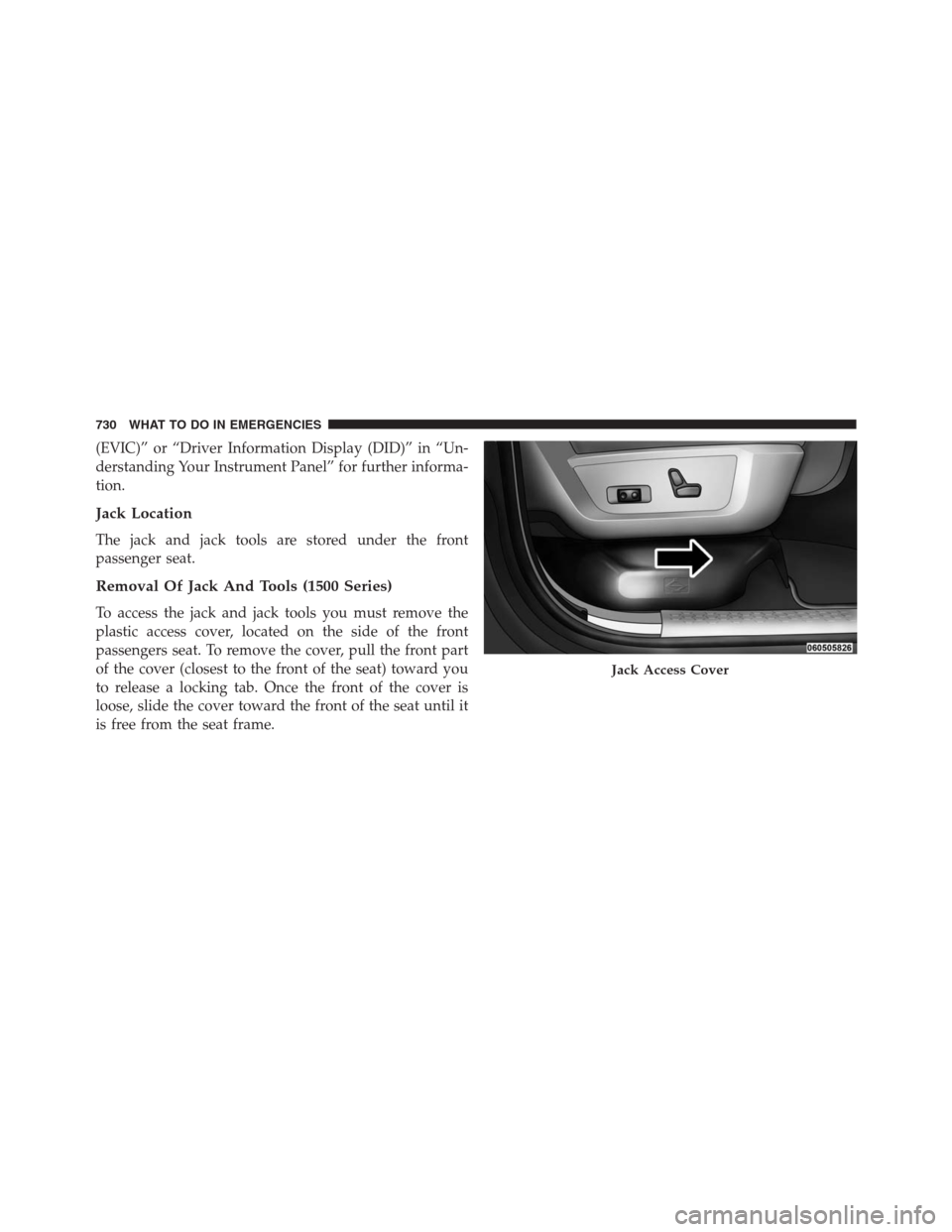
Jack Location
The jack and jack tools are stored under the front
passenger seat.
Removal Of Jack And Tools (1500 Series)
To access the jack and jack tools you must remove the
plastic access cover, located on the side of the front
passengers seat. To remove the cover, pull the front part
of the cover (closest to the front of the seat) toward you
to release a locking tab. Once the front of the cover is
loose, slide the cover toward the front of the seat until it
is free from the seat frame.
Jack Access Cover
730 WHAT TO DO IN EMERGENCIES
Page 740 of 916
WARNING!(Continued)
•Turn on the Hazard Warning flasher.
•Block the wheel diagonally opposite the wheel to
be raised.
•Set the parking brake firmly and set an automatic
transmission in PARK; a manual transmission in
REVERSE.
•Never start or run the engine with the vehicle on a
jack.
•Do not let anyone sit in the vehicle when it is on a
jack.
•Do not get under the vehicle when it is on a jack. If
you need to get under a raised vehicle, take it to a
service center where it can be raised on a lift.
•Only use the jack in the positions indicated and for
lifting this vehicle during a tire change.
(Continued)
WARNING!(Continued)
•If working on or near a roadway, be extremely
careful of motor traffic.
•To assure that spare tires, flat or inflated, are
securely stowed, spares must be stowed with the
valve stem facing the ground.
Jack Warning Label
738 WHAT TO DO IN EMERGENCIES
Page 744 of 916

Connect the jack tube extension and wheel wrench.
CAUTION!
Before raising the wheel off the ground, make sure
that the jack will not damage surrounding truck parts
and adjust the jack position as required.4. By rotating the lug wrench clockwise, raise the vehicle
until the wheel just clears the surface.
WARNING!
Raising the vehicle higher than necessary can make
the vehicle unstable and cause a collision. It could
slip off the jack and hurt someone near it. Raise the
vehicle only enough to remove the tire.
5. Remove the wheel nuts and pull the wheel off. Install
the spare wheel and wheel nuts with the cone shaped
end of the wheel nuts toward the wheel. To avoid the
risk of forcing the vehicle off the jack, do not fully
tighten the wheel nuts until the vehicle has been
lowered.
6. Finish tightening the lug nuts. Push down on the
wrench while at the end of the handle for increased
leverage. Tighten the lug nuts in a star pattern until
Rear Jacking Location
742 WHAT TO DO IN EMERGENCIES
Page 745 of 916

each nut has been tightened twice. For the correct lug
nut torque refer to “Torque Specifications” in this
section. If in doubt about the correct tightness, have
them checked with a torque wrench by you authorized
dealer or service station.
WARNING!
A loose tire or jack thrown forward in a collision or
hard stop could injure someone in the vehicle. Al-
ways stow the jack parts and the extra tire and wheel
in the places provided.
7. Install the wheel center cap and remove the wheel
blocks. Do not install chrome or aluminum wheel
center caps on the spare wheel. This may result in cap
damage.8. Lower the jack to its fully closed position. If the bottle
jack will not lower by turning the dial (thumbwheel)
by hand, it may be necessary to use the jack drive tube
in order to lower the jack. Stow the replaced tire, jack,
and tools as previously described.
9. Adjust the tire pressure when possible.
NOTE:Do not oil wheel studs. For chrome wheels, do
not substitute with chrome plated wheel nuts.
To Stow The Flat Or Spare
NOTE:Vehicles equipped with aluminum wheels can-
not be stored under the vehicle because the wheel
retainer will not fit through the wheel pilot hole. Secure
the flat tire in the bed of the truck.Have the flat tire
repaired or replaced immediately.
6
WHAT TO DO IN EMERGENCIES 743