2016 Peugeot 308 start
[x] Cancel search: startPage 86 of 398
84
308_en_Chap03_ergonomie-et-confort_ed02-2015
230 V / 50 Hz power socket
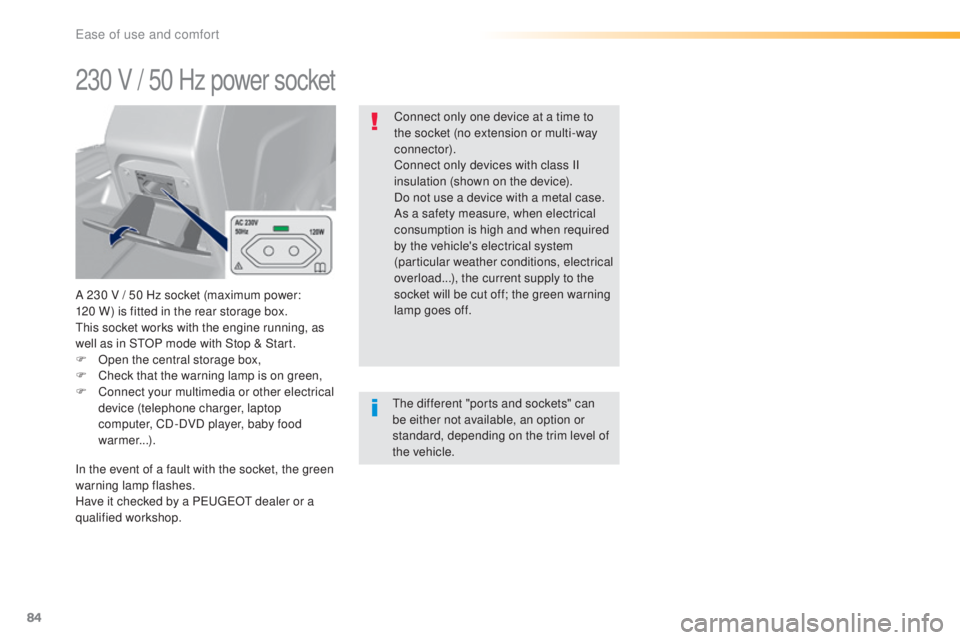
A 230 V / 50 Hz socket (maximum power:
120 W) is fitted in the rear storage box.
thi
s socket works with the engine running, as
well as in S
tOP m
ode with Stop & Start.
F
Op
en the central storage box,
F
Ch
eck that the warning lamp is on green,
F
Co
nnect your multimedia or other electrical
device (telephone charger, laptop
computer, CD-DVD player, baby food
warmer...).
In the event of a fault with the socket, the green
warning lamp flashes.
Have it checked by a P
eu
ge
Ot d
ealer or a
qualified workshop. Connect only one device at a time to
the socket (no extension or multi-way
connector).
Connect only devices with class II
insulation (shown on the device).
Do not use a device with a metal case.
As a safety measure, when electrical
consumption is high and when required
by the vehicle's electrical system
(particular weather conditions, electrical
overload...), the current supply to the
socket will be cut off; the green warning
lamp goes off.
the d
ifferent "ports and sockets" can
be either not available, an option or
standard, depending on the trim level of
the vehicle.
ease of use and comfort
Page 93 of 398
91
308_en_Chap03_ergonomie-et-confort_ed02-2015
In order for these systems to be fully effective, follow the operation and maintenance
guidelines below:
F
t
o ob
tain an even air distribution, take care not to obstruct the exterior air intake grilles
located at the base of the windscreen, the nozzles, the vents and the air outlets, as well
as the air extractor located in the boot.
F
Do n
ot cover the sunshine sensor, located on the dashboard; this is used for regulation
of the air conditioning system.
F
Op
erate the air conditioning system for at least 5 to 10 minutes, once or twice a month
to keep it in per fect working order.
F
e
ns
ure that the passenger compartment filter is in good condition and have the filter
elements replaced regularly.
We r
ecommend the use of a combined passenger compartment filter.
tha
nks to its
special active additive, it contributes to the purification of the air breathed by the
occupants and the cleanliness of the passenger compartment (reduction of allergic
symptoms, bad odours and greasy deposits).
F
t
o en
sure correct operation of the air conditioning system, you are also advised to have
it checked regularly as recommended in the warranty and maintenance record.
F
If t
he system does not produce cold air, switch it off and contact a P
eu
ge
Ot d
ealer or
a qualified workshop.
Recommendations for ventilation and air conditioning
If after an extended stop in sunshine,
the interior temperature is very high, first
ventilate the passenger compartment for
a few moments.
Put the air flow control at a setting high
enough to quickly change the air in the
passenger compartment.
the a
ir conditioning system does not
contain chlorine and does not present
any danger to the ozone layer.
the c
ondensation created by the air
conditioning results in a discharge
of water under the vehicle which is
perfectly normal.
When towing the maximum load on a steep gradient in high temperatures, switching off the
air conditioning increases the available engine power and so improves the towing ability.
Stop & Start
the heating and air conditioning
s ystems only work when the engine
is running.
to ma
intain a comfortable
temperature in the passenger
compartment, you can temporarily
deactivate the Stop & Start system (see
the corresponding section).
3
ease of use and comfort
Page 103 of 398
101
308_en_Chap03_ergonomie-et-confort_ed02-2015
Front demist - defrost
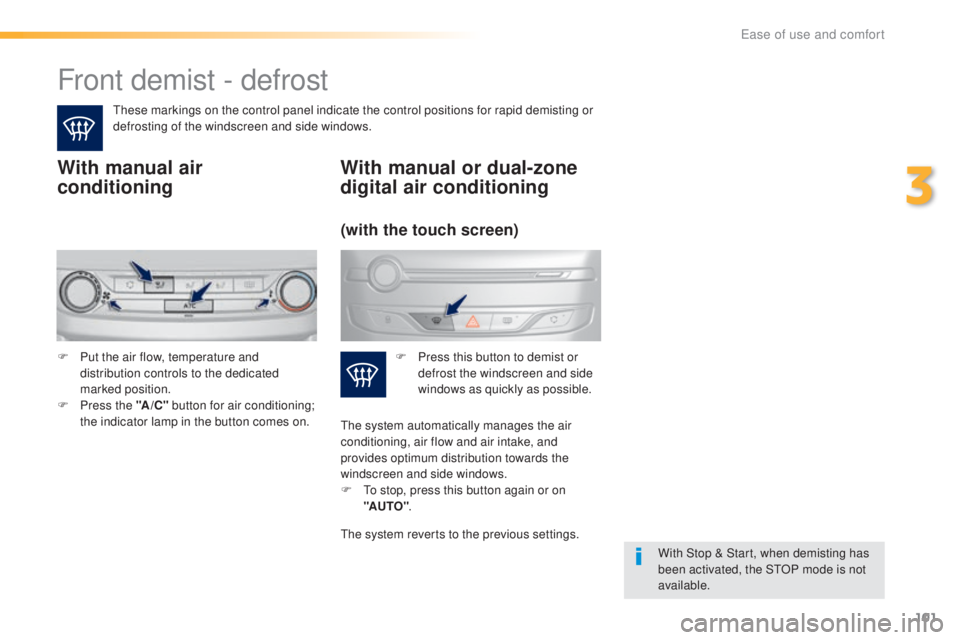
these markings on the control panel indicate the control positions for rapid demisting or
d efrosting of the windscreen and side windows.
With manual air
conditioning
With Stop & Start, when demisting has
been activated, the StOP m ode is not
available.
With manual or dual-zone
digital air conditioning
F Put the air flow, temperature and
d istribution controls to the dedicated
marked position.
F
Pr
ess the "A /C " button for air conditioning;
the indicator lamp in the button comes on. F Pr
ess this button to demist or
defrost the windscreen and side
windows as quickly as possible.
(with the touch screen)
the system automatically manages the air
c onditioning, air flow and air intake, and
provides optimum distribution towards the
windscreen and side windows.
F
t
o st
op, press this button again or on
"AUTO" .
the s
ystem reverts to the previous settings.
3
ease of use and comfort
Page 108 of 398
106
308_en_Chap04_eclairage-et-visibilite_ed02-2015
Mirrors
Adjustment
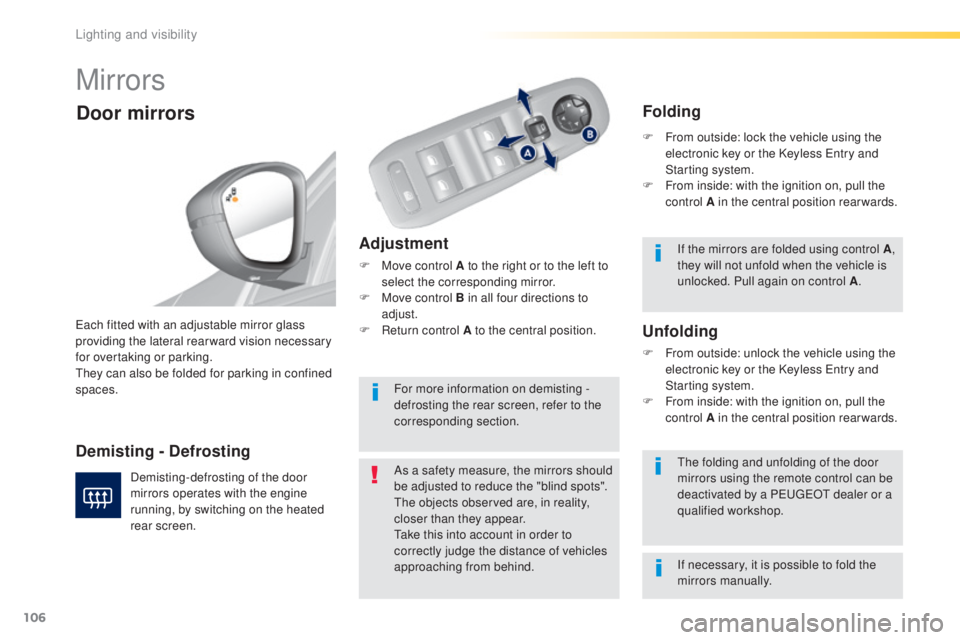
F Move control A to the right or to the left to
select the corresponding mirror.
F
Mov
e control B in all four directions to
adjust.
F
Re
turn control A to the central position.
eac
h fitted with an adjustable mirror glass
providing the lateral rear ward vision necessary
for overtaking or parking.
the
y can also be folded for parking in confined
spaces.
Demisting - Defrosting
Door mirrors
Demisting-defrosting of the door
mirrors operates with the engine
running, by switching on the heated
rear screen. As a safety measure, the mirrors should
be adjusted to reduce the "blind spots".
the o
bjects observed are, in reality,
closer than they appear.
tak
e this into account in order to
correctly judge the distance of vehicles
approaching from behind.the f olding and unfolding of the door
mirrors using the remote control can be
deactivated by a P
eu
ge
Ot d
ealer or a
qualified workshop.
Unfolding
F From outside: unlock the vehicle using the
e lectronic key or the Keyless ent ry and
Starting system.
F
Fr
om inside: with the ignition on, pull the
control A in the central position rearwards.
Folding
F From outside: lock the vehicle using the
e lectronic key or the Keyless ent ry and
Starting system.
F
Fr
om inside: with the ignition on, pull the
control A in the central position rearwards.
If the mirrors are folded using control A ,
they will not unfold when the vehicle is
unlocked. Pull again on control A .
For more information on demisting -
defrosting the rear screen, refer to the
corresponding section.
If necessary, it is possible to fold the
mirrors manually.
Lighting and visibility
Page 114 of 398
112
308_en_Chap04_eclairage-et-visibilite_ed02-2015
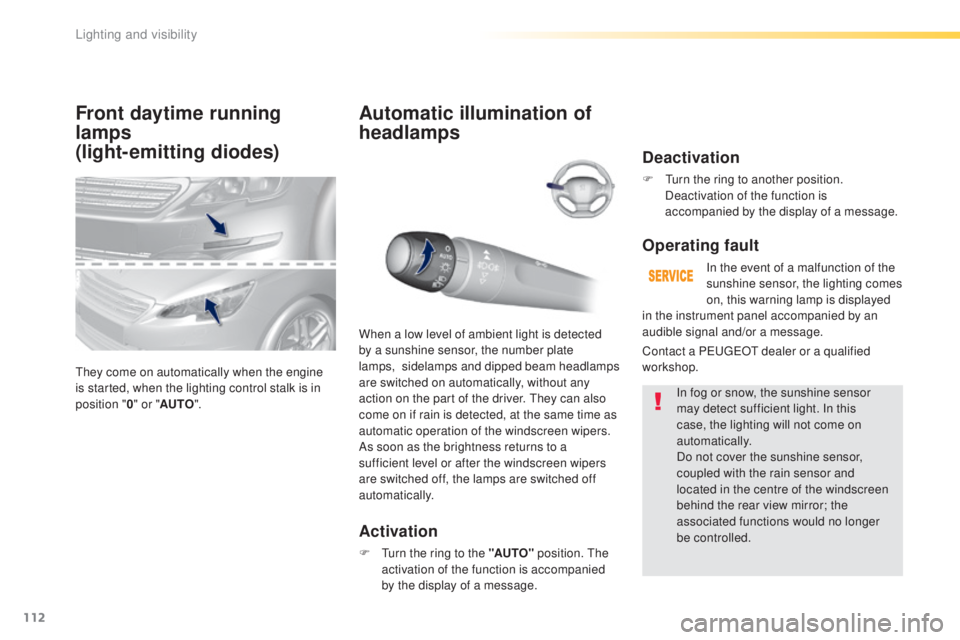
Front daytime running
lamps
(light-emitting diodes)
they come on automatically when the engine
i s started, when the lighting control stalk is in
position " 0" or " AUTO ".
Automatic illumination of
headlamps
Activation
F turn the ring to the "AUTO" p osition. the
a ctivation of the function is accompanied
by the display of a message.
When a low level of ambient light is detected
by a sunshine sensor, the number plate
lamps,
si
delamps and dipped beam headlamps
are switched on automatically, without any
action on the part of the driver.
the
y can also
come on if rain is detected, at the same time as
automatic operation of the windscreen wipers.
As soon as the brightness returns to a
sufficient level or after the windscreen wipers
are switched off, the lamps are switched off
automatically.
Deactivation
F turn the ring to another position.
D eactivation of the function is
accompanied by the display of a message.
Operating fault
In the event of a malfunction of the
sunshine sensor, the lighting comes
on, this warning lamp is displayed
In fog or snow, the sunshine sensor
may detect sufficient light. In this
case, the lighting will not come on
automatically.
Do not cover the sunshine sensor,
coupled with the rain sensor and
located in the centre of the windscreen
behind the rear view mirror; the
associated functions would no longer
be controlled.
Contact a P
eu
ge
Ot d
ealer or a qualified
workshop. in the instrument panel accompanied by an
audible signal and/or a message.
Lighting and visibility
Page 115 of 398
113
308_en_Chap04_eclairage-et-visibilite_ed02-2015
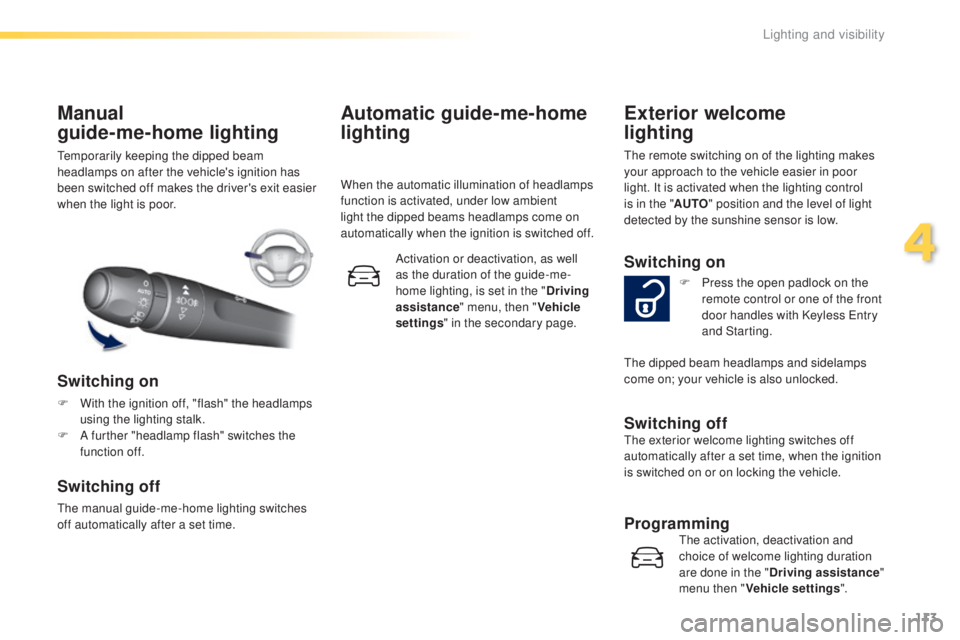
temporarily keeping the dipped beam
h eadlamps on after the vehicle's ignition has
been switched off makes the driver's exit easier
when the light is poor.
Manual
guide-me-home lighting
Switching on
F With the ignition off, "flash" the headlamps
us ing the lighting stalk.
F
A fu
rther "headlamp flash" switches the
function off.
Switching off
the manual guide-me-home lighting switches
o ff automatically after a set time.
Automatic guide-me-home
lighting
When the automatic illumination of headlamps
function is activated, under low ambient
light the dipped beams headlamps come on
automatically when the ignition is switched off.
Activation or deactivation, as well
as the duration of the guide-me-
home lighting, is set in the " Driving
assistance " menu, then " Vehicle
settings " in the secondary page.
Exterior welcome
lighting
the remote switching on of the lighting makes
y our approach to the vehicle easier in poor
light. It is activated when the lighting control
is in the " AUTO" position and the level of light
detected by the sunshine sensor is low.
Switching on
F Press the open padlock on the
r emote control or one of the front
door handles with Keyless
ent
ry
and Starting.
Switching offthe exterior welcome lighting switches off
a utomatically after a set time, when the ignition
is switched on or on locking the vehicle.
Programmingthe activation, deactivation and
c hoice of welcome lighting duration
are done in the " Driving assistance "
menu then " Vehicle settings ".
the
dipped beam headlamps and sidelamps
come on; your vehicle is also unlocked.
4
Lighting and visibility
Page 124 of 398
122
308_en_Chap05_securite_ed02-2015
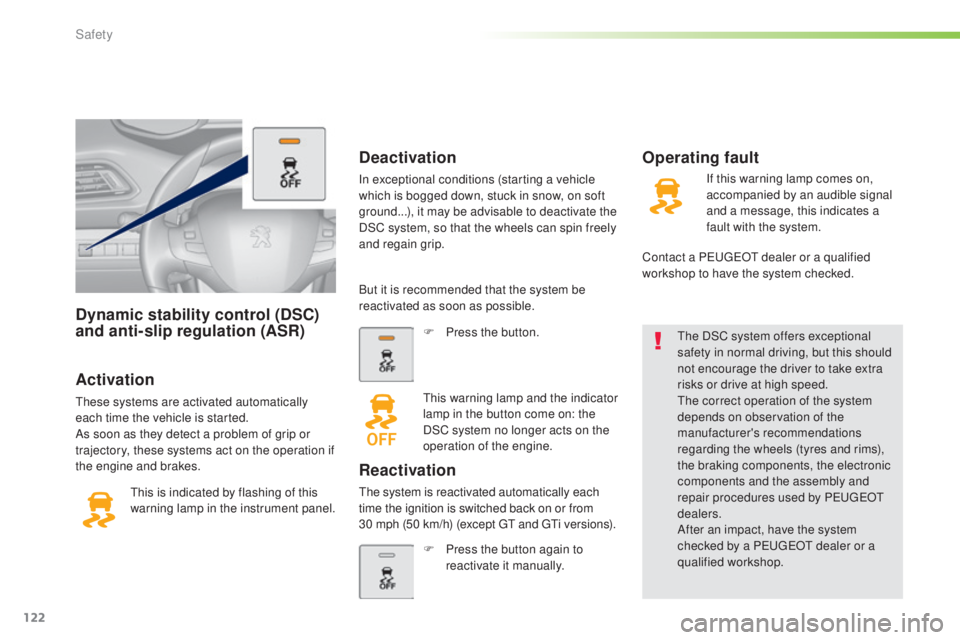
Dynamic stability control (DSC)
and anti-slip regulation (ASR)
Activation
these systems are activated automatically
e ach time the vehicle is started.
As soon as they detect a problem of grip or
trajectory, these systems act on the operation if
the engine and brakes.
thi
s is indicated by flashing of this
warning lamp in the instrument panel.
the D
SC system offers exceptional
safety in normal driving, but this should
not encourage the driver to take extra
risks or drive at high speed.the c orrect operation of the system
depends on observation of the
manufacturer's recommendations
regarding the wheels (tyres and rims),
the braking components, the electronic
components and the assembly and
repair procedures used by P
eu
ge
Ot
d
ealers.
After an impact, have the system
checked by a P
eu
ge
Ot d
ealer or a
qualified workshop.
Deactivation
In exceptional conditions (starting a vehicle
which is bogged down, stuck in snow, on soft
ground...), it may be advisable to deactivate the
DSC system, so that the wheels can spin freely
and regain grip.
Operating fault
But it is recommended that the system be
reactivated as soon as possible.
F
Pr
ess the button.
thi
s warning lamp and the indicator
lamp in the button come on: the
DSC system no longer acts on the
operation of the engine.
Reactivation
the system is reactivated automatically each
t ime the ignition is switched back on or from
30 mph (50 km/h) (except
g
t
a
nd
g
t
i ve
rsions).
F
Pr
ess the button again to
reactivate it manually. If this warning lamp comes on,
accompanied by an audible signal
and a message, this indicates a
fault with the system.
Contact a P
eu
ge
Ot d
ealer or a qualified
workshop to have the system checked.
Safety
Page 148 of 398
146
308_en_Chap06_conduite_ed02-2015
A few driving recommendations
Observe the driving regulations at all times and
remain vigilant whatever the traffic conditions.
Pay close attention to the traffic and keep your
hands on the wheel so that you are ready to
react at any time to any eventuality.
On a long journey, a break every two hours is
strongly recommended.
In difficult weather, drive smoothly, anticipate
the need to brake and increase the distance
from other vehicles.Never drive with the parking brake
applied - Risk of overheating and
damage to the braking system!
Do not park or run the engine when
stationary in areas where inflammable
substances and materials (dry grass,
dead leaves...) might come into contact
with the hot exhaust system - Risk of
fire!
Never leave a vehicle unsupervised
with the engine running. If you have
to leave your vehicle with the engine
running, apply the parking brake
and put the gearbox into neutral or
position
N
or P, depending on the type
of gearbox.
Driving on flooded
roads
We strongly advise against driving on flooded
roads, as this could cause serious damage
to the engine or gearbox, as well as to the
electrical systems of your vehicle.
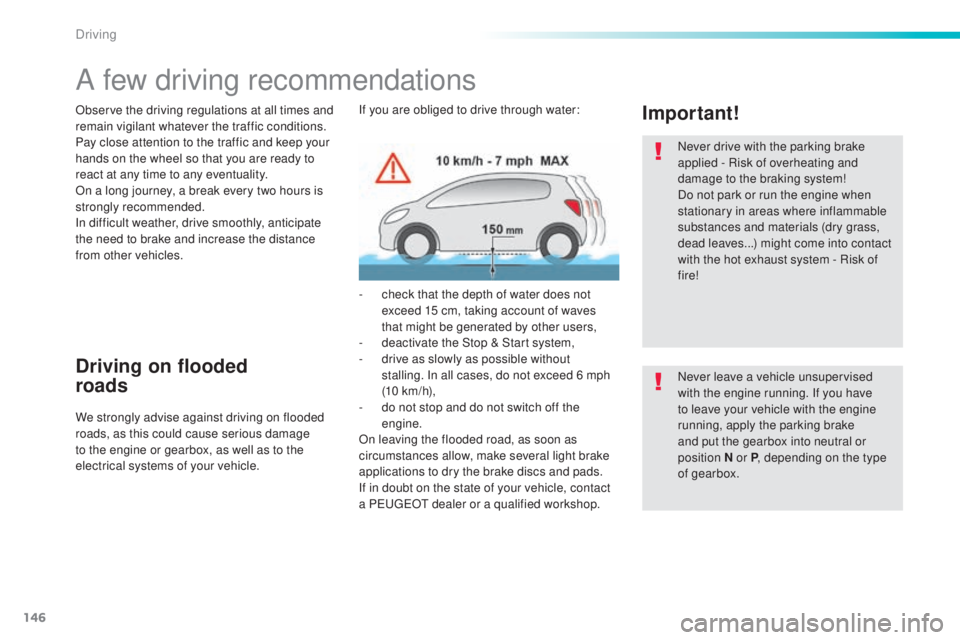
Important!If you are obliged to drive through water:
-
ch
eck that the depth of water does not
exceed 15 cm, taking account of waves
that might be generated by other users,
-
de
activate the Stop & Start system,
-
dr
ive as slowly as possible without
stalling. In all cases, do not exceed 6 mph
(10
k
m/h),
-
do n
ot stop and do not switch off the
engine.
On leaving the flooded road, as soon as
circumstances allow, make several light brake
applications to dry the brake discs and pads.
If in doubt on the state of your vehicle, contact
a P
eu
ge
Ot d
ealer or a qualified workshop.
Driving