Page 229 of 398
227
308_en_Chap07_info-pratiques_ed02-2015
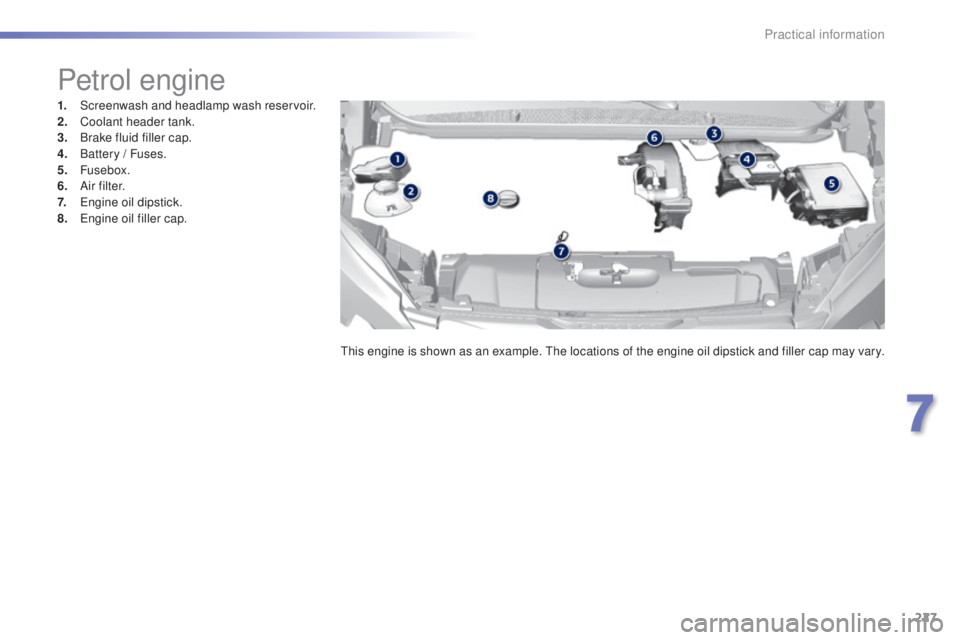
Petrol engine
1. Screenwash and headlamp wash reservoir.
2. Co olant header tank.
3.
Br
ake fluid filler cap.
4.
Ba
ttery / Fuses.
5.
F
usebox.
6.
A i
r f i l t e r.
7.
engin
e oil dipstick.
8.
eng
ine oil filler cap.
thi
s engine is shown as an example.
the l
ocations of the engine oil dipstick and filler cap may vary.
7
Practical information
Page 230 of 398
228
308_en_Chap07_info-pratiques_ed02-2015
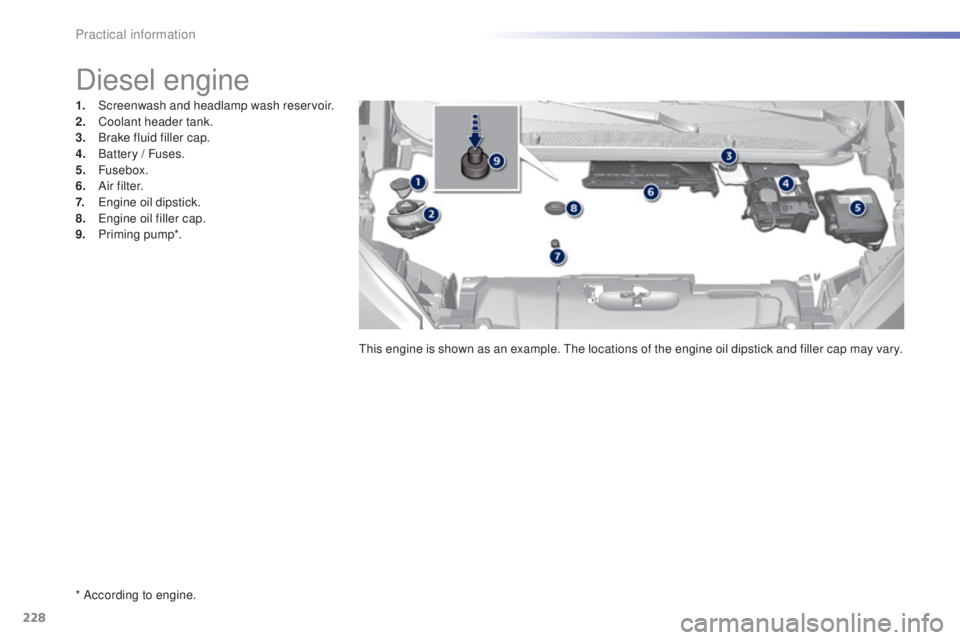
* According to engine.
Diesel engine
1. Screenwash and headlamp wash reservoir.
2. Co olant header tank.
3.
Br
ake fluid filler cap.
4.
Ba
ttery / Fuses.
5.
F
usebox.
6.
A i
r f i l t e r.
7.
engin
e oil dipstick.
8.
eng
ine oil filler cap.
9.
Pr
iming pump*.
thi
s engine is shown as an example.
the l
ocations of the engine oil dipstick and filler cap may vary.
Practical information
Page 231 of 398

229
308_en_Chap07_info-pratiques_ed02-2015
Checking levels
take care when working under the bonnet, as certain areas of the engine may be extremely hot (risk of burns) and the cooling fan could start at
a ny time (even with the ignition off).
Engine oil level
the check is carried out either when
t he ignition is switched on using the
oil level indicator in the instrument
panel for vehicles so equipped, or
using the dipstick.Checking using the dipstick
F Locate the dipstick in the engine
c ompartment of your vehicle.
For more information on the petrol or Diesel
engine, refer to the corresponding section.
F
t
ak
e the dipstick by its coloured grip and
remove it completely.
F
Wi
pe the end of the dipstick using a clean
non-fluffy cloth.
F
Re
fit the dipstick and push fully down, then
pull it out again to make the visual check:
the correct level is between the marks A
and B .
Check all of these levels regularly, in line with the manufacturer's service schedule.
top t
hem up if necessary, unless other wise indicated.
If a level drops significantly, have the corresponding system checked by a P
eu
ge
Ot d
ealer or a qualified workshop.
A = MA X
to en
sure that the reading is correct, your
vehicle must be parked on a level sur face
with the engine having been off for more than
30
m
inutes.
It is normal to top up the oil level between
two services (or oil changes). P
eu
ge
Ot
r
ecommends that you check the level, and top
up if necessary, every 3 000 miles (5 000 kms). B = MIN
If you find that the level is above the A mark or
below the B mark, do not star t the engine .
-
If t
he level is above the MAX mark (risk
of damage to the engine), contact a
P
eu
ge
Ot d
ealer or a qualified workshop.
-
If t
he level is below the MIN mark, you
must top up the engine oil.
7
Practical information
Page 232 of 398

230
308_en_Chap07_info-pratiques_ed02-2015
Oil grade
Before topping-up the oil or changing the oil,
check that the oil is the correct grade for your
engine and conforms to the manufacturer's
recommendations.
Topping-up the engine oil level
F Locate the oil filler cap in the engine
compartment of your vehicle.
For more information on the petrol or Diesel
engine, refer to the corresponding section.
F
u
ns
crew the oil filler cap to reveal the filler
aperture.
F
Ad
d oil in small quantities, avoiding any
spills on engine components (risk of fire).
F
Wa
it a few minutes before checking the
level again using the dipstick.
F
Ad
d more oil if necessary.
F
Af
ter checking the level, carefully refit the
oil filler cap and the dipstick in its tube. After topping-up the oil, the check when
switching on the ignition with the oil
level indicator in the instrument panel
is not valid during the 30 minutes after
topping up.
Engine oil change
Refer to the manufacturer's service schedule
for details of the interval for this operation.
In order to maintain the reliability of the engine
and emission control system, never use
additives in the engine oil.
Practical information
Page 234 of 398
232
308_en_Chap07_info-pratiques_ed02-2015
Avoid prolonged contact of used oil or
fluids with the skin.
Most of these fluids are harmful to
health or indeed very corrosive.
Do not discard used oil or fluids into
sewers or onto the ground.
tak
e used oil to a P
eu
ge
Ot d
ealer or
a qualified workshop (France) or to an
authorised waste disposal site.
Used products
To p p i n g u p
this additive must be topped up by a
Peu geOt d ealer or a qualified workshop
without delay.
Diesel additive level (Diesel
engine with particle filter)
A low additive level is indicated by
illumination of this warning lamp,
accompanied by an audible warning
and a message in the instrument
panel screen.
Practical information
Page 235 of 398

233
308_en_Chap07_info-pratiques_ed02-2015
Checks
12 V battery
the battery does not require any maintenance.
H owever, check that the terminals are clean
and correctly tightened, particularly in summer
and winter.Refer to the manufacturer's
service schedule for details of the
replacement intervals for these
components.
Air filter and passenger compartment filter
Replace the oil filter each time the
engine oil is changed.
Refer to the manufacturer's
service schedule for details of
the replacement interval for this
component.Oil filterthe presence of this label, in particular with
t he Stop & Start system, indicates the use of
a specific 12 V lead-acid battery with special
technology and specification.
the
involvement
of a P
eu
ge
Ot d
ealer or a qualified workshop
is essential when replacing or disconnecting
the battery.
Particle filter (Diesel)
the start of saturation of the particle
f ilter is indicated by the temporary
illumination of this warning lamp
accompanied by a message in the
multifunction screen.
As soon as the traffic conditions permit,
regenerate the filter by driving at a
speed of at least 40 mph (60 km/h) until
the warning lamp goes off.
If the warning lamp stays on, this
indicates a low additive level.
For more information on checking
levels, refer to the corresponding
section.
On a new vehicle, the first particle
filter regeneration operations may be
accompanied by a "burning" smell,
which is per fectly normal.
Following prolonged operation of the
vehicle at very low speed or at idle,
you may, in exceptional circumstances,
notice the emission of water vapour at
the exhaust on acceleration.
thi
s does
not affect the behaviour of the vehicle
or the environment.
unl
ess otherwise indicated, check these components in accordance with the manufacturer's
service schedule and according to your engine.
Other wise, have them checked by a Peu
geOt d
ealer or a qualified workshop.
When carrying out work on the battery, refer
to the "12 V battery" section for details of the
precautions to be taken before disconnecting
the battery and following its reconnection. Depending on the environment (e.g. dusty
atmosphere) and the use of the vehicle (e.g.
city driving), replace them twice as often if
necessary
.
A clogged passenger compartment filter may
have an adverse effect on the per formance
of the air conditioning system and generate
undesirable odours.
7
Practical information
Page 248 of 398
246
308_en_Chap08_en-cas-de-panne_ed02-2015
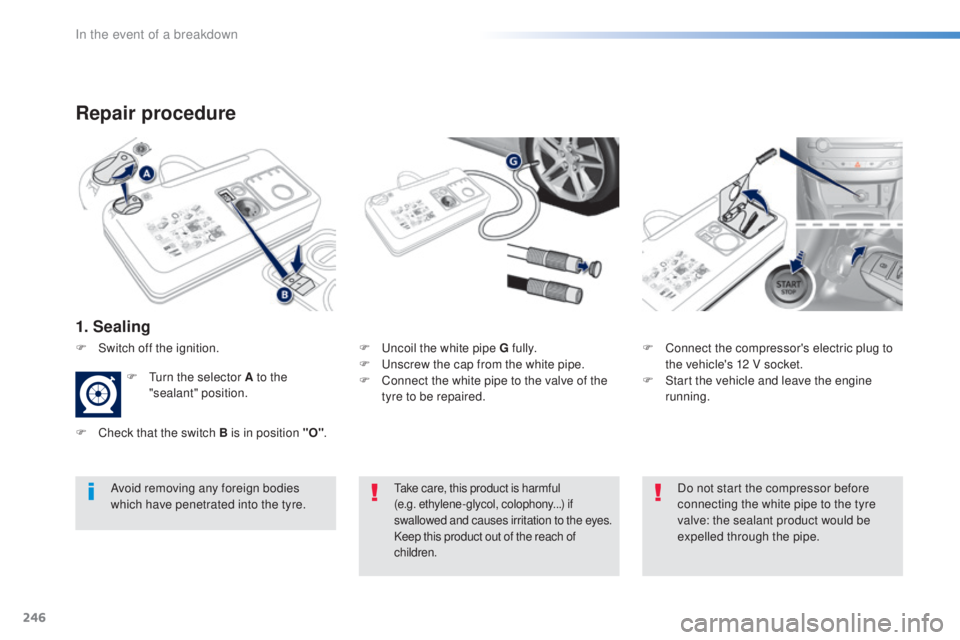
Repair procedure
1. Sealing
F uncoil the white pipe G fully.
F uns crew the cap from the white pipe.
F
Co
nnect the white pipe to the valve of the
tyre to be repaired. F Co
nnect the compressor's electric plug to
the vehicle's 12 V socket.
F
St
art the vehicle and leave the engine
running.
take care, this product is harmful
( e.g. e thylene-glycol, colophony...) if
swallowed and causes irritation to the eyes.
Keep this product out of the reach of
children.Avoid removing any foreign bodies
which have penetrated into the tyre. Do not start the compressor before
connecting the white pipe to the tyre
valve: the sealant product would be
expelled through the pipe.
F
Swi
tch off the ignition.
F
t
ur
n the selector A to the
"sealant" position.
F
Ch
eck that the switch B is in position "O"
.
In the event of a breakdown
Page 251 of 398
249
308_en_Chap08_en-cas-de-panne_ed02-2015
Checking tyre pressures /
inflating accessories
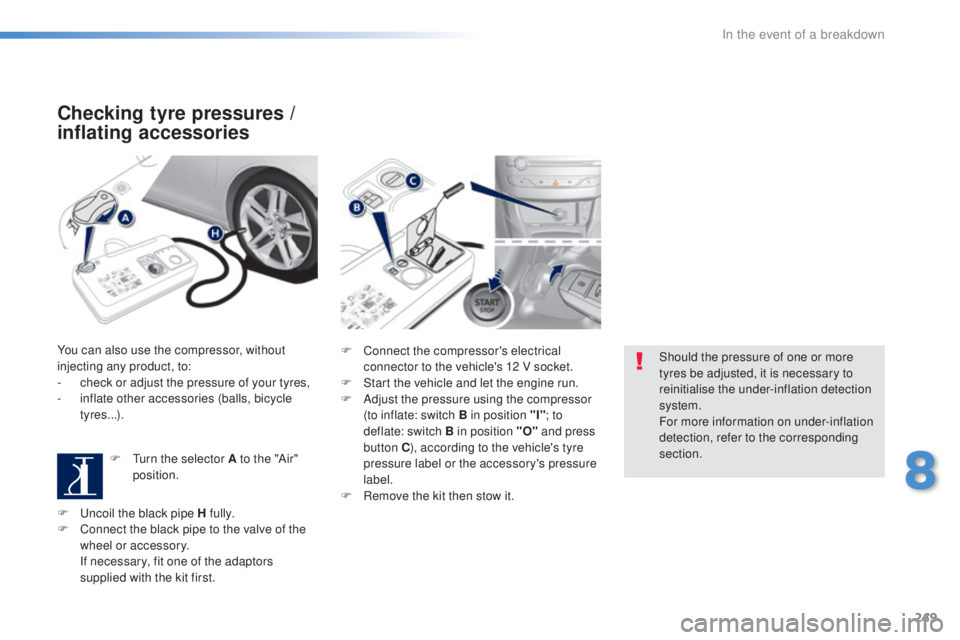
You can also use the compressor, without
injecting any product, to:
-
ch
eck or adjust the pressure of your tyres,
-
in
flate other accessories (balls, bicycle
tyres...).
F
t
ur
n the selector A to the "Air"
position. F Con
nect the compressor's electrical
connector to the vehicle's 12 V socket.
F
St
art the vehicle and let the engine run.
F
Ad
just the pressure using the compressor
(to inflate: switch B in position "I" ; to
deflate: switch B in position "O" and press
button C ), according to the vehicle's tyre
pressure label or the accessory's pressure
label.
F
Re
move the kit then stow it.Should the pressure of one or more
tyres be adjusted, it is necessary to
reinitialise the under-inflation detection
system.
For more information on under-inflation
detection, refer to the corresponding
section.
F
u
nc
oil the black pipe H fully.
F
Co
nnect the black pipe to the valve of the
wheel or accessory.
If n
ecessary, fit one of the adaptors
supplied with the kit first.
8
In the event of a breakdown