2016 PEUGEOT 3008 towing
[x] Cancel search: towingPage 144 of 344
142
3008_en_Chap08_conduite_ed01-2015
Automatic application,
engine off
With the vehicle stationary, the parking brake
is automatically applied when the engine is
switched off.
Maximum application is essential:
-
i
n the case of a vehicle towing a caravan
or a trailer, if the automatic functions are
activated but you are applying the parking
brake manually,
-
w
hen the gradient you are parked on is
variable in its effect (e.g. on a ferry, in a
lorry, during towing). -
i
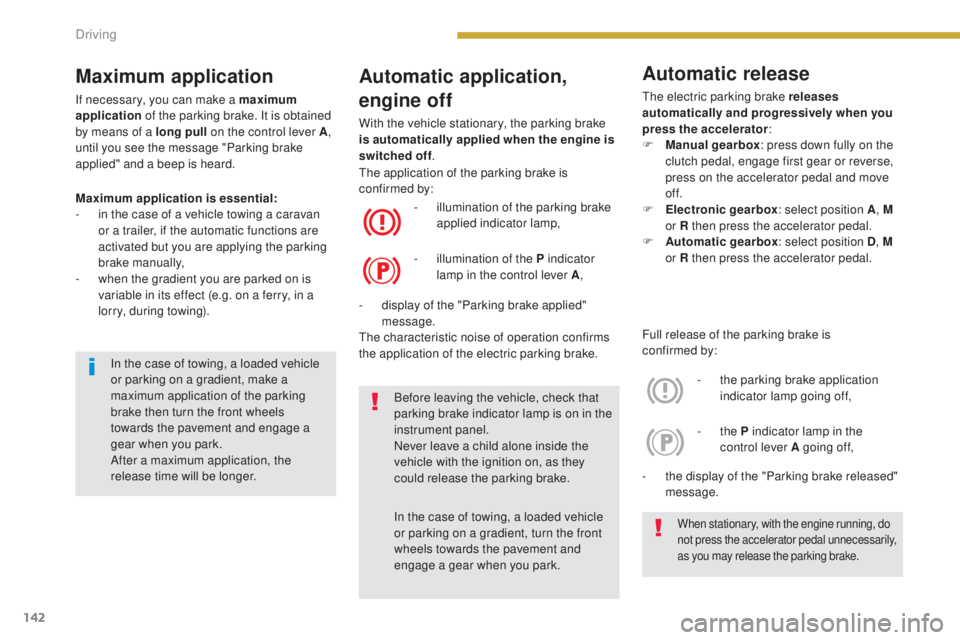
llumination of the parking brake
applied indicator lamp,
-
d
isplay of the "Parking brake applied"
message.
The characteristic noise of operation confirms
the application of the electric parking brake. The application of the parking brake is
confirmed by:
-
i
llumination of the P indicator
lamp in the control lever A ,
Before leaving the vehicle, check that
parking brake indicator lamp is on in the
instrument panel.
Never leave a child alone inside the
vehicle with the ignition on, as they
could release the parking brake.
In the case of towing, a loaded vehicle
or parking on a gradient, turn the front
wheels towards the pavement and
engage a gear when you park.
When stationary, with the engine running, do
not press the accelerator pedal unnecessarily,
as you may release the parking brake.
In the case of towing, a loaded vehicle
or parking on a gradient, make a
maximum application of the parking
brake then turn the front wheels
towards the pavement and engage a
gear when you park.
After a maximum application, the
release time will be longer.
Maximum application
If necessary, you can make a maximum
application of the parking brake. It is obtained
by means of a long pull on the control lever
A,
until you see the message "Parking brake
applied" and a beep is heard.
Full release of the parking brake is
confirmed
by:
-
t
he parking brake application
indicator lamp going off,
-
t
he display of the "Parking brake released"
message. -
the P indicator lamp in the
control lever A going of f,
Automatic release
The electric parking brake releases
automatically and progressively when you
press the accelerator :
F
M
anual gearbox : press down fully on the
clutch pedal, engage first gear or reverse,
press on the accelerator pedal and move
of f.
F
E
lectronic gearbox : select position A, M
or R then press the accelerator pedal.
F
A
utomatic gearbox : select position D, M
or R then press the accelerator pedal.
Driving
Page 204 of 344
202
3008_en_Chap10_infos-pratiques_ed01-2015
List of tools
All of these tools are specific to your vehicle.
Do not use them for other purposes.
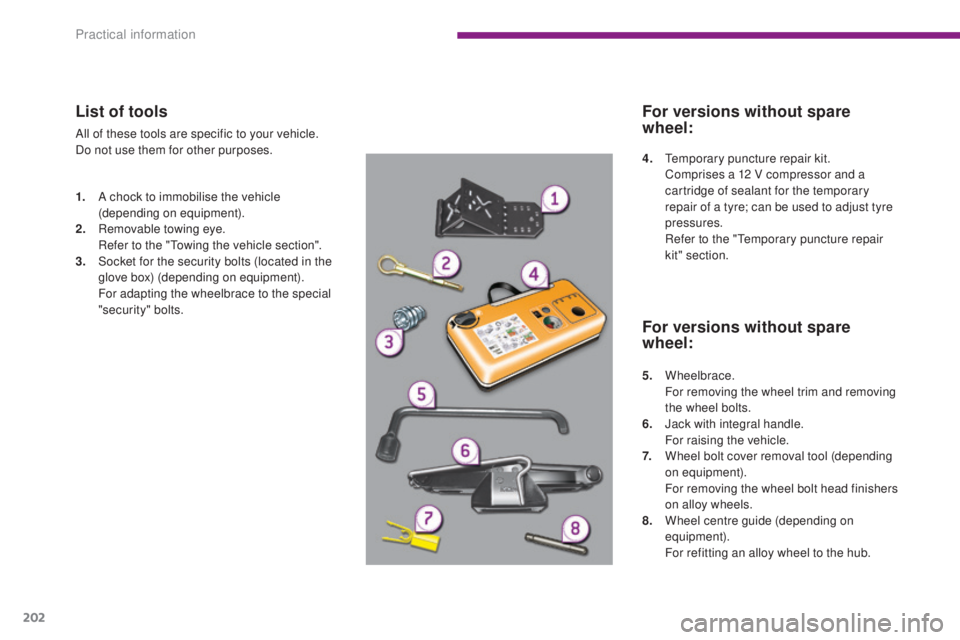
1.
A c
hock to immobilise the vehicle
(depending on equipment).
2.
R
emovable towing eye.
R
efer to the "Towing the vehicle section".
3.
S
ocket for the security bolts (located in the
glove box) (depending on equipment).
F
or adapting the wheelbrace to the special
"security" bolts. 4.
T
emporary puncture repair kit.
C
omprises a 12 V compressor and a
cartridge of sealant for the temporary
repair of a tyre; can be used to adjust tyre
pressures.
R
efer to the "Temporary puncture repair
kit" section.
5.
Wheelbrace.
F
or removing the wheel trim and removing
the wheel bolts.
6.
J
ack with integral handle.
F
or raising the vehicle.
7.
W
heel bolt cover removal tool (depending
on equipment).
F
or removing the wheel bolt head finishers
on alloy wheels.
8.
W
heel centre guide (depending on
equipment).
F
or refitting an alloy wheel to the hub.
For versions without spare
wheel:
For versions without spare
wheel:
Practical information
Page 234 of 344
232
3008_en_Chap10_infos-pratiques_ed01-2015
Changing a wiper blade
Removing
F Raise the corresponding wiper arm.
F U nclip the wiper blade and remove it.
Fitting
F Put the corresponding new wiper blade in place and clip it.
F
F
old down the wiper arm carefully.
Before removing a front
wiper blade
F Within one minute after switching off the ignition, operate the wiper stalk to
position the wiper blades vertically on the
windscreen.
After fitting a front wiper
blade
F Switch on the ignition.
F O perate the wiper stalk again to park the
wiper blades.
Towing the vehicle
Access to the tools
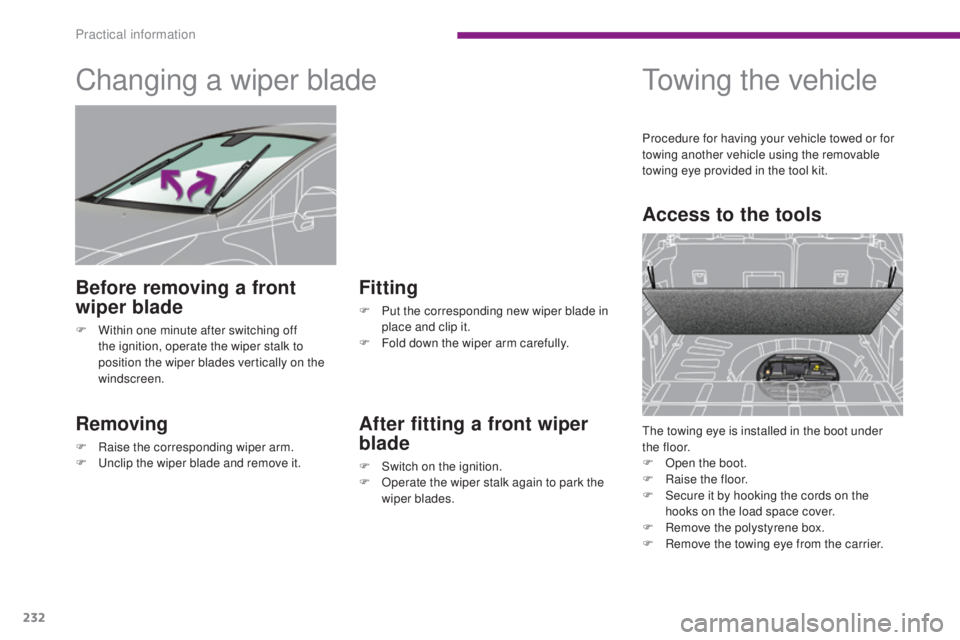
The towing eye is installed in the boot under
t h e f l o o r.
F
O
pen the boot.
F
Ra
ise the floor.
F
S
ecure it by hooking the cords on the
hooks on the load space cover.
F
R
emove the polystyrene box.
F
R
emove the towing eye from the carrier.
Procedure for having your vehicle towed or for
towing another vehicle using the removable
towing eye provided in the tool kit.
Practical information
Page 235 of 344
233
3008_en_Chap10_infos-pratiques_ed01-2015
Towing your vehicle
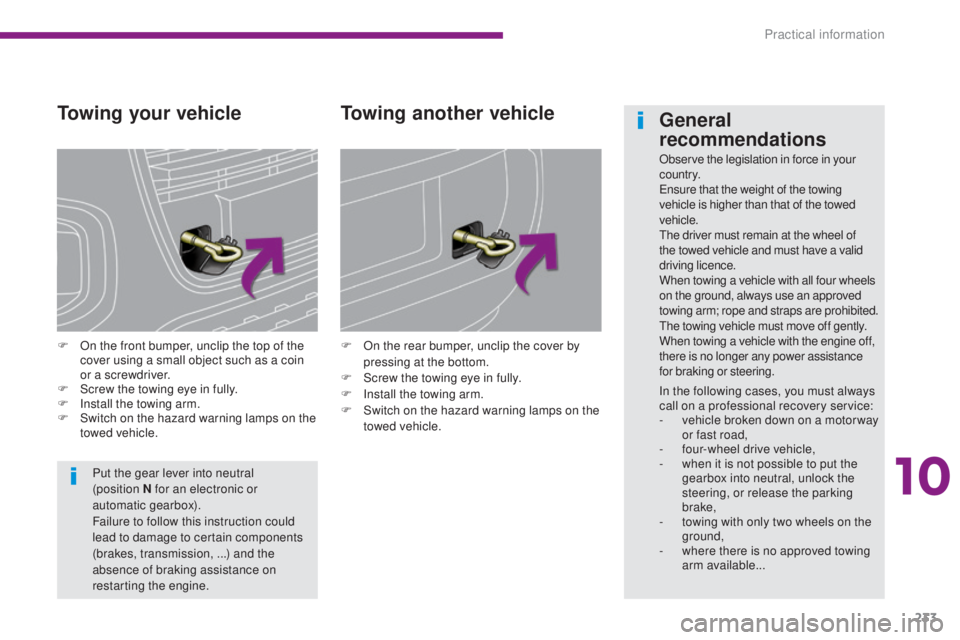
F On the front bumper, unclip the top of the cover using a small object such as a coin
or a screwdriver.
F
S
crew the towing eye in fully.
F
I
nstall the towing arm.
F
S
witch on the hazard warning lamps on the
towed vehicle. F
O n the rear bumper, unclip the cover by
pressing at the bottom.
F
S
crew the towing eye in fully.
F
I
nstall the towing arm.
F
S
witch on the hazard warning lamps on the
towed vehicle.
Towing another vehicle
Put the gear lever into neutral
(position N for an electronic or
automatic gearbox).
Failure to follow this instruction could
lead to damage to certain components
(brakes, transmission, ...) and the
absence of braking assistance on
restarting the engine.
General
recommendations
Observe the legislation in force in your
c o unt r y.
Ensure that the weight of the towing
vehicle is higher than that of the towed
vehicle.
The driver must remain at the wheel of
the towed vehicle and must have a valid
driving licence.
When towing a vehicle with all four wheels
on the ground, always use an approved
towing arm; rope and straps are prohibited.
The towing vehicle must move off gently.
When towing a vehicle with the engine off,
there is no longer any power assistance
for braking or steering.
In the following cases, you must always
call on a professional recovery service:
-
v
ehicle broken down on a motor way
or fast road,
-
f
our-wheel drive vehicle,
-
w
hen it is not possible to put the
gearbox into neutral, unlock the
steering, or release the parking
brake,
-
t
owing with only two wheels on the
ground,
-
w
here there is no approved towing
arm available...
10
Practical information
Page 238 of 344
236
3008_en_Chap10_infos-pratiques_ed01-2015
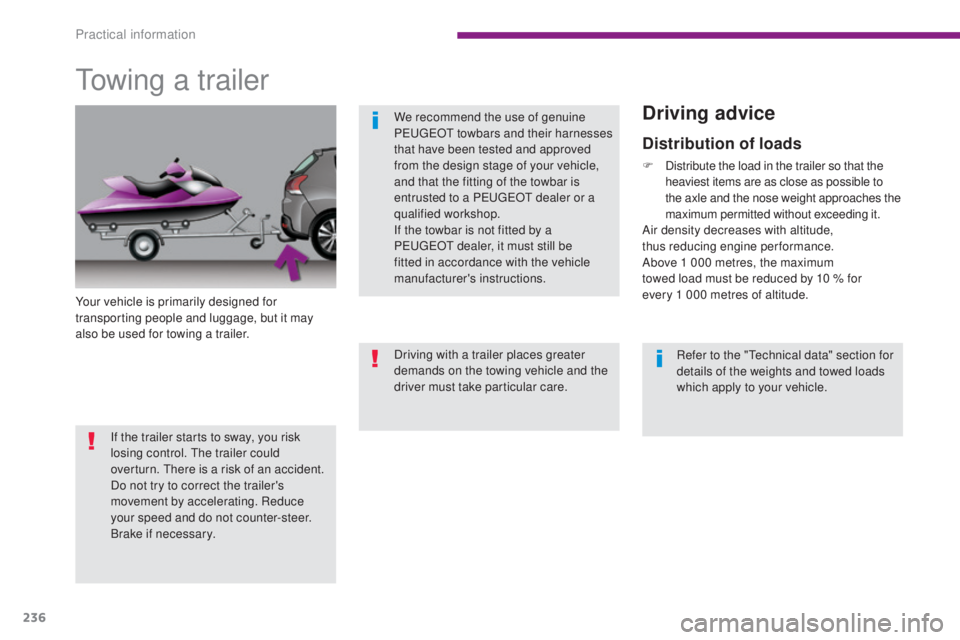
Towing a trailer
Your vehicle is primarily designed for
transporting people and luggage, but it may
also be used for towing a trailer.Refer to the "Technical data" section for
details of the weights and towed loads
which apply to your vehicle.
We recommend the use of genuine
PEUGEOT towbars and their harnesses
that have been tested and approved
from the design stage of your vehicle,
and that the fitting of the towbar is
entrusted to a PEUGEOT dealer or a
qualified workshop.
If the towbar is not fitted by a
PEUGEOT dealer, it must still be
fitted in accordance with the vehicle
manufacturer's instructions.
Driving with a trailer places greater
demands on the towing vehicle and the
driver must take particular care.
If the trailer starts to sway, you risk
losing control. The trailer could
overturn. There is a risk of an accident.
Do not try to correct the trailer's
movement by accelerating. Reduce
your speed and do not counter-steer.
Brake if necessary.
Driving advice
Distribution of loads
F Distribute the load in the trailer so that the heaviest items are as close as possible to
the axle and the nose weight approaches the
maximum permitted without exceeding it.
Air density decreases with altitude,
thus reducing engine performance.
Above
1 000 metres, the maximum
towed load must be reduced by 10
% for
every
1 000 metres of altitude.
Practical information
Page 239 of 344
237
3008_en_Chap10_infos-pratiques_ed01-2015
Side wind
F Take into account the increased sensitivity to side wind.
Cooling
Towing a trailer on a slope increases the
temperature of the coolant.
As the fan is electrically controlled, its cooling
capacity is not dependent on the engine speed.
F
T
o lower the engine speed, reduce your
speed.
The maximum towed load on a long incline
depends on the gradient and the ambient
temperature.
In all cases, keep a check on the coolant
temperature.
Braking
Towing a trailer increases the braking distance.
To avoid overheating of the brakes on a long
mountain type of descent, the use of engine
braking is recommended.
Ty r e s
F Check the tyre pressures of the towing vehicle and of the trailer, observing the
recommended pressures.
Lighting
F Check the electrical lighting and signalling on the trailer.
The rear parking sensors will be
deactivated automatically if a genuine
PEUGEOT towbar is used.
F
I
f the warning lamp and the STOP
warning lamp come on, stop the
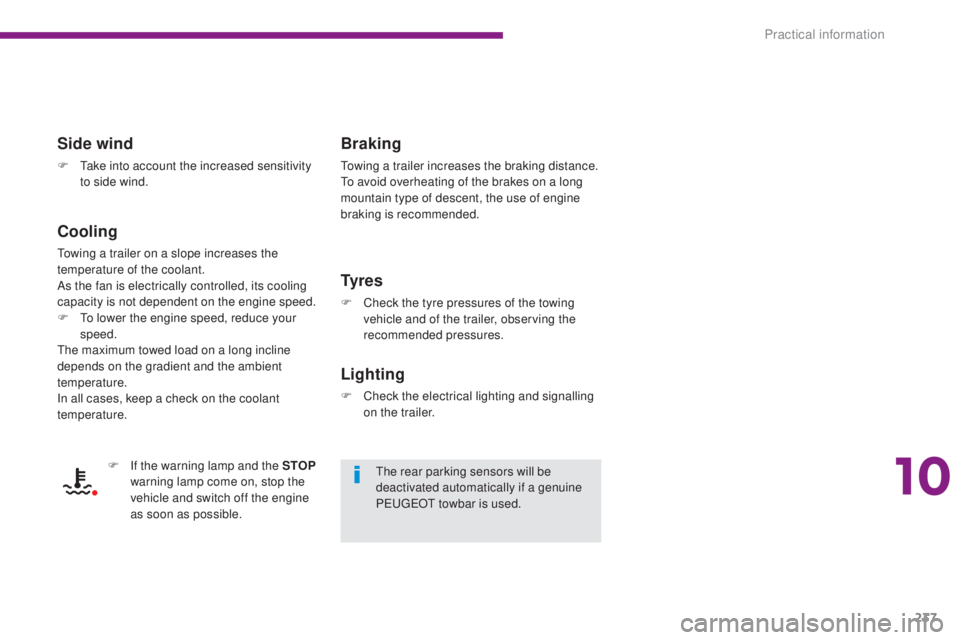
vehicle and switch off the engine
as soon as possible.
10
Practical information
Page 241 of 344
239
3008_en_Chap10_infos-pratiques_ed01-2015
Very cold climate screen
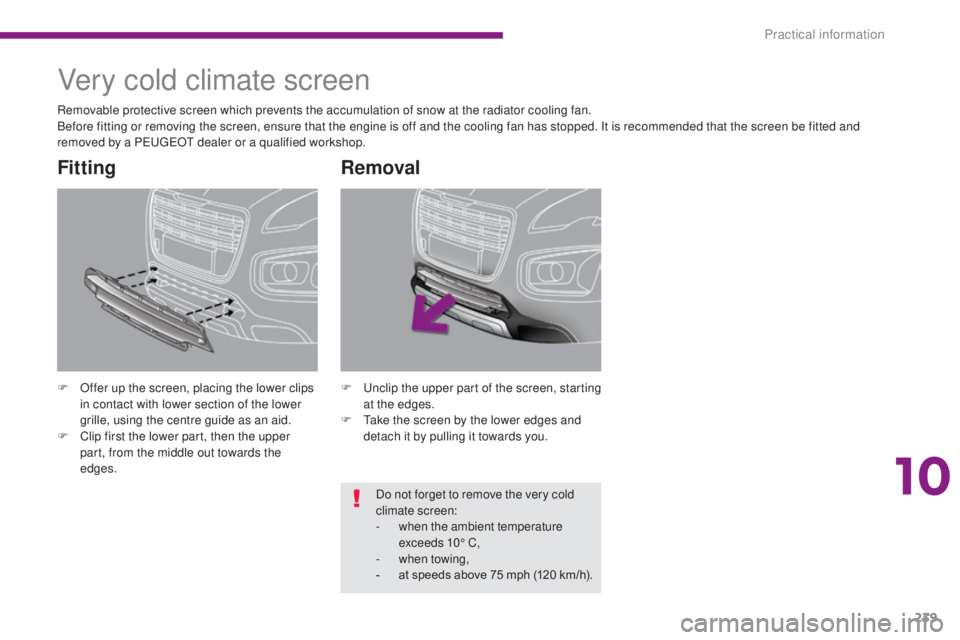
F Offer up the screen, placing the lower clips in contact with lower section of the lower
grille, using the centre guide as an aid.
F
C
lip first the lower part, then the upper
part, from the middle out towards the
edges.
Fitting
F Unclip the upper part of the screen, starting at the edges.
F
T
ake the screen by the lower edges and
detach it by pulling it towards you.
Removal
Removable protective screen which prevents the accumulation of snow at the radiator cooling fan.
Before fitting or removing the screen, ensure that the engine is off and the cooling fan has stopped. It is recommended that the screen be fitted and
removed by a PEUGEOT dealer or a qualified workshop.
Do not forget to remove the very cold
climate screen:
-
w
hen the ambient temperature
exceeds 10° C,
-
w
hen towing,
-
a
t speeds above 75 mph (120 km/h).
10
Practical information
Page 245 of 344
243
3008_en_Chap11_caracteristiques_ed01-2015
* The kerb weight is equal to the unladen weight + driver (75 kg).
** T he weight of the braked trailer can be increased, within the GTW limit, if the GV W of the towing vehicle is reduced by an equal amount; warning,
towing using a lightly loaded towing vehicle may have an adverse effect on its road holding.
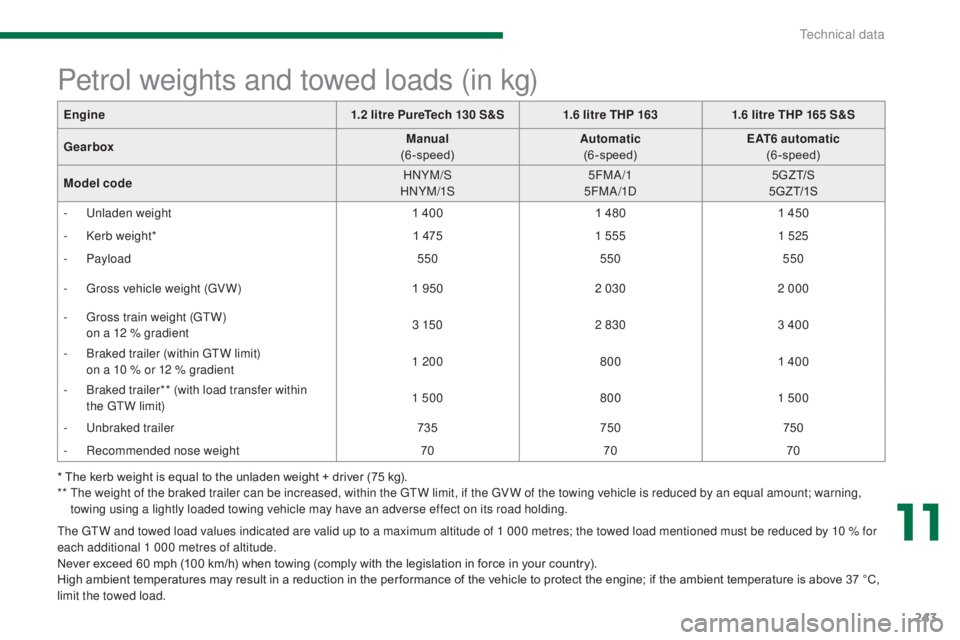
Petrol weights and towed loads (in kg)
The GTW and towed load values indicated are valid up to a maximum altitude of 1 000 metres; the towed load mentioned must be reduced by 10 % for
each additional 1 000 metres of altitude.
Never exceed 60 mph (100 km/h) when towing (comply with the legislation in force in your country).
High ambient temperatures may result in a reduction in the per formance of the vehicle to protect the engine; if the ambient temperature is above 37 °C,
limit the towed load. Engine
1.2 litre PureTech 130 S&S 1.6 litre THP 163 1.6 litre THP 165 S&S
Gearbox Manual
(6-speed) Automatic
(6-speed) EAT6 automatic
(6-speed)
Model code HNYM/S
HNYM/1S 5FMA /1
5FM A /1D 5G Z T/S
5G Z T/1S
-
U
nladen weight
1 4001 4801 450
-
K
erb weight*
1 4751 555 1 525
-
Payload
550550550
-
G
ross vehicle weight (GV W)
1 9502 0302 000
-
G
ross train weight (GTW)
o
n a 12 % gradient
3 150
2 830 3 400
-
B
raked trailer (within GTW limit)
o
n a 10 % or 12 % gradient
1 200
8001 400
-
B
raked trailer** (with load transfer within
the GTW limit)
1 500
8001 500
-
U
nbraked trailer
735750750
-
R
ecommended nose weight
707070
11
Technical data