2016 PEUGEOT 108 brake
[x] Cancel search: brakePage 79 of 268

77
108_en_Chap04_conduite_ed01-2016
gear selector
etg electronic gearbox
the five-speed etg electronic gearbox offers a choice between the ease of automated operation or the pleasure of manual gear changing.
R.
R
everse: with your foot on the brake pedal,
move the gear selector to the right then
for ward to select this position.
N.
N
eutral: with your foot on the brake pedal,
select this position to start the engine.
e.
A
utomatic (
ea
sy) mode: move the gear
selector back to select this mode.
M.
M
anual mode with sequential gear
changing: move the gear selector back
then to the left to select this mode. Press behind the "+"
steering
mounted control paddle to change up.
Steering mounted control paddles
the position of the gear selector ( R, N , e or M)
is displayed in the instrument panel.
In automatic (
ea
sy) mode, when you
temporarily take control of gear changing,
the gear engaged is also displayed in the
instrument panel.
Display in the instrument panel
Press behind the "-" steering
mounted control paddle to change
down.
th
e steering mounted control paddles
cannot be used to select neutral or to
engage or come out of reverse gear.
4
Driving
Page 80 of 268

78
108_en_Chap04_conduite_ed01-2016
F With the parking brake applied, press the brake pedal then select position N .
F
S
tart the engine.
Moving off
if you do not press the brake pedal or
if the gear selector is not in position N ,
engine starting is not possible.
Never leave a child unsupervised inside
the vehicle with the engine running.F
Sel
ect position e using the gear selector.
th
e gearbox then operates in auto-active
mode, without any intervention required by
the
driver.
It continuously selects the most suitable gear
for:
- op timised fuel consumption,
-
t
he driving style,
-
t
he profile of the road,
-
t
he load in the vehicle.
to o
btain optimum acceleration, when
overtaking another vehicle for example, press
firmly on the accelerator pedal going beyond
the point of resistance.
Automatic (eA SY) mode
It is possible to change mode at any time, by
moving the gear selector from position
e to
position M and the other way round.
F
W
ith your foot on the brake pedal, select
position R ,
e
or M
.
F
R
elease the parking brake.
F
P
rogressively release the brake pedal.
A
ccelerate away.
th
e creep function may be temporarily
unavailable if the clutch temperature is
too high or the gradient too steep. An
audible signal gives a warning if the
clutch temperature is too high.
Never select neutral N when the vehicle
is moving.
th
is function makes manoeuvring the vehicle
at low speed easier (parking, traffic jams…).
After first placing the gear selector in
position
e
,
M or R
, the vehicle moves off as
soon as you take your foot off the brake
pedal , at low speed, with the engine at idle.
Creep function
Driving
Page 81 of 268

79
108_en_Chap04_conduite_ed01-2016
temporarily taking control of
gear changes
You can temporarily take control of gear
changes using the "+" and "-"
steering
mounted control paddles.
ge
ar change commands are only acted on if
the engine speed allows.
t
h
ere is an audible
signal if a command is not accepted.
th
e gear engaged is displayed in the
instrument panel.
th
is function allows you to anticipate certain
situations such as overtaking a vehicle or
approaching a corner.
After a few moments with no action on the
controls, the gearbox returns to automatic
control of the gears. It is possible to change mode at any time, by
moving the gear selector from position
e to
position M and the other way round.
Never select neutral N when the vehicle
is moving.
F
P
lace the gear selector in position M
.
F
C
hange up or down using:
- t he gear selector, pushing:
- back, "+" to change up,
-
for ward, "-" to change down.
-
o
r the "+" or "-" steering mounted
control paddle.
the
gear engaged is displayed.
ge
ar change commands are only acted on if
the engine speed allows.
It is not necessary to release the accelerator
peal during gear changes.
t
h
ere is an audible
signal if a command is not accepted.
When braking or slowing down, the gearbox
automatically changes down so that pick-up is
in the right gear.
Manual mode
under sharp acceleration, the gearbox will
not change up without action by the driver on
the gear selector or steering mounted control
paddles (unless the engine speed is close to
maximum).
to e
ngage reverse, the vehicle must be
stationary with your foot on the brake pedal.
F
Sel
ect position R .
Reverse
there is an audible signal on engaging reverse.
4
Driving
Page 82 of 268

80
108_en_Chap04_conduite_ed01-2016
the vehicle can be stopped whatever the
position of the gear selector (N,
e or R).
However, there is an audible signal on opening
the driver's door if the gear selector is not at
position N .
Switching off
When the vehicle is stopped with the
engine running, always put the gear
selector to neutral N .
th
ere is a continuous audible signal
if you turn the ignition switch to "
oFF "
w
ith the vehicle in 2
nd, 3rd, 4th or 5th g e a r.
In this case return the ignition switch
to "
oN "
, move the gear selector to
position
N , then to position
e
,
M or R ,
then turn the ignition switch to "
oFF ".
O
n a slope, use the brakes to
immobilise the vehicle and place the
gear selector in position N ,
e
or R . With the ignition on, illumination
of this warning lamp indicates a
gearbox fault.
Contact a P
e
uge
Ot
dealer or a
qualified workshop.
operating faults
In all cases, it is essential that you
apply the parking brake to immobilise
the vehicle.
Before doing anything under the
bonnet, check that the gear selector is
in neutral N and the parking brake is
applied.
Limits of operation
On a gradient, or when hill start assist is
activated, never hold the vehicle using the
accelerator : you could damage the clutch.
In these situations there is an audible signal.
F
M
ove the gear selector to position N .
F
W
ait 15 minutes to allow the clutch to cool
down before setting off. -
c
heck that the ignition switch is at the "
oN
"
p
osition,
-
p
lace the gear selector at N
, then move it
to e
,
M or R
.
If 1 is flashing in the instrument panel:
- p lace the gear selector at e or M
, then
move it to N .
If R is flashing in the instrument panel:
-
p
lace the gear selector at R, then move it
to N .
If
N
is flashing in the instrument panel
accompanied by an audible signal for a long time:
Driving
Page 84 of 268

82
108_en_Chap04_conduite_ed01-2016
Hill start assist
System which keeps your vehicle immobilised
temporarily (approximately 2 seconds) when
starting on a gradient, the time it takes to
move your foot from the brake pedal to the
accelerator pedal.
th
is system only operates when:
-
t
he vehicle is completely stationary, with
your foot on the brake pedal,
-
c
ertain conditions of slope are met,
-
w
ith the driver’s door closed.
th
e hill start assist system cannot be
deactivated.
on a
n ascending slope, with the vehicle
stationar y, the vehicle is held for a
momentarily when you release the brake
pedal:
-
i
f you are in first gear or neutral with a
manual gearbox,
-
i
f you are in position e or M with an etg
electronic gearbox.operation
on a descending slope, with the vehicle
stationary and reverse gear engaged, the
vehicle is held momentarily when you
release the brake pedal.
operating fault
If a fault in the system occurs, this
warning lamp comes on. Contact
a P
e
uge
Ot
dealer or a qualified
workshop to have the system
checked.
Do not exit the vehicle while it is being
held in the hill start assist phase.
If you need to exit the vehicle with the
engine running, apply the parking brake
manually.
Driving
Page 109 of 268

107
108_en_Chap06_securite_ed01-2016
electronic Stability Control (eSC) incorporating
the following systems:
-
a
nti-lock braking system (ABS) and the
electronic brake force distribution (
eB
FD),
-
em
ergency braking assistance,
-
t
raction control (
tR
C),
-
d
ynamic stability control (DSC).
electronic stability control (eS C)
Definitions
Anti-lock braking system (ABS)
and electronic brake force
distribution (
e
BFD)
these systems improve the stability and
manoeuvrability of your vehicle when braking
and contribute towards better control in
corners, in particular on poor or slippery road
surfaces.
th
e ABS prevents wheel lock in the event of
emergency braking.
th
e electronic brake force distribution system
manages the braking pressure wheel by wheel.
emergency braking assistance
In an emergency, this system enables you to
reach the optimum braking pressure more
quickly and therefore reduce the stopping
distance.
It is triggered according to the speed at which
the brake pedal is pressed.
t
h
is is felt by a
reduction in the resistance of the pedal and an
increase in the effectiveness of the braking.
traction control (tR C)
this system optimises traction in order to limit
wheel slip by acting on the brakes of the driving
wheels and on the engine. It also improves
the directional stability of the vehicle on
acceleration.
Dynamic stability control (DSC)
If there is a difference between the path
followed by the vehicle and that required by the
driver, this system monitors each wheel and
automatically acts on the brake of one or more
wheels and on the engine to return the vehicle
to the required path, within the limits of the laws
of physics.
6
Safety
Page 110 of 268
108
108_en_Chap06_securite_ed01-2016
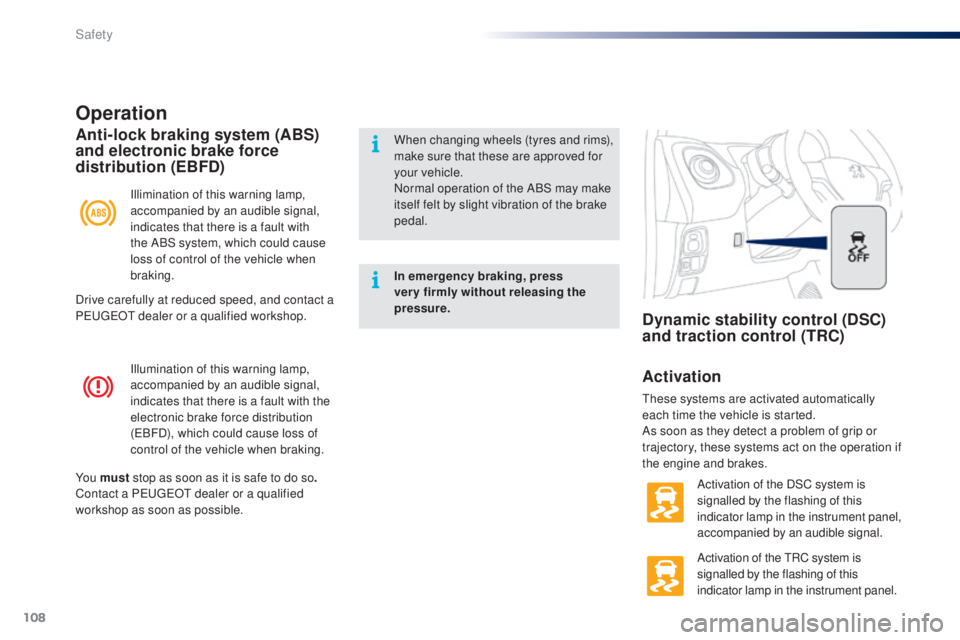
Illumination of this warning lamp,
accompanied by an audible signal,
indicates that there is a fault with the
electronic brake force distribution
(
eB
FD), which could cause loss of
control of the vehicle when braking.
operation
Illimination of this warning lamp,
accompanied by an audible signal,
indicates that there is a fault with
the ABS system, which could cause
loss of control of the vehicle when
braking.
Anti-lock braking system (ABS)
and electronic brake force
distribution (
e
BFD)When changing wheels (tyres and rims),
make sure that these are approved for
your vehicle.
Normal operation of the ABS may make
itself felt by slight vibration of the brake
pedal.
In emergency braking, press
very firmly without releasing the
pressure.
Yo u must stop as soon as it is safe to do so .
Contact a P
e
uge
Ot
dealer or a qualified
workshop as soon as possible.
Dynamic stability control (DSC)
and traction control (tR C)
Activation
these systems are activated automatically
each time the vehicle is started.
As soon as they detect a problem of grip or
trajectory, these systems act on the operation if
the engine and brakes. Activation of the DSC system is
signalled by the flashing of this
indicator lamp in the instrument panel,
accompanied by an audible signal.
Activation of the
t
R
C system is
signalled by the flashing of this
indicator lamp in the instrument panel.
Drive carefully at reduced speed, and contact a
P
e
uge
Ot
dealer or a qualified workshop.
Safety
Page 112 of 268
110
108_en_Chap06_securite_ed01-2016
Active City Brake
Active City Brake is a driving assistance system
that aims to avoid a frontal collision or reduce
the speed of an impact if the driver does not
react or reacts too late (brake application too
late).
th
is system is designed to improve
driving safety.
It remains the driver's responsibility to
continuously monitor the state of the
traffic and to assess the distances and
relative speeds of other vehicles.
Active City Brake can in no
circumstances replace the need for
vigilance on the part of the driver.
Never look at the laser sensor through
an optical instrument (magnifying glass,
microscope...) at a distance of less than
10 centimetres: risk of eye injury.
Automatic braking occurs later than if
done by the driver, so as to intervene
only when there is a high risk of
collision.Principle
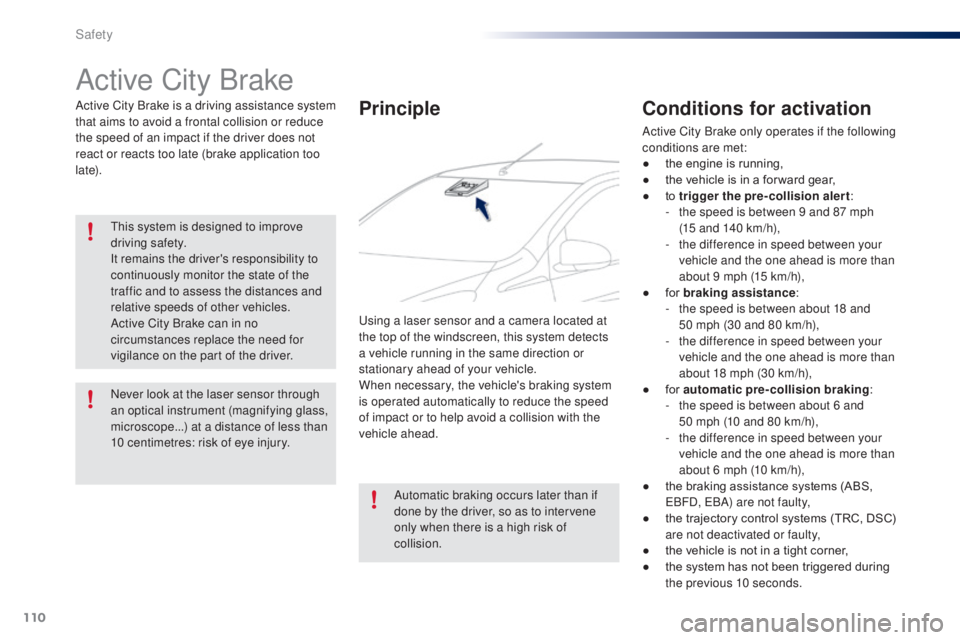
using a laser sensor and a camera located at
the top of the windscreen, this system detects
a vehicle running in the same direction or
stationary ahead of your vehicle.
When necessary, the vehicle's braking system
is operated automatically to reduce the speed
of impact or to help avoid a collision with the
vehicle ahead.
Conditions for activation
Active City Brake only operates if the following
conditions are met:
●
t
he engine is running,
●
t
he vehicle is in a for ward gear,
●
t
o trigger the pre-collision alert :
-
t
he speed is between 9 and 87 mph
(15 and 140 km/h),
-
t
he difference in speed between your
vehicle and the one ahead is more than
about 9 mph (15 km/h),
●
f
or braking assistance :
-
t
he speed is between about 18 and
50
mph (30 and 80 km/h),
-
t
he difference in speed between your
vehicle and the one ahead is more than
about 18 mph (30 km/h),
●
f
or automatic pre-collision braking:
-
t
he speed is between about 6 and
50
mph (10 and 80 km/h),
-
t
he difference in speed between your
vehicle and the one ahead is more than
about 6 mph (10 km/h),
●
t
he braking assistance systems (ABS,
eB
FD, e
B
A) are not faulty,
●
t
he trajectory control systems (TRC, DSC)
are not deactivated or faulty,
●
t
he vehicle is not in a tight corner,
●
t
he system has not been triggered during
the previous 10 seconds.
Safety