2016 PEUGEOT 108 ECU
[x] Cancel search: ECUPage 111 of 268
109
108_en_Chap06_securite_ed01-2016
the tRC and DSC systems offer
increased safety in normal driving, but
should not encourage the driver to take
extra risks or drive at high speed.
th
e correct operation of these
systems depends on observation of
the manufacturer's recommendations
regarding the wheels (tyres and rims),
the braking components, the electronic
components and the assembly and
repair procedures used by P
e
uge
Ot
dealers.
After an impact, have the system
checked by a P
e
uge
Ot
dealer or a
qualified workshop.
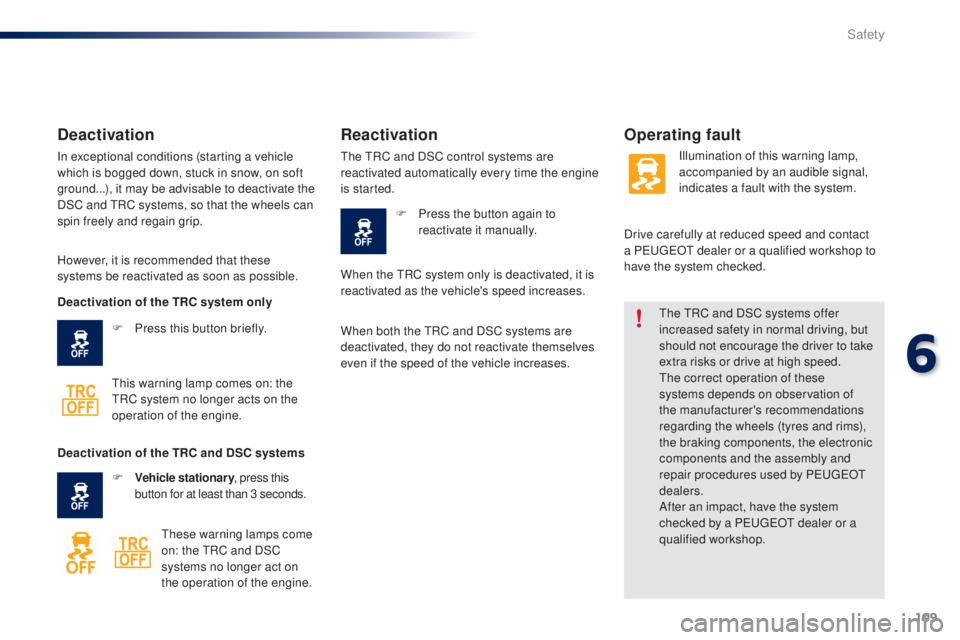
Deactivation
In exceptional conditions (starting a vehicle
which is bogged down, stuck in snow, on soft
ground...), it may be advisable to deactivate the
DSC and
t
R
C systems, so that the wheels can
spin freely and regain grip.
operating fault
However, it is recommended that these
systems be reactivated as soon as possible.
F
P
ress this button briefly.
th
is warning lamp comes on: the
tR
C system no longer acts on the
operation of the engine.
Reactivation
the tRC and DSC control systems are
reactivated automatically every time the engine
is started.
F
P
ress the button again to
reactivate it manually. Illumination of this warning lamp,
accompanied by an audible signal,
indicates a fault with the system.
Drive carefully at reduced speed and contact
a P
e
uge
Ot
dealer or a qualified workshop to
have the system checked.
Deactivation of the
t
R
C system only
Deactivation of the
t
R
C and DSC systems
F
V
ehicle stationary , press this
button for at least than 3 seconds.
th
ese warning lamps come
on: the
t
R
C and DSC
systems no longer act on
the operation of the engine. When the
t
R
C system only is deactivated, it is
reactivated as the vehicle's speed increases.
When both the
t
R
C and DSC systems are
deactivated, they do not reactivate themselves
even if the speed of the vehicle increases.
6
Safety
Page 112 of 268
110
108_en_Chap06_securite_ed01-2016
Active City Brake
Active City Brake is a driving assistance system
that aims to avoid a frontal collision or reduce
the speed of an impact if the driver does not
react or reacts too late (brake application too
late).
th
is system is designed to improve
driving safety.
It remains the driver's responsibility to
continuously monitor the state of the
traffic and to assess the distances and
relative speeds of other vehicles.
Active City Brake can in no
circumstances replace the need for
vigilance on the part of the driver.
Never look at the laser sensor through
an optical instrument (magnifying glass,
microscope...) at a distance of less than
10 centimetres: risk of eye injury.
Automatic braking occurs later than if
done by the driver, so as to intervene
only when there is a high risk of
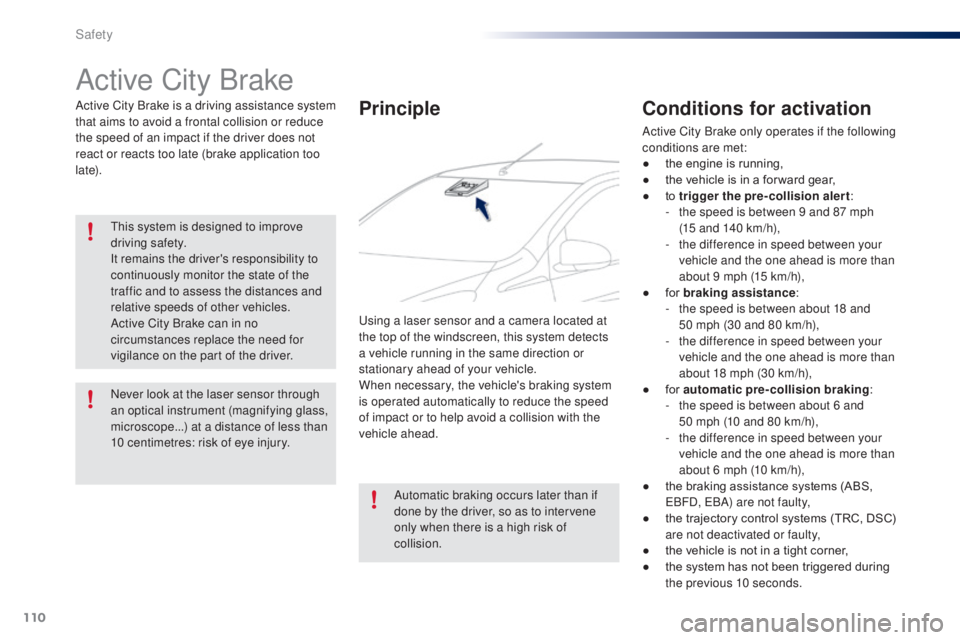
collision.Principle
using a laser sensor and a camera located at
the top of the windscreen, this system detects
a vehicle running in the same direction or
stationary ahead of your vehicle.
When necessary, the vehicle's braking system
is operated automatically to reduce the speed
of impact or to help avoid a collision with the
vehicle ahead.
Conditions for activation
Active City Brake only operates if the following
conditions are met:
●
t
he engine is running,
●
t
he vehicle is in a for ward gear,
●
t
o trigger the pre-collision alert :
-
t
he speed is between 9 and 87 mph
(15 and 140 km/h),
-
t
he difference in speed between your
vehicle and the one ahead is more than
about 9 mph (15 km/h),
●
f
or braking assistance :
-
t
he speed is between about 18 and
50
mph (30 and 80 km/h),
-
t
he difference in speed between your
vehicle and the one ahead is more than
about 18 mph (30 km/h),
●
f
or automatic pre-collision braking:
-
t
he speed is between about 6 and
50
mph (10 and 80 km/h),
-
t
he difference in speed between your
vehicle and the one ahead is more than
about 6 mph (10 km/h),
●
t
he braking assistance systems (ABS,
eB
FD, e
B
A) are not faulty,
●
t
he trajectory control systems (TRC, DSC)
are not deactivated or faulty,
●
t
he vehicle is not in a tight corner,
●
t
he system has not been triggered during
the previous 10 seconds.
Safety
Page 113 of 268
111
108_en_Chap06_securite_ed01-2016
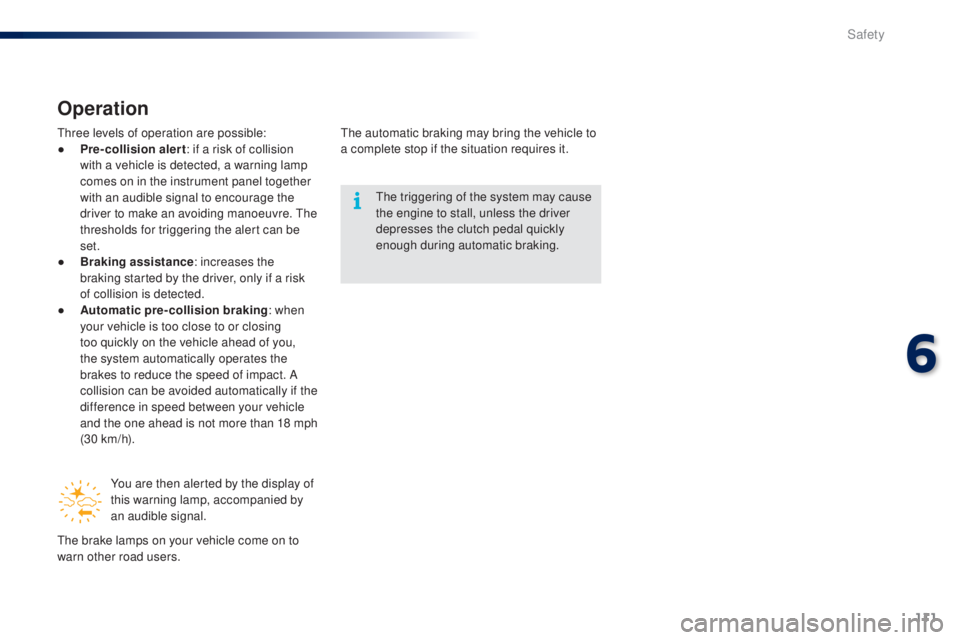
operation
three levels of operation are possible:
● P re-collision alert : if a risk of collision
with a vehicle is detected, a warning lamp
comes on in the instrument panel together
with an audible signal to encourage the
driver to make an avoiding manoeuvre.
t
h
e
thresholds for triggering the alert can be
set.
●
Br
aking assistance : increases the
braking started by the driver, only if a risk
of collision is detected.
●
A
utomatic pre-collision braking: when
your vehicle is too close to or closing
too quickly on the vehicle ahead of you,
the system automatically operates the
brakes to reduce the speed of impact. A
collision can be avoided automatically if the
difference in speed between your vehicle
and the one ahead is not more than 18 mph
(30 km/h).
You are then alerted by the display of
this warning lamp, accompanied by
an audible signal.th e automatic braking may bring the vehicle to
a complete stop if the situation requires it.
th
e brake lamps on your vehicle come on to
warn other road users.
th
e triggering of the system may cause
the engine to stall, unless the driver
depresses the clutch pedal quickly
enough during automatic braking.
6
Safety
Page 114 of 268
112
108_en_Chap06_securite_ed01-2016
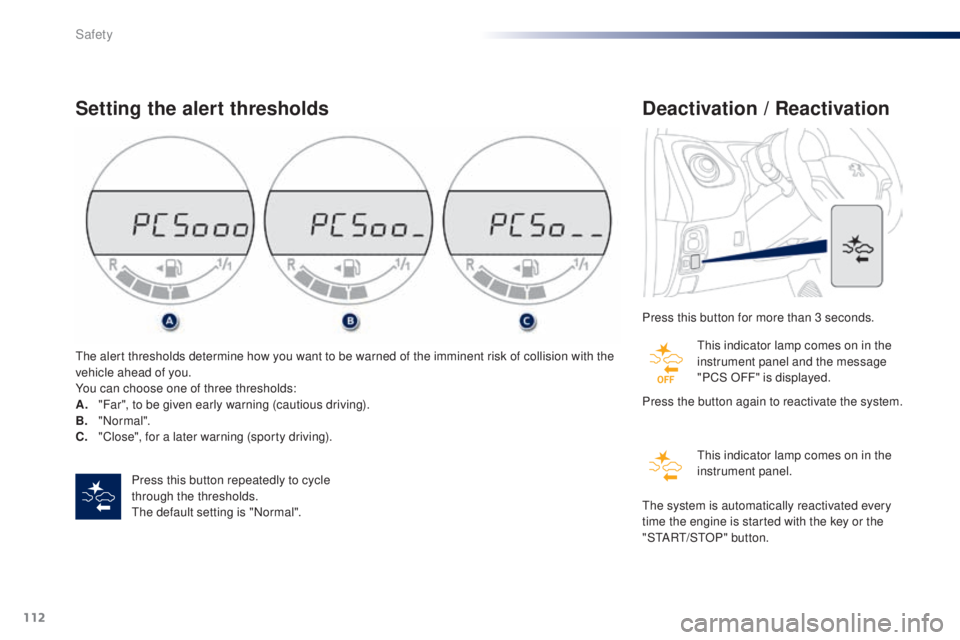
Setting the alert thresholds
Press this button repeatedly to cycle
through the thresholds.
the
default setting is "Normal".
th
e alert thresholds determine how you want to be warned of the imminent risk of collision with the
vehicle ahead of you.
You can choose one of three thresholds:
A.
"
Far", to be given early warning (cautious driving).
B.
"Normal".
C.
"
Close", for a later warning (sporty driving).
Deactivation / Reactivation
Press this button for more than 3 seconds.
Press the button again to reactivate the system.
th
e system is automatically reactivated every
time the engine is started with the key or the
"S
t
A
R
t/
S t
O
P" button.
th
is indicator lamp comes on in the
instrument panel.
th
is indicator lamp comes on in the
instrument panel and the message
"PCS OFF" is displayed.
Safety
Page 115 of 268
113
108_en_Chap06_securite_ed01-2016
Never leave accumulations of snow or
any object projecting above the bonnet
or in front of the roof: this might fall into
the field of vision of the sensor and
generate a detection.
operating limits
the system only detects vehicles (cars, lorries)
that are stationary or moving in the same
direction as your vehicle. In difficult weather conditions (very
heavy rain, snow, fog, hail...), braking
distances increase, which can reduce
the ability of the system to avoid a
collision.
the
driver must therefore remain
particularly vigilant.
th
e system is not triggered or is interrupted if
the driver:
-
a
ccelerates strongly (even if the speed
limiter is on),
-
o
r turns the steering wheel suddenly
(avoiding manoeuvre).
Detection capability is less effective if:
-
y
ou are driving on roads with pronounced
bends and/or on roads in poor condition,
-
y
our vehicle is excessively loaded, as
this changes the horizontal attitude of the
vehicle.
-
y
our vehicle skids.It does not detect small vehicles
(bicycles, motorcycles), pedestrians or
animals, nor non-reflective stationary
objects.unwanted triggering of the system
It is possible for the system to detect a risk of
imminent collision and start working, in the
following conditions in particular:
-
d
etection of an object located close to the
edge of the road entering a corner (safety
barrier, lamp post or road sign),
-
d
etection of a structure located at the top
or bottom of a steep slope (advertising
hoarding, steet lighting),
-
d
etection of reflective objects (central
reservation...) in the road,
-
d
etection of the upper bar of a bridge or a
traffic light gantry,
-
p
assing a vehicle travelling in the other
direction in a corner,
-
p
assing a vehicle traveling in the other
direction, at a crossroads, when your
vehicle is turning left or right,
-
i
f the vehicle ahead of you sends up water
or snow,
-
i
f your vehicle stops very close to an
overhanging wall or other vehicles,
-
w
hen your vehicle closes rapidly on the
vehicle ahead,
-
i
f the vehicle is raised or lowered,
-
i
f the vehicle passes through a plastic curtain,
-
i
f driving through mist or smoke,
-
i
f the sensor is misaligned (following
replacement after a collision).
6
Safety
Page 116 of 268
114
108_en_Chap06_securite_ed01-2016
operating faults
Sensor fault
the operation of the laser sensor may suffer
inter ference from accumulations of dirt or
misting of the windscreen or the presence of
an object causing an obstruction (e.g.: bonnet
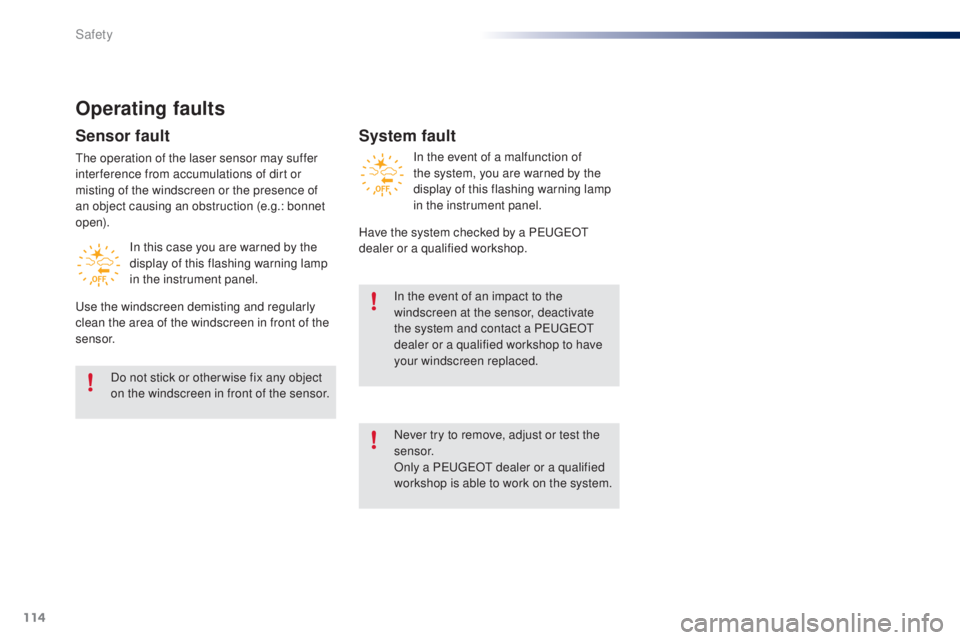
open).In this case you are warned by the
display of this flashing warning lamp
in the instrument panel.
use
the windscreen demisting and regularly
clean the area of the windscreen in front of the
sensor.
Do not stick or other wise fix any object
on the windscreen in front of the sensor.
System fault
In the event of a malfunction of
the system, you are warned by the
display of this flashing warning lamp
in the instrument panel.
Have the system checked by a P
e
uge
Ot
dealer or a qualified workshop.
In the event of an impact to the
windscreen at the sensor, deactivate
the system and contact a P
e
uge
Ot
dealer or a qualified workshop
to have
your windscreen replaced.
Never try to remove, adjust or test the
sensor.
Only a P
e
uge
Ot
dealer or a qualified
workshop is able to work on the system.
Safety
Page 117 of 268
115
108_en_Chap06_securite_ed01-2016
Seat belts
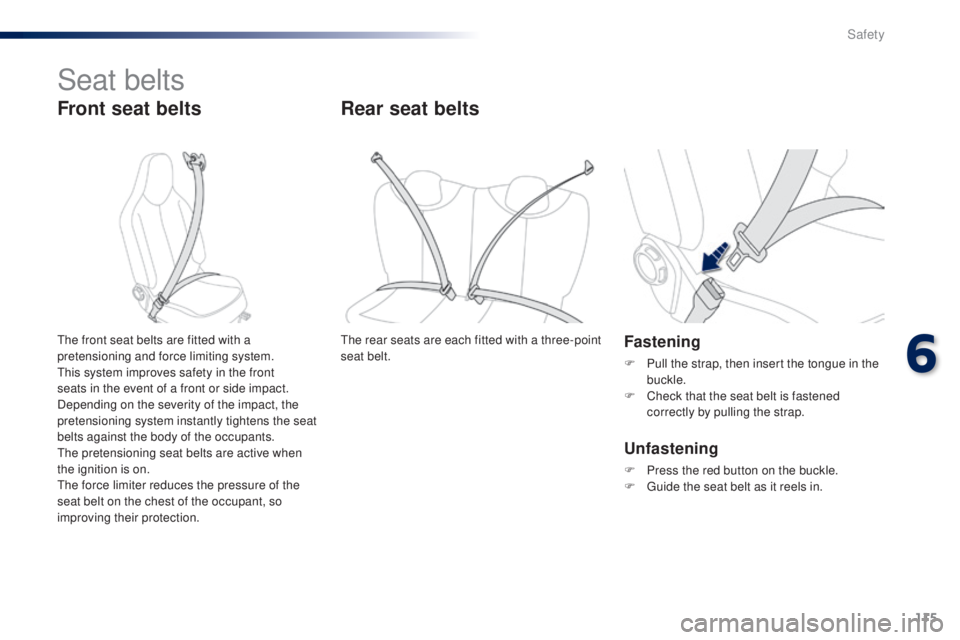
Front seat belts
Fastening
F Pull the strap, then insert the tongue in the buckle.
F
C
heck that the seat belt is fastened
correctly by pulling the strap.
th
e front seat belts are fitted with a
pretensioning and force limiting system.th
is system improves safety in the front
seats in the event of a front or side impact.
Depending on the severity of the impact, the
pretensioning system instantly tightens the seat
belts against the body of the occupants.
the
pretensioning seat belts are active when
the ignition is on.
th
e force limiter reduces the pressure of the
seat belt on the chest of the occupant, so
improving their protection.
Rear seat belts
the rear seats are each fitted with a three-point
seat belt.
unfastening
F Press the red button on the buckle.
F gu ide the seat belt as it reels in.
6
Safety
Page 118 of 268
116
108_en_Chap06_securite_ed01-2016
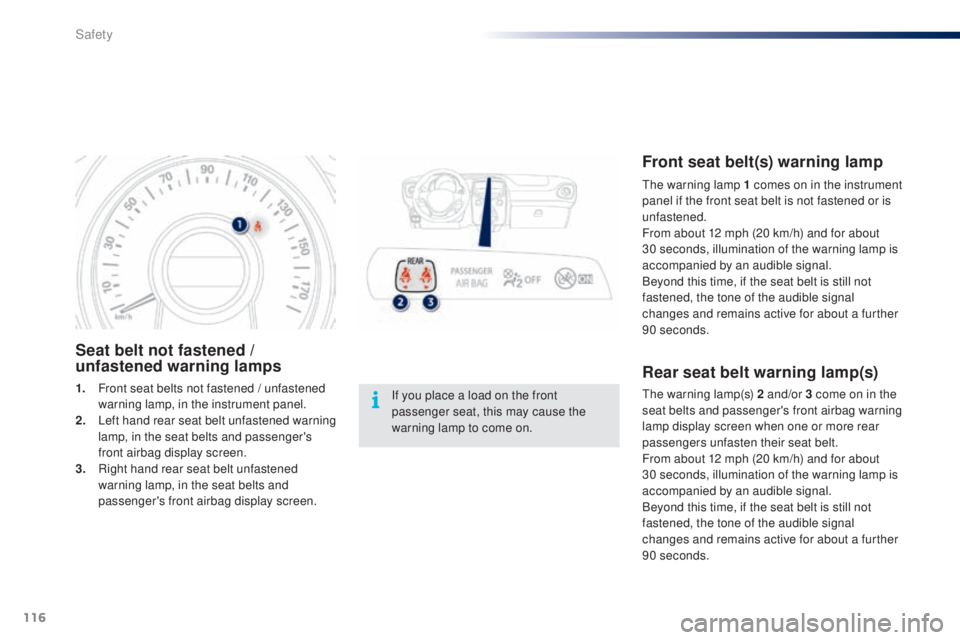
Seat belt not fastened /
unfastened warning lamps
1. Front seat belts not fastened / unfastened warning lamp, in the instrument panel.
2.
L
eft hand rear seat belt unfastened warning
lamp, in the seat belts and passenger's
front airbag display screen.
3.
R
ight hand rear seat belt unfastened
warning lamp, in the seat belts and
passenger's front airbag display screen.Rear seat belt warning lamp(s)
the warning lamp(s) 2 and/or 3 come on in the
seat belts and passenger's front airbag warning
lamp display screen when one or more rear
passengers unfasten their seat belt.
From about 12 mph (20 km/h) and for about
30 seconds, illumination of the warning lamp is
accompanied by an audible signal.
Beyond this time, if the seat belt is still not
fastened, the tone of the audible signal
changes and remains active for about a further
90 seconds.
If you place a load on the front
passenger seat, this may cause the
warning lamp to come on.
Front seat belt(s) warning lamp
the warning lamp 1
comes on in the instrument
panel if the front seat belt is not fastened or is
unfastened.
From about 12 mph (20 km/h) and for about
30 seconds, illumination of the warning lamp is
accompanied by an audible signal.
Beyond this time, if the seat belt is still not
fastened, the tone of the audible signal
changes and remains active for about a further
90 seconds.
Safety