2016 OPEL ZAFIRA TOURER park assist
[x] Cancel search: park assistPage 202 of 301

200Driving and operating
When the system detects a vehicle inthe side blind zone while driving
forward, either while passing a
vehicle or being passed, an amber
warning symbol B will illuminate in
the relevant exterior mirror. If the
driver then activates the turn signal,
the warning symbol B starts flashing
amber as a warning not to change
lanes.
Note
If the passing vehicle is at least
10 km/h faster than the passed
vehicle, the warning symbol B in the
relevant exterior mirror will not
illuminate.Side blind spot alert is active from
speeds of 10 km/h up to 140 km/h.
Driving faster than 140 km/h
deactivates the system, indicated by
low lighting warning symbols B in
both exterior mirrors. Reducing the speed again will extinguish the
warning symbols. If a vehicle is then
detected in the blind zone, the
warning symbols B will illuminate as
normal on the relevant side.
When the vehicle is started, both exterior mirror displays will briefly
come on to indicate that the system is operating.
The system can be activated or
deactivated in the menu Settings in
the Info-Display, vehicle
personalisation 3 130.
Deactivation is indicated by a
message in the Driver Information
Centre (DIC).
Detection zones
The system sensor covers a zone of
approx. 3 metres on both sides of the
vehicle. This zone starts at each
exterior mirror and extends rearwardsby approx. 3 metres. The height of the zone is approx. between 0.5 metres
and 2 metres off the ground.
The system is deactivated if the
vehicle is towing a trailer.
Side blind spot alert is designed to
ignore stationary objects such as
guardrails, posts, curbs, walls and
beams. Parked vehicles or oncoming
vehicles are not detected.
Fault
Occasional missed alerts can occur
under normal circumstances and will
increase in wet conditions.
Side blind spot alert does not operate when the left or right corners of the
rear bumper are covered with mud,
dirt, snow, ice, slush, or in heavy
rainstorms. Cleaning instructions
3 264.
In the event of a fault in the system or if the system does not work due to
temporary conditions, a message is
displayed in the Driver Information
Centre (DIC). Seek the assistance of
a workshop in case of a permanent
fault.
Page 203 of 301

Driving and operating201Rear view cameraThe rear view camera assists the
driver when reversing by displaying a
view of the area behind the vehicle.
The view of the camera is displayed
in the Colour-Info-Display.9 Warning
The rear view camera does not
replace driver vision. Note that
objects that are outside the
camera's field of view and the
advanced parking assist sensors,
e.g. below the bumper or
underneath the vehicle, are not
displayed.
Do not reverse the vehicle by only looking at the Info-Display and
check the surrounding area
behind and around the vehicle
before reversing.
Activation
Rear view camera is automatically
activated when reverse gear is
engaged.
Functionality
The camera is mounted in the tailgate handle and has a viewing angle of
130°.
Due to the high position of the
camera, the rear bumper can be seen
on the display as a guide to position.
The area displayed by the camera is
limited. The distance of the image that
appears on the display differs from
the actual distance.
Guiding lines
Dynamic guiding lines are horizontal
lines in 1 metre intervals projected on
the picture to define the distance to
shown objects.
Page 204 of 301

202Driving and operating
Trajectory lane of the vehicle is
shown in accordance with the
steering angle.
The function can be deactivated in the
Settings menu in the Info-Display.
Vehicle personalisation 3 130.
Warning symbols
Warning symbols are indicated as
triangles 9 on the picture which
shows obstacles detected by the rear sensors of the advanced parking
assist.
Display settings
Navi 650 /Navi 950 : Brightness can be
set with the up/down buttons of the
multifunction knob.
CD 600 : Brightness can be set by first
pressing and then turning the
multifunction knob.
Deactivation
The camera is deactivated when a
certain forward speed is exceeded or
if reverse gear is not engaged for
approx. 10 seconds.
Activation or deactivation of the rear
view camera can be changed in the
Settings menu in the Info-Display.
Vehicle personalisation 3 130.
Fault
Fault messages are displayed with a
9 on the top line of the Info-Display.
The rear view camera may not
operate properly when:
■ The surrounding area is dark.
■ The sun or the beam of headlights is shining directly into the camera
lens.
■ Ice, snow, mud, or anything else covers the camera lens. Clean the
lens, rinse it with water, and wipe it
with a soft cloth.
■ The tailgate is not closed correctly.
■ The vehicle had a rear-end accident.
■ There are extreme temperature changes.
Page 211 of 301
Driving and operating209
Fill the tank completely at regular
intervals to prevent corrosion in the
tank.
Faults and remedies
If gas mode is not possible, check the following:
■ Is there enough liquid gas present?
■ Is there enough petrol present for starting?
Due to extreme temperatures in
combination with the gas
composition, it may take slightly
longer before the system switches
from petrol to gas mode.
In extreme situations, the system may
also switch back to petrol mode if the
minimum requirements are not
fulfilled.
Seek the assistance of a workshop in the event of all other faults.Caution
Repairs and adjustments may onlybe made by trained specialists in
order to maintain the safety and
warranty on the LPG system.
Liquid gas is given a particular odour
(odorised) so that any leaks can be
detected easily.
9 Warning
If you smell gas in the vehicle or in
the immediate vicinity, switch to petrol mode immediately. No
smoking. No naked flames or
ignition sources.
If the gas odour persists, do not start
the engine. Have the cause of the
fault remedied by a workshop.
When using underground car parks,
follow the instructions of the operator
and local laws.
Note
In the event of an accident, switch off
the ignition and lights.
Fuel for natural gas
operation Use natural gas with a methane
content of approx. 78 - 99 %. L-gas
(low) has approx. 78 - 87 % and H-gas (high) has approx. 87 - 99 %. Biogas
with the same methane content can
also be used if it has been chemically
prepared and desulphurised.
Only use natural gas or biogas that complies with DIN 51624.
Liquid gas or LPG must not be used.
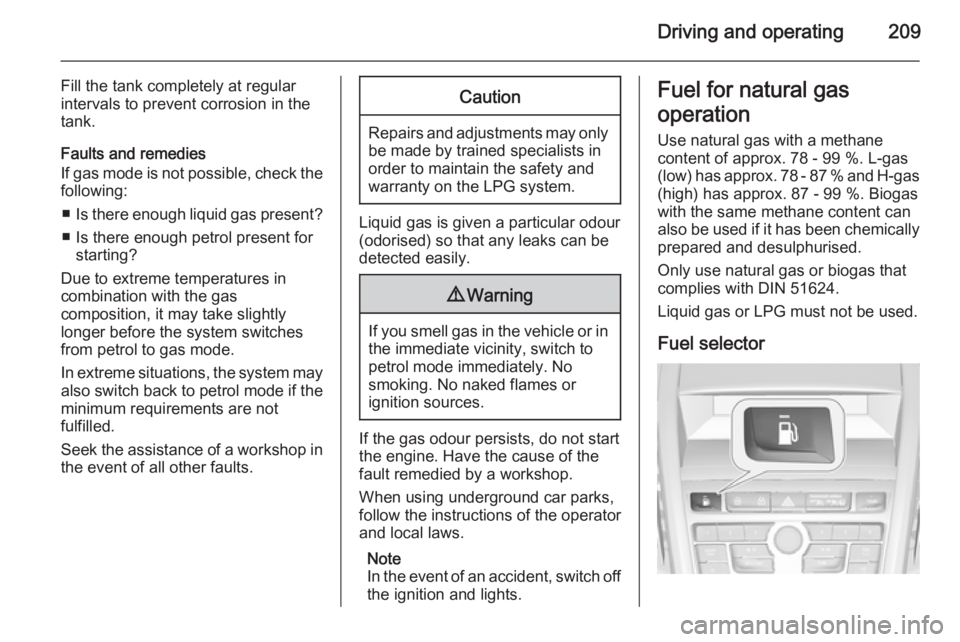
Fuel selector
Page 246 of 301

244Vehicle care
No.Circuit1–2Trailer outlet3Parking assist4Selective catalytic reduction
system5–6–7Power seat8–9Selective catalytic reduction
system10Nitrogen oxide sensor11Trailer module/Trailer socket12Trailer module13Trailer outlet14–15–No.Circuit16Interior mirror/Rear view
camera17Power outlet18–19Steering wheel heating20Sunblind21Heated front seats22–23–24Selective catalytic reduction
system25–26–27–28–29–30–No.Circuit31–32Active damping system/Lane
departure warning
Page 247 of 301

Vehicle care245Vehicle tools
Tools
Some tools, the towing eye and (only on vehicles with spare wheel) the
vehicle jacking equipment are placed
in the rear storage in the load
compartment floor.
Open the cover in front of the tailgate.
Wheels and tyres
Tyre condition, wheel condition
Drive over edges slowly and at right
angles if possible. Driving over sharp
edges can cause tyre and wheel
damage. Do not trap tyres on the kerb when parking.
Regularly check the wheels for
damage. Seek the assistance of a workshop in the event of damage or
unusual wear.
Winter tyres Winter tyres improve driving safety at
temperatures below 7 °C and should
therefore be fitted on all wheels.
In accordance with country-specific
regulations, affix the speed sticker in
the driver's field of view.Tyre designations
E.g. 215/60 R 16 95 H215=tyre width, mm60=cross-section ratio (tyre height
to tyre width), %R=belt type: RadialRF=type: RunFlat16=wheel diameter, inches95=load index e.g. 95 is equivalent to 690 kgH=speed code letter
Speed code letter:
Q=up to 160 km/hS=up to 180 km/hT=up to 190 km/hH=up to 210 km/hV=up to 240 km/hW=up to 270 km/h
Directional tyres
Fit directional tyres such that they rollin the direction of travel. The rolling
direction is indicated by a symbol
(e.g. an arrow) on the sidewall.
Page 256 of 301

254Vehicle care
If tyre pressure is more than
1.3 bar , set it to the correct value.
Repeat the procedure until there
is no more loss of pressure.
If the tyre pressure has fallen
below 1.3 bar, the vehicle must
not be used. Seek the assistance
of a workshop.
18. Stow away tyre repair kit in load compartment.
Note
The driving characteristics of the
repaired tyre are severely affected,
therefore have this tyre replaced.
If unusual noise is heard or the
compressor becomes hot, turn
compressor off for at least
30 minutes.
The built-in safety valve opens at a
pressure of 7 bar.
Note the expiry date of the kit. After
this date its sealing capability is no
longer guaranteed. Pay attention to
storage information on sealant
bottle.
Replace the used sealant bottle. Dispose of the bottle as prescribed
by applicable laws.
The compressor and sealant can be used from approx. -30 °C.
The adapters supplied can be used
to pump up other items e.g.
footballs, air mattresses, inflatable
dinghies etc. They are located on the
underside of the compressor. To
remove, screw on compressor air hose and withdraw adapter.
Wheel changing
Some vehicles are equipped with a
tyre repair kit instead of a spare wheel 3 251.Make the following preparations and
observe the following information:
■ Park the vehicle on a level, firm and
non-skid surface. The front wheels
must be in the straight-ahead
position.
■ Apply the parking brake and engage first gear, reverse gear or
P .
■ Remove the spare wheel 3 257.
■ Never change more than one wheel
at once.
■ Use the jack only to change wheels
in case of puncture, not for
seasonal winter or summer tyre
change.
■ The jack is maintenance-free.
■ If the ground on which the vehicle is standing is soft, a solid board
(max. 1 cm thick) should be placed
under the jack.
■ Take heavy objects out of the vehicle before jacking up.
■ No people or animals may be in the
vehicle when it is jacked-up.
Page 297 of 301

295
Child restraint installationlocations ................................... 62
Child restraints.............................. 61
Child restraint systems ................61
Cigarette lighter .........................104
Climate control ............................. 16
Climate control systems .............148
Clock........................................... 102
Code ........................................... 124
Control indicators........................ 108
Control of the vehicle .................157
Controls ........................................ 97
Convex shape .............................. 29
Coolant and antifreeze ...............269
Cruise control ....................117, 177
Cupholders .................................. 67
Curtain airbag system .................. 59
Curve lighting.............................. 139
D Danger, Warnings and Cautions ...4
Daytime running lights ...............139
Declaration of conformity ............289
DEF ............................................ 164
Diesel exhaust fluid ....................164
Diesel fuel system bleeding .......229
Diesel particle filter .............115, 163
Door open .................................. 117
Door panel storage .......................68
Doors ............................................ 25Driver assistance systems..........177
Driver Information Centre ...........118
Driving characteristics and towing tips .............................. 217
Driving hints ................................ 157
E Electric adjustment ......................29
Electrical system......................... 238
Electric parking brake .........113, 172
Electric parking brake fault .........113
Electronic climate control system 150
Electronic driving programmes ..169
Electronic Stability Control.......... 175
Electronic Stability Control and Traction Control system ..........115
Electronic Stability Control off..... 115
End-of-life vehicle recovery .......222
Engine compartment fuse box ...240
Engine coolant ........................... 225
Engine coolant temperature gauge ..................................... 107
Engine data ............................... 276
Engine exhaust .......................... 163
Engine identification ...................272
Engine oil ................... 223, 269, 273
Engine oil pressure ....................116
Entry lighting .............................. 146
Event data recorders ..................291
Exit lighting ................................ 146Exterior care .............................. 264
Exterior light ............................... 116
Exterior lighting ....................13, 136
Exterior mirrors ............................. 29
F
Fault ........................................... 169
First aid kit ................................... 93
Fixed air vents ........................... 155
Flex-Fix system ............................ 71
Fog light ..................................... 117
Fog lights ................................... 233
Folding mirrors ............................. 29
Folding tray .................................. 93
Following distance indication ......190
Forward collision alert................. 187
Front airbag system .....................58
Front fog lights ........................... 143
Front seats.................................... 38
Front storage ................................ 68
Fuel............................................. 207
Fuel consumption - CO 2-
Emissions ............................... 215
Fuel for diesel engines ..............207
Fuel for liquid gas operation .......208
Fuel for natural gas operation ...209
Fuel for petrol engines ...............207
Fuel gauge ................................. 106
Fuel selector .............................. 106
Fuses ......................................... 238