2016 NISSAN VERSA NOTE seat adjustment
[x] Cancel search: seat adjustmentPage 52 of 402
FORWARD-FACING CHILD
RESTRAINT INSTALLATION USING
THE SEAT BELTS
WARNING
●The three-point seat belt with Auto-
matic Locking Retractor (ALR) must be
used when installing a child restraint.
Failure to use the ALR mode will result
in the child restraint not being properly
secured. The restraint could tip over or
be loose and cause injury to a child in a
sudden stop or collision. Also, it can
change the operation of the front pas-
senger air bag. For additional informa-
tion, refer to “Front passenger air bag
and status light” in this section.
● When installing a child restraint system
in the rear center position, both the
center seat belt connector tongue and
buckle tongue must be secured. For ad-
ditional information, refer to “Attaching
the center seat belt” in this section. Refer to all Warnings and Cautions in the “Child
safety” and “Child restraints” sections before in-
stalling a child restraint.
Do not use the lower anchors if the combined
weight of the child and the child restraint exceeds
65 lbs (29.5 kg) . If the combined weight of the
child and the child restraint is greater than 65 lbs,
(29.5 kg) use the vehicle’s seat belt (not the
lower anchors) to install the child restraint. Be
sure to follow the child restraint manufacturer’s
instructions for installation. Follow these steps to install a forward-facing
child restraint using the vehicle seat belt in the
rear seats or in the front passenger seat:
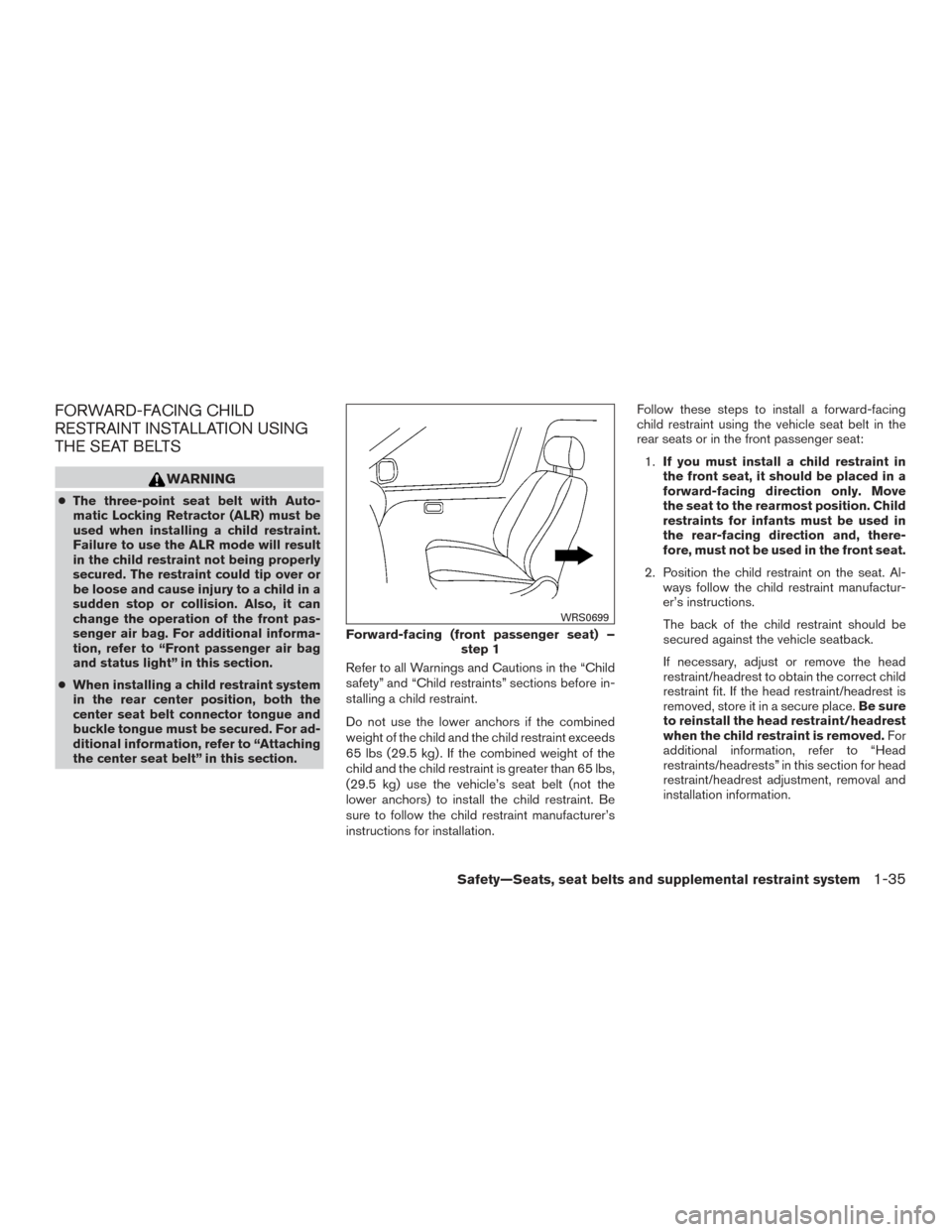
1. If you must install a child restraint in
the front seat, it should be placed in a
forward-facing direction only. Move
the seat to the rearmost position. Child
restraints for infants must be used in
the rear-facing direction and, there-
fore, must not be used in the front seat.
2. Position the child restraint on the seat. Al- ways follow the child restraint manufactur-
er’s instructions.
The back of the child restraint should be
secured against the vehicle seatback.
If necessary, adjust or remove the head
restraint/headrest to obtain the correct child
restraint fit. If the head restraint/headrest is
removed, store it in a secure place. Be sure
to reinstall the head restraint/headrest
when the child restraint is removed. For
additional information, refer to “Head
restraints/headrests” in this section for head
restraint/headrest adjustment, removal and
installation information.
Forward-facing (front passenger seat) – step 1
WRS0699
Safety—Seats, seat belts and supplemental restraint system1-35
Page 57 of 402
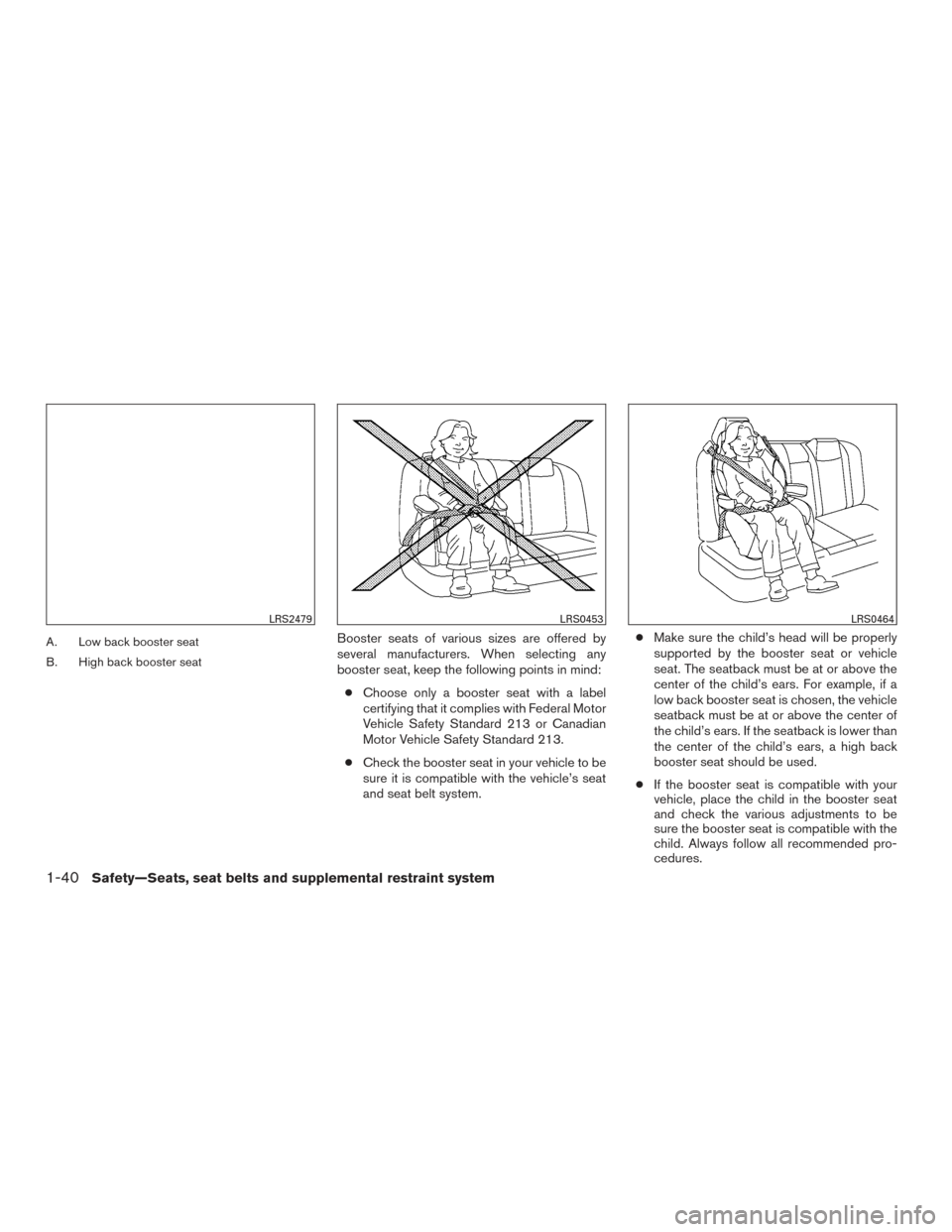
A. Low back booster seat
B. High back booster seatBooster seats of various sizes are offered by
several manufacturers. When selecting any
booster seat, keep the following points in mind:● Choose only a booster seat with a label
certifying that it complies with Federal Motor
Vehicle Safety Standard 213 or Canadian
Motor Vehicle Safety Standard 213.
● Check the booster seat in your vehicle to be
sure it is compatible with the vehicle’s seat
and seat belt system. ●
Make sure the child’s head will be properly
supported by the booster seat or vehicle
seat. The seatback must be at or above the
center of the child’s ears. For example, if a
low back booster seat is chosen, the vehicle
seatback must be at or above the center of
the child’s ears. If the seatback is lower than
the center of the child’s ears, a high back
booster seat should be used.
● If the booster seat is compatible with your
vehicle, place the child in the booster seat
and check the various adjustments to be
sure the booster seat is compatible with the
child. Always follow all recommended pro-
cedures.
LRS2479LRS0453LRS0464
1-40Safety—Seats, seat belts and supplemental restraint system
Page 58 of 402
All U.S. states and Canadian provinces or
territories require that infants and small
children be restrained in an approved child
restraint at all times while the vehicle is
being operated.
The instructions in this section apply to booster
seat installation in the rear seats or the front
passenger seat.
Booster seat installation
WARNING
To avoid injury to child, do not use the
lap/shoulder belt in the Automatic Lock-
ing Retractor (ALR) mode when using a
booster seat with the seat belts.
For additional information, refer to all Warnings
and Cautions in the “Child safety”, “Child re-
straints” and “Booster seats” sections of this
manual before installing a child restraint.
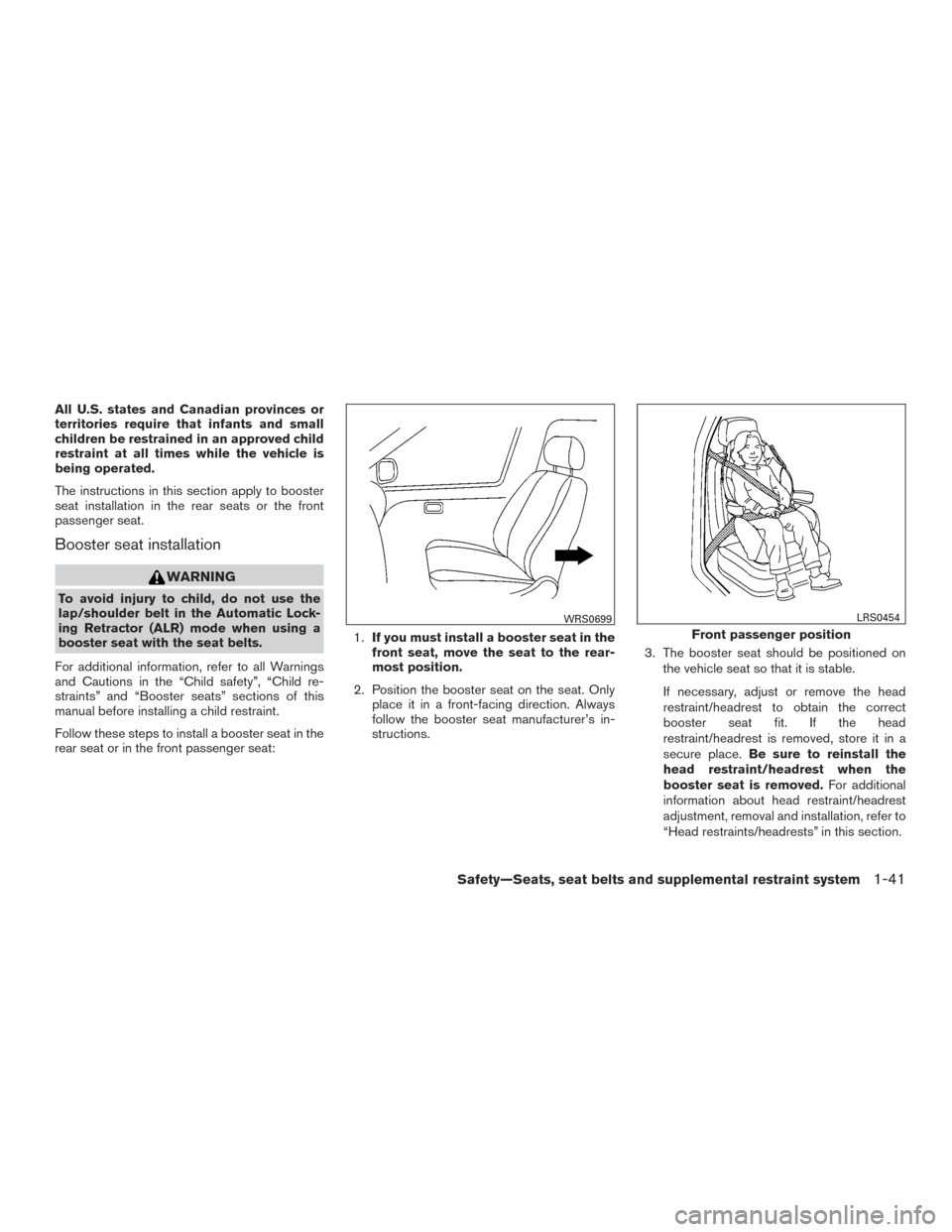
Follow these steps to install a booster seat in the
rear seat or in the front passenger seat: 1.
If you must install a booster seat in the
front seat, move the seat to the rear-
most position.
2. Position the booster seat on the seat. Only place it in a front-facing direction. Always
follow the booster seat manufacturer’s in-
structions. 3. The booster seat should be positioned on
the vehicle seat so that it is stable.
If necessary, adjust or remove the head
restraint/headrest to obtain the correct
booster seat fit. If the head
restraint/headrest is removed, store it in a
secure place. Be sure to reinstall the
head restraint/headrest when the
booster seat is removed. For additional
information about head restraint/headrest
adjustment, removal and installation, refer to
“Head restraints/headrests” in this section.
WRS0699
Front passenger position
LRS0454
Safety—Seats, seat belts and supplemental restraint system1-41
Page 94 of 402
The Intelligent Key warning light blinks red if the
Intelligent Key is taken outside of the vehicle
while the ignition switch is placed in the ACC or
ON position.● If the Intelligent Key warning light blinks,
make sure of the location of the Intelligent
Key as soon as possible. The Intelligent Key
should be carried by the driver while operat-
ing the vehicle.
● The Intelligent Key warning light turns off
about 10 seconds after the Intelligent Key is
brought inside the vehicle.
The Intelligent Key warning light blinks green
indicating that the Intelligent Key battery is almost
discharged.
For additional information, refer to “NISSAN In-
telligent Key®” in the “Pre-driving checks and
adjustments” section of this manual.
Power steering warning light
WARNING
● If the engine is not running or is turned
off while driving, the power assist for
the steering will not work. Steering will
be harder to operate. ●
When the power steering warning light
illuminates with the engine running,
there will be no power assist for the
steering. You will still have control of
the vehicle, but the steering will be
harder to operate. Have the power
steering system checked. It is recom-
mended you visit a NISSAN dealer for
this service.
When the ignition switch is placed in the ON
position, the power steering warning light illumi-
nates. After starting the engine, the power steer-
ing warning light turns off. This indicates the
power steering is operational.
If the power steering warning light illuminates
while the engine is running, it may indicate the
power steering is not functioning properly and
may need servicing. Have the power steering
checked. It is recommended you visit a NISSAN
dealer for this service.
When the power steering warning light illumi-
nates with the engine running, there will be no
power assist for the steering, but you will still
have control of the vehicle. At this time, greater
steering effort is required to operate the steering
wheel, especially in sharp turns and at low
speeds. For additional information, refer to “Power steer-
ing” in the “Starting and driving” section of this
manual.
P position selecting warning
light (if so equipped)
The light blinks red and the warning buzzer
sounds if you are outside of the vehicle with the
Intelligent Key and the engine is off, but the shift
lever is not in the P (Park) position.
When the warning light blinks, place the ignition
switch in the ON position, move the shift lever to
the P (Park) position, then place the ignition
switch in the LOCK position.
Seat belt warning light andchime
The light and chime remind you to fasten your
seat belts. The light illuminates whenever the
ignition switch is placed in the ON or START
position and remains illuminated until the driver’s
seat belt is fastened. At the same time, the chime
sounds for about 6 seconds unless the driver’s
seat belt is securely fastened.
Instruments and controls2-17
Page 145 of 402
REAR HATCH RELEASE
The rear hatch release mechanism allows the rear
hatch to be opened in the event of a discharged
battery.
To release the rear hatch from the inside of the
vehicle, perform the following operations:1. Fold the rear seats down. For additional information, refer to “Folding rear seat” in the
“Safety — seats, seat belts and supplemen-
tal restraint system” section of this manual.
2. Insert a suitable tool in the access opening. Move the release lever to the left (passenger
side) . The rear hatch will be unlatched. 3. Use the exterior rear hatch handle to open.
NOTE:
If you had to open the rear hatch using this
lever, have your vehicle checked. It is rec-
ommended you visit a NISSAN dealer for
this service as soon as possible.
OPENER OPERATION
The fuel-filler door release is located below the
instrument panel. To open the fuel-filler door, pull
the release. To lock, close the fuel-filler door
securely.
LPD2366LPD2371
FUEL-FILLER DOOR
3-26Pre-driving checks and adjustments
Page 331 of 402
on a fairly steep hill with only the parking brake
applied. If the parking brake needs adjustment, it
is recommended that you visit a NISSAN dealer
for this service.
SeatsCheck seat position controls such as seat
adjusters, seat back recliner, etc. to ensure they
operate smoothly and all latches lock securely in
every position. Check that the head
restraints/headrests move up and down
smoothly and the locks hold securely in all
latched positions.
Seat belts Check that all parts of the seat belt
system (for example, buckles, anchors, adjusters
and retractors) operate properly and smoothly,
and are installed securely. Check the belt web-
bing for cuts, fraying, wear or damage.
Steering wheel Check for changes in the steer-
ing system, such as excessive freeplay, hard
steering or strange noises.
Warning lights and chimes Make sure all
warning lights and chimes are operating properly.
Windshield wiper and washer* Check that
the wipers and washer operate properly and that
the wipers do not streak.
Windshield defroster Check that the air
comes out of the defroster outlets properly and in
sufficient quantity when operating the heater or
air conditioner.Under the hood and vehicle
The maintenance items listed here should be
checked periodically (for example, each time you
check the engine oil or refuel) .
Battery* Check the fluid level in each cell. It
should be between the MAX and MIN lines. Ve-
hicles operated in high temperatures or under
severe conditions require frequent checks of the
battery fluid level.
NOTE:
Care should be taken to avoid situations
that can lead to potential battery discharge
and potential no-start conditions such as:
1. Installation or extended use of electronic accessories that consume battery power
when the engine is not running (Phone char-
gers, GPS, DVD players, etc.)
2. Vehicle is not driven regularly and/or only driven short distances. In these cases, the
battery may need to be charged to maintain
battery health.
Brake and clutch (if so equipped) fluid lev-
els* Make sure that the brake and clutch fluid
level is between the MIN and MAX lines on the
reservoir. Engine coolant level*
Check the coolant level
when the engine is cold.
Engine drive belts* Make sure the drive belts
are not frayed, worn, cracked or oily.
Engine oil level* Check the level after parking
the vehicle on a level surface with the engine off.
Wait more than 10 minutes for the oil to drain
back into the oil pan.
Exhaust system Make sure there are no loose
supports, cracks or holes. If the sound of the
exhaust seems unusual or there is a smell of
exhaust fumes, immediately have the exhaust
system inspected. It is recommended that you
visit a NISSAN dealer for this service. For addi-
tional information, refer to “Exhaust gas (carbon
monoxide)” in the “Starting and driving” section of
this manual.
Fluid leaks Check under the vehicle for fuel, oil,
water or other fluid leaks after the vehicle has
been parked for a while. Water dripping from the
air conditioner (if so equipped) after use is nor-
mal. If you should notice any leaks or if gasoline
fumes are evident, check for the cause and have
it corrected immediately.
8-4Maintenance and do-it-yourself
Page 397 of 402
K
Key.........................3-2
Key fob battery replacement .......8-24,8-24
Keyless entry With Intelligent Key system
(See Intelligent Key system) ......3-9,3-17
Keys NISSAN Intelligent Key® .......3-3,3-11
L
Labels Air conditioner specification label .....9-12
C.M.V.S.S. certification label ........9-11
Emissioncontrolinformationlabel.....9-11
Engine serial number ............9-11
F.M.V.S.S. certification label .........9-11
Tire and Loading Information label .....9-12
Vehicle identification number (VIN) .....9-10
Vehicle identification number (VIN) plate . .9-10
Warning labels (for SRS) ..........1-58
LATCH (Lower Anchors and Tethers for CHildren)
System ......................1-24
License plate Installing the license plate ..........9-13
Light Airbagwarninglight.........1-59,2-18
Brake light (See stop light) .........8-29
Bulb check/instrument panel ........2-13
Bulb replacement ..............8-29
Charge warning light ............2-14
ExteriorandInteriorlights..........8-29
Foglights...................8-28 Foglightswitch ...............2-28
Headlight and turn signal switch
......2-25
Headlight control switch ..........2-25
Headlights..................8-27
Interiorlight..............2-40,2-41
Lightbulbs..................8-27
Low tire pressure warning light .......2-15
Low windshield-washer fluid warning
light......................2-16
Passenger air bag and status light .....1-51
Security indicator light ............2-20
Warning/indicator lights and audible
reminders ............2-12,2-13,2-18
Lights.......................8-27
Lock Child safety rear door lock ..........3-7
Door locks ...................3-6
Fuel-filler door lock opener lever ......3-26
Power door locks ............3-6,3-7
Loose fuel cap warning ..........2-6,3-27
Lowfuelwarninglight..............2-14
Low tire pressure warning light .........2-15
Low windshield-washer fluid warning light . . .2-16
Luggage (See vehicle loading information) . .9-13
M
Maintenance Generalmaintenance.............8-2
Insidethevehicle...............8-3
Maintenance precautions ...........8-5
Outside the vehicle ..............8-2
Seatbeltmaintenance............1-19
Underthehoodandvehicle .........8-4
Maintenancerequirements............8-2 Malfunction indicator light
............2-19
Manual front seat adjustment ...........1-3
Manual windows .................2-40
Mappocket....................2-31
Meters and gauges ................2-3
Instrument brightness control ........2-27
Mirror Outside mirrors ...............3-31
Rearview ...................3-30
Vanity mirror .................3-30
Mirrors ......................3-30
Mobileapps ...................4-78
N
NissanConnect
SM................4-78
NISSAN Intelligent Key® .........3-3,3-11
NISSAN Intelligent Key® battery discharge
indicator .....................5-12
NISSAN Vehicle Immobilizer
System ............2-21,3-5,5-10,5-13
NISSAN voice recognition system ......4-112
O
Octane rating (See fuel octane rating) ......9-5
Odometer .....................2-5
Oil Capacities and recommended
fuel/lubricants.................9-2
Changingengineoil.............8-11
Changing engine oil filter ..........8-12
Checking engine oil level ..........8-10
Engineoil...................8-10
10-4
Page 398 of 402
Engine oil and oil filter recommendation . . .9-6
Engine oil viscosity..............9-7
Oneshotcall...........4-83,4-97,4-107
Outside mirrors .................3-31
Overheat Ifyourvehicleoverheats...........6-14
Owner’s manual order form ...........9-21
Owner’s manual/service manual order
information ....................9-21
P
Parking Parking brake operation ...........5-20
Parking/parking on hills ...........5-25
Parking brake ...................5-20
Phone, Bluetooth® hands-free
system ...............4-79,4-94,4-104
Power Power door locks ............3-6,3-7
Power outlet .................2-31
Power rear windows .............2-39
Power steering system ...........5-26
Power windows ...............2-38
Rear power windows ............2-39
Power outlet ...................2-31
Power steering ..................5-26
Precautions Maintenance precautions ...........8-5
Precautions on booster
seats...........1-22,1-29,1-35,1-39
Precautions on child
restraints .........1-22,1-29,1-35,1-39
Precautionsonseatbeltusage.......1-10 Precautions on supplemental restraint
system
....................1-42
Precautions when starting and driving ....5-2
Programmablefeatures ..........4-7,4-49
Push starting ...................6-14
R
Radio Car phone or CB radio ...........4-79
FM-AM radio with compact disc (CD)
player .....................4-44
FM/AM radio with compact disc (CD)
player .....................4-48
FM/AM/SAT radio with compact disc (CD)
player .................4-53,4-58
Steering wheel audio control switch ....4-76
Readiness for inspection maintenance (I/M)
test........................9-20
Rear center seat belt ..............1-16
Rear power windows ..............2-39
Rearseat......................1-4
Rearview mirror .................3-30
RearView Monitor ................4-10
Rear window defroster switch .........2-25
Rear window wiper and washer switches . . .2-24
Recommended Fluids ...............9-2
Recorders EventData..................9-20
Refrigerant recommendation ...........9-7
Registering a vehicle in another country ....9-10
Reporting safety defects (US only) .......9-19 S
Safety Child safety rear door lock ..........3-7
Child seat belts .....1-22,1-29,1-35,1-39
Reporting safety defects (US only) .....9-19
Seat adjustment Front manual seat adjustment ........1-3
Rear seat adjustment .............1-4
Seatbackpockets................2-32
Seat belt Child safety ..................1-19
Infants and small children ..........1-20
Injured Person ................
1-13
Largerchildren................1-20
Precautions on seat belt usage .......1-10
Pregnant women ...............1-13
Rear center seat belt ............1-16
Seatbeltextenders .............1-18
Seatbeltmaintenance............1-19
Seatbelts................1-10,7-5
Shoulder belt height adjustment ......1-18
Three-point type with retractor .......1-13
Seat belt extenders ...............1-18
Seatbeltwarninglight..........1-13,2-17
Seats Adjustment ...................1-2
Armrests....................1-5
Frontseats...................1-2
Heatedseats.................2-29
Manualfrontseatadjustment.........1-3
Rearseat....................1-4
Seats/floor mats ..................7-4
Security indicator light ..............2-20
10-5