Page 456 of 636
●Keep the battery surface clean and dry.
Clean the battery with a solution of baking
soda and water.
● Make certain the terminal connections are
clean and securely tightened.
● Push the ignition switch to the OFF position
and wait 2 minutes before disconnecting the
battery.
● If the vehicle is not to be used for 30 days or
longer, disconnect the negative (-) battery
terminal cable to prevent discharge.
NOTE:
Care should be taken to avoid situations
that can lead to potential battery discharge
and potential no-start conditions such as: 1. Installation or extended use of electronic accessories that consume battery power
when the engine is not running (Phone char-
gers, GPS, DVD players, etc.) .
2. Vehicle is not driven regularly and/or only driven short distances. In these cases, the
battery may need to be charged to maintain
battery health.WARNING
●Do not expose the battery to flames, an
electrical spark or a cigarette. Hydrogen
gas generated by the battery is explo-
sive. Explosive gases can cause blind-
ness or injury. Do not allow battery fluid
to contact your skin, eyes, fabrics or
painted surfaces. Sulfuric acid can
cause blindness or injury. After touch-
ing a battery or battery cap, do not
touch or rub your eyes. Thoroughly
wash your hands. If the acid contacts
your eyes, skin or clothing, immediately
flush with water for at least 15 minutes
and seek medical attention.
● Do not operate the vehicle if the fluid in
the battery is low. Low battery fluid can
cause a higher load on the battery
which can generate heat, reduce battery
life, and in some cases lead to an
explosion.
● When working on or near a battery, al-
ways wear suitable eye protection and
remove all jewelry.
● Battery posts, terminals and related ac-
cessories contain lead and lead com-
pounds. Wash hands after handling. ●
Keep battery out of the reach of
children.
● Do not tip the battery. Keep the vent
caps tight and the battery level.
BATTERY
Do-it-yourself8-13
Page 458 of 636
CAUTION
●Do not ground accessories directly to
the battery terminal. Doing so will by-
pass the variable voltage control sys-
tem and the vehicle battery may not
charge completely.
● Use electrical accessories with the en-
gine running to avoid discharging the
vehicle battery. Your vehicle is equipped with a variable voltage
control system. This system measures the
amount of electrical discharge from the battery
and controls voltage generated by the generator.
The current sensor
�Ais located near the battery
along the negative battery cable. If you add elec-
trical accessories to your vehicle, be sure to
ground them to a suitable body ground such as
the frame or engine block area.
1. Power steering fluid pump pulley
2. Automatic belt tensioner pulley
3. Water pump pulley
4. Cooling fan pulley
5. Air conditioner compressor pulley
6. Crankshaft pulley
7. Generator pulley
WARNING
Be sure the ignition switch is in the OFF or
LOCK position before servicing drive belt.
The engine could rotate unexpectedly.
LDI2959
VK56VD engine
WDI0661
VARIABLE VOLTAGE CONTROL
SYSTEM (if so equipped) DRIVE BELT
Do-it-yourself8-15
Page 459 of 636
1. Visually inspect the belt for signs of unusualwear, cuts, fraying or looseness. If the belt is
in poor condition or is loose, have it replaced
or adjusted. It is recommended that you visit
a NISSAN dealer for this service.
2. Have the belt checked regularly for condi- tion and tension in accordance with the
maintenance schedule. For additional infor-
mation, refer to the “Maintenance” section of
this manual.
For additional information on the Cummins 5.0L
engine drive belt, refer to the “Titan Diesel Own-
er’s Manual”.
REPLACING SPARK PLUGS
Iridium-tipped spark plugs
It is not necessary to replace iridium-tipped spark
plugs as frequently as conventional type spark
plugs because they last much longer. Follow the
maintenance log shown in the “Maintenance”
section of this manual. Do not service iridium-
tipped spark plugs by cleaning or regapping.
● Always replace spark plugs with rec-
ommended or equivalent ones.
WARNING
Be sure the engine and ignition switch are
off and that the parking brake is engaged
securely.
CAUTION
Be sure to use the correct socket to re-
move the spark plugs. An incorrect socket
can damage the spark plugs.
If replacement is required, it is recommended that
you visit a NISSAN dealer for this service.
LDI2972
SPARK PLUGS (gasoline engine only)
8-16Do-it-yourself
Page 460 of 636
WARNING
●Operating the engine with the air
cleaner removed can cause you or oth-
ers to be burned. The air cleaner not
only cleans the air, it stops the flame if
the engine backfires. If it isn’t there, and
the engine backfires, you could be
burned. Do not drive with the air cleaner
removed, and be careful when working
on the engine with the air cleaner
removed. ●
Never pour fuel into the throttle body or
attempt to start the engine with the air
cleaner removed. Doing so could result
in serious injury.
To remove the filter from the air cleaner, push the
tabs and pull the cover upward.
The viscous paper type filter element should not
be cleaned and reused. Replace the air filter
according to the maintenance log shown in the
“Maintenance” section of this manual.
When replacing the air filter, wipe the inside of
the air cleaner housing and the cover with a damp
cloth.
NOTE:
After installing a new air cleaner, make
sure the air cleaner cover is seated in the
housing and latch the tabs.
For additional information on the Cummins 5.0L
engine air cleaner, refer to the “Titan Diesel Own-
er’s Manual”.
IN-CABIN MICROFILTER
The in-cabin microfilter restricts the entry of air-
borne dust and pollen particles and reduces
some objectionable outside odors. The filter is
located behind the glove box. For additional in-
formation on change intervals, refer to “Standard
maintenance” in the “Maintenance” section of this
manual.
If replacement is required, it is recommended that
you visit a NISSAN dealer for this service.
VK56VD engine
LDI2960
AIR CLEANER
Do-it-yourself8-17
Page 462 of 636
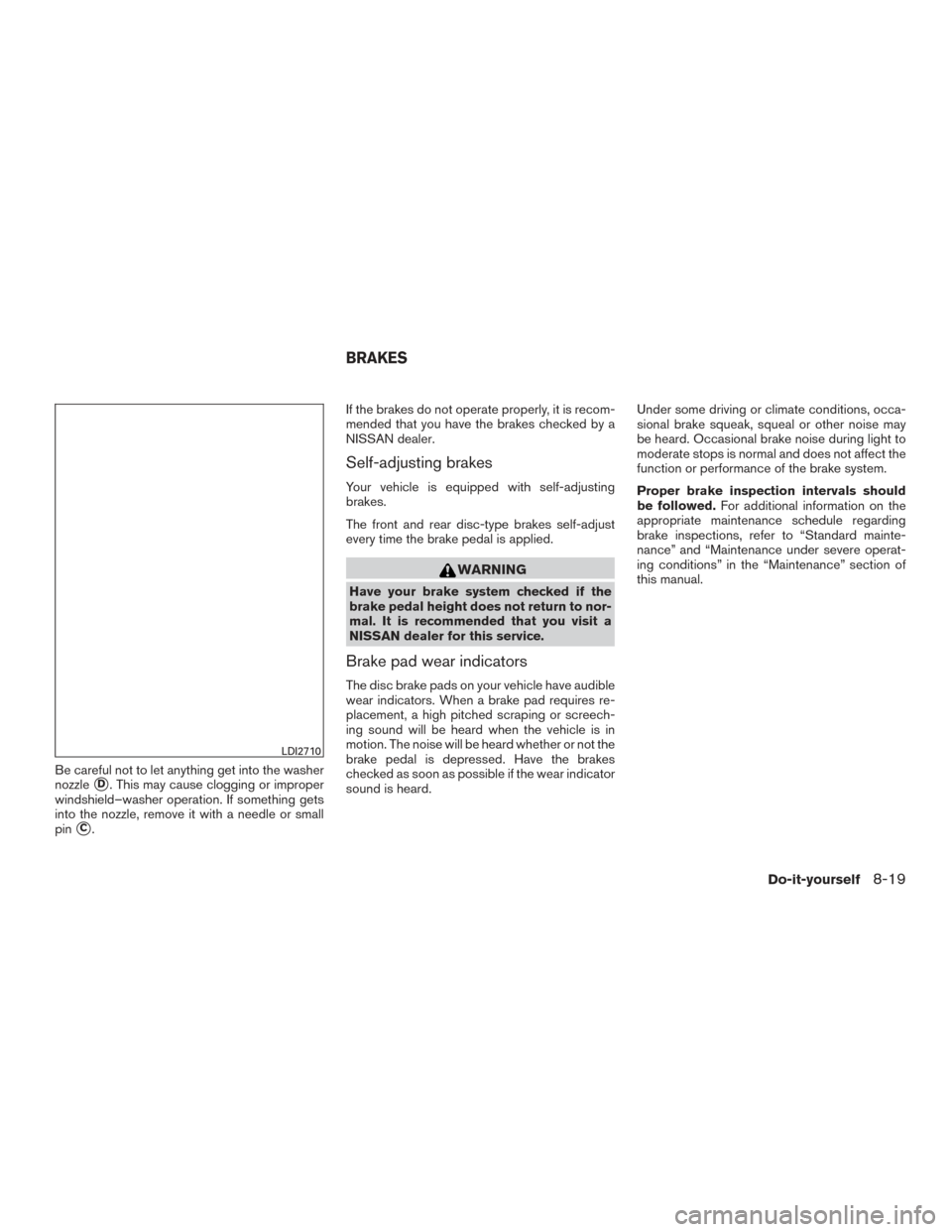
Be careful not to let anything get into the washer
nozzle
�D. This may cause clogging or improper
windshield–washer operation. If something gets
into the nozzle, remove it with a needle or small
pin
�C. If the brakes do not operate properly, it is recom-
mended that you have the brakes checked by a
NISSAN dealer.
Self-adjusting brakes
Your vehicle is equipped with self-adjusting
brakes.
The front and rear disc-type brakes self-adjust
every time the brake pedal is applied.
WARNING
Have your brake system checked if the
brake pedal height does not return to nor-
mal. It is recommended that you visit a
NISSAN dealer for this service.
Brake pad wear indicators
The disc brake pads on your vehicle have audible
wear indicators. When a brake pad requires re-
placement, a high pitched scraping or screech-
ing sound will be heard when the vehicle is in
motion. The noise will be heard whether or not the
brake pedal is depressed. Have the brakes
checked as soon as possible if the wear indicator
sound is heard.
Under some driving or climate conditions, occa-
sional brake squeak, squeal or other noise may
be heard. Occasional brake noise during light to
moderate stops is normal and does not affect the
function or performance of the brake system.
Proper brake inspection intervals should
be followed.
For additional information on the
appropriate maintenance schedule regarding
brake inspections, refer to “Standard mainte-
nance” and “Maintenance under severe operat-
ing conditions” in the “Maintenance” section of
this manual.
LDI2710
BRAKES
Do-it-yourself8-19
Page 463 of 636
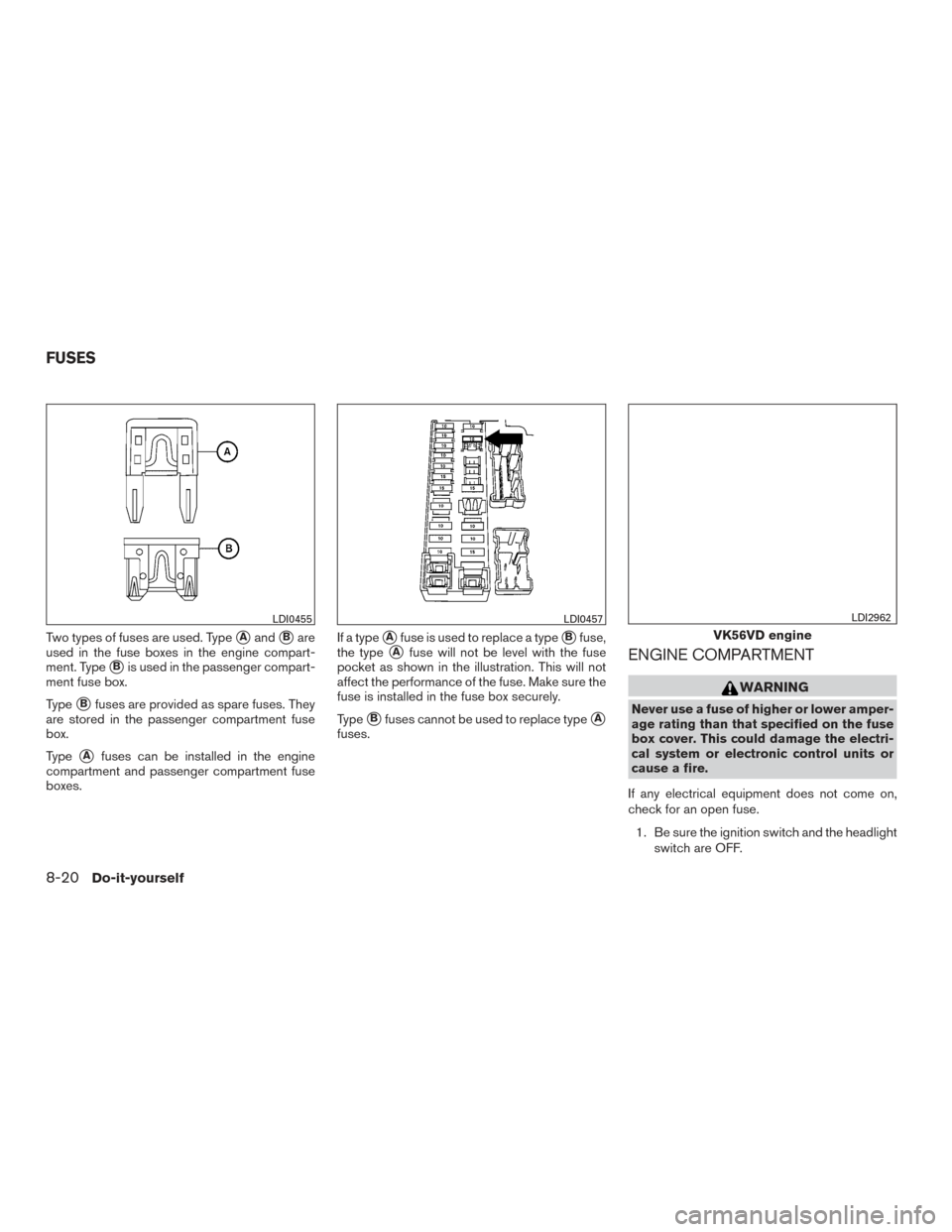
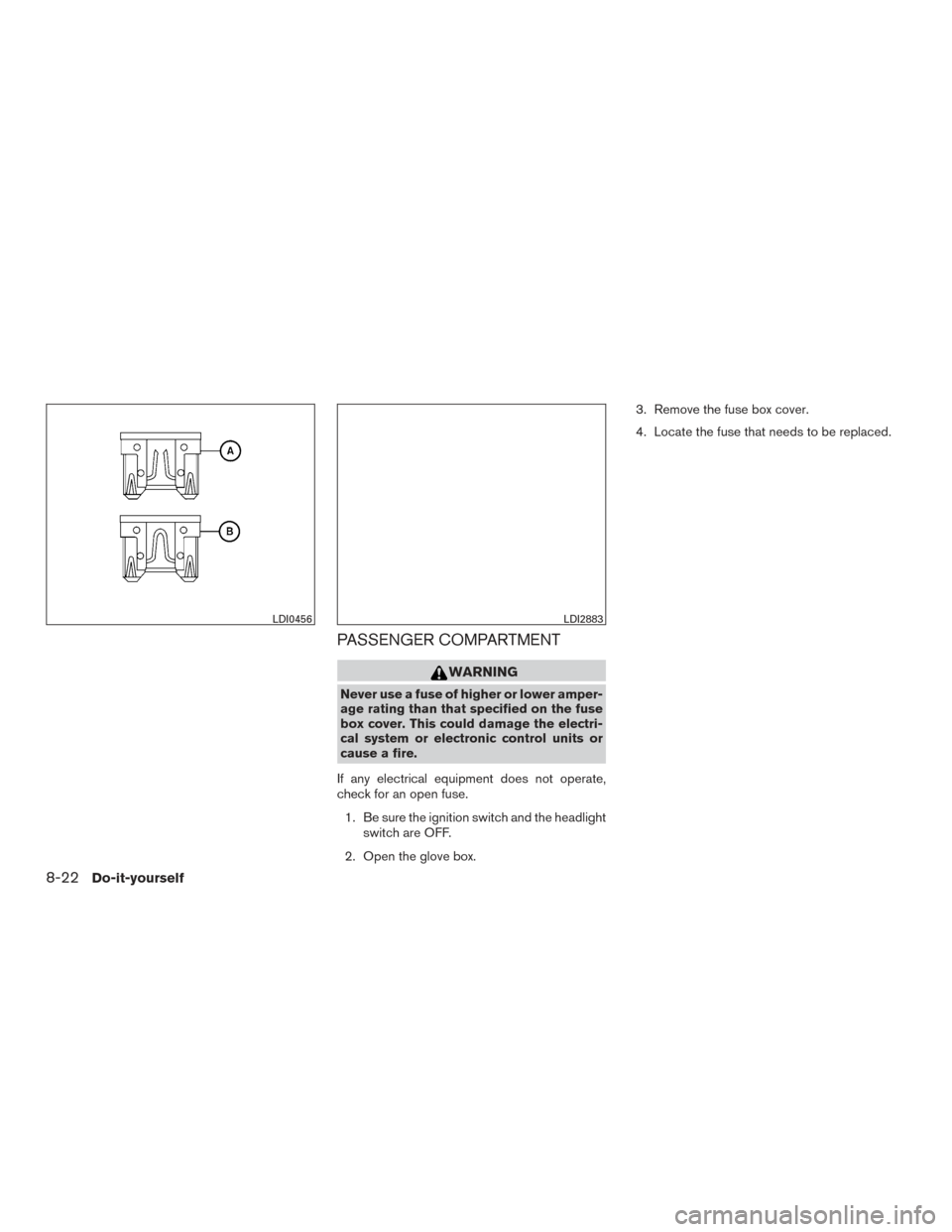
Two types of fuses are used. Type�Aand�Bare
used in the fuse boxes in the engine compart-
ment. Type
�Bis used in the passenger compart-
ment fuse box.
Type
�Bfuses are provided as spare fuses. They
are stored in the passenger compartment fuse
box.
Type
�Afuses can be installed in the engine
compartment and passenger compartment fuse
boxes. If a type
�Afuse is used to replace a type�Bfuse,
the type
�Afuse will not be level with the fuse
pocket as shown in the illustration. This will not
affect the performance of the fuse. Make sure the
fuse is installed in the fuse box securely.
Type
�Bfuses cannot be used to replace type�A
fuses.
ENGINE COMPARTMENT
WARNING
Never use a fuse of higher or lower amper-
age rating than that specified on the fuse
box cover. This could damage the electri-
cal system or electronic control units or
cause a fire.
If any electrical equipment does not come on,
check for an open fuse. 1. Be sure the ignition switch and the headlight switch are OFF.
LDI0455LDI0457
VK56VD engine
LDI2962
FUSES
8-20Do-it-yourself
Page 465 of 636
PASSENGER COMPARTMENT
WARNING
Never use a fuse of higher or lower amper-
age rating than that specified on the fuse
box cover. This could damage the electri-
cal system or electronic control units or
cause a fire.
If any electrical equipment does not operate,
check for an open fuse. 1. Be sure the ignition switch and the headlight switch are OFF.
2. Open the glove box. 3. Remove the fuse box cover.
4. Locate the fuse that needs to be replaced.
LDI0456LDI2883
8-22Do-it-yourself
Page 474 of 636
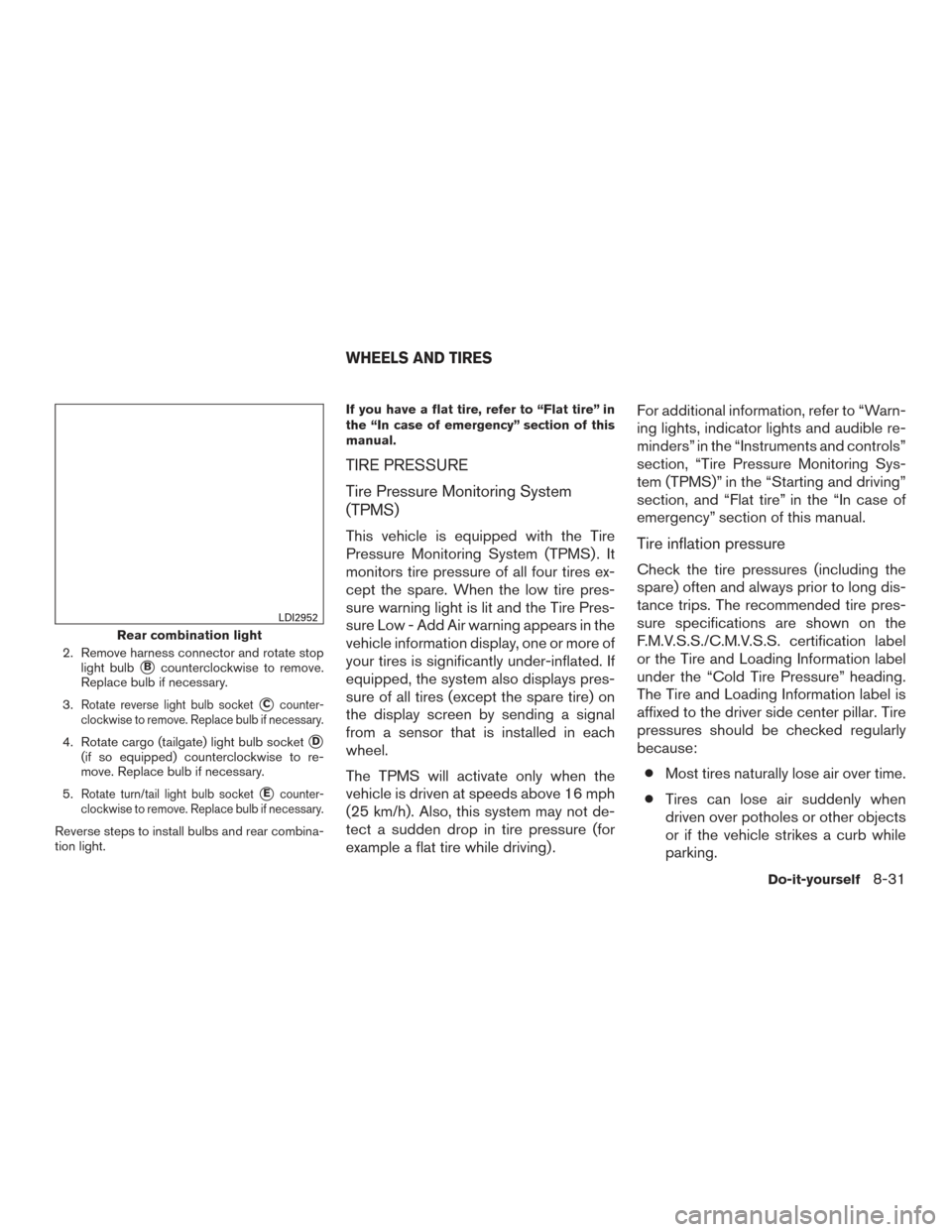
2. Remove harness connector and rotate stoplight bulb
�Bcounterclockwise to remove.
Replace bulb if necessary.
3.
Rotate reverse light bulb socket�Ccounter-
clockwise to remove. Replace bulb if necessary.
4. Rotate cargo (tailgate) light bulb socket�D
(if so equipped) counterclockwise to re-
move. Replace bulb if necessary.
5.
Rotate turn/tail light bulb socket�Ecounter-
clockwise to remove. Replace bulb if necessary.
Reverse steps to install bulbs and rear combina-
tion light. If you have a flat tire, refer to “Flat tire” in
the “In case of emergency” section of this
manual.
TIRE PRESSURE
Tire Pressure Monitoring System
(TPMS)
This vehicle is equipped with the Tire
Pressure Monitoring System (TPMS) . It
monitors tire pressure of all four tires ex-
cept the spare. When the low tire pres-
sure warning light is lit and the Tire Pres-
sure Low - Add Air warning appears in the
vehicle information display, one or more of
your tires is significantly under-inflated. If
equipped, the system also displays pres-
sure of all tires (except the spare tire) on
the display screen by sending a signal
from a sensor that is installed in each
wheel.
The TPMS will activate only when the
vehicle is driven at speeds above 16 mph
(25 km/h). Also, this system may not de-
tect a sudden drop in tire pressure (for
example a flat tire while driving) .
For additional information, refer to “Warn-
ing lights, indicator lights and audible re-
minders” in the “Instruments and controls”
section, “Tire Pressure Monitoring Sys-
tem (TPMS)” in the “Starting and driving”
section, and “Flat tire” in the “In case of
emergency” section of this manual.Tire inflation pressure
Check the tire pressures (including the
spare) often and always prior to long dis-
tance trips. The recommended tire pres-
sure specifications are shown on the
F.M.V.S.S./C.M.V.S.S. certification label
or the Tire and Loading Information label
under the “Cold Tire Pressure” heading.
The Tire and Loading Information label is
affixed to the driver side center pillar. Tire
pressures should be checked regularly
because:
● Most tires naturally lose air over time.
● Tires can lose air suddenly when
driven over potholes or other objects
or if the vehicle strikes a curb while
parking.
Rear combination light
LDI2952
WHEELS AND TIRES
Do-it-yourself8-31