Page 613 of 636
INSPECTION
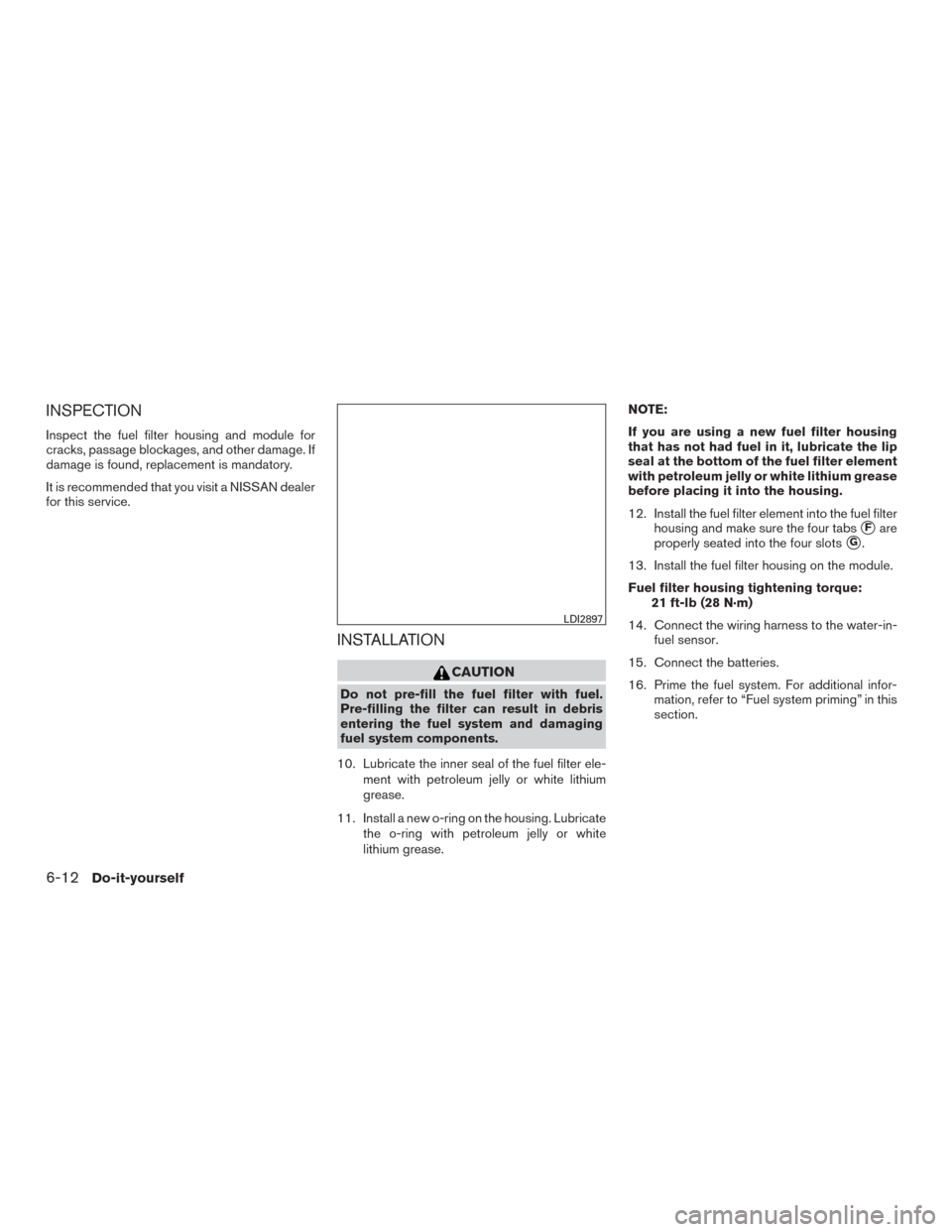
Inspect the fuel filter housing and module for
cracks, passage blockages, and other damage. If
damage is found, replacement is mandatory.
It is recommended that you visit a NISSAN dealer
for this service.
INSTALLATION
CAUTION
Do not pre-fill the fuel filter with fuel.
Pre-filling the filter can result in debris
entering the fuel system and damaging
fuel system components.
10. Lubricate the inner seal of the fuel filter ele- ment with petroleum jelly or white lithium
grease.
11. Install a new o-ring on the housing. Lubricate the o-ring with petroleum jelly or white
lithium grease. NOTE:
If you are using a new fuel filter housing
that has not had fuel in it, lubricate the lip
seal at the bottom of the fuel filter element
with petroleum jelly or white lithium grease
before placing it into the housing.
12. Install the fuel filter element into the fuel filter
housing and make sure the four tabs
�Fare
properly seated into the four slots
�G.
13. Install the fuel filter housing on the module.
Fuel filter housing tightening torque: 21 ft-lb (28 N·m)
14. Connect the wiring harness to the water-in- fuel sensor.
15. Connect the batteries.
16. Prime the fuel system. For additional infor- mation, refer to “Fuel system priming” in this
section.
LDI2897
6-12Do-it-yourself
Page 615 of 636
CAUTION
Clean all around the filter area before dis-
assembly. Dirt or contaminants can dam-
age the fuel system.
REMOVAL
WARNING
●Depending on the circumstance, fuel is
flammable. When inspecting or per-
forming service or repairs on the fuel
system, to reduce the possibility of fire
and resulting severe personal injury,
death, or property damage, never
smoke or allow sparks or flames (such
as pilot lights, electrical switches, or
welding equipment) in the work area.
● Do not bleed the fuel system of a hot
engine; this can result in fuel spilling
onto a hot exhaust manifold, which can
cause a fire.
1. Push the ignition switch to the OFF position and wait 2 minutes before disconnecting the
battery.
2. Disconnect the batteries.
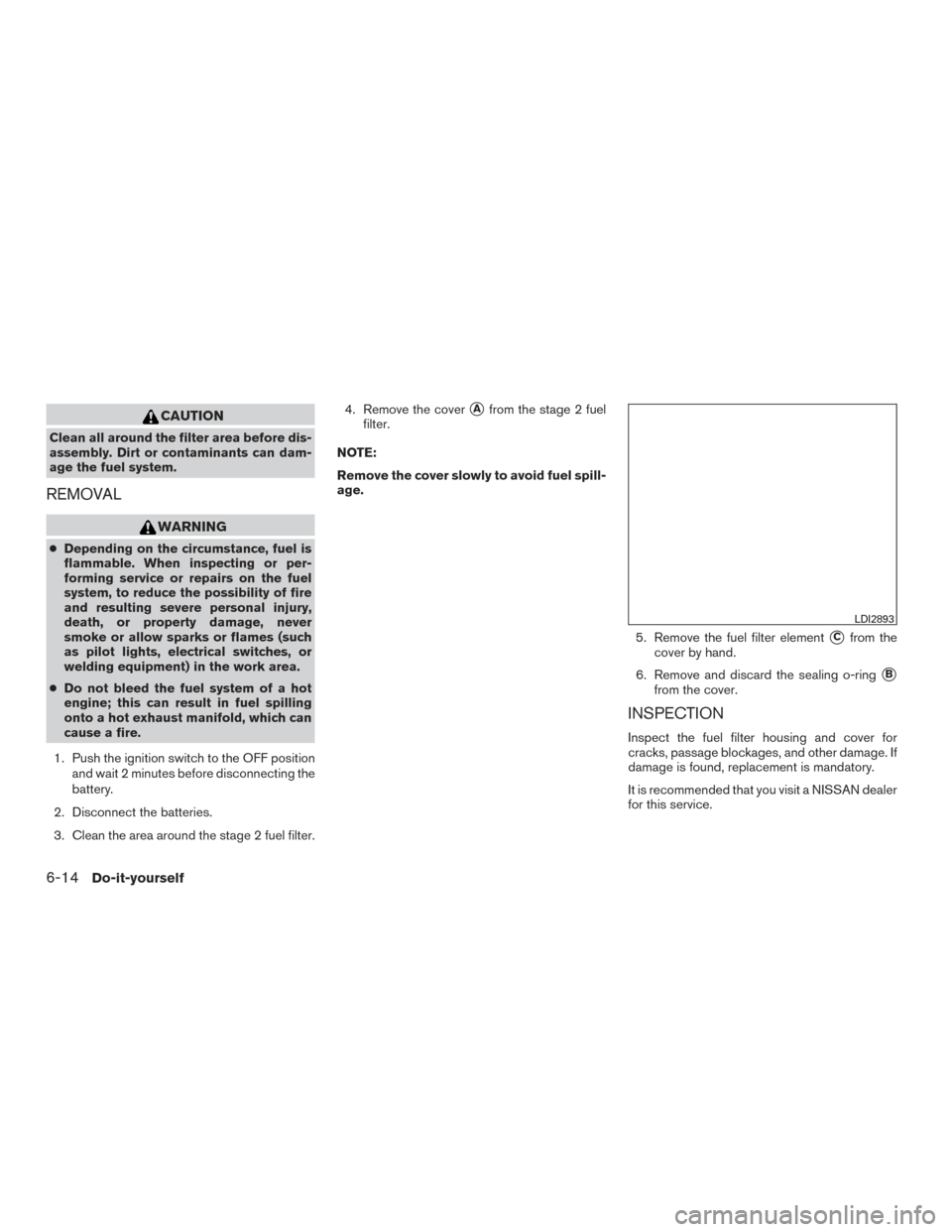
3. Clean the area around the stage 2 fuel filter. 4. Remove the cover
�Afrom the stage 2 fuel
filter.
NOTE:
Remove the cover slowly to avoid fuel spill-
age.
5. Remove the fuel filter element
�Cfrom the
cover by hand.
6. Remove and discard the sealing o-ring
�B
from the cover.
INSPECTION
Inspect the fuel filter housing and cover for
cracks, passage blockages, and other damage. If
damage is found, replacement is mandatory.
It is recommended that you visit a NISSAN dealer
for this service.
LDI2893
6-14Do-it-yourself
Page 617 of 636
DRAINING WATER
WARNING
To avoid the risk of personal injury or fire,
drain diesel fuel into an approved con-
tainer and safely dispose of in accordance
with local environmental regulations.
CAUTION
Continuing vehicle operation without
properly draining could cause serious
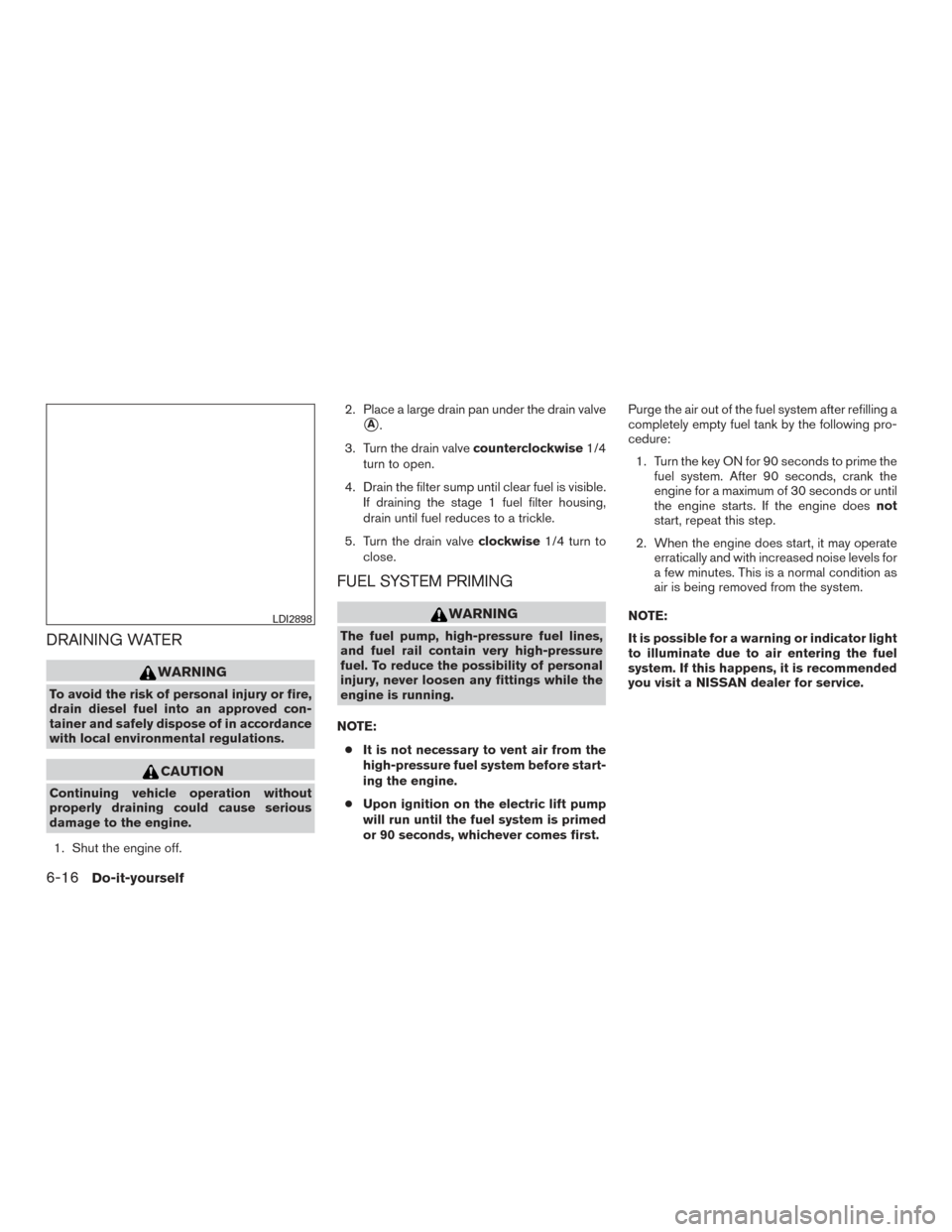
damage to the engine.1. Shut the engine off. 2. Place a large drain pan under the drain valve
�A.
3. Turn the drain valve counterclockwise1/4
turn to open.
4. Drain the filter sump until clear fuel is visible. If draining the stage 1 fuel filter housing,
drain until fuel reduces to a trickle.
5. Turn the drain valve clockwise1/4 turn to
close.
FUEL SYSTEM PRIMING
WARNING
The fuel pump, high-pressure fuel lines,
and fuel rail contain very high-pressure
fuel. To reduce the possibility of personal
injury, never loosen any fittings while the
engine is running.
NOTE: ● It is not necessary to vent air from the
high-pressure fuel system before start-
ing the engine.
● Upon ignition on the electric lift pump
will run until the fuel system is primed
or 90 seconds, whichever comes first. Purge the air out of the fuel system after refilling a
completely empty fuel tank by the following pro-
cedure:
1. Turn the key ON for 90 seconds to prime the fuel system. After 90 seconds, crank the
engine for a maximum of 30 seconds or until
the engine starts. If the engine does not
start, repeat this step.
2. When the engine does start, it may operate erratically and with increased noise levels for
a few minutes. This is a normal condition as
air is being removed from the system.
NOTE:
It is possible for a warning or indicator light
to illuminate due to air entering the fuel
system. If this happens, it is recommended
you visit a NISSAN dealer for service.
LDI2898
6-16Do-it-yourself
Page 619 of 636
AUTOMATIC REGENERATION
Automatic regeneration occurs when the control
module detects the exhaust filter needs to be
cleaned. This is a normal process and will not
typically require any operator interaction.
If the automatic regeneration is not able to clean
the exhaust filter the vehicle information display
will display the following messages in order of
severity:● Exhaust Filter Overloaded See Owners
Manual for Drive Pattern
● Exhaust Filter Overloaded Engine Power
Reduced See Owners Manual for
● Exhaust Filter Overloaded Immediate Ser-
vice Required
The instructions for these messages in the “Me-
ters and Gauges” section of this manual will
inform the driver to modify their driving pattern to
enable the automatic regeneration process.
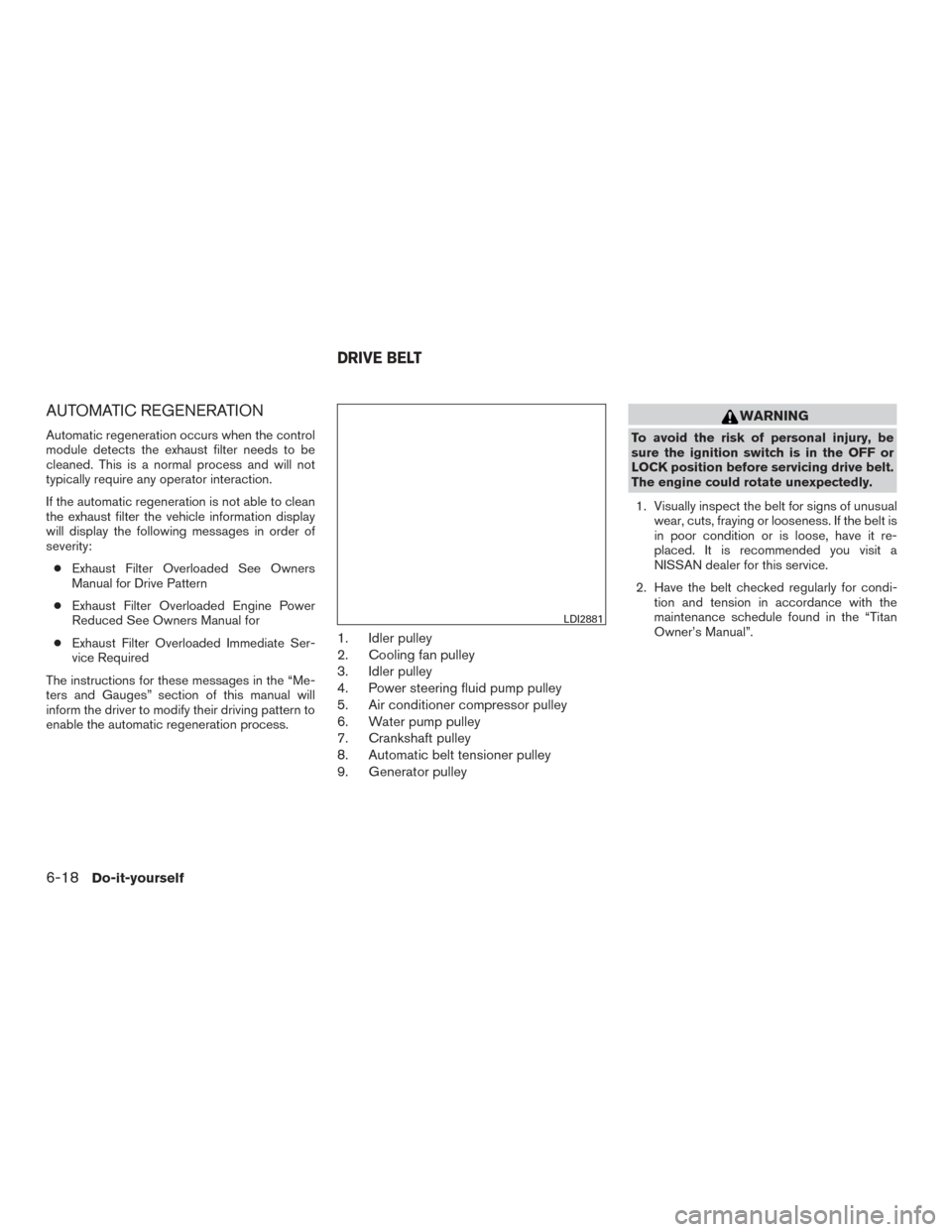
1. Idler pulley
2. Cooling fan pulley
3. Idler pulley
4. Power steering fluid pump pulley
5. Air conditioner compressor pulley
6. Water pump pulley
7. Crankshaft pulley
8. Automatic belt tensioner pulley
9. Generator pulley
WARNING
To avoid the risk of personal injury, be
sure the ignition switch is in the OFF or
LOCK position before servicing drive belt.
The engine could rotate unexpectedly.
1. Visually inspect the belt for signs of unusual wear, cuts, fraying or looseness. If the belt is
in poor condition or is loose, have it re-
placed. It is recommended you visit a
NISSAN dealer for this service.
2. Have the belt checked regularly for condi- tion and tension in accordance with the
maintenance schedule found in the “Titan
Owner’s Manual”.
LDI2881
DRIVE BELT
6-18Do-it-yourself
Page 623 of 636
In order to maintain the proper operation of a
diesel engine, it is important to take proper care
of it, which includes cleaning as indicated.
CLEANING THE ENGINE
Engines are more efficient when they are clean
because grease and dirt buildup keep the engine
warmer than normal.
When washing:● Take care when using a power washer to
clean the engine. The high-pressure fluid
could penetrate the sealed parts and cause
damage.
● Do not spray a hot engine with cold water to
avoid cracking the engine block or other
engine components.
● Spray an engine shampoo and/or degreaser
on all parts that require cleaning and pres-
sure rinse clean.
● Never wash or rinse the engine while it is hot
or running; water in the running engine may
cause internal damage.
● Never wash or rinse any control box electri-
cal connections.
● Cover the battery, power distribution box,
and air filter assembly to prevent water dam-
age when cleaning the engine.
CLEANING THE EXHAUST
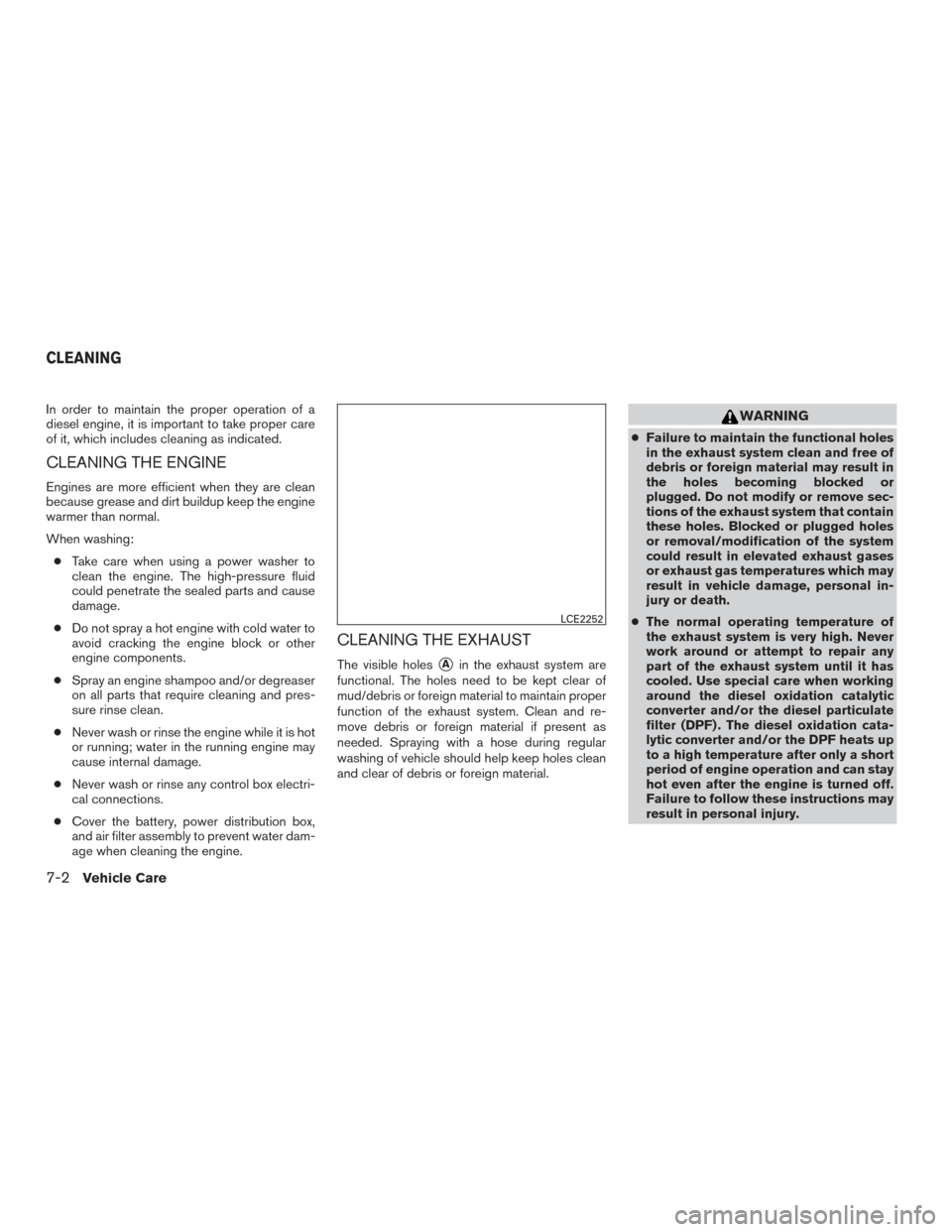
The visible holes�Ain the exhaust system are
functional. The holes need to be kept clear of
mud/debris or foreign material to maintain proper
function of the exhaust system. Clean and re-
move debris or foreign material if present as
needed. Spraying with a hose during regular
washing of vehicle should help keep holes clean
and clear of debris or foreign material.
WARNING
● Failure to maintain the functional holes
in the exhaust system clean and free of
debris or foreign material may result in
the holes becoming blocked or
plugged. Do not modify or remove sec-
tions of the exhaust system that contain
these holes. Blocked or plugged holes
or removal/modification of the system
could result in elevated exhaust gases
or exhaust gas temperatures which may
result in vehicle damage, personal in-
jury or death.
● The normal operating temperature of
the exhaust system is very high. Never
work around or attempt to repair any
part of the exhaust system until it has
cooled. Use special care when working
around the diesel oxidation catalytic
converter and/or the diesel particulate
filter (DPF) . The diesel oxidation cata-
lytic converter and/or the DPF heats up
to a high temperature after only a short
period of engine operation and can stay
hot even after the engine is turned off.
Failure to follow these instructions may
result in personal injury.
LCE2252
CLEANING
7-2Vehicle Care
Page 624 of 636
●When cleaning blocked or plugged
holes in the exhaust system, care
should be taken to minimize the quan-
tity of water entering the exhaust sys-
tem. Excessive water that enters the
exhaust system could cause damage re-
quiring exhaust system to be replaced.
Vehicle Care7-3
Page 632 of 636
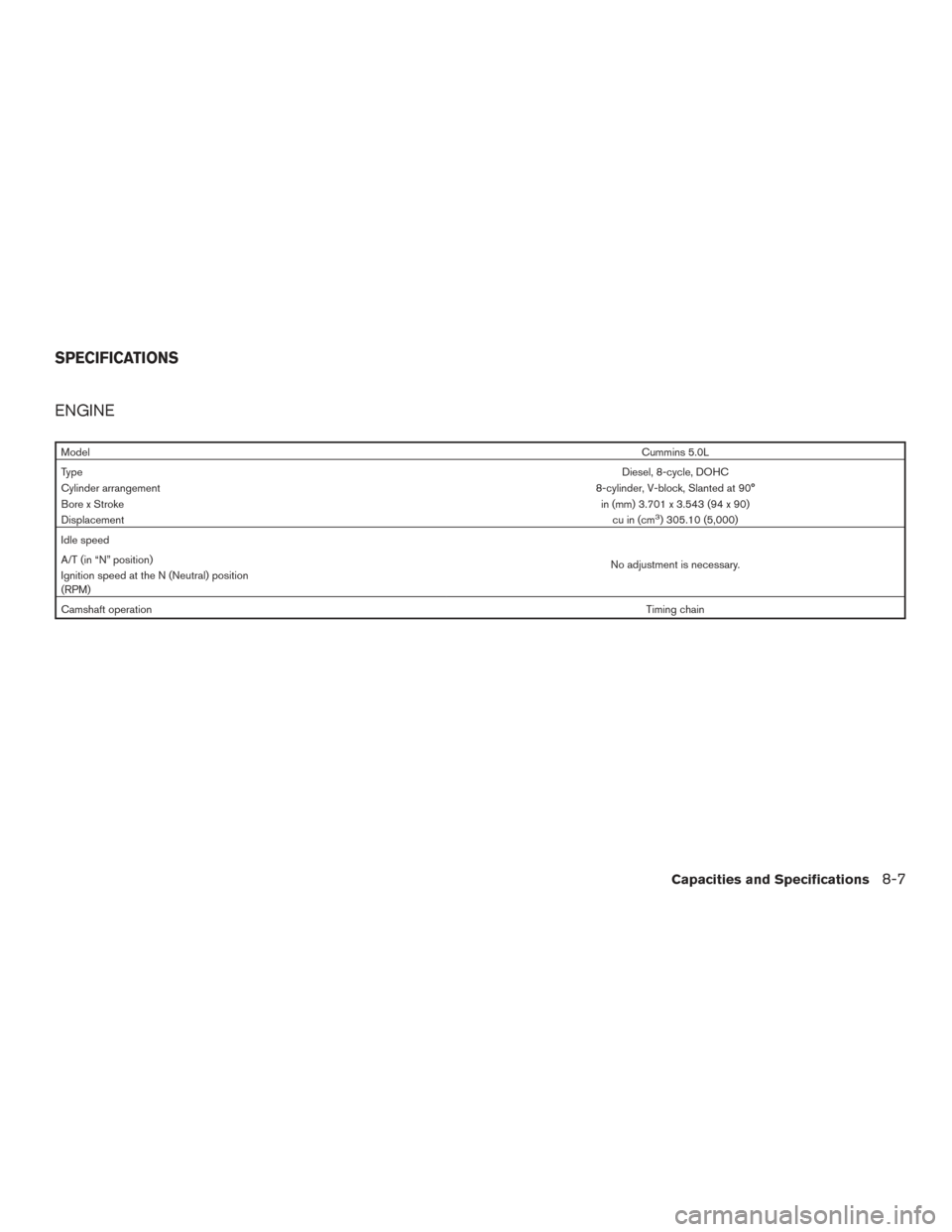
ENGINE
ModelCummins 5.0L
Type Diesel, 8-cycle, DOHC
Cylinder arrangement 8-cylinder, V-block, Slanted at 90°
Bore x Stroke in (mm) 3.701 x 3.543 (94 x 90)
Displacement cu in (cm
3) 305.10 (5,000)
Idle speed
No adjustment is necessary.
A/T (in “N” position)
Ignition speed at the N (Neutral) position
(RPM)
Camshaft operation
Timing chain
SPECIFICATIONS
Capacities and Specifications8-7