2016 NISSAN ROGUE tires
[x] Cancel search: tiresPage 446 of 478
Tire pressures
●When towing a trailer, inflate the ve-
hicle tires to the recommended cold
tire pressure indicated on the Tire
and Loading Information label.
● Trailer tire condition, size, load rating
and proper inflation pressure should
be in accordance with the trailer and
tire manufacturer’s specifications.
Safety chains
Always use suitable safety chains between your
vehicle and the trailer. The safety chains should
be crossed and should be attached to the hitch,
not to the vehicle bumper or axle. The safety
chains can be attached to the bumper if the hitch
ball is mounted to the bumper. Be sure to leave
enough slack in the chains to permit turning
corners.
Trailer lights
CAUTION
When splicing into the vehicle electrical
system, a commercially available power-
type module/converter must be used to
provide power for all trailer lighting. This
unit uses the vehicle battery as a direct
power source for all trailer lights while
using the vehicle tail light, stoplight and
turn signal circuits as a signal source. The
module/converter must draw no more that
15 milliamps from the stop and tail lamp
circuits. Using a module/converter that
exceeds these power requirements may
damage the vehicle’s electrical system.
See a reputable trailer retailer to obtain
the proper equipment and to have it
installed.
Trailer lights should comply with federal and/or
local regulations. For assistance in hooking up
trailer lights, contact a NISSAN dealer or repu-
table trailer retailer. Vehicles equipped with the
optional trailer tow package are equipped with a
7-pin trailer harness connector. If your trailer is
equipped with a flat 4-pin connector, an adapter
will be needed to connect the trailer lights to the
vehicle. Adapters are available at auto parts
stores and hitch retailers.
Pre-towing tips
● Be certain your vehicle maintains a level
position when a loaded and/or unloaded
trailer is hitched. Do not drive the vehicle if it
has an abnormal nose-up or nose-down
condition; check for improper tongue load,
overload, worn suspension or other possible
causes of either condition.
● Always secure items in the trailer to prevent
load shift while driving.
●
Keep the cargo load as low as possible in the
trailer to keep the trailer center of gravity low.
● Load the trailer so approximately 60% of the
trailer load is in the front half and 40% is in
the back half. Also make sure the load is
balanced side to side.
● Check your hitch, trailer tire pressure, ve-
hicle tire pressure, trailer light operation, and
trailer wheel lug nuts every time you attach a
trailer to the vehicle.
● Be certain your rearview mirrors conform to
all federal, state or local regulations. If not,
install any mirrors required for towing before
driving the vehicle.
●
Determine the overall height of the vehicle and
trailer so the required clearance is known.
Technical and consumer information9-23
Page 449 of 478
CAUTION
●Failure to follow these guidelines can
result in severe transmission damage.
● Never flat tow your All-wheel drive
(AWD) vehicle.
● DO NOT tow your All-wheel drive (AWD)
vehicle with any wheels on the ground.
Doing so may cause serious and expen-
sive damage to the powertrain.
● For emergency towing procedures refer
to “Towing recommended by NISSAN”
in the “In case of emergency” section of
this manual.
FLAT TOWING FOR FRONT WHEEL
DRIVE VEHICLE (if so equipped)
Towing your vehicle with all four wheels on the
ground is sometimes called flat towing. This
method is sometimes used when towing a vehicle
behind a recreational vehicle, such as a motor
home.
CAUTION
● Failure to follow these guidelines can
result in severe transmission damage.
● Whenever flat towing your vehicle, al-
ways tow forward, never backward.
● Never tow your front wheel drive vehicle
with the front tires on the ground. Doing
so may cause serious and expensive
damage to the powertrain.
● DO NOT tow your front wheel drive con-
tinuously variable transmission vehicle
with all four wheels on the ground (flat
towing) . Doing so WILL DAMAGE inter-
nal transmission parts due to lack of
transmission lubrication.
● For emergency towing procedures refer
to “Towing recommended by NISSAN”
in the “In case of emergency” section of
this manual.
Continuously Variable Transmission
To tow a vehicle equipped with a continuously
variable transmission, an appropriate vehicle
dolly MUST be placed under the towed vehicle’s
drive wheels. Alwaysfollow the dolly manufac-
turer’s recommendations when using their prod-
uct. DOT (Department of Transportation) Quality
Grades: All passenger car tires must conform to
federal safety requirements in addition to these
grades.
Quality grades can be found where applicable on
the tire sidewall between tread shoulder and
maximum section width. For example:
Treadwear 200 Traction AA Temperature A
Treadwear
The treadwear grade is a comparative rating
based on the wear rate of the tire when tested
under controlled conditions on a specified gov-
ernment test course. For example, a tire graded
150 would wear one and one-half (1 1/2) times
as well on the government course as a tire graded
100. The relative performance of tires depends
upon the actual conditions of their use, however,
and may depart significantly from the norm due to
variations in driving habits, service practices and
differences in road characteristics and climate.
Traction AA, A, B and C
The traction grades, from highest to lowest, are
AA, A, B, and C. Those grades represent the
tire’s ability to stop on wet pavement as mea-
sured under controlled conditions on specified
government test surfaces of asphalt and con-
crete. A tire marked C may have poor traction
performance.
UNIFORM TIRE QUALITY GRADING
9-26Technical and consumer information
Page 450 of 478
WARNING
The traction grade assigned to this tire is
based on straight-ahead braking traction
tests, and does not include acceleration,
cornering, hydroplaning, or peak traction
characteristics.
Temperature A, B and C
The temperature grades are A (the highest) , B,
and C, representing the tire’s resistance to the
generation of heat, and its ability to dissipate heat
when tested under controlled conditions on a
specified indoor laboratory test wheel. Sustained
high temperature can cause the material of the
tire to degenerate and reduce tire life, and exces-
sive temperature can lead to sudden tire failure.
The grade C corresponds to a level of perfor-
mance which all passenger car tires must meet
under the Federal Motor Safety Standard No.
109. Grades B and A represent higher levels of
performance on the laboratory test wheel than
the minimum required by law.
WARNING
The temperature grade for this tire is es-
tablished for a tire that is properly inflated
and not overloaded. Excessive speed,
under-inflation, or excessive loading, ei-
ther separately or in combination, can
cause heat build-up and possible tire
failure. Your NISSAN vehicle is covered by the following
emission warranties:
For USA
1. Emission Defects Warranty
2. Emissions Performance Warranty
Details of this warranty may be found with other
vehicle warranties in your Warranty Information
Booklet which comes with your NISSAN vehicle.
If you did not receive a Warranty Information
Booklet, or it is lost, you may obtain a replace-
ment by writing to: ● Nissan North America, Inc.
Consumer Affairs Department
P.O. Box 685003
Franklin, TN 37068-5003
For Canada
Emission Control System Warranty
Details of this warranty may be found with other
vehicle warranties in your Warranty Information
Booklet which comes with your NISSAN vehicle.
If you did not receive a Warranty Information
Booklet, or it is lost, you may obtain a replace-
ment by writing to: ● Nissan Canada Inc.
5290 Orbitor Drive
Mississauga, Ontario, L4W 4Z5
EMISSION CONTROL SYSTEM
WARRANTY
Technical and consumer information9-27
Page 460 of 478
Tirepressure.................8-32
Tire rotation..................8-41
Types of tires.................8-38
Uniform tire quality grading .........9-26
Wheels and tires ...............8-32
Wheel/tire size .................9-9
Tirepressure...................8-32 Low tire pressure warning light .......2-12
Tire Pressure Monitoring System (TPMS) ....5-3
Top tether strap child restraint .........1-30
Towing Flattowing...............9-25,9-26
Towing load/specification ..........9-20
Towtrucktowing...............6-13
Trailer towing .................9-17
Towing a trailer ..................9-17
Transmission Continuously Variable Transmission (CVT)
fluid......................8-12
Driving with Continuously Variable
Transmission (CVT) .............5-18
Travel (See registering a vehicle in another
country) ......................9-10
Trip odometer ...................2-4
Troubleshooting guide
(NISSAN voice recognition system) .....4-106
Turn signal switch ................2-41
U
Uniform tire quality grading ...........9-26
USB interface ...............4-61,4-63
Audio file operation ..........4-62,4-64 V
Vanity mirror ...................3-33
Vehicle dimensions and weights .........9-9
Vehicle dynamic control (VDC) off switch . . .2-43
Vehicle identification ...............9-10
Vehicle identification number (VIN) .......9-10
Vehicle identification number (VIN)
(Chassis number) ................9-10
Vehicle identification number (VIN) plate ....9-10
Vehicle immobilizer system ....2-33,5-12,5-15
Vehicle Information Display ...........2-19
Vehicle loading information ...........9-13
Vehicle recovery ..............6-15,6-16
Vehicle security system .............2-32
Vehicle security system (NISSAN Vehicle Immobi-
lizer System) , engine start .....2-33,5-12,5-15
Ventilators ....................4-31
Visors.......................3-33
Voice Prompt Interrupt ..........4-82,4-95
Voice recognition system ...........4-102
W
Warning Airbagwarninglight.........1-65,2-15
Anti-lock brake warning light ........2-11
Battery charge warning light ........2-12
Blind Spot Warning (BSW) warning
light ..................2-11,5-24
Brake warning light .............2-11
Hazard warning flasher switch ........6-2
Loose fuel cap warning ........2-30,3-31
Lowfuelwarninglight ........2-14,2-30 Low tire pressure warning light
.......2-12
Low windshield-washer fluid warning
light ..................2-14,2-30
Passenger air bag and status light .....1-56
Seat belt warning light ........1-18,2-15
Supplemental air bag warning light .1-65, 2-15
TPMS ......................2-4
Vehicle security system ...........2-32
Warning/indicator lights and audible
reminders ............2-10,2-11,2-15
Warning labels (for SRS) ..........1-64
W
arning/indicator lights and audible
reminders..............2-10,2-11,2-15 Audiblereminders.......2-10,2-11,2-15
Checkingbulbs ...............2-11
Indicatorlights.........2-10,2-11,2-15
Warning lights .........2-10,2-11,2-15
Warning lights ...........2-10,2-11,2-15
Warning lights, indicator lights and audible
reminders.....................2-10
Washer switch Rear window wiper and washer
switches...................2-35
Weights (See dimensions and weights) .....9-9
Wheels and tires .................8-32
Wheel/tire size ...................9-9
When traveling or registering in another
country ......................9-10
Windows .....................2-57
Locking passengers’ windows .......2-58
Power rear windows .............2-59
Rear power windows ............2-59
Windshield-washerfluid.............8-13
Windshieldwiperblades............8-18
10-7
Page 462 of 478
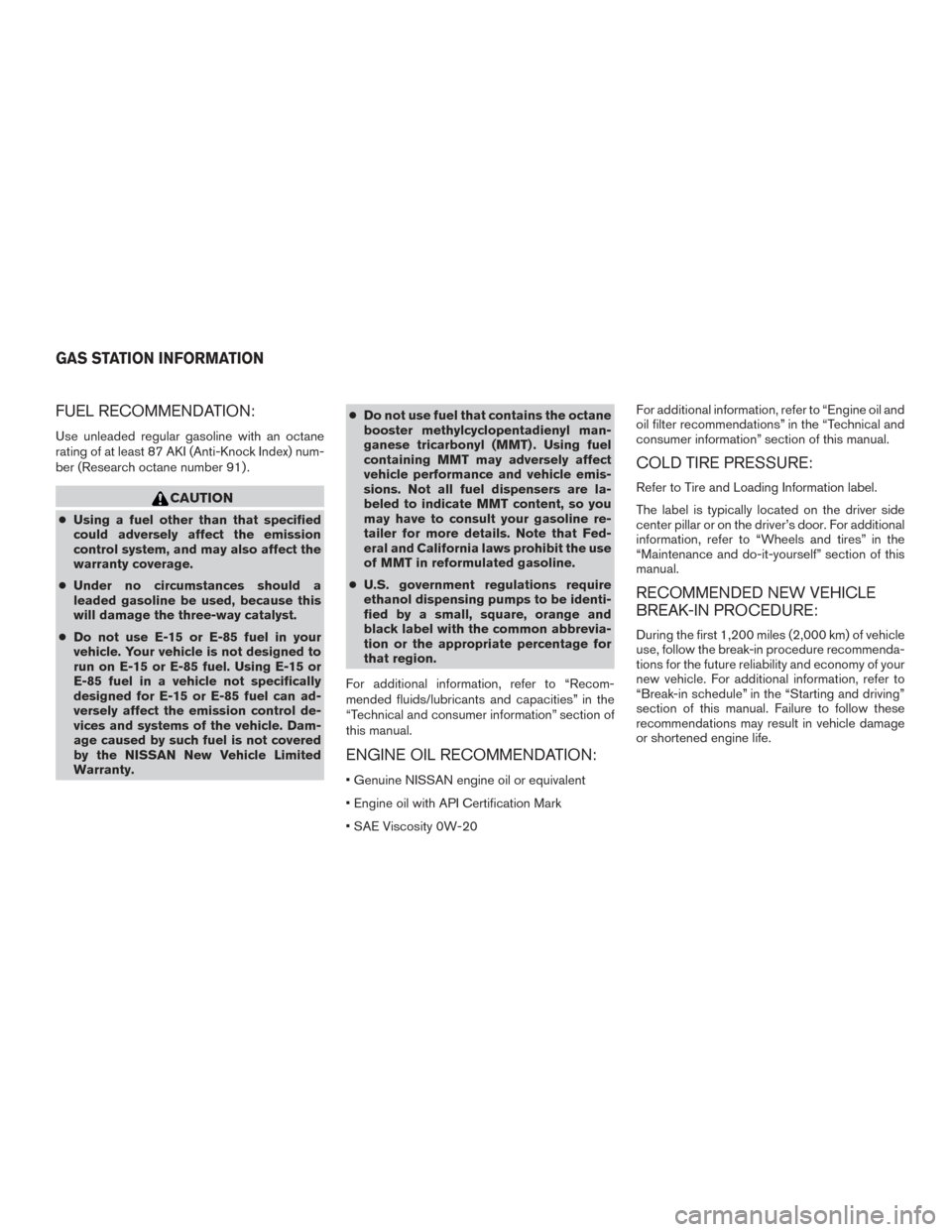
FUEL RECOMMENDATION:
Use unleaded regular gasoline with an octane
rating of at least 87 AKI (Anti-Knock Index) num-
ber (Research octane number 91) .
CAUTION
●Using a fuel other than that specified
could adversely affect the emission
control system, and may also affect the
warranty coverage.
● Under no circumstances should a
leaded gasoline be used, because this
will damage the three-way catalyst.
● Do not use E-15 or E-85 fuel in your
vehicle. Your vehicle is not designed to
run on E-15 or E-85 fuel. Using E-15 or
E-85 fuel in a vehicle not specifically
designed for E-15 or E-85 fuel can ad-
versely affect the emission control de-
vices and systems of the vehicle. Dam-
age caused by such fuel is not covered
by the NISSAN New Vehicle Limited
Warranty. ●
Do not use fuel that contains the octane
booster methylcyclopentadienyl man-
ganese tricarbonyl (MMT) . Using fuel
containing MMT may adversely affect
vehicle performance and vehicle emis-
sions. Not all fuel dispensers are la-
beled to indicate MMT content, so you
may have to consult your gasoline re-
tailer for more details. Note that Fed-
eral and California laws prohibit the use
of MMT in reformulated gasoline.
● U.S. government regulations require
ethanol dispensing pumps to be identi-
fied by a small, square, orange and
black label with the common abbrevia-
tion or the appropriate percentage for
that region.
For additional information, refer to “Recom-
mended fluids/lubricants and capacities” in the
“Technical and consumer information” section of
this manual.
ENGINE OIL RECOMMENDATION:
• Genuine NISSAN engine oil or equivalent
• Engine oil with API Certification Mark
• SAE Viscosity 0W-20 For additional information, refer to “Engine oil and
oil filter recommendations” in the “Technical and
consumer information” section of this manual.
COLD TIRE PRESSURE:
Refer to Tire and Loading Information label.
The label is typically located on the driver side
center pillar or on the driver’s door. For additional
information, refer to “Wheels and tires” in the
“Maintenance and do-it-yourself” section of this
manual.
RECOMMENDED NEW VEHICLE
BREAK-IN PROCEDURE:
During the first 1,200 miles (2,000 km) of vehicle
use, follow the break-in procedure recommenda-
tions for the future reliability and economy of your
new vehicle. For additional information, refer to
“Break-in schedule” in the “Starting and driving”
section of this manual. Failure to follow these
recommendations may result in vehicle damage
or shortened engine life.
GAS STATION INFORMATION